
BAR-207 · Lesson 1 of 12 · 14 min
Becoming a lawyer in Connecticut
▶ Video coming soon A video version of this lesson is on the way.
Graham Leclerc sat the Connecticut bar exam in July 2026, on the first day Connecticut ever gave the NextGen exam. He graduated from law school in May 2026, grew up in Waterbury and works as a law clerk at a small litigation firm in Hartford that handles personal injury, small business disputes and a steady stream of landlord and tenant matters. When results came out on October 9, 2026, his scaled score was 604. Connecticut's passing score is 616. He has filed for the February 2027 exam, and a friend from law school suggested he call Hollis Marchetti, a bar-prep coach who has spent fifteen years helping candidates and six years grading bar essays for a Uniform Bar Examination jurisdiction.
'Twelve points is a gap you can close,' Marchetti tells him at their first session. 'But before we talk about the exam, I want you to see the whole road. Passing is one of several things Connecticut needs from you. Candidates who treat admission as a single test get surprised by the other parts, and the surprises cost months. You have already done the hardest part once. This time we make sure nothing else trips you.'
This course follows their conversations from November 2026 into the new year. This first lesson maps the whole process: who controls admission in Connecticut, which bodies do the work, what every applicant must show, and the order in which the steps usually happen. Later lessons take each step in detail and then turn to the Connecticut law that a new lawyer in the state needs to know.
Who controls admission
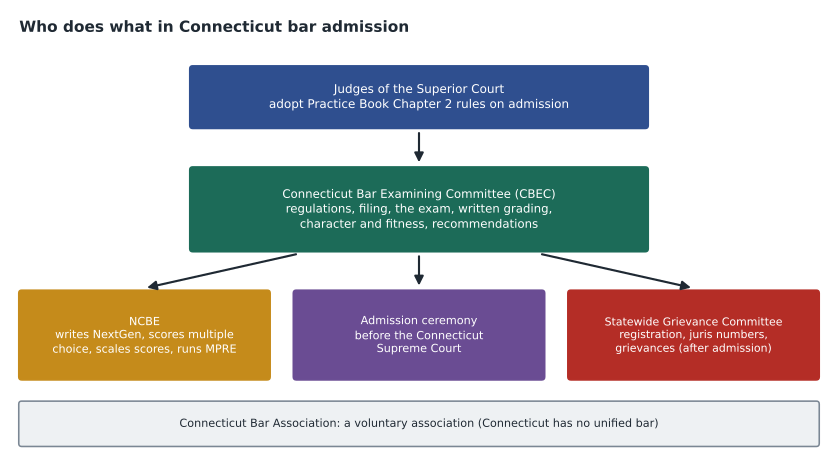
Admission to the bar in Connecticut belongs to the judges of the Superior Court, acting under the rules in the Connecticut Practice Book. Chapter 2 of the Practice Book, titled Attorneys, contains the rules on admission by examination, admission without examination, registration, continuing legal education and discipline. The judges delegate the detailed work of testing and investigating applicants to the Connecticut Bar Examining Committee, usually called the CBEC. The committee adopts its own regulations under the Practice Book, sets filing periods and fees, administers the exam, grades the written parts with its own graders, reviews character and fitness, and recommends successful applicants for admission.
The committee is made up of judges and lawyers appointed by the judges of the Superior Court. A retired judge, the Honorable Anne C. Dranginis, chaired it during the 2026 transition to NextGen. The committee has a director and an administrative office in Hartford, at 100 Washington Street, which receives applications, answers questions, publishes notices and runs the online portal on the Judicial Branch website. When the committee changes its regulations, it adopts the change at a public meeting and publishes it in the Connecticut Law Journal before it takes effect. The most recent round of regulation changes was adopted on October 3, 2025, published on October 28, 2025, and took effect on January 26, 2026. Those changes set up the NextGen exam, adjusted fees and filing windows and rewrote several eligibility rules.
The other players
The National Conference of Bar Examiners, or NCBE, writes the NextGen exam, scores its multiple-choice questions, scales and equates every score and runs the Multistate Professional Responsibility Examination (MPRE). NCBE does not decide who is admitted. Connecticut also does not use NCBE's character and fitness investigation service. It runs its own background review, so every form and instruction comes from the Connecticut committee.
After admission, a different set of bodies takes over. The Statewide Grievance Committee keeps the register of Connecticut attorneys, assigns each lawyer a juris number, collects the annual registration and handles grievances with the Office of Chief Disciplinary Counsel. The Client Security Fund, financed by an annual fee on lawyers, reimburses clients who lose money through a lawyer's dishonest conduct. These are court functions, not bar association functions.
That last point surprises candidates from many other states. Connecticut does not have a unified, or mandatory, bar. The Connecticut Bar Association is a voluntary professional association. It offers sections, continuing education and publications, and many lawyers join it, but membership is not a condition of practice. A candidate who writes to the Connecticut Bar Association with a question about an application has written to the wrong place. Questions about filing, the exam and character review go to the CBEC's administrative office.
Two ways in
Connecticut offers two basic routes to admission. The first is admission by examination: sitting the Connecticut exam and earning a passing score. The second is admission without examination, which is open to lawyers already admitted elsewhere. Within that second route there are two variations. Lawyers with a qualifying Uniform Bar Examination score from another jurisdiction may transfer the score, and experienced lawyers from a reciprocal jurisdiction may be admitted on the strength of their practice under Practice Book section 2-13. Lesson 11 covers both. There is no diploma privilege in Connecticut and, as of November 2026, no completed experiential route that replaces the exam, although the judiciary created a Public Service Pathway to Licensure Task Force in 2026 to study one.
| Route | Who uses it | Key requirement |
|---|---|---|
| Admission by examination | Recent graduates and most first-time applicants | A passing score on the Connecticut exam (616 on NextGen) |
| Score transfer | Lawyers and candidates with a UBE score earned elsewhere | Legacy UBE 266 or NextGen 616, within five years |
| Admission without examination (section 2-13) | Lawyers admitted in a reciprocal jurisdiction | Practice for five of the last ten years |
What every applicant must show
Whatever the route, every applicant must prove the same core qualifications. The first is legal education: a Juris Doctor from a law school approved by the American Bar Association, or a legal education the committee has approved under Article II of its regulations. The second is a passing score on the MPRE, which Connecticut sets at 80, reported directly to Connecticut by NCBE. The third is good moral character and fitness to practice, established through the committee's background review. The fourth, for applicants by examination, is a passing score on the Connecticut exam. Applicants must also be at least eighteen to be admitted, although the 2026 regulations allow younger candidates to sit the exam.
Notice what is missing from that list. Connecticut does not require a separate course or test on Connecticut law before admission. Some neighboring jurisdictions add one: New York has its own online course and test, and Massachusetts requires a Massachusetts law component on NextGen. Connecticut relies on the national exam and expects new lawyers to learn local practice after admission. That makes this course's lessons on Connecticut law more important, not less, because nothing in the admission process forces a new lawyer to learn the Practice Book or the Connecticut statutes before the first client walks in.
The usual order of steps
The steps can overlap, but most candidates meet them in a predictable order. During law school they take the MPRE, often in the second or third year. In the filing window before their exam, they submit the online application, which doubles as the character and fitness questionnaire, pay the fee and register their laptop. They graduate, send proof of the degree at least seven days before the exam, and sit the exam over a day and a half. While the exam is graded, the committee continues the character review. Results are released several weeks later. Successful candidates whose files are complete are recommended for admission, and most are sworn in at a group ceremony before the Connecticut Supreme Court about a month after results.
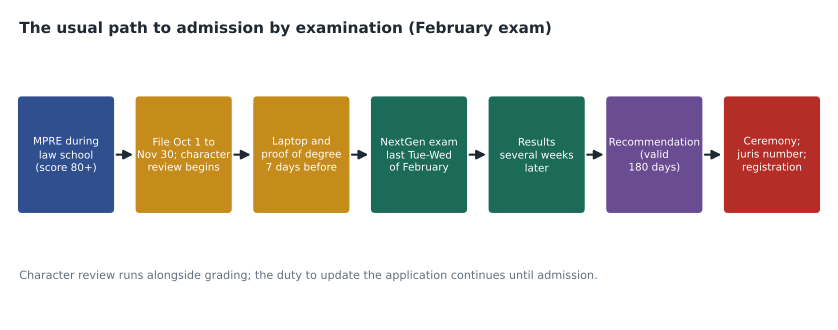
For Graham, several of those steps are already done. His MPRE score of 88, earned in his third year, is on file with the committee, well above the required 80. His character questionnaire was completed for the July exam, and he has updated it with his new address and his job. What remains is the February exam itself, the continuing duty to keep his file current, and the ceremony.
Where candidates go wrong
Marchetti keeps a list of the most common ways Connecticut candidates lose time. The first is missing the filing window. Connecticut gives the exam twice a year and opens filing for a limited period before each one, and in 2026 the committee also capped the July exam at 600 applications, filled on a first-come, first-served basis. A candidate who waits until the last week can find that the window has closed early. The second is an incomplete or inconsistent character questionnaire. The committee checks what applicants say against their law school records, court records and credit history, and the most damaging problems usually arise from what an applicant left out, not from what happened. The third is treating results day as the finish line. A passing score earns a recommendation only when the file is complete, and a recommendation lasts 180 days.
The fourth trap is specific to Connecticut's new rules. Since January 2026, an applicant who has failed the Connecticut exam four times may file only for a February administration. The rule does not end anyone's chances, but it changes the calendar for repeaters, and Graham, on his second attempt, notes it in his planner so that it never surprises him.
How this course is organized
The next four lessons cover the admission process in depth: eligibility and filing (lesson 2), character and fitness and the MPRE (lesson 3), the NextGen exam as Connecticut gives it (lesson 4), and the move from the legacy UBE to NextGen and what it means for candidates (lesson 5). Lesson 6 explains how Connecticut law appears, and does not appear, on an exam that tests no state law. Lessons 7 to 10 turn to Connecticut law that new lawyers meet early: courts and civil procedure under the Practice Book, torts and the Connecticut Unfair Trade Practices Act, family law, property and probate, and the Rules of Professional Conduct. Lesson 11 covers score transfer, admission without examination and the duties that begin after admission. Lesson 12 is a capstone with original practice questions and an exam-day plan.
Every fact in this course was checked against the Connecticut Bar Examining Committee's notices, regulations and minutes, the Connecticut Practice Book, NCBE's published jurisdiction information and results, and the Connecticut General Statutes, as they stood in November 2026. Where an official page could not be reached or a detail could not be confirmed, the course says so or describes the rule in general terms. Rules change often, and Connecticut changed its admission regulations as recently as January 2026, so always check the committee's current notices before relying on a date or a fee.
Marchetti's first assignment
At the end of the session, Marchetti asks Graham for three things by their next call. The first is his July score report, broken down by section, so they can see where the twelve points went. The second is a list of every change in his life since he filed in March: address, job, any traffic or court matter, any change in his finances. The third is a one-page calendar from now to the end of February with his work hours on it. 'You know the law better than you did in July,' she says. 'What you need now is a plan that fits your actual week, and a file the committee never has to ask you about.'
Common mistakes
MistakeThe Connecticut Bar Association decides who is admitted.
InsteadThe judges of the Superior Court control admission through the Practice Book and the Connecticut Bar Examining Committee; the Connecticut Bar Association is voluntary.
MistakeConnecticut uses NCBE for character investigations.
InsteadConnecticut runs its own character and fitness review.
MistakeEvery applicant must complete a Connecticut law course.
InsteadConnecticut has no separate state-law course or component.
MistakePassing the exam is the last step.
InsteadA recommendation depends on a complete file, and it lasts 180 days; admission follows at a ceremony.
Reading the July score report
At their second call, Graham shares his July score report. Because NextGen produces a single scaled score for the whole exam, the report does not break his 604 into separate MBE, MEE and MPT numbers the way the legacy UBE did. What NCBE provides is diagnostic information on his performance across the exam's content areas and question types. Marchetti reads it the way she reads every report: not as a verdict but as a map. His standalone multiple-choice work was close to the passing range. The integrated question sets, where he had to answer short written questions built on a single client file, pulled him down, and one of his three performance tasks was unfinished.
'That tells me something useful,' she says. 'You know the law well enough. You ran out of time and you wrote long where the graders wanted short. Those are habits, and habits can change in three months.' Graham writes two goals at the top of his calendar: finish every performance task with ten minutes to spare, and answer every integrated question set in the space the question invites, no more.
Marchetti also reminds him that the committee will not tell him how many points he earned on each written answer, and that Connecticut does not regrade a NextGen exam on request. The diagnostic report and his own memory of the exam are the evidence he has. They spend the rest of the call reconstructing the unfinished performance task: what the task memo asked for, how long he spent reading the library, and where the minutes went. By the end he can see the moment, about forty minutes in, when he should have started writing.
Summary and key terms
- The judges of the Superior Court control admission through Chapter 2 of the Practice Book and the Connecticut Bar Examining Committee.
- NCBE writes and scales the exam and runs the MPRE; Connecticut runs its own character review.
- Routes in: admission by examination, score transfer, and admission without examination under section 2-13.
- Every applicant needs an approved legal education, an MPRE score of 80, good character and fitness and, if testing, a passing exam score.
- Connecticut has no unified bar and no separate Connecticut law requirement.
- CBEC
- The Connecticut Bar Examining Committee, which gives the exam and reviews applicants.
- Practice Book
- The Connecticut rules of court, including Chapter 2 on attorneys.
- Juris number
- The registration number assigned to each Connecticut attorney.
- Statewide Grievance Committee
- The body that keeps the attorney register and handles grievances.
- Voluntary bar
- A bar association that lawyers may join but are not required to join.
Lesson quiz · 5 questions
Score 60% or more to complete this lesson.
Create a free account to save your progress, take quizzes and earn a certificate.