
BAR-207 · Lesson 11 of 12 · 15 min
Score transfer, admission without examination, new pathways and practice after admission
▶ Video coming soon A video version of this lesson is on the way.
Not everyone in Hollis Marchetti's study group needs to sit the Connecticut exam. Marcus Bell passed the first NextGen exam in Missouri in July 2026 with a score of 648, and a firm in Stamford has asked whether he could join its office. Ngozi, preparing for New York, wonders how she could add Connecticut later. And Graham, once admitted, wants to know what he must do every year to stay in good standing. 'Admission is a door with several handles,' Marchetti tells them on a group call. 'Let's look at each one, and then at what you owe the court once you are through it.'
This lesson covers the ways a lawyer or candidate can be admitted in Connecticut without sitting the Connecticut exam, the ways Connecticut lets some lawyers practice without full admission, the policy work on new pathways, and the obligations that begin after admission.
Transferring a UBE score
Connecticut accepts transferred Uniform Bar Examination scores from other jurisdictions. Under the committee's 2026 regulations, a transferred legacy UBE score must be at least 266, and a transferred NextGen score must be at least 616, matching Connecticut's own passing scores. The application must be filed within five years of the exam on which the qualifying score was earned. Connecticut began accepting transferred NextGen scores with the July 2026 administration. Connecticut does not accept transferred MBE scores standing alone, and a candidate cannot combine parts of different exams.
A score transfer applicant must meet every other requirement for admission: an approved legal education, the MPRE at 80 reported directly by NCBE, and character and fitness clearance by the Connecticut committee. The applicant files a score transfer application, pays the fee, which rose to 850 dollars in 2026, and arranges for NCBE to send the score. When an applicant files to transfer a score concurrently with taking an exam elsewhere, the regulations set deadlines for the score to reach the administrative office: December 31 for a July exam and June 30 for a February exam. The committee's July 2026 minutes show that it was also looking at data on transfer applicants who had failed in the jurisdiction where they tested, a sign that transfer rules may receive further attention.
Marcus's case is straightforward. His Missouri NextGen score of 648 is above Connecticut's 616 and well within the five-year window. If he files a Connecticut transfer application, has NCBE send his MPRE score and clears Connecticut's character review, he can be admitted without sitting another exam.
| Route | Who qualifies | Key requirements |
|---|---|---|
| UBE score transfer | Anyone with a qualifying UBE score earned elsewhere | Legacy 266 or NextGen 616, within five years; MPRE 80; character review; 850-dollar fee |
| Admission without examination (section 2-13) | Lawyers admitted in a reciprocal jurisdiction | Principal livelihood from practice five of the last ten years; good standing; education; character; 1,800-dollar fee |
| Authorized house counsel | In-house lawyers admitted elsewhere | Registration with the committee; limited to the employer; 1,200-dollar fee |
| Pro hac vice | Lawyers admitted elsewhere, for one case | Motion to the court, sponsoring Connecticut lawyer |
Admission without examination
Practice Book section 2-13 allows experienced lawyers from reciprocal jurisdictions to be admitted on motion, which Connecticut calls admission without examination. The applicant must be a member of the bar of another state, territory or the District of Columbia, and at least one jurisdiction where the applicant is admitted must be reciprocal, meaning that it would admit Connecticut lawyers without examination on similar terms. The applicant must have practiced law as a principal means of livelihood for at least five of the ten years immediately before applying, and must be in good standing. If the applicant previously failed a Connecticut bar exam, those five years must come after the last failed attempt.
Qualifying practice includes representing clients, service as a government lawyer, teaching at an accredited law school, judicial service and clerkships, work as authorized house counsel and combinations of these, so long as the practice was lawful where it was performed. The applicant must meet Connecticut's education requirement, prove good character and fitness, satisfy the professional responsibility requirement and provide recommendations, including certifications from two members of the Connecticut bar of at least five years' standing. Full-time faculty and clinical fellows at accredited Connecticut law schools have a separate route under the same section. The fee for admission without examination is 1,800 dollars.
New York and Connecticut recognize each other as reciprocal for this purpose. That matters to Ngozi. If she is admitted in New York and practices there as her principal livelihood for five years, she can apply to Connecticut without examination. If she wants Connecticut sooner, she could transfer a UBE score instead, if her New York score meets Connecticut's minimum and the five-year window is open.
Limited forms of practice
Two limited forms of practice are worth knowing. Authorized house counsel registration lets a lawyer admitted elsewhere work in Connecticut as in-house counsel for a single employer without full admission; the 2026 fee is 1,200 dollars, and the lawyer may not represent anyone but the employer. Pro hac vice admission lets a lawyer admitted elsewhere appear in a particular Connecticut case on motion, with a Connecticut lawyer appearing as well. Neither is a substitute for admission for a lawyer who wants a general Connecticut practice.
New pathways
Connecticut has not adopted an alternative to the bar exam, such as a supervised practice or portfolio route. In 2026 the judiciary created the Connecticut Public Service Pathway to Licensure Task Force to study one, and the committee's April 2026 minutes discuss the need for committee members to take part. Several other jurisdictions have already adopted such routes; BAR-101, How Bar Admission Works in the United States, describes them. A Connecticut candidate should watch the task force's work but plan on the exam.
Swearing in
Successful applicants whose files are complete are recommended to the judges of the Superior Court for admission. Most are sworn in at a group ceremony before the Connecticut Supreme Court, generally about a month after results are published. Candidates check in with government-issued photo identification, may bring two guests, and must stay through the oath; leaving early means the applicant's name is not submitted for admission. An applicant who misses the ceremony can be admitted in absentia before a judge, but the admission date is the date the oaths are administered and is recognized only after the completed materials are returned to the committee. A recommendation for admission is valid for 180 days.
After admission
Admission starts a set of continuing obligations. Every attorney registers annually with the Statewide Grievance Committee, online between January and early March, and pays the Client Security Fund fee. Under Practice Book section 2-27A, attorneys must complete at least twelve hours of continuing legal education each calendar year, at least two of them in ethics and professionalism, and certify compliance on the annual registration. Newly admitted attorneys are exempt for the calendar year in which they are admitted. Up to two excess hours may be carried forward to the next year. Lawyers must keep proof of compliance for seven years. A lawyer who fails to register or to meet the requirement may be administratively suspended.
| Obligation | Rule |
|---|---|
| Annual registration | Online, January to early March (Practice Book section 2-27(d)) |
| Continuing legal education | 12 hours a year, 2 in ethics; exempt in the year of admission (section 2-27A) |
| Carry-forward | Up to 2 excess hours |
| Records | Keep proof for seven years |
| Client Security Fund | Annual fee (section 2-70) |
| Admission elsewhere or discipline | Report within thirty days (sections 2-24 and 2-25) |
Graham's first year
Graham hopes to be sworn in during spring 2027. Marchetti maps his first year for him. In the calendar year of his admission he will be exempt from continuing education, but she suggests he take a basic practice course anyway, especially on trust accounts and Connecticut procedure. The next January he will register for the first time as an admitted lawyer, and that calendar year he must complete his twelve hours. 'Treat the twelve hours as a minimum,' she says. 'The lawyers who get into trouble in their first years are rarely the ones who know too much Connecticut practice.'
Common mistakes
MistakeConnecticut accepts any passing UBE score from anywhere.
InsteadTransferred scores must be at least 266 (legacy) or 616 (NextGen), within five years.
MistakeAny experienced lawyer can be admitted without examination.
InsteadThe applicant must be admitted in a reciprocal jurisdiction and have five of the last ten years in practice.
MistakeNew lawyers must complete twelve CLE hours in their first calendar year.
InsteadThey are exempt in the year of admission.
MistakeConnecticut has a supervised-practice alternative to the exam.
InsteadA task force is studying one; none exists as of November 2026.
Marcus's application in detail
Marchetti walks the group through the steps Marcus would take if he accepts the Stamford offer, because they show how a transfer works in practice. First, Marcus would confirm that his Missouri NextGen score, 648, meets Connecticut's 616 minimum and was earned in July 2026, well within five years. Second, he would file the Connecticut transfer application in the committee's portal and pay the 850-dollar fee. Third, he would ask NCBE to transmit his NextGen score to Connecticut and to send his MPRE score directly as well; his MPRE must meet Connecticut's 80. Fourth, he would complete Connecticut's character and fitness questionnaire. Even though Missouri has already cleared him, Connecticut runs its own review, and he would have to answer Connecticut's questions in full. Fifth, he would wait for review, respond to any questions, and attend a ceremony or be sworn in before a judge once recommended.
Marcus asks whether his Missouri admission means Connecticut will treat him as an experienced lawyer. It does not. Admission without examination under section 2-13 requires five of the last ten years in practice. A recent graduate with a portable score uses the transfer route; the motion route is for lawyers with years of practice.
Common transfer problems
Transfer applications fail most often for three reasons. The score was earned too long ago; Connecticut's limit is five years from the exam, and a candidate who waits too long loses the option. The score is below Connecticut's minimum; a legacy score that passed in a 260 jurisdiction does not transfer to Connecticut unless it is at least 266. Or the candidate tried to use only part of a score, such as an MBE score, which Connecticut does not accept. A fourth, quieter problem is the character questionnaire: transfer applicants sometimes assume a prior admission makes Connecticut's review a formality, and file incomplete answers. The committee reviews every applicant on its own standards.
Moving between Connecticut and New York
Because so many lawyers in southwestern Connecticut work in New York and vice versa, the two states' admission rules matter to each other. New York gives its own version of the UBE, plus its own New York law course and test, and has its own NextGen timeline. A candidate admitted in Connecticut who wants New York, or the reverse, should compare the routes carefully: a score transfer if the score and timing allow, or admission on motion after the required years of practice under the reciprocity the two states recognize. Ngozi's plan, to sit in New York in February 2027 and consider Connecticut later, is common; so is the reverse path for Connecticut lawyers whose firms open offices in Manhattan.
Staying active, going inactive
Admitted lawyers who stop practicing in Connecticut can choose an inactive status rather than letting their registration lapse. Inactive or retired lawyers are generally exempt from continuing education and may have reduced fees, but they may not practice. Returning to active status requires following the committee's and the Statewide Grievance Committee's procedures, which can include catching up on continuing education. A lawyer who simply ignores registration risks administrative suspension, which can follow the lawyer to other jurisdictions and to applications for future admission elsewhere.
Building a first-year practice plan
Marchetti asks Graham to write a one-page practice plan for his first year after admission, and to keep it with his exam plan. It lists the registrations he must complete: the juris number, e-filing, and the annual Statewide Grievance Committee registration. It lists the money obligations: the Client Security Fund fee and, if he ever holds client funds himself, a properly opened trust account. It lists the learning he wants to do beyond the required minimum: a course on Connecticut civil procedure, a session on trust account rules, and volunteer work through an attorney of the day program. And it lists the people he will ask for help: Abernathy, a classmate who clerked for a Superior Court judge, and the bar association's ethics committee.
'Admission is not the end of learning,' Marchetti says. 'It is the start of being responsible for what you do not know. The plan just makes sure you find out before a client does.'
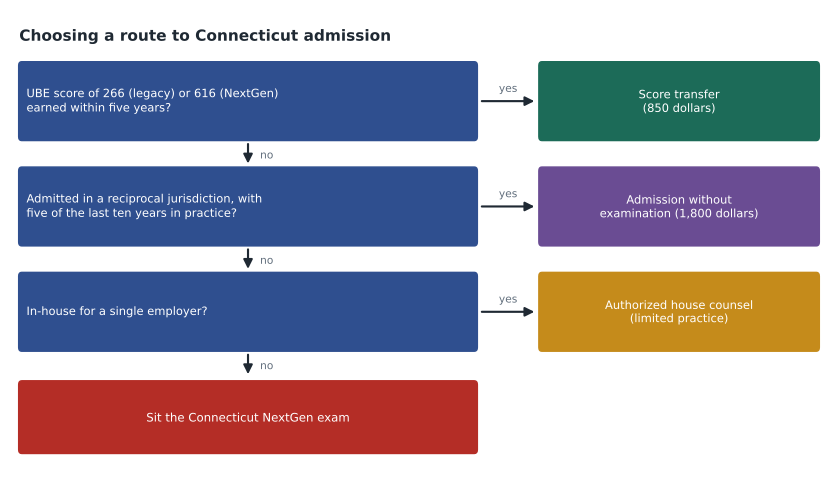
Choosing a route
Marchetti closes the group call with a simple decision guide. A candidate who has not yet passed any bar exam must sit the Connecticut exam, as Graham will in February. A candidate who has passed the legacy UBE or NextGen elsewhere should compare the score with Connecticut's minimum and check the time limit before filing to transfer, as Marcus is considering. A lawyer with several years of practice in another jurisdiction should read the admission without examination rule carefully, including the reciprocity requirement and the practice-years calculation, before assuming it applies. An in-house lawyer who will advise only an employer should look at authorized house counsel registration. And a lawyer needed for one case should seek pro hac vice permission through local counsel. Each route has its own form, fee and character review, and the committee's current regulations decide every detail.
Ngozi asks the question the others are thinking: can she use one route now and another later? Marchetti says yes, as long as each step is permitted when it is taken. A lawyer admitted by score transfer is a full member of the bar, and a lawyer registered as house counsel can later apply for full admission by an available route. What candidates cannot do is practice first and seek permission afterward. Unauthorized practice of law is a serious problem for anyone hoping to be admitted, and it can appear on a later character and fitness application.
The first weeks after admission
For new lawyers, the practical steps after the ceremony come quickly. The oath must be taken, the juris number obtained, and the registration with the Statewide Grievance Committee completed. A lawyer joining a firm will usually be added to the firm's e-filing account, while a solo practitioner must arrange trust accounts, malpractice insurance if desired and an office system for deadlines before taking the first client.
Summary and key terms
- Connecticut accepts transferred legacy UBE scores of 266 and NextGen scores of 616, within five years; no MBE-only transfers.
- Section 2-13 admits lawyers from reciprocal jurisdictions with five of the last ten years in practice; New York is reciprocal.
- Authorized house counsel and pro hac vice allow limited practice.
- A task force formed in 2026 is studying a public service pathway; none exists yet.
- After admission: annual registration, 12 CLE hours with 2 in ethics (exempt in the admission year), and the Client Security Fund fee.
- Score transfer
- Admission based on a qualifying UBE score earned in another jurisdiction.
- Admission without examination
- Connecticut's admission on motion for experienced lawyers under section 2-13.
- Reciprocal jurisdiction
- A jurisdiction that would admit Connecticut lawyers without examination.
- Authorized house counsel
- A limited registration for in-house lawyers admitted elsewhere.
- MCLE
- Minimum continuing legal education required of Connecticut lawyers each year.
Lesson quiz · 5 questions
Score 60% or more to complete this lesson.
Create a free account to save your progress, take quizzes and earn a certificate.