
BAR-207 · Lesson 5 of 12 · 16 min
From the legacy UBE to NextGen: what changed in Connecticut
▶ Video coming soon A video version of this lesson is on the way.
Graham's roommate from law school failed the February 2026 Connecticut exam, the last legacy Uniform Bar Examination the state ever gave. She sat again in July, on NextGen, and passed. When Graham tells Hollis Marchetti about her, the coach is not surprised. 'She took two different exams six months apart,' Marchetti says. 'The law underneath them is mostly the same. The way it is tested is not. Understanding what changed is the best way to understand what NextGen wants from you.'
Connecticut was one of the first jurisdictions to make the switch. This lesson explains what the legacy exam was, why NCBE replaced it, how Connecticut managed the transition and what the change means for candidates who studied for one exam and now face the other.
The legacy UBE in Connecticut
Connecticut adopted the Uniform Bar Examination and gave it for several years before the switch. The legacy UBE had three parts written by NCBE: the Multistate Bar Examination (MBE), two hundred multiple-choice questions over a full day; the Multistate Essay Examination (MEE), six thirty-minute essays; and the Multistate Performance Test (MPT), two ninety-minute tasks. The MBE counted for 50 percent of the score, the MEE for 30 percent and the MPT for 20 percent. Scores were reported on a 400-point scale, and Connecticut's passing score was 266. Essays scored just below passing, between 256 and 265, were reread. A score of 266 or more could be transferred to other UBE jurisdictions, and Connecticut accepted transferred legacy scores at the same level.
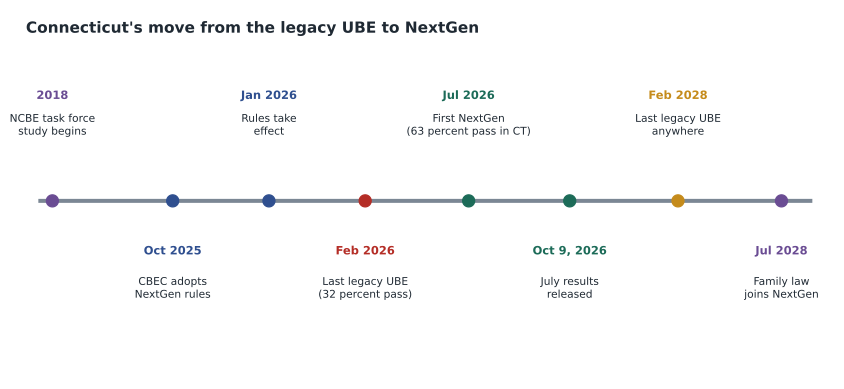
The final legacy exam in Connecticut was given in February 2026. That administration was hard on candidates: of 187 who sat, 60 passed, a rate of about 32 percent, with 44 percent of first-time takers and 26 percent of repeaters passing. February exams typically have a larger share of repeaters and lower pass rates than July exams in every jurisdiction, so the figure is not a judgment on the old exam, but it shows the size of the group that began 2026 needing another attempt.
Why NCBE changed the exam
NCBE built NextGen after a multi-year study of what new lawyers actually do, launched by a testing task force in 2018. The study's conclusion was that the old exam put too much weight on memorizing a long list of rules and too little on the skills of practice. NextGen narrows the list of subjects, tests fewer rules in more depth, and integrates skills such as client counseling, negotiation, research and drafting into the questions. NCBE has also said that some topics within the eight subjects are tested from memory, while others are tested only with the law supplied in a library.
| Feature | Legacy UBE (through February 2026) | NextGen (from July 2026) |
|---|---|---|
| Length | Two full days | A day and a half, three sessions |
| Parts | MBE, MEE, MPT | Multiple choice, integrated sets, performance tasks in every session |
| Subjects tested from memory | Twelve or more, including several essay-only subjects | Eight foundational subjects, plus family law from July 2028 |
| Weighting | MBE 50, MEE 30, MPT 20 | Multiple choice 49, integrated sets 21, tasks 30 |
| Score scale | Up to 400; Connecticut passing 266 | 500 to 750; Connecticut passing 616 |
| Separate MBE score | Yes | No |
How Connecticut made the switch
Connecticut prepared for NextGen through its regulations and through close work with NCBE. The committee adopted the NextGen regulations in October 2025, effective January 2026, setting the exam's structure, scoring and passing score and giving its own graders responsibility for the written components. Its spring 2026 minutes record the steps that followed: a new NCBE jurisdiction portal, data from NCBE's January 2026 beta test, and further pilot testing of accessibility features. The July 2026 exam ran over two days, with a third day for some accommodated candidates, and NCBE reported afterward that ten jurisdictions had completed the first administration across sixteen testing locations. Connecticut's chair, a retired judge, told NCBE the committee was pleased with the platform and confident the exam better reflects the fundamental knowledge new attorneys need.
The changeover brought one practical cost the committee has acknowledged in its minutes: the written questions differ in style from the old essays, and the director raised whether grader pay might need adjusting. Candidates will not see that debate, but it is a reminder that graders are learning the new exam too, using NCBE's materials and calibration.
What changed for candidates
For candidates who studied for the old exam, four changes matter most. First, the essay-only subjects are no longer tested from memory. Conflict of laws, family law, trusts and estates and secured transactions were tested on the MEE but are not among NextGen's eight foundational subjects, although NCBE has said family law will be added in July 2028 and that trusts and estates may appear with the law supplied. Second, skills are now scored directly. A candidate must be ready to draft a short clause, advise a client on options or decide which authority in a library controls, not just state a rule. Third, time pressure moves. The old MBE was a long sprint; NextGen asks the candidate to switch every session between quick multiple-choice questions, short written answers and a longer task. Fourth, there is no separate multiple-choice score to lean on. A strong multiple-choice performance cannot rescue weak written work as easily as a strong MBE once could.
For repeaters, the change also affects score transfer and timing. A legacy score earned in Connecticut in February 2026 or earlier can still be transferred to other jurisdictions that accept legacy scores, within their time limits, but a candidate who failed the legacy exam must pass NextGen to be admitted by examination in Connecticut. Connecticut accepts transferred legacy UBE scores of 266 or more and NextGen scores of 616 or more, within five years, so a candidate with a strong legacy score from another state may not need to sit at all.
Studying across the change
Graham studied for July using a commercial NextGen course, so he did not have to unlearn the old exam. His roommate did. Marchetti's advice for candidates crossing the change is practical. Keep the substantive outlines for the eight foundational subjects; most of the law is the same. Drop memorization of essay-only subjects except as background, unless the candidate will sit after July 2028, when family law returns. Replace old MEE practice with integrated question sets and short-answer drills, and replace MPT practice with NextGen performance tasks, including research tasks. Use NCBE's official study aids, which include practice sets and simulated exams written for NextGen.
Worked problem
Advising a February 2026 repeater
Noelle failed the February 2026 legacy exam in Connecticut with a scaled score of 259. She studied mainly with old MEE essays and MBE question banks. She wants to sit in February 2027.
Show solution
- Her legacy score cannot be carried into NextGen; she must earn 616 on the new exam.
- Her MBE preparation still helps with the standalone multiple-choice questions on the eight subjects.
- She needs new practice in integrated sets and performance tasks, which together carry 51 percent of the score.
- She should check whether any jurisdiction where she might also practice would accept her legacy score; with 259 she would not meet Connecticut's 266 transfer minimum anyway.
Answer: Noelle should rebuild her written practice around NextGen formats and keep her doctrinal outlines, filing early in the October window.
A note on comparisons
It is tempting to compare Connecticut's 63 percent July 2026 pass rate with the 32 percent of February 2026 and conclude that NextGen is easier. NCBE warns against that. February and July pools differ; July 2026 was the first administration of a new exam, taken mostly by recent graduates; and NCBE changed how it counts first-time takers, now treating a candidate as first-time only if the candidate has never taken any bar exam anywhere. The national July 2026 figures, 72.7 percent overall, 85.2 percent for first-time takers and 41.0 percent for repeaters, fall within the range of July pass rates from 2021 to 2025. The honest conclusion is that NextGen is a different exam, not an easier one.
Common mistakes
MistakeA legacy UBE score can be combined with NextGen results.
InsteadNextGen produces one score; a legacy score cannot be carried into it.
MistakeFamily law and trusts are still tested from memory.
InsteadThey are not among NextGen's eight subjects; family law joins in July 2028 and trusts may appear with the law supplied.
MistakeNextGen is easier because the pass rate rose.
InsteadNCBE cautions against comparing administrations; February and July pools differ.
MistakeConnecticut still gives the legacy UBE to repeaters.
InsteadThe last legacy exam in Connecticut was February 2026.
Transferring and comparing scores across the change
The switch also raises questions for candidates who earned legacy scores elsewhere. Connecticut accepts transferred legacy UBE scores of 266 or more and NextGen scores of 616 or more, so a candidate with a strong legacy score from another state can use it in Connecticut within the five-year window. Other jurisdictions make their own choices: some accept NextGen scores from the start, others will accept them only later, and a few have said they will not accept transferred NextGen scores at all. NCBE publishes a table of each jurisdiction's decisions. A Connecticut candidate who passes NextGen and expects to want admission in a neighboring state should check that state's policy before assuming the score will travel.
Because the two scales differ, there is no simple conversion between a legacy score and a NextGen score. Jurisdictions set their NextGen passing scores separately, guided by NCBE's standard-setting work and its November 2025 recommendation of 610 to 620. Connecticut chose 616. A candidate cannot calculate what a legacy 266 would have been on NextGen, and should not try; the two exams measure overlapping but different things.
Graham's own comparison
Graham never took the legacy exam, but his law school's bar preparation course still used some old MEE essays in the spring of 2026. Marchetti asks him which habits from that practice helped him in July and which hurt. Writing under time pressure helped. Memorizing long rule statements for subjects that NextGen does not test hurt, because it took time he could have spent on performance tasks. Organizing answers around the elements of a rule helped on every written component. Writing long, complete essays did not fit the short answers NextGen wants in its integrated sets.
'That is the shift in one sentence,' she says. 'The old exam rewarded reciting the law. The new exam rewards using it, briefly and accurately, in the format a supervising lawyer asks for.'
Looking ahead to 2028
The change will continue after Graham's exam. February 2028 is the last legacy UBE anywhere, after which every UBE jurisdiction will give NextGen. Family law joins the tested subjects in July 2028. NCBE has said trusts and estates may appear with law supplied, and it continues to adjust the content scope and the examinees' guide as it learns from each administration. Connecticut's committee has also agreed to revisit its passing score after studying the July 2026 results. A candidate planning to sit in 2027 or 2028 should treat everything in this lesson as the state of play in November 2026 and check the committee's notices and NCBE's current materials before building a study plan.
Why Connecticut went first
Connecticut was among the ten jurisdictions that gave NextGen in July 2026, along with Idaho, Maryland, Missouri, Oregon, Washington and several territories. Jurisdictions that adopted early took on risk: a new platform, new grading and no history of results to guide candidates. They also gained influence over how the exam developed and spared their candidates the uncertainty of studying for an exam they knew was about to be replaced. Connecticut's committee chose an early date and set a passing score at the lower end of NCBE's recommended range, with a commitment to revisit it once real results were in. For candidates, the practical effect is that Connecticut has some of the most experience with NextGen of any jurisdiction, and its notices and minutes are worth reading for anyone preparing for the exam elsewhere.
Advice for crossing candidates
Marchetti's summary for anyone who studied for the old exam and now faces the new one has three points. Keep the law of the eight subjects. Change the way you practice writing, toward short answers and complete tasks. And use official NextGen materials, because they show the exam's style better than any old question bank can.
What stayed the same
For all the change, much of the Connecticut process did not move in 2026. The committee still administers the exam, still decides character and fitness, and still sets the filing windows and fees. The MPRE requirement of 80 is unchanged. The two administrations a year, in late February and late July, continue. Candidates still need an approved law degree or a route under the committee's regulations for foreign-educated applicants. And Connecticut still adds no separate state-law component, so the content a candidate must master for the exam is set nationally. Marchetti stresses this to Graham because repeaters sometimes assume that a new exam means a new process. It does not: the administrative steps he took for July are the steps he takes for February, with the same care.
Why the content changed
NCBE describes NextGen as an exam built around the knowledge and skills newly licensed lawyers use most, based on a national practice analysis it carried out before designing the exam. That study surveyed practicing lawyers about the tasks they perform and the knowledge they rely on in their first years. Its results drove the main changes: fewer subjects tested in depth, a larger role for practical skills such as research, client counseling and negotiation, and integrated questions that ask candidates to apply law to facts as lawyers do in a real file. Several subjects tested on the legacy essays, such as family law, trusts and estates, secured transactions and conflict of laws, are not among the eight NextGen subjects, and candidates should check NCBE's current content scope rather than old outlines.
A repeater's honest inventory
Marchetti asks Graham to write down what he did for July that he would keep and what he would change. Keep: the daily multiple-choice drills, which built his speed, and the outline of the eight subjects. Change: he spent too many hours reading lectures written for the old essay format, too few completing full performance tasks under time, and almost none practicing short integrated set answers. He also notices that he studied alone for the whole summer and never compared his written answers with anyone else's. For February he arranges a weekly exchange of practice answers with a classmate who is also retaking, so that each can see what a different good answer looks like. The inventory takes an hour and becomes the backbone of his new schedule.
Summary and key terms
- Connecticut's legacy UBE (MBE, MEE, MPT; passing 266) ended in February 2026.
- NextGen tests eight subjects with integrated skills; family law joins in July 2028.
- Connecticut adopted NextGen by regulation effective January 2026 and gave it first in July 2026.
- Connecticut accepts transferred legacy scores of 266 and NextGen scores of 616, within five years.
- Pass rates across the change should not be compared directly.
- MBE
- The legacy 200-question multiple-choice exam.
- MEE
- The legacy essay exam of six thirty-minute essays.
- MPT
- The legacy performance test of two ninety-minute tasks.
- Legacy UBE
- The Uniform Bar Examination made up of the MBE, MEE and MPT.
- Foundational subjects
- The eight areas of law NextGen tests from memory.
Lesson quiz · 5 questions
Score 60% or more to complete this lesson.
Create a free account to save your progress, take quizzes and earn a certificate.