
BAR-204 · Lesson 9 of 12 · 17 min
Arkansas property and family law
▶ Video coming soon A video version of this lesson is on the way.
Two clients at Caleb's firm have problems that look unrelated. One, an older woman named Ruth Dunaway, wants to know what happens to the family farm if her husband dies first: his name alone is on the deed, though they have lived there for forty years. The other, a young man named Tyler, wants a divorce after two years of marriage and wants to know who keeps the house. Marchetti groups them together for the ninth session. 'Arkansas property law and Arkansas family law are tied together by the same idea,' she says. 'The state protects a family's home and a spouse's share in ways that are older and stronger than the rules you studied for the MBE.'
Dower and curtesy
Arkansas is one of the few states that still recognize dower and curtesy, the common law rights of a surviving spouse in the deceased spouse's property. Historically, dower was the widow's right and curtesy the widower's; Arkansas statutes now treat the rights equally for surviving husbands and wives. Under Ark. Code Ann. section 28-11-301, a surviving spouse is entitled to a life estate in one-third of the lands the deceased spouse owned in an estate of inheritance at any time during the marriage, unless the right was relinquished in legal form, where the deceased left a child or children. The spouse also takes one-third of the deceased's personal property outright. Where there are no children, section 28-11-307 gives larger shares, generally one-half of the real estate and of the personal property, with special rules that depend on how the deceased acquired the property and how long the marriage lasted.
Dower attaches to land the spouse owned during the marriage, not merely land owned at death. That is why buyers and title insurers in Arkansas ask whether a seller is married and require the seller's spouse to sign the deed relinquishing dower or curtesy. A deed from a married owner without the spouse's relinquishment can leave the buyer's title subject to the spouse's inchoate dower interest, which ripens if the selling spouse dies first.
Worked problem
Ruth and the farm
Ruth's husband, Earl, owns the 200-acre farm in his name alone. They have two adult children. If Earl dies with a will leaving the farm entirely to their son, what rights does Ruth have?
Show solution
- Dower attaches to land Earl owned during the marriage: the farm.
- With children surviving, section 28-11-301 gives Ruth a life estate in one-third of Earl's lands, unless she relinquished it in legal form.
- Dower is not defeated by a will; a surviving spouse may elect to take against the will and claim dower and the statutory shares instead.
- Ruth also has homestead rights in the home, discussed next.
Answer: Ruth can claim a life estate in one-third of the farm and homestead rights, even against Earl's will.
The homestead
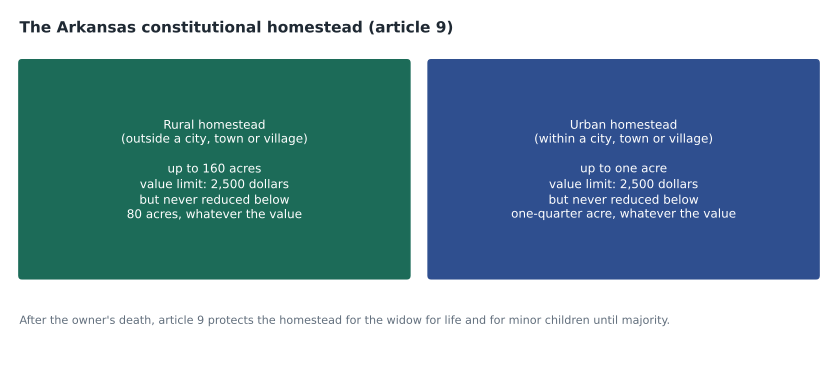
The Arkansas Constitution protects the homestead in article 9. A rural homestead, outside any city, town or village and owned and occupied as a residence, may consist of up to 160 acres, and is exempt from most debts up to a value of 2,500 dollars; but regardless of value, it may not be reduced to less than 80 acres. An urban homestead, within a city, town or village, may consist of up to one acre, with the same 2,500 dollar value limit, and may not be reduced to less than one-quarter acre regardless of value. The homestead is protected from sale for the owner's general debts, with exceptions for purchase money, taxes, and certain other obligations.
Those numbers sound small, and the dollar figure is, because it has not been changed since the nineteenth century. But the acreage floors give the protection real force: an 80-acre rural homestead or a quarter-acre town lot is protected regardless of its value. The constitution also protects the homestead after the owner's death. Article 9, section 6 gives the deceased owner's widow the rents and profits of the homestead for her life, and protects minor children until they reach majority, even if the owner left debts. The text was written in 1874 and speaks of the widow; a lawyer advising a surviving husband should check how current Arkansas law applies it.
Co-ownership and recording
Arkansas recognizes tenancy in common, joint tenancy with right of survivorship, and tenancy by the entirety for married couples. A conveyance to a married couple is generally presumed to create a tenancy by the entirety, which gives the survivor the whole property and protects it from the separate creditors of one spouse. On divorce, a tenancy by the entirety is converted by statute into a tenancy in common, unless the court divides the property otherwise.
The Arkansas recording statute, Ark. Code Ann. section 14-15-404, provides that a deed or instrument affecting title to land is not valid against a subsequent purchaser for value without notice unless it is recorded. In practice, Arkansas lawyers and title companies treat recording as the way to protect a buyer or lender, and examine the county records, including dower relinquishments, before closing.
Adverse possession in Arkansas
Adverse possession in Arkansas requires the familiar common law elements: possession that is actual, open, notorious, continuous, hostile, exclusive and accompanied by intent to hold against the true owner, for seven years. Since 1995, Ark. Code Ann. section 18-11-106 adds two requirements: the possessor must have color of title, a writing that appears to convey title, and must have paid the taxes on the property, or on contiguous property to which he or she has color of title, for the seven years. The statute made adverse possession much harder to prove than under the common law rule alone. It also contains an exception for boundary line adjustments between neighbors.
| Element | Arkansas requirement |
|---|---|
| Possession | Actual, open, notorious, continuous, hostile, exclusive, with intent to hold |
| Period | Seven years |
| Color of title | Required since 1995 by section 18-11-106 |
| Taxes | Possessor must have paid taxes on the land or contiguous land for the period |
| MBE default | Common law elements; statutory period varies; no color of title or tax requirement assumed |
Landlord and tenant
Arkansas long stood out as the only state without an implied warranty of habitability in residential leases. Act 1052 of 2021 changed that in part. For residential leases entered into or renewed after November 1, 2021, it requires landlords to provide minimum standards: a source of hot and cold running water, electricity, potable drinking water, sanitary sewer and plumbing that meet the codes in effect when installed, a functioning roof and building envelope, and heating and air conditioning that function to the extent they served the premises when the lease was signed. If a landlord fails to remedy a noncompliance within thirty days of the tenant's notice, a tenant who is current on rent may terminate the lease and recover the security deposit. The Act does not allow the tenant to withhold rent, and termination is the remedy it provides. The Act also changed the unlawful detainer process, requiring a tenant who wants to stay during the case to show cause and post security for rent.
Divorce
Turning to Tyler's question, Arkansas divorce law has both fault and no-fault grounds. Under Ark. Code Ann. section 9-12-301, grounds include adultery, cruel treatment and indignities, habitual drunkenness, felony conviction and others, along with a no-fault ground: the spouses have lived separate and apart for eighteen continuous months without cohabitation. Arkansas also requires residency: one party must have been a resident for sixty days before filing and for three months before the final decree, and a short waiting period applies after filing.
Arkansas also offers covenant marriage, created by the Covenant Marriage Act of 2001. Couples who choose it agree to premarital counseling and accept narrower grounds for divorce and longer separation periods. Few couples elect it, but a lawyer must ask, because it changes the available grounds.
Dividing property
Arkansas divides property under Ark. Code Ann. section 9-12-315. All marital property is to be distributed one-half to each party unless the court finds such a division inequitable, in which case it must state its reasons in the order, considering factors such as the length of the marriage, the parties' ages, health and earning capacity, and contributions to the marriage, including as a homemaker. Separate property, such as property acquired before the marriage or by gift or inheritance, is generally returned to the owning spouse. The presumption of equal division is stronger than the general equitable distribution taught on the MBE, and courts must explain any departure from it.
Worked problem
Tyler's house
Tyler and his wife bought a house a year into their two-year marriage, titled to both, with a down payment from Tyler's inheritance from his grandmother. They separated three months ago. Can he file now, and how will the house be divided?
Show solution
- A no-fault divorce needs eighteen months of living apart; three months is not enough, so he would need a fault ground or must wait.
- Residency: at least one spouse must have lived in Arkansas sixty days before filing.
- The house titled to both spouses is likely a tenancy by the entirety and marital property, divided equally unless the court finds that inequitable.
- The inheritance used for the down payment may be traced as separate property or support an unequal division, a fact-heavy question the court must explain.
Answer: He cannot yet use the no-fault ground; the house is presumptively split equally, with an argument for crediting his inheritance.
Support
Child support in Arkansas is set under guidelines adopted by the supreme court in its Administrative Order No. 10, which moved to an income shares model in recent years, considering both parents' incomes. Alimony is discretionary, based on need and ability to pay, and may be rehabilitative or permanent. A new lawyer should use the current guidelines and worksheet, which the court updates from time to time.
Common mistakes
MistakeDower was abolished long ago everywhere.
InsteadArkansas still recognizes dower and curtesy, equally for surviving husbands and wives.
MistakeThe homestead exemption is worth only 2,500 dollars.
InsteadThe value limit is 2,500 dollars, but the acreage floors (80 rural acres, a quarter urban acre) protect the homestead regardless of value.
MistakeSeven years of open possession is enough for adverse possession in Arkansas.
InsteadSince 1995 the possessor also needs color of title and payment of taxes for the period.
MistakeAn Arkansas tenant may withhold rent for poor conditions.
InsteadAct 1052 of 2021 allows termination after notice and thirty days, not rent withholding.
Dower in real estate practice
Dower affects ordinary transactions every day in Arkansas. When a married person sells land titled in his or her name alone, the buyer's lawyer and title company will ask the seller's spouse to join in the deed to relinquish dower or curtesy. When a married person mortgages land, the lender will ask for the same relinquishment so that the mortgage is not subject to the spouse's interest. When an owner dies, title examiners check whether the surviving spouse's dower has been assigned or relinquished before insuring a sale by the heirs. A new real estate lawyer who forgets the spouse's signature creates a title defect that may not surface until years later, when the selling spouse dies.
Premarital and postnuptial agreements can also address dower. Arkansas allows spouses to give up dower and curtesy by agreement, and couples entering second marriages, like many of Caleb's farm clients, often use a premarital agreement to keep land in the family line while providing for the new spouse in other ways. Such agreements must meet the formal and fairness requirements of Arkansas law to be enforced, and a lawyer drafting one should advise each spouse to have independent counsel.
The homestead and creditors
The homestead's protection from creditors matters in collection practice and bankruptcy. A judgment creditor generally cannot force the sale of a debtor's homestead to satisfy ordinary debts, subject to the exceptions in the constitution, such as debts for the purchase money of the homestead, for improvements to it and for taxes. In bankruptcy, Arkansas debtors may choose between the state exemptions, including the constitutional homestead, and the federal exemptions, subject to federal limits on homestead exemptions for recently acquired property. The choice depends on the value and size of the home and the debtor's other assets, and is one of the first questions a debtor's lawyer in Arkansas answers.
Custody
Arkansas decides child custody under the best interest of the child standard. Arkansas statutes state that joint custody is favored, and a rebuttable presumption that joint custody is in the child's best interest was added for many cases by legislation in 2021, which can be overcome by clear and convincing evidence that it is not. Courts consider the factors identified in the statutes and cases, including each parent's relationship with the child, stability, and any history of domestic abuse, which can rebut a joint custody presumption. Custody and support orders remain subject to modification on a material change in circumstances.
Summary and key terms
- Dower and curtesy give a surviving spouse a life estate in one-third of land the deceased owned during the marriage (with children), and larger shares without children; buyers require spousal relinquishment.
- The homestead under article 9: up to 160 rural acres or one urban acre, a 2,500 dollar value limit but floors of 80 acres and one-quarter acre; the widow and minor children are protected after the owner's death.
- Adverse possession requires seven years plus, since 1995, color of title and payment of taxes.
- Act 1052 of 2021 created minimum habitability standards with a termination remedy.
- Divorce grounds include eighteen months of separation; marital property is divided equally unless the court finds that inequitable and explains why.
- Dower and curtesy
- A surviving spouse's rights in the deceased spouse's property, preserved by Arkansas statute.
- Homestead
- A family residence protected from most creditors by article 9 of the Arkansas Constitution.
- Color of title
- A writing that appears to convey title but may be defective; required for adverse possession in Arkansas.
- Tenancy by the entirety
- Co-ownership by spouses with a right of survivorship and protection from one spouse's creditors.
- Covenant marriage
- A form of marriage, available since 2001, with counseling requirements and narrower divorce grounds.
Lesson quiz · 5 questions
Score 60% or more to complete this lesson.
Create a free account to save your progress, take quizzes and earn a certificate.