
BAR-204 · Lesson 8 of 12 · 15 min
Arkansas torts: comparative fault, damages and immunity
▶ Video coming soon A video version of this lesson is on the way.
A farmer named Dale Whitt walks into Caleb's firm the week after the eighth session is scheduled. His pickup was hit at a rural intersection by a delivery truck that ran a stop sign, but Dale was driving fifteen miles over the speed limit, and the truck's insurer says he was mostly to blame. Dale wants to know whether he can recover anything, and whether there is a limit on what a jury can give him. Caleb brings the questions to Marchetti. 'Good,' she says. 'Those are exactly the two questions where Arkansas tort law parts company with what the MBE taught you.'
Modified comparative fault
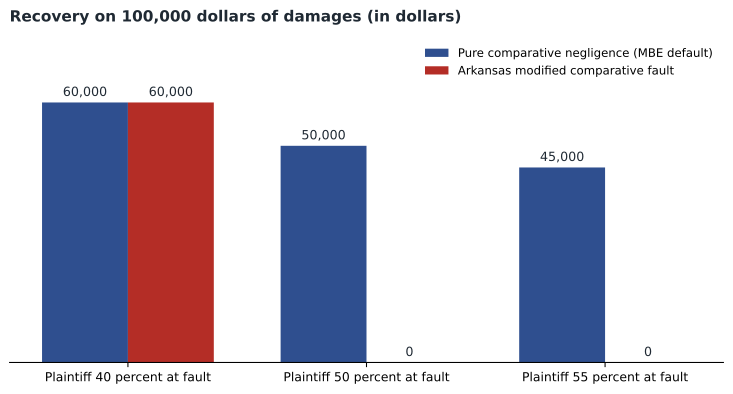
Arkansas abolished contributory negligence as a complete bar decades ago and adopted comparative fault by statute. The current rule is in Ark. Code Ann. section 16-64-122. A claimant whose fault is less than the fault of the party or parties from whom the claimant seeks to recover may recover damages, reduced in proportion to the claimant's own fault. A claimant whose fault is equal to or greater than the fault of those parties recovers nothing. This is a modified comparative fault system of the kind often called the 50 percent bar: a plaintiff who is exactly half at fault loses.
The comparison runs between the claimant and the party or parties from whom the claimant seeks recovery. If several defendants are sued, the claimant's fault is compared with their combined fault for purposes of the bar.
Worked problem
Can Dale recover?
A jury finds Dale 40 percent at fault for speeding and the truck driver 60 percent at fault for running the stop sign. Dale's damages are 250,000 dollars. What does he recover? What if the jury finds them each 50 percent at fault?
Show solution
- Compare Dale's fault (40 percent) with the defendant's (60 percent): 40 is less than 60, so he may recover.
- Reduce the damages by his share of fault: 250,000 dollars minus 40 percent is 150,000 dollars.
- At 50 percent each, Dale's fault is equal to the defendant's, not less, so under section 16-64-122 he recovers nothing.
- On the MBE, by contrast, pure comparative negligence would give him 125,000 dollars at 50 percent.
Answer: 150,000 dollars at 40 percent; nothing at 50 percent.
The Civil Justice Reform Act of 2003
In 2003 the General Assembly passed the Civil Justice Reform Act, a broad tort reform statute. Among its changes, it largely abolished joint and several liability in favor of several liability: in general, each defendant is liable only for its own share of the plaintiff's damages, in proportion to its percentage of fault, rather than for the whole amount. The Act also contained provisions that the Supreme Court of Arkansas later struck down. In Johnson v. Rockwell Automation, Inc., 2009 Ark. 241, the court held that the Act's provision allowing juries to allocate fault to nonparties violated the separation of powers, because it intruded on the court's power to make rules of practice and procedure. The decision illustrates a theme in Arkansas law: the supreme court guards its rule-making authority under Amendment 80 closely, and statutes that the court sees as procedural rules can be invalidated on that basis.
No caps on damages
Dale's second question has a simple answer in Arkansas, and it is unusual among states. Article 5, section 32 of the Arkansas Constitution provides that no act of the General Assembly shall limit the amount to be recovered for injuries resulting in death or for injuries to persons or property, with an exception that allows the legislature to set workers' compensation benefits. The supreme court has applied that provision to strike down statutory caps. In Bayer CropScience LP v. Schafer, 2011 Ark. 518, a case arising from contamination of the rice supply with an unapproved genetically engineered variety, the court held that the statutory cap on punitive damages in Ark. Code Ann. section 16-55-208 was unconstitutional.
The result is that Arkansas juries may award compensatory and punitive damages without a statutory ceiling, subject to the ordinary controls of trial practice, remittitur and the federal due process limits on punitive damages from cases such as State Farm v. Campbell. Proposals to amend the constitution to allow caps have been made; one was removed from the 2018 general election ballot by the supreme court before the vote. As of November 2026, article 5, section 32 remains in place, and new lawyers should check for any later amendment before advising a client.
Punitive damages
Punitive damages themselves are governed by statute. Under the Civil Justice Reform Act's punitive damages provisions, a plaintiff must prove by clear and convincing evidence that the defendant knew or ought to have known, in light of the surrounding circumstances, that its conduct would naturally and probably result in injury or damage and that it continued the conduct with malice or in reckless disregard of the consequences, from which malice may be inferred, or that it intentionally pursued a course of conduct for the purpose of causing injury or damage. Ordinary negligence, however serious its results, does not support punitive damages. The trial is typically bifurcated so that the jury decides liability and compensatory damages before hearing evidence on punitive damages.
| Issue | MBE default | Arkansas |
|---|---|---|
| Plaintiff's fault | Pure comparative negligence | Modified: recovers only if plaintiff's fault is less than the defendants' |
| Multiple defendants | Joint and several liability | Generally several liability under the 2003 Act |
| Caps on damages | Not tested | Prohibited by Ark. Const. art. 5, section 32; punitive cap struck in Bayer (2011) |
| Punitive damages standard | Not tested in detail | Clear and convincing evidence of malice, reckless disregard or intent |
Medical injury claims
Claims against health care providers fall under the Arkansas Medical Malpractice Act, Ark. Code Ann. section 16-114-201 and following. The Act requires, in most cases, expert testimony to establish the standard of care, its breach and causation, and it sets a two-year limitations period with its own rules. Here too the supreme court has struck provisions it saw as procedural. In Broussard v. St. Edward Mercy Health System, Inc., 2012 Ark. 14, the court held that a statutory requirement that the plaintiff's expert be of the same medical specialty as the defendant violated the separation of powers. A new lawyer handling a medical claim should read the Act alongside the cases that have narrowed it.
Product liability
Arkansas imposes strict liability on suppliers of defective products. Under Ark. Code Ann. section 4-86-102, a supplier of a product is liable for harm caused by the product if it was supplied in a defective condition that rendered it unreasonably dangerous and that defective condition was a proximate cause of the harm. The Arkansas Product Liability Act of 1979, section 16-116-101 and following, defines terms and sets rules for product liability actions, including the treatment of compliance with government standards. Product claims may also be brought in negligence or breach of warranty. Comparative fault applies to product claims as well.
Immunities
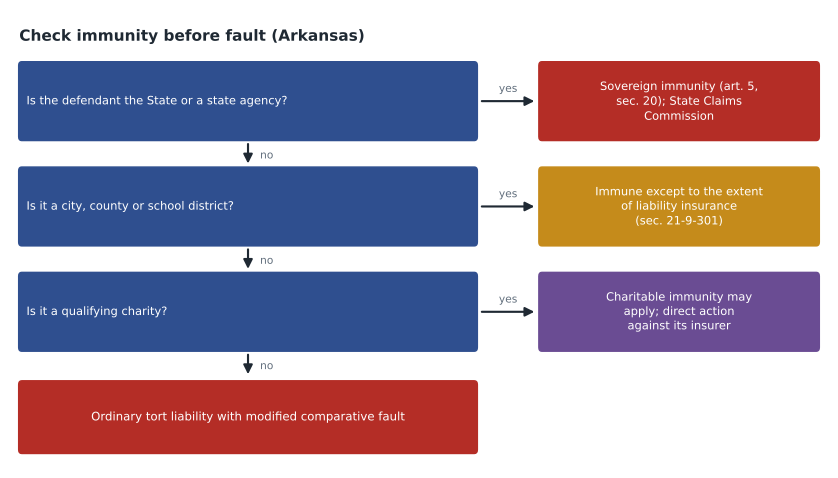
Arkansas preserves immunities that many states have narrowed. The state itself is protected by article 5, section 20 of the constitution, which provides that the State of Arkansas shall never be made a defendant in any of her courts. In Board of Trustees of the University of Arkansas v. Andrews, 2018 Ark. 12, the supreme court read that provision strictly and held that the General Assembly cannot waive the state's sovereign immunity by statute. Claims against the state generally go instead to the Arkansas State Claims Commission.
Cities, counties, school districts and other political subdivisions are immune from tort liability by statute, Ark. Code Ann. section 21-9-301, except to the extent they are covered by liability insurance. Arkansas also still recognizes a form of charitable immunity for qualifying charitable organizations, and a statute allows an injured person to sue the liability insurer of an immune charity directly. These rules can decide a case before fault is ever discussed, so the first question about any defendant should be whether it is immune.
Wrongful death and survival
When an injury causes death, Arkansas law provides two kinds of claims. The wrongful death statute, Ark. Code Ann. section 16-62-102, allows a claim for the benefit of the decedent's spouse, children, parents, siblings and certain others for their own losses, such as lost support and mental anguish, brought by the personal representative or, if there is none, by the heirs. The survival statute preserves the decedent's own claims, such as pain and suffering before death and medical expenses. Both are subject to comparative fault and, because of article 5, section 32, to no statutory cap.
Common mistakes
MistakeArkansas uses pure comparative negligence.
InsteadArkansas uses a modified system: a claimant recovers only if his or her fault is less than the defendants'.
MistakeA 50-50 split lets the plaintiff recover half.
InsteadUnder section 16-64-122 a claimant whose fault equals the defendants' recovers nothing.
MistakeArkansas caps punitive damages.
InsteadThe statutory cap was struck down in Bayer CropScience v. Schafer (2011) under article 5, section 32.
MistakeThe legislature can waive the state's sovereign immunity.
InsteadIn Board of Trustees v. Andrews (2018), the court held it cannot; claims go to the State Claims Commission.
Caleb drafts a short note to the partner on Dale's case: comparative fault will decide the case, because Dale recovers nothing if the jury puts him at half the fault or more; there is no cap on damages; and the trucking company is an ordinary defendant with no immunity. 'Now you are thinking like an Arkansas lawyer,' Marchetti says.
Working through a fault allocation
Comparative fault questions in Arkansas often involve more than two parties. Suppose a plaintiff sues two defendants, and the jury assigns 30 percent of the fault to the plaintiff, 50 percent to the first defendant and 20 percent to the second. The plaintiff's fault, 30 percent, is less than the combined fault of the defendants, 70 percent, so the plaintiff may recover, with damages reduced by 30 percent. Under several liability, each defendant generally pays its own share: the first defendant 50 percent of the damages, the second 20 percent. If the second defendant is insolvent, the plaintiff generally bears that loss rather than the first defendant, which is the practical effect of moving away from joint and several liability.
Lawyers on both sides therefore pay close attention to who is in the case. Because Johnson v. Rockwell Automation struck the provision allowing fault to be allocated to nonparties, a defendant that wants to shift fault to another person generally must bring that person into the case, for example by a third-party complaint, rather than simply asking the jury to assign fault to an absent party.
Negligence per se and statutes
Arkansas treats the violation of a statute or ordinance as evidence of negligence rather than negligence per se in most cases, leaving the jury to weigh it with the other evidence. The difference from the per se rule tested on the MBE can matter: in Dale's case, his speeding and the truck driver's failure to stop are both evidence for the jury to weigh in allocating fault, not automatic findings of negligence.
Practical damages questions
Because Arkansas forbids caps, damages evidence carries special weight. Plaintiffs' lawyers develop proof of medical expenses, lost earnings, pain and suffering and, where warranted, punitive damages. Defendants focus on causation, comparative fault and the reasonableness of claimed expenses. The collateral source rule generally prevents a defendant from reducing damages by showing that the plaintiff's losses were paid by insurance or other independent sources, though the details of how medical bills are proved can be contested. A new lawyer valuing a case in Arkansas must work without the ceiling that limits exposure in many other states.
Workers' compensation and its exception
Article 5, section 32 contains one important exception: the General Assembly may prescribe the amount of compensation employers pay for injuries to employees. Workers' compensation therefore operates with statutory benefit schedules and as the exclusive remedy against the employer for most workplace injuries, while claims against third parties, such as a manufacturer whose machine injured the worker, proceed in tort without caps. An injured worker's lawyer in Arkansas often handles both, coordinating the employer's lien on any third-party recovery.
Summary and key terms
- Ark. Code Ann. section 16-64-122: a claimant recovers, reduced by his or her fault, only if that fault is less than the fault of the defendants; equal or greater fault bars recovery.
- The 2003 Civil Justice Reform Act generally replaced joint and several liability with several liability; its nonparty fault provision was struck in Johnson v. Rockwell (2009).
- Article 5, section 32 forbids statutory limits on damages; Bayer CropScience v. Schafer (2011) struck the punitive damages cap.
- Punitive damages require clear and convincing evidence of malice, reckless disregard or intent.
- The state has sovereign immunity that the legislature cannot waive (Andrews, 2018); political subdivisions are immune except to the extent of insurance.
- Modified comparative fault
- A system in which a plaintiff recovers reduced damages only if his or her fault is below a threshold; in Arkansas, less than the defendants'.
- Several liability
- Liability of each defendant only for its own share of damages, in proportion to its fault.
- Article 5, section 32
- The Arkansas constitutional provision forbidding laws that limit recovery for injury or death.
- Sovereign immunity
- The State of Arkansas's immunity from suit in its own courts under article 5, section 20.
- Remittitur
- A court's order reducing an excessive jury award, usually with the option of a new trial.
Lesson quiz · 5 questions
Score 60% or more to complete this lesson.
Create a free account to save your progress, take quizzes and earn a certificate.