
BAR-204 · Lesson 3 of 12 · 18 min
Character and fitness and the MPRE
▶ Video coming soon A video version of this lesson is on the way.
Caleb arrives at the third session with his list of addresses, jobs and references, and a worry. In his second year of law school he got a speeding ticket in Missouri that he paid by mail, and as an undergraduate he was put on probation for a semester after a party in his dormitory. He wants to know whether either one will keep him out of the Arkansas bar. 'Almost certainly not,' Marchetti says. 'What keeps people out is rarely the thing they did. It is the thing they did not disclose.'
What Arkansas is looking for
Every applicant for admission in Arkansas must show the board that he or she has the good moral character and the mental and emotional stability to practice law. The board's instructions list this alongside the education and status requirements as a condition of eligibility, and the rule on admission on motion refers to the character and fitness standards of Rule XIII. The question is forward-looking: whether the applicant can be trusted to handle clients' money, keep their secrets, tell the truth to courts and other lawyers, and meet deadlines. Past conduct matters as evidence of what the applicant is likely to do.
Courts across the country have long held that a state may require good character for admission to the bar, but that the standard must be applied rationally and with due process. In Schware v. Board of Bar Examiners (1957), the United States Supreme Court held that New Mexico could not deny admission based on decades-old conduct, including past membership in the Communist Party, without evidence connecting it to the applicant's present fitness. Arkansas's process, like every state's, works within that frame.
The Arkansas questionnaire
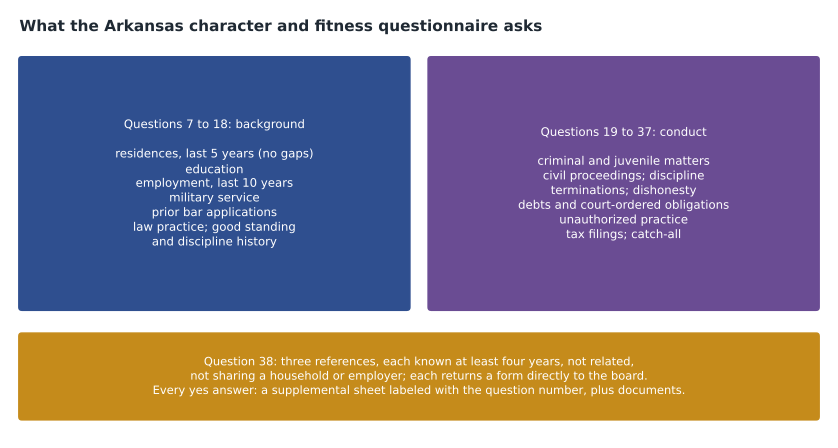
The heart of the Arkansas review is the applicant's own questionnaire. The instructions for the July 2026 exam walk through it in two parts. Questions 7 through 18 cover background: every residence in the past five years with no gaps, education, employment in the past ten years other than law practice, military service, prior bar applications, law practice, and good standing and discipline history. Questions 19 through 37 cover conduct: criminal and juvenile matters, civil lawsuits, discipline by schools, employers and licensing bodies, terminations from jobs, accusations of dishonesty, bonds, debts and court-ordered obligations, mental health defenses raised in proceedings, unauthorized practice of law, and tax filing. There is also a catch-all question asking for anything else the board should know.
Every 'yes' answer must be explained on a supplemental sheet labeled with the question number, with supporting documents attached. If a document cannot be obtained in time, the applicant must say when it will arrive and why it is late. Question 38 asks for three references who have known the applicant for at least four years, who are not related to the applicant by blood or marriage, and who do not share a household or employer with another reference. Each reference returns a form directly to the board, and the instructions put the duty on the applicant to follow up and confirm that they did.
Standard applicants also complete NCBE's character and fitness application, and NCBE prepares a report for the board based on its own investigation. Abbreviated applicants who are retaking within three years skip the new NCBE application and send updates directly to the board. Courtesy-seat applicants skip the NCBE application because Arkansas will not admit them on that score.
Candor is the rule
Marchetti returns to Caleb's worry. Both of his incidents fall within questions the application asks: the speeding ticket is a minor traffic matter that may or may not fall within the criminal question, depending on its exact wording, and the dormitory probation is school discipline. Her advice is the advice of every bar examiner: read the question exactly, and when in doubt, disclose. A paid traffic ticket and a semester of student probation, honestly reported and explained, are the kind of matter boards see every day. The same incidents, discovered by the board after the applicant failed to report them, become a question about honesty, and honesty is the central character trait the board is testing.
The duty also continues. The board expects applications to stay current through the date of admission. If Caleb receives another citation, is sued, misses a child support payment, or changes jobs after filing, he must tell the board promptly. A change in employment matters even for applicants admitted by transferred score, whose instructions say so expressly.
Common areas of concern
Boards across the United States see the same handful of issues repeatedly, and Arkansas's questionnaire asks about each. Financial responsibility is one: unpaid debts, defaulted student loans, judgments and unfiled tax returns raise questions about whether an applicant will handle client funds responsibly. Criminal history is another, especially offenses involving dishonesty, violence or substance abuse. Academic misconduct, such as plagiarism, raises honesty concerns. Prior discipline or termination from employment, and any unauthorized practice of law, also draw attention. None of these is an automatic bar. Boards look at how serious the conduct was, how long ago it happened, what the applicant has done since, and, above all, whether the applicant is candid about it.
Mental health questions are treated differently than they once were. Many jurisdictions, following a national trend, have narrowed or removed questions about mental health diagnoses and treatment, focusing instead on conduct. The Arkansas questionnaire, as described in the 2026 instructions, asks about mental health defenses raised in legal proceedings rather than about diagnosis or treatment in general. Applicants should answer exactly what the current form asks.
Worked problem
Disclosing a debt
Caleb's classmate Jordan has 4,000 dollars in credit card debt that went to collection in 2024. He set up a payment plan in 2025 and is current. Does he disclose it, and how?
Show solution
- Read the debt question exactly: if it asks about accounts placed with a collection agency, the 2024 collection falls within it.
- Answer yes and attach a supplemental sheet labeled with the question number.
- Explain the cause briefly, the payment plan and its current status, and attach the plan and recent statements.
- Keep the board updated if anything changes before admission.
Answer: He discloses it with documents; a debt being repaid under a plan and candidly reported is a common, manageable matter.
The MPRE
The second requirement in this lesson is the Multistate Professional Responsibility Examination. NCBE writes and administers the MPRE several times a year at testing centers. It is a two-hour, 60-question multiple-choice exam on the law governing lawyers: the ABA Model Rules of Professional Conduct, the ABA Model Code of Judicial Conduct, and related law. Fifty questions are scored and ten are being tested for future use. Scores are reported on a scaled range of 50 to 150. The MPRE course in this program, BAR-140, covers its content in depth.
Arkansas requires a scaled MPRE score of at least 85. That is among the highest requirements in the country; required scores range from 75 to 86 across jurisdictions. A score of 85 is comfortably above the national mean, so Arkansas candidates should prepare for the MPRE seriously rather than treating it as a formality.
The Arkansas MPRE window
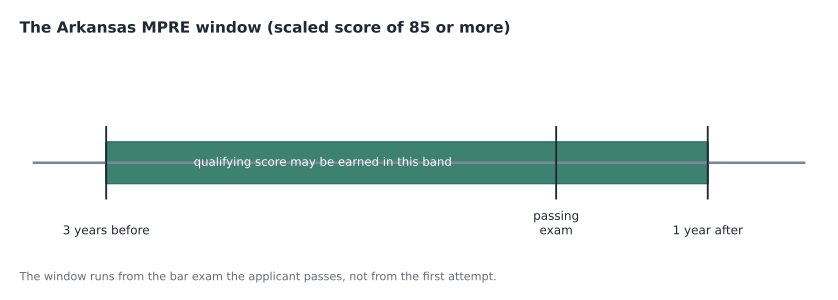
Arkansas also limits when the score may be earned. The board's instructions say the qualifying MPRE score must be earned either within three years before the date of the bar exam the applicant passes, or within one year after that exam. The window runs from the exam the applicant passes, not from the first exam the applicant sat. That matters for repeat takers: a score that was valid for a first attempt can expire before a later passing attempt. Applicants admitted by transferred UBE score must also show an MPRE score of at least 85.
Applicants must have NCBE send their MPRE score directly to the Arkansas board. The instructions say that if NCBE has already sent the score, the board has it on file, and that an applicant who is unsure can email the board to check. Ordering the score report is the applicant's job, not the law school's.
Worked problem
Does the MPRE score still count?
Jordan scored 88 on the MPRE in August 2023. He failed the July 2025 and February 2026 Arkansas exams and passed in July 2026. Does his 2023 score count?
Show solution
- The window runs from the exam he passed: July 2026.
- Three years before July 2026 reaches back to July 2023; August 2023 falls inside the window.
- If he had passed only in February 2027, three years back would reach February 2024, and the August 2023 score would fall outside it.
- In that case he would need a new qualifying score earned by February 2028, one year after the passing exam.
Answer: Yes, for a July 2026 pass; a later pass could have pushed the score outside the window.
When to take the MPRE
Most Arkansas students take the MPRE during law school after completing a professional responsibility course, often in the spring of the second year or the fall of the third. That timing usually puts the score well within three years of a first bar attempt. Candidates who expect to sit the bar later, such as those taking a clerkship or a job outside law first, should calculate the window before they test. Because Arkansas also accepts a score earned within a year after the passing exam, a candidate who missed the MPRE during school can still qualify by taking it soon after the bar exam, though admission waits until the score is in.
Common mistakes
MistakeMinor matters do not need to be disclosed.
InsteadRead each question exactly and disclose anything it reaches; failing to disclose is far more serious than most underlying conduct.
MistakeThe application is final once filed.
InsteadApplicants must keep it current through the date of admission.
MistakeAny passing MPRE score works in Arkansas.
InsteadArkansas requires 85, near the top of the national range.
MistakeThe MPRE window runs from the first bar exam taken.
InsteadIt runs from the exam the applicant passes: three years before or one year after.
Caleb decides to report both incidents, with a copy of the paid ticket and the letter ending his probation. His MPRE score, a 94 from March 2025, sits safely inside the window for February or July 2027. 'Now,' Marchetti says, 'let us talk about the exam itself.'
What happens when the board has a concern
Most Arkansas applications move through character and fitness review without incident. When the board or its investigators see something that needs explanation, the usual first step is a request for more information: a letter asking for court records, a fuller account of an incident, proof that a debt is being paid, or letters from people who can speak to the applicant's conduct since. Applicants should answer such requests promptly, completely and in the same candid tone as the application itself. A defensive or minimizing answer often does more harm than the underlying event.
If questions remain, the board can investigate further and, where the rules provide, hold a hearing at which the applicant may appear and present evidence. Applicants facing serious questions often consult a lawyer who handles admissions matters. Boards generally look for evidence of rehabilitation: time elapsed since the conduct, consistent good conduct since, restitution where money was involved, treatment where substance use was involved, and a candid acknowledgment of what happened. An applicant who can show those things is in a much stronger position than one who argues that nothing was wrong.
Preparing references
References are easy to neglect because the applicant does not control them. The Arkansas instructions put the burden on the applicant to make sure each reference returns the form directly to the board. A practical approach is to ask each person in advance, explain what the form is and when it is due, give them the board's address or delivery instructions, and follow up a week later. Choose people who know you well rather than people with impressive titles who know you slightly: a former employer who supervised you for three years is a better reference than a judge you met twice. Remember the Arkansas rules: at least four years of acquaintance, no relatives by blood or marriage, and no two references from the same household or the same employer.
Using the MPRE as preparation for practice
The MPRE is often treated as a hurdle, but its content is the law that governs every day of practice: confidentiality, conflicts, fees, client funds, candor to courts and communications with represented persons. Arkansas's high required score is a reason to learn the material properly rather than cram it. A candidate who masters the Model Rules for the MPRE has a head start on the Arkansas Rules of Professional Conduct, which follow them closely, and on avoiding the most common disciplinary problems in a new lawyer's first years.
A note on timing the character application
Because character and fitness review can take months when questions arise, file early in the window rather than on the deadline. An applicant who files in September for a February exam gives the board time to request records and receive references before exam day, and gives himself time to answer without stress.
Summary and key terms
- Every Arkansas applicant must show good moral character and the mental and emotional stability to practice law.
- The Arkansas questionnaire covers background (questions 7 to 18) and conduct (questions 19 to 37); every yes answer needs a labeled supplemental sheet and documents; three qualified references respond directly.
- Candor is the central test: nondisclosure is often more serious than the underlying conduct, and applications must be kept current until admission.
- Arkansas requires a scaled MPRE score of at least 85.
- The MPRE score must be earned within three years before or one year after the bar exam the applicant passes.
- Character and fitness
- The requirement that an applicant show the honesty, responsibility and stability needed to practice law.
- Supplemental sheet
- The explanation an Arkansas applicant attaches for each yes answer, labeled with the question number.
- MPRE
- The Multistate Professional Responsibility Examination, a 60-question NCBE test on the law governing lawyers.
- Scaled score
- A score adjusted for the difficulty of a test form so that results are comparable across administrations.
- MPRE window
- In Arkansas, three years before through one year after the bar exam the applicant passes.
Lesson quiz · 5 questions
Score 60% or more to complete this lesson.
Create a free account to save your progress, take quizzes and earn a certificate.