
BAR-204 · Lesson 12 of 12 · 13 min
Capstone: Arkansas practice questions and an exam-day plan
▶ Video coming soon A video version of this lesson is on the way.
The last session is two weeks before Caleb's exam. Marchetti splits it in two. 'First, a test of what you now know about Arkansas: the admission rules and the Arkansas law from Lessons 7 to 10. None of this is on your exam in February, but all of it is on your first year of practice, and some of it may be on the exam for the students who follow you. Second, your plan for exam week, which is very much on your February.'
Part one: admission questions
Work through these questions before reading the answers. Each is original and based on the rules as they stood in November 2026.
Question 1. Nadia graduates in May 2027 from a law school that received provisional ABA approval in 2026. Is she eligible to sit the Arkansas exam? Answer: yes. Arkansas requires a J.D. from a school ABA-approved at the time the degree was conferred, and provisional approval in 2026 means the school was approved when Nadia graduated in 2027. A classmate who graduated before the school's approval would not be eligible on that degree.
Question 2. Luis wants to sit the July 2027 exam. He mails his application on March 30, 2027, and it arrives on April 2. Is it timely? Answer: no. The application must be received by the board's office by the April 1 deadline; a postmark does not count, and the instructions describe no late-filing period. If April 1 fell on a weekend or holiday, the deadline would move to the next business day, which does not help Luis here.
Question 3. Grace sat the July 2026 Arkansas exam and scored 268. Her friend in a neighboring UBE state scored 268 on the same exam and passed. Did Grace pass? Can she transfer her 268 anywhere? Answer: Grace did not pass in Arkansas, which requires 270. Her score is a portable UBE score; she can transfer it to a jurisdiction whose passing score is 268 or less and whose other requirements she meets, if she wants to be admitted there instead.
Question 4. Jordan scored 84 on the MPRE in 2025. Can he be admitted in Arkansas if he passes the bar exam in February 2027? Answer: not with that score. Arkansas requires 85. He must retake the MPRE and earn at least 85 within the window: three years before or one year after the exam he passes.
Question 5. A Missouri lawyer passed the NextGen exam in July 2026 and wants to transfer her score to Arkansas in 2027. Answer: as of November 2026 she cannot. Arkansas does not accept transferred NextGen scores. Unless the court changes its rules after considering the board's report and public comments due December 31, 2026, she must qualify another way, such as admission on motion after three of five years of practice in a reciprocal jurisdiction.
Part two: Arkansas law questions
Question 6. A pedestrian is struck by a car; the jury finds the pedestrian 45 percent at fault and the driver 55 percent at fault, with damages of 80,000 dollars. What does the pedestrian recover under Arkansas law? Answer: 44,000 dollars. Her fault (45 percent) is less than the driver's (55 percent), so she may recover, reduced by her own share: 80,000 dollars less 45 percent is 44,000 dollars. Had the jury found her 55 percent at fault, she would recover nothing, because her fault would not be less than the driver's.
Question 7. A jury awards 2 million dollars in punitive damages against a manufacturer, and the manufacturer argues that an Arkansas statute caps punitive damages. Answer: the statutory cap in Ark. Code Ann. section 16-55-208 was held unconstitutional under article 5, section 32 of the Arkansas Constitution in Bayer CropScience LP v. Schafer (2011). The manufacturer's remaining arguments are the punitive damages standard itself, which requires clear and convincing evidence of malice, reckless disregard or intent, remittitur and federal due process limits.
Question 8. A school district bus injures a student. The district carries liability insurance with a 250,000 dollar limit. What is the significance? Answer: under Ark. Code Ann. section 21-9-301, political subdivisions such as school districts are immune from tort liability except to the extent of liability insurance. The insurance limit is therefore critical to the student's recovery in an action against the district.
Question 9. A husband owns a house in his name alone, and he sells it without his wife's signature on the deed. Years later he dies. What risk does the buyer face? Answer: if the wife did not relinquish her dower interest, she may claim dower in the house, a life estate in one-third if the husband left children, because dower attaches to land the husband owned during the marriage. That is why Arkansas closings require the spouse to sign a relinquishment of dower or curtesy.
Question 10. A neighbor has openly farmed a strip of land for twelve years under a mistaken belief that it was his, but he has no deed to the strip and has never paid taxes on it. Can he claim it by adverse possession? Answer: probably not. Since 1995, Ark. Code Ann. section 18-11-106 requires color of title and payment of taxes on the land or contiguous land for seven years, in addition to the common law elements. He has neither. The statute has an exception for boundary line adjustments between neighbors, which he should examine.
Question 11. A woman dies leaving a typed document signed by her and two witnesses who were never told it was her will. What problem arises? Answer: an Arkansas formal will requires publication, the testator's declaration to the witnesses that the instrument is her will, under section 28-25-103. If the evidence shows no publication, the will may be denied probate. It cannot be saved as a holographic will, because it is typed.
Question 12. A man dies intestate leaving a wife of eighteen months and his parents, but no descendants. Who takes the intestate estate? Answer: because the marriage lasted less than three years, the wife takes one-half and the other half passes to his other heirs in the order the statute sets, beginning with his parents. Had they been married three years, she would take it all.
Part three: an essay
Here is an original essay question in the style an Arkansas component might use. Allow thirty minutes. In 2019, Hank, a widower with two adult children, married Lila. In 2021 he bought a 120-acre farm outside Paris, Arkansas, titled in his name alone, and they lived on it. In 2024 Hank wrote a page entirely in his own hand, signed and dated, leaving the farm to his daughter, Mae. Hank died in 2026. Mae offers the handwritten page for probate. Lila wants to stay on the farm. Discuss the rights of Mae and Lila.
A strong answer would make these points. First, the handwritten page: under section 28-25-104 a holographic will is valid if its entire body and signature are in Hank's handwriting, and it must be proved after death by at least three credible disinterested witnesses familiar with his handwriting. If proved, it passes the farm to Mae.
Second, Lila's dower: Hank owned the farm during the marriage, and he left children, so under section 28-11-301 Lila is entitled to a life estate in one-third of the farm unless she relinquished it in legal form. Lila may elect to take against the will under section 28-39-401 and claim her dower and statutory shares of personal property.
Third, the homestead: the farm was Hank and Lila's residence outside any town, a rural homestead under article 9. The rural homestead may include up to 160 acres, and regardless of value cannot be reduced below 80 acres; the 120-acre farm fits within those limits. Article 9, section 6 gives the owner's widow the rents and profits of the homestead for her life. Lila's homestead right lets her remain in the home, and Mae's ownership under the will is subject to it.
Fourth, practical advice: Lila should be advised promptly about the time limit for electing against the will, and both sides should consider negotiation, such as Mae buying out Lila's life interests, because the combination of dower and homestead rights will prevent Mae from using or selling the farm freely during Lila's life.
Part four: exam week
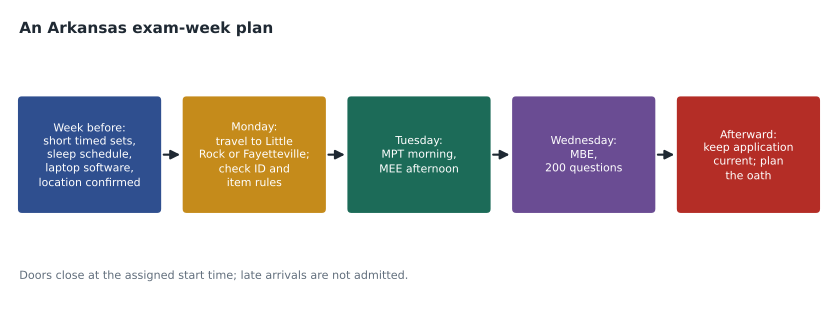
Marchetti turns to the plan Caleb will use in February. The week before, he should take short timed sets rather than full exams, review his rule outlines and the MPT approach, and set his sleep schedule to the exam's start times. He should confirm his assigned location, which the board announces at least 45 days before the exam, and plan the drive to Fayetteville or Little Rock with time to spare, because doors close at the assigned start time and late arrivals are not admitted.
He should register and test his laptop and the exam software before the deadline in the instructions, pack his charger, and be ready to finish by hand if the laptop fails. He should check the list of prohibited items, which includes phones, watches, paper, pens, food, drinks and bags, and bring the required photo identification on both days.
On Tuesday he will work the two MPT tasks in the morning and the six MEE essays in the afternoon; on Wednesday he will answer the 200 MBE questions. Between days he should rest rather than cram. After the exam, he should keep his application current until admission, line up the officer who will administer his oath, and, while waiting for results, turn his notes on Arkansas law into the practice file Lesson 6 suggested.
Common mistakes
MistakeA 268 passes in Arkansas because it passes elsewhere.
InsteadArkansas requires 270; a 268 can be transferred only to jurisdictions with a lower passing score.
MistakeA typed will can be saved as a holographic will.
InsteadA holographic will must be entirely in the testator's handwriting.
MistakeA will leaving the farm to a child ends the widow's right to live there.
InsteadThe widow's dower and constitutional homestead rights survive the will.
MistakeLate arrivals can still sit the exam.
InsteadDoors close at the assigned time and late arrivals are not admitted.
Caleb asks one last question: what score should he aim for? 'Plan for 275,' Marchetti says again, 'and go in knowing you have prepared for the exam they will actually give you.'
Part five: self-assessment
After the practice questions, Marchetti asks Caleb to score himself honestly on each area and to note where his answers were incomplete. For the admission questions, the most common errors among her past students were confusing mailing with receipt for deadlines, forgetting that the MPRE window runs from the exam passed, and assuming that a passing score in another UBE jurisdiction passes in Arkansas. For the Arkansas law questions, the most common errors were applying pure comparative negligence instead of Arkansas's modified rule, forgetting the color of title and tax requirements for adverse possession, and overlooking the surviving spouse's dower and homestead rights when a will seems to give everything to someone else.
She suggests a simple way to keep the Arkansas law alive after the exam. Each week in the first year of practice, read one Arkansas supreme court opinion in an area your firm handles, and note any statute or rule it applies. Within a year, the distinctive Arkansas rules in this course will be second nature, and you will notice when the court or the General Assembly changes them.
Final reminders
Before exam week, Caleb should reread the instructions for the February 2027 exam in full, because rules on items, identification and laptops can change between administrations. He should confirm that his MPRE score is on file with the board, that his references have responded, and that his application reflects any changes since he filed. After the exam, he should keep checking his email for requests from the board, and he should not discuss the exam questions with others, which the instructions and NCBE's rules forbid.
And when the results arrive and he is certified, he should choose an officer authorized under Rule VI to administer his oath, file his petition promptly, enroll, and begin his first CLE reporting period. 'Then,' Marchetti says, 'you will finally be what you have been studying to become: an Arkansas lawyer.'
One more essay to practice
Try a second essay on your own. Rosa, a married owner of a quarter-acre house lot inside Fort Smith, owes a credit card judgment of 40,000 dollars, and the judgment creditor seeks to sell the house. The house is worth 180,000 dollars, and Rosa lives there with her husband and two minor children. Discuss whether the creditor can sell the house. A strong answer identifies the urban homestead under article 9: within a city, up to one acre, with a 2,500 dollar value limit, but never reduced below one-quarter acre regardless of value. Rosa's quarter-acre lot is protected regardless of its value against an ordinary credit card judgment, because that debt falls outside the constitution's exceptions for purchase money, improvements and taxes.
Summary and key terms
- Admission: ABA-approved J.D. at graduation, filing by November 15 or April 1, MPRE 85 within the window, UBE 270, character and fitness, and an oath before an authorized officer.
- Arkansas law in practice: modified comparative fault, no damages caps, immunity checks, dower and curtesy, the constitutional homestead and the 1995 adverse possession statute.
- Wills: publication and two witnesses for formal wills; holographic wills proved by three disinterested witnesses; the spouse may elect against the will.
- Intestacy: descendants take first; without them, the spouse takes all after three years of marriage, otherwise half.
- Exam week: confirm location, test the laptop, follow the item rules, arrive early, and keep the application current after the exam.
- Capstone
- A final lesson that combines the course's topics in practice questions and a plan.
- Rural homestead
- A homestead outside any city, town or village: up to 160 acres, never reduced below 80 acres.
- Election against the will
- A surviving spouse's choice to take dower and statutory shares instead of the will's gifts.
- Relinquishment of dower
- A spouse's signature on a deed giving up dower or curtesy in the land conveyed.
- Assigned location
- The exam site, Little Rock or Fayetteville, announced to each applicant at least 45 days before the exam.
Lesson quiz · 5 questions
Score 60% or more to complete this lesson.
Create a free account to save your progress, take quizzes and earn a certificate.