
BAR-204 · Lesson 10 of 12 · 15 min
Arkansas wills, probate and the surviving spouse
▶ Video coming soon A video version of this lesson is on the way.
Three weeks before the tenth session, Ruth Dunaway's husband Earl died. In his desk the family found two documents: a typed will, signed by Earl and two witnesses in 1998, leaving everything to Ruth, and a single handwritten page dated 2024, signed 'E. Dunaway', leaving the farm to their son. Ruth wants to know which document controls, and whether her son can take the farm. 'This is the lesson where everything in the course comes together,' Marchetti says. 'Wills, intestacy, dower and the homestead all meet in a single estate.'
Formal wills
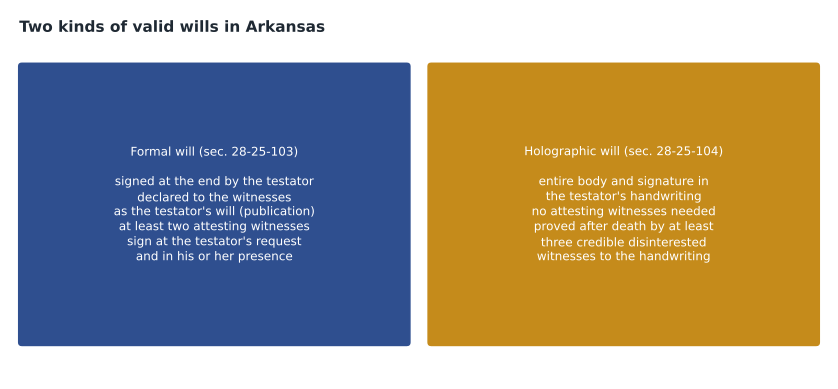
A valid Arkansas will requires a testator who is at least eighteen and of sound mind, and compliance with the execution formalities in Ark. Code Ann. section 28-25-103. The testator must sign at the end of the instrument, or another person may sign for the testator at the testator's direction and in his or her presence. The testator must declare to the attesting witnesses that the instrument is his or her will, a step called publication, and must sign or acknowledge the signature in their presence. At least two attesting witnesses must sign at the testator's request and in the testator's presence.
The publication requirement is a point where Arkansas is stricter than many states, and strict compliance matters. A will that two witnesses signed without hearing or seeing any indication from the testator that it was a will can be refused probate. Arkansas also allows a will to be made self-proved with an affidavit of the testator and witnesses signed before an officer authorized to administer oaths, which lets the will be admitted to probate without calling the witnesses.
Holographic wills
Arkansas recognizes holographic wills, which many states do not. Under Ark. Code Ann. section 28-25-104, a will is valid without attesting witnesses if the entire body of the will and the signature are in the testator's own handwriting. After death, the handwriting and signature must be established by the evidence of at least three credible disinterested witnesses who are familiar with the testator's handwriting. The requirement that the entire body be handwritten is strict: printed or typed words that are material to the dispositions can defeat a holographic will.
A later valid will can revoke an earlier one, expressly or by inconsistency. Arkansas also recognizes revocation by a physical act, such as burning, tearing, canceling or obliterating the will with the intent to revoke, done by the testator or by another person in the testator's presence and at his direction.
Worked problem
Earl's two wills
Earl's 1998 typed will was properly executed with two witnesses. His 2024 page is entirely in his handwriting, dated, and signed "E. Dunaway", leaving the farm to his son. What must the son prove, and what happens to Ruth's rights?
Show solution
- A holographic will is valid if the entire body and the signature are in Earl's handwriting: the page appears to qualify.
- The son must prove the handwriting and signature through at least three credible disinterested witnesses familiar with Earl's writing.
- If proved, the 2024 will revokes the 1998 will to the extent of the inconsistency: the farm passes to the son under the later will, and the rest may still pass under the earlier one.
- Ruth can elect to take against the will and claim her dower and statutory shares and her homestead rights, so the son takes the farm subject to them.
Answer: The holographic page can control the farm if proved by three disinterested witnesses, but Ruth keeps dower and homestead rights.
The surviving spouse's election
A will cannot defeat the protections Arkansas gives a surviving spouse. Under Ark. Code Ann. section 28-39-401, a surviving spouse may elect to take against the will. A spouse who does takes the dower or curtesy interest and the statutory shares of personal property described in Lesson 9, rather than what the will provides. The election must be made within the time the statute sets after the will is admitted to probate, so an estate lawyer representing a surviving spouse must compare the will's gifts with the spouse's statutory rights early in the case.
The constitutional homestead also protects the widow and minor children, as Lesson 9 explained, and the probate code adds allowances for the family out of the estate. Together these mean that in Arkansas a spouse who is left out of a will, or given less than the statutory rights, still has substantial protection.
Pretermitted children
Arkansas also protects children the testator did not mention. Under Ark. Code Ann. section 28-39-407, if a testator fails to mention a child, or the issue of a deceased child, the omitted child generally takes the share he or she would have taken if the testator had died without a will, unless it appears from the will that the omission was intentional. The Arkansas rule applies to children living when the will was made as well as to those born afterward, which is broader than the rule in many states. Careful Arkansas drafters therefore name every child, even one who is intentionally left out.
Intestate succession
If a person dies without a valid will, the intestacy statutes in Ark. Code Ann. section 28-9-201 and following determine who inherits. Arkansas's scheme has a feature that surprises lawyers from other states. Under section 28-9-214, the decedent's descendants take first, ahead of the surviving spouse. If there are no descendants, the surviving spouse takes the entire intestate estate if the couple had been married for at least three continuous years; if they had been married for less than three years, the spouse takes one-half and the other half passes to the decedent's other relatives, such as parents and siblings, in the order the statute sets.
That does not mean a surviving spouse with children receives nothing. Dower and curtesy and the statutory shares of personal property apply whether or not there is a will, and the homestead protections still apply. In an intestate estate with children, the spouse takes dower, a life estate in one-third of the land, and one-third of the personal property, and the children take the rest of the intestate estate.
| Situation | Surviving spouse takes (intestate) | Plus |
|---|---|---|
| Decedent leaves descendants | Nothing as an heir; descendants inherit | Dower or curtesy (life estate in one-third of land) and one-third of personal property; homestead rights |
| No descendants; married 3 years or more | The entire intestate estate | Homestead rights |
| No descendants; married less than 3 years | One-half; the rest to other relatives | Dower or curtesy shares and homestead rights |
Probate in Arkansas
Estates are administered in the probate division of the circuit court under the Arkansas Probate Code. A will is offered for probate by petition, and the court appoints a personal representative, called an executor if named in the will and an administrator otherwise. The personal representative publishes notice to creditors, who must present claims within the period the code sets or be barred. The personal representative collects assets, pays valid claims, taxes and expenses, and distributes what remains under the will or the intestacy statutes. Small estates may be collected without full administration by an affidavit procedure when the estate's value is below the statutory limit.
Arkansas also offers ways to pass property outside probate. Joint tenancy with survivorship and tenancy by the entirety pass to the survivor automatically. Payable-on-death accounts and beneficiary designations on insurance and retirement accounts pass by contract. Arkansas also authorizes beneficiary deeds, a form of transfer-on-death deed for real estate, by which an owner can name a beneficiary who takes the land at the owner's death without probate, while the owner keeps full control during life.
Trusts
Arkansas adopted the Arkansas Trust Code, based on the Uniform Trust Code, in 2005, codified at Ark. Code Ann. section 28-73-101 and following. It covers creating trusts, the trustee's duties of loyalty, prudence and impartiality, the beneficiaries' rights to information, modification and termination, and revocable trusts. Revocable living trusts are widely used in Arkansas estate planning to avoid probate and keep affairs private. But a revocable trust does not defeat dower in the way a non-spouse might hope; a surviving spouse's rights in property the deceased owned during the marriage must be considered in planning.
A note for the future exam
Since July 2026, trusts and estates are no longer tested on the MEE, and NextGen tests them only with the law supplied. If the Supreme Court of Arkansas adds an Arkansas component when the legacy UBE ends, wills, probate and the spouse's rights are among the most likely topics, because they are distinctively Arkansan and NextGen leaves them out. Candidates who will sit after February 2028 should keep this lesson.
Common mistakes
MistakeArkansas does not allow handwritten wills.
InsteadIt does: a holographic will needs the entire body and signature in the testator's handwriting, proved by three credible disinterested witnesses.
MistakeTwo witnesses signing is all a formal will needs.
InsteadThe testator must also sign at the end and declare the instrument to be his or her will (publication).
MistakeA surviving spouse inherits everything if there is no will.
InsteadDescendants take first; the spouse takes all only if there are no descendants and the marriage lasted three years.
MistakeA will can cut off the surviving spouse.
InsteadThe spouse may elect to take against the will and claim dower or curtesy, statutory shares and homestead rights.
Will contests
A will offered for probate in Arkansas can be contested on familiar grounds: lack of the required formalities, lack of testamentary capacity, undue influence, fraud, or revocation. Capacity requires that the testator understood the nature and extent of the property, the natural objects of his or her bounty and the effect of the will. Undue influence requires influence that destroys the testator's free agency; Arkansas courts presume undue influence in some circumstances, such as when a beneficiary who was in a confidential relationship with the testator procured the will, shifting the burden to that beneficiary to show the will was the testator's free act. Contests must be filed within the time the probate code sets after the will is admitted.
In Earl's estate, Ruth's lawyer will consider all of these. Was the 2024 page entirely in Earl's handwriting, and can three disinterested witnesses prove it? Did Earl have capacity in 2024? Did the son procure the page while in a position of trust? Even if the page stands, Ruth's dower, statutory shares and homestead rights remain. A careful lawyer will analyze the will contest and the spouse's statutory rights together, because the client's best outcome may come from either or both.
Planning with Arkansas rules in mind
Good estate planning in Arkansas accounts for the rules in this lesson. A planner representing a married client must consider dower and curtesy and the right to elect against the will, and may use a premarital agreement or a careful plan that gives the spouse at least the value of the statutory rights. A planner should name every child in the will to avoid the pretermitted child statute. A planner should execute every will with the full Arkansas formalities, including publication, and attach a self-proving affidavit, rather than relying on a holographic will, which invites disputes about handwriting. And a planner should coordinate the will with beneficiary designations, joint accounts, beneficiary deeds and revocable trusts, because property that passes outside probate does not follow the will.
Representing a personal representative
A new lawyer often first meets probate practice representing an executor or administrator. The personal representative owes fiduciary duties to the estate's beneficiaries and creditors: to collect and protect the assets, to give the required notices, to pay valid claims in the order the code sets, to keep accurate accounts and to distribute what remains correctly. The lawyer's job is to guide the personal representative through each step, file the required documents in the probate division, and advise on disputes with claimants and heirs. Missing the creditor-claim deadlines, or distributing before claims are resolved, can expose the personal representative to personal liability.
Probate timing and the family
The probate code also gives the family some protection during administration. The surviving spouse and minor children may be entitled to statutory allowances from the estate for their support, and the homestead remains protected while the estate is settled. A personal representative must take those rights into account before paying general creditors. For Ruth, that means her home and support are protected while her lawyer evaluates the will contest and her election, which can take months.
Summary and key terms
- A formal will needs the testator's signature at the end, publication to the witnesses and at least two attesting witnesses (section 28-25-103).
- Holographic wills are valid if entirely handwritten and signed, proved by at least three credible disinterested witnesses (section 28-25-104).
- A surviving spouse may elect against the will and take dower or curtesy and statutory shares (section 28-39-401); omitted children are protected (section 28-39-407).
- In intestacy, descendants take first; without descendants, the spouse takes all if married three years, otherwise half.
- Estates are administered in the probate division of circuit court; the Arkansas Trust Code (2005) follows the Uniform Trust Code.
- Publication
- The testator's declaration to the witnesses that the instrument is his or her will, required in Arkansas.
- Holographic will
- A will entirely in the testator's handwriting and signed, valid in Arkansas without attesting witnesses.
- Election against the will
- A surviving spouse's choice to take statutory rights instead of the will's provisions.
- Pretermitted child
- A child the testator failed to mention, who generally takes an intestate share unless the omission was intentional.
- Beneficiary deed
- An Arkansas deed naming a beneficiary to take real estate at the owner's death without probate.
Lesson quiz · 5 questions
Score 60% or more to complete this lesson.
Create a free account to save your progress, take quizzes and earn a certificate.