
BAR-204 · Lesson 7 of 12 · 15 min
Arkansas courts and civil procedure
▶ Video coming soon A video version of this lesson is on the way.
Caleb's firm has just filed its first lawsuit with his name on the draft. The case is a dispute between a poultry grower and a feed supplier over a contract, and the senior partner has asked him to check every deadline. He brings the file to the seventh session. 'This is the right time to learn Arkansas procedure,' Marchetti says. 'Not because the exam tests it, but because you are about to be responsible for it.'
The court system after Amendment 80
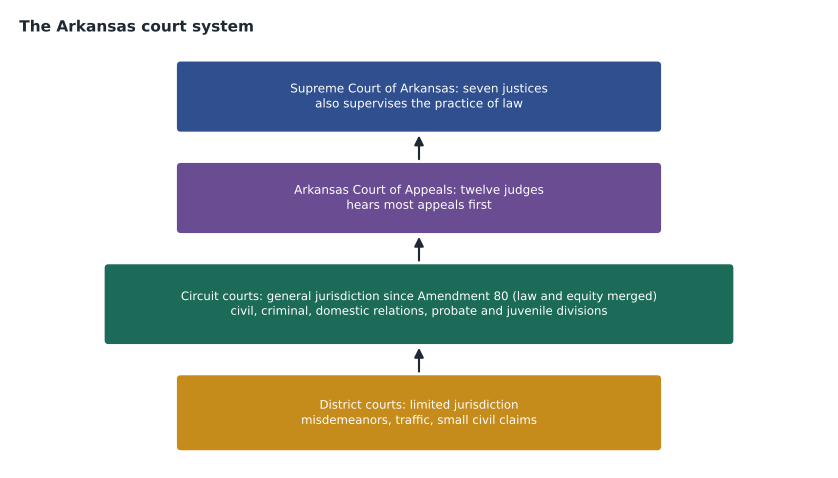
Arkansas reorganized its trial courts through Amendment 80 to the Arkansas Constitution, approved by voters in 2000 and effective in 2001. Before Amendment 80, Arkansas kept separate courts of law and courts of equity, called chancery courts, a division that most states had abandoned long before. Amendment 80 merged them into a single trial court of general jurisdiction, the circuit court, and gave the supreme court power to organize circuit courts into divisions. Circuit courts today hear civil cases, criminal felony cases, domestic relations, probate and juvenile matters, usually through specialized divisions within each judicial circuit.
Below the circuit courts are the district courts, courts of limited jurisdiction that grew out of the old municipal and county courts. District courts hear misdemeanors, traffic cases, preliminary matters in felonies, small civil claims and landlord-tenant cases within their limits, and many have small claims divisions where parties may appear without lawyers. Decisions of district courts can be appealed to the circuit court, which usually hears the case anew.
At the top are two appellate courts. The Supreme Court of Arkansas has seven justices, elected statewide in nonpartisan elections to eight-year terms. It hears certain appeals directly, including cases involving the interpretation of the constitution, death penalty and life imprisonment cases, and attorney discipline, and it may take any appeal it chooses. It also supervises the practice of law, including bar admission. The Arkansas Court of Appeals has twelve judges elected from districts. It hears most appeals in the first instance, and the supreme court may review its decisions.
Arkansas also has federal courts: the United States District Courts for the Eastern and Western Districts of Arkansas, whose appeals go to the United States Court of Appeals for the Eighth Circuit. Caleb's firm, in Fayetteville, files most federal cases in the Western District.
The Arkansas Rules of Civil Procedure
Civil cases in Arkansas circuit courts are governed by the Arkansas Rules of Civil Procedure, which the supreme court adopted in 1979, modeled on the Federal Rules of Civil Procedure. A lawyer who knows the federal rules will recognize most of the structure: a complaint and answer, service of process under Rule 4, motions to dismiss under Rule 12, joinder, discovery, summary judgment under Rule 56 and trial. But Arkansas did not adopt every federal change, and several differences matter in practice.
Pleading is one. Arkansas requires fact pleading. Rule 8 calls for a statement of facts showing that the pleader is entitled to relief, and Arkansas courts have long read that to require facts rather than conclusions. That differs in wording and history from the federal plausibility standard of Bell Atlantic Corp. v. Twombly and Ashcroft v. Iqbal, which Arkansas courts do not follow as such. A complaint that would survive in federal court can be dismissed in Arkansas state court if it states conclusions instead of facts.
Voluntary dismissal is another. Under Arkansas Rule 41(a), a plaintiff may take a voluntary nonsuit, an absolute right to dismiss the action without prejudice, at any time before the case is finally submitted to the jury or to the court. That right is far broader than the federal rule, which allows dismissal without a court order only before the defendant answers or moves for summary judgment. Paired with Arkansas's savings statute, Ark. Code Ann. section 16-56-126, which generally gives a plaintiff one year after a nonsuit to refile even if the limitations period has run, the nonsuit gives Arkansas plaintiffs a strategic tool that federal plaintiffs lack. A second voluntary dismissal of the same claim, however, generally operates as a judgment on the merits.
| Issue | Federal rule | Arkansas rule |
|---|---|---|
| Pleading standard | Plausibility (Twombly and Iqbal) | Fact pleading under Rule 8 |
| Voluntary dismissal | Without order only before answer or summary judgment motion | Nonsuit as of right before final submission (Rule 41(a)) |
| Refiling after dismissal | Depends on limitations; no general savings statute | Savings statute generally allows one year after a nonsuit |
| Court structure | District courts and courts of appeals | Circuit courts (merged law and equity under Amendment 80) |
Service of process gets particular attention from Arkansas courts. Rule 4 sets the methods of service and a deadline for completing it after the complaint is filed, which the court may extend on a motion made within that period. Arkansas courts have repeatedly held that statutes and rules on service are strictly construed and that strict compliance is required; a defective service can mean dismissal even if the defendant actually received the papers. Caleb's first task on the feed case is to calendar the service deadline and check the exact method for serving the defendant, a corporation, through its registered agent.
Limitations periods
Arkansas statutes of limitations differ from claim to claim. Most general tort claims, including negligence, must be brought within three years under Ark. Code Ann. section 16-56-105. Actions on written contracts generally have five years under section 16-56-111, while oral contracts fall under the three-year statute. Medical injury claims against health care providers generally have two years under section 16-114-203, with special rules on discovery and minors. Wrongful death actions generally have three years under section 16-62-102. Claims under the Uniform Commercial Code for breach of a contract for the sale of goods have their own four-year period. Each of these has exceptions, and a new lawyer should read the statute for every claim rather than rely on a summary.
Worked problem
Calendaring the feed case
The poultry grower signed a written supply contract in January 2023; the supplier delivered contaminated feed in March 2024; the grower's flock was lost in April 2024. The firm files in September 2026. Which periods matter?
Show solution
- A claim for breach of a contract for the sale of goods falls under the UCC's four-year statute, running in general from the breach.
- A breach in March 2024 gives until about March 2028 under that period.
- A negligence claim, if the facts support one, generally has three years under section 16-56-105, running to about March or April 2027.
- If the firm later took a nonsuit, the savings statute generally would give one year to refile, but a second nonsuit would generally bar the claim.
Answer: The firm is within the periods for both theories; calendar the earliest one, the tort period, and the service deadline.
Appeals
In civil cases, a party who wants to appeal must file a notice of appeal within thirty days after entry of the judgment, under the Arkansas Rules of Appellate Procedure for civil cases. Timely posttrial motions can extend that time, but the rules on extension are technical. Most appeals go first to the Court of Appeals, and the supreme court may take cases on review or directly. Arkansas appellate courts require that issues be preserved by a timely objection or ruling below; a point raised for the first time on appeal generally will not be considered.
Arkansas Rules of Evidence
The Arkansas Rules of Evidence, based on the Uniform Rules of Evidence, follow the Federal Rules of Evidence in structure and in most content. Hearsay, its exceptions, relevance and character evidence work much as they do under the federal rules. As with procedure, Arkansas did not adopt every later federal amendment, so a lawyer should check the Arkansas rule, not the federal one, before trial.
Why procedure matters to new lawyers
Marchetti ends with a warning she gives every new lawyer. Missed deadlines and defective service are among the most common sources of malpractice claims and disciplinary complaints. Procedure is unforgiving: an excellent case can be lost because service was made on the wrong person or a notice of appeal was filed a day late. The Arkansas Rules of Professional Conduct require diligence, and the most basic form of diligence is a reliable calendar.
Common mistakes
MistakeArkansas still has separate chancery courts.
InsteadAmendment 80 merged law and equity into circuit courts in 2001.
MistakeArkansas follows the federal plausibility pleading standard.
InsteadArkansas requires fact pleading under its Rule 8.
MistakeA plaintiff can nonsuit and refile as often as she likes.
InsteadA nonsuit is as of right before final submission, and the savings statute generally gives a year to refile, but a second voluntary dismissal generally operates as an adjudication on the merits.
MistakeEvery Arkansas tort claim has a three-year limit.
InsteadMany do, but medical injury claims generally have two years, written contracts five, and other claims their own periods.
Discovery and pretrial practice
Discovery in Arkansas circuit courts follows the familiar federal pattern: interrogatories, requests for production, requests for admission and depositions, with the scope of discovery covering matters relevant to the claims and defenses and not privileged. Arkansas lawyers should read the Arkansas rules rather than assume federal practice, because Arkansas did not adopt every federal amendment, including some of the federal changes on proportionality and initial disclosures. Local practice also varies among circuits, and many judges issue scheduling orders that set the deadlines for discovery, expert disclosures and dispositive motions.
Summary judgment in Arkansas is governed by Rule 56. The moving party must show that there is no genuine issue of material fact and that it is entitled to judgment as a matter of law, and Arkansas courts view the evidence in the light most favorable to the party resisting the motion. Arkansas appellate courts have often described summary judgment as an extreme remedy, appropriate only when it is clear that there is no issue of fact to be litigated. A new lawyer should not assume that a motion likely to succeed in federal court will succeed in an Arkansas circuit court.
Juries and verdicts
Arkansas guarantees the right to a jury trial in civil cases as it existed at the adoption of the constitution, and civil juries consist of twelve members. In civil cases, a verdict may be returned by nine or more jurors rather than a unanimous jury. Criminal verdicts must be unanimous. Arkansas juries in criminal cases also play a role in sentencing in many cases, a feature that surprises lawyers from states where the judge alone sentences.
District court practice for new lawyers
Many new Arkansas lawyers try their first cases in district court, which handles misdemeanors, traffic offenses, small civil claims and landlord-tenant matters within its limits. Procedure there is simpler, and the small claims division allows parties to appear without lawyers; lawyers generally may not appear for parties in small claims, so a client with a larger or more complex claim belongs in the civil division or in circuit court. Because a party dissatisfied with a district court judgment can usually appeal to circuit court for a trial anew, the district court is often the first, not the last, stage of a dispute.
A calendar habit
Marchetti gives Caleb a last procedural habit. For every case, he should keep a single calendar entry for each deadline, with the rule or statute that creates it written in the entry: service under Rule 4, the answer under Rule 12, discovery cutoffs in the scheduling order, the limitations period, and thirty days for the notice of appeal. He should calendar a reminder well before each deadline as well as the deadline itself. Most procedural disasters come from a deadline nobody wrote down.
Criminal procedure in brief
Criminal cases in Arkansas follow the Arkansas Rules of Criminal Procedure. Felonies are prosecuted in circuit court, usually by information filed by the prosecuting attorney rather than by grand jury indictment, and misdemeanors in district court. Arkansas's speedy trial rule requires, in general, that a defendant be brought to trial within twelve months of arrest or charge, excluding periods of delay the rule allows, and a violation results in dismissal. Juries in Arkansas felony cases determine guilt and, in many cases, recommend the sentence within the statutory range. A new lawyer who takes court-appointed or public defender work will meet these rules immediately.
Summary and key terms
- Amendment 80 (2000, effective 2001) merged law and equity into circuit courts; district courts hear limited matters; the Supreme Court of Arkansas has seven justices and the Court of Appeals twelve judges.
- The Arkansas Rules of Civil Procedure follow the federal rules in structure but require fact pleading.
- Rule 41(a) gives an absolute right to nonsuit before final submission; the savings statute generally allows one year to refile.
- Service rules are strictly construed; general tort claims usually have three years, written contracts five, medical injury two.
- A civil notice of appeal is due within thirty days after entry of judgment.
- Amendment 80
- The 2000 amendment that merged Arkansas courts of law and equity into circuit courts.
- Circuit court
- Arkansas's trial court of general jurisdiction, organized into divisions.
- Fact pleading
- Arkansas's requirement that a complaint state facts showing entitlement to relief.
- Voluntary nonsuit
- A plaintiff's right under Arkansas Rule 41(a) to dismiss without prejudice before final submission.
- Savings statute
- Ark. Code Ann. section 16-56-126, which generally gives one year to refile after a nonsuit.
Lesson quiz · 5 questions
Score 60% or more to complete this lesson.
Create a free account to save your progress, take quizzes and earn a certificate.