
BAR-203 · Lesson 6 of 12 · 16 min
The course on Arizona law
▶ Video coming soon A video version of this lesson is on the way.
Rafael has already registered for the Arizona Supreme Court's course on Arizona law, but he has not started it. 'It is six hours of video,' he says. 'I was going to do it the week after the exam.' Marchetti thinks that is a reasonable plan, but she wants him to understand what the course is, why Arizona requires it and how to use it. This lesson covers the course's legal basis, its format and content, and how a candidate can turn it into a useful set of Arizona rule notes for the first year of practice.
Why Arizona requires it
Arizona's bar exam tests general law. Through February 2027 it is the UBE, which tests the common-law and majority rules NCBE uses across the country, and from July 2027 it is NextGen, which does the same. Neither tests Arizona law. Rather than add a state-law exam, as some jurisdictions have done, Arizona requires every new lawyer to complete a short course on Arizona law before admission. Rule 34(i) provides that applicants under Rule 34(e) (admission on motion), Rule 34(g) (score transfer) and Rule 35 (admission by examination) must complete an Arizona law course whose content and delivery the court approves. In practice, that means every applicant, by every route.
The idea is not to test mastery but to make sure every new Arizona lawyer has at least been introduced to the places where Arizona law departs from what the bar exam tested, before handling a client's matter. A lawyer who learned the majority rule on joint and several liability for the MBE, for example, needs to know that Arizona has largely abolished it before advising an injured client.
Format and access
The course is delivered online through the Arizona Supreme Court's education services. Registration is open, with no time limit or seat limit, and uses an access code published by the court for admission on motion, UBE transfer and bar exam applicants. Exam applicants pay for it through the 185 dollar administrative fee for admission, which includes the course.
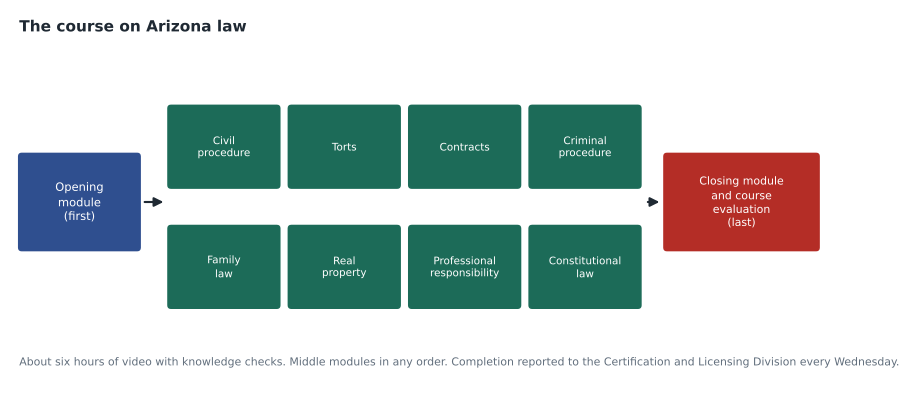
According to the court's course page, the course contains about six hours of video instruction, along with supplemental materials and knowledge checks. The opening and closing modules must be completed in order, while the other curriculum modules may be taken in any order. The course is not graded in the sense of a pass or fail exam, but completion requires finishing all modules and the final course evaluation. Completion reports are sent to the Certification and Licensing Division every Wednesday, so an applicant who finishes late in the week should expect a short delay before the division records completion.
The court's guidance for exam applicants says the course is required before admission, not before taking the exam. An applicant may complete it at any point, but admission cannot be finalized until it is done. Score transfer and motion applicants should plan to finish it while their character review is pending, so that it does not become the last item holding up admission.
What the course covers
The court lists eight subject areas, each with a focus on Arizona law: civil procedure, torts, contracts, criminal procedure, family law, real property, professional responsibility and constitutional law. The list tracks the bar exam subjects, so a new lawyer can connect each Arizona rule to the general rule already learned. The course's content is approved by the court and may change; the descriptions below are the topics this course recommends a candidate expect and look for, based on where Arizona law is most distinctive, not a transcript of the court's videos.
| Subject | Arizona topics worth watching for |
|---|---|
| Civil procedure | The Arizona Rules of Civil Procedure, broad initial disclosure duties, case tiers and limits on discovery, notice-of-claim rules for public entities |
| Torts | Pure comparative fault, several liability, nonparties at fault, the constitutional bar on damages caps |
| Contracts | Arizona's implied covenant of good faith and fair dealing, attorney fee awards in contract actions |
| Criminal procedure | Arizona Rules of Criminal Procedure, the Victims' Bill of Rights, the state constitution's search and seizure provision |
| Family law | Community property, equitable division without regard to fault, spousal maintenance, legal decision-making and parenting time, covenant marriage |
| Real property | Deeds of trust and trustee's sales, anti-deficiency protection, the recording statute, community property with right of survivorship |
| Professional responsibility | Arizona's Ethical Rules (Rule 42), alternative business structures, legal paraprofessionals |
| Constitutional law | The Arizona Constitution's declaration of rights, its anti-abrogation and anti-cap provisions, and the court's rulemaking power |
Using the course well
Marchetti's advice is to treat the course as the start of an Arizona practice notebook, not a box to tick. For each module, she suggests a one-page sheet with three columns: the general rule as the bar exam tests it, the Arizona rule, and the source (a statute, a rule of procedure or a leading case). 'In your first year, someone will ask you whether a client can recover if she was mostly at fault, or whether the bank can sue for the rest of the mortgage after a trustee's sale,' she says. 'You want a sheet you wrote yourself that sends you to the right statute in thirty seconds.'
She also tells him not to start the course during the last six weeks before the exam. The course teaches Arizona rules that differ from the rules the UBE tests, and mixing them during final review invites errors. 'Finish the MBE first. Learn the Arizona exceptions after. Your brain can hold both, but not in the same week.'
For candidates who will sit NextGen in July 2027 or later, the same advice applies. NextGen tests general law, not Arizona law, and the course remains a separate admission requirement after the exam.
A note on Arizona's other required courses
The course on Arizona law is an admission requirement. After admission, new lawyers face separate requirements under the State Bar's rules, including continuing legal education and a professionalism course for new admittees. Lesson 11 describes them. Candidates sometimes confuse the two and assume the State Bar's course satisfies the admission requirement, or the reverse. They are different, run by different bodies, at different times.
Worked problem
Planning Rafael's course time
The February 2027 exam is on February 23 and 24. Rafael's legal aid office wants him sworn in as early as possible after results. When should he take the course on Arizona law?
Show solution
- The course is required before admission but not before the exam.
- Taking it during the last weeks before the exam risks confusing Arizona and UBE rules.
- Completion is reported to the division weekly, so finishing well before results avoids delay.
- He can complete six hours over the two weeks after the exam and finish the evaluation by mid-March.
Answer: Rafael schedules the course for the first two weeks of March, finishes the evaluation by March 15 and confirms that his completion appears in the next weekly report, well before results are expected.
Common mistakes
MistakeThe course on Arizona law is only for exam applicants.
InsteadRule 34(i) requires it for exam, score transfer and motion applicants.
MistakeI must finish the course before I can sit the exam.
InsteadIt must be completed before admission, not before the exam.
MistakeFinishing the last video is enough.
InsteadCompletion requires the final course evaluation; reports go to the division weekly.
MistakeThe course will teach me the law tested on the exam.
InsteadThe exam tests general law; the course teaches where Arizona law differs.
Building the notebook: a worked page
Marchetti shows Rafael what a good notebook page looks like, using torts as the example. At the top: 'Allocation of fault in Arizona.' The first column states the MBE default: pure comparative negligence and joint and several liability unless the question says otherwise. The second column states the Arizona rule: pure comparative fault under A.R.S. 12-2505, with no right to comparative negligence for a claimant who acted intentionally, willfully or wantonly, and a separate impairment defense under A.R.S. 12-711; several liability under A.R.S. 12-2506, with exceptions for acting in concert, vicarious liability and certain federal and hazardous waste claims; allocation of fault to nonparties after notice under Arizona Rule 26(b)(5). The third column gives the sources and a note to read the current text of each statute before advising a client. At the bottom, a box for practice tips: identify every possible nonparty at fault early, decide whether to sue them before the limitation period runs, and remember that the jury decides whether to apply a plaintiff's fault.
He does the same for each of the eight modules, and by the end he has eight pages that fit in a binder. 'In your first month,' Marchetti says, 'you will look at those pages more than any treatise.'
Why not a state-law exam?
Some jurisdictions test their own law on the bar exam. Alabama is adding a three-hour state-law essay to its NextGen exam, Texas has its own law component, and Florida, Virginia and others test state law directly. Arizona has chosen a lighter approach: a required course with knowledge checks but no pass or fail exam. The court's choice reflects a judgment that the bar exam should test minimum competence in general law and lawyering skills, and that state-specific knowledge is better learned through instruction close to the start of practice and through continuing education afterward. It also keeps Arizona scores fully portable: a candidate who passes in Arizona has nothing extra to explain when transferring a score to another UBE or NextGen jurisdiction, and a candidate transferring in has only the course to complete.
The tradeoff is that the course does not prove mastery. A new Arizona lawyer may complete it and still have only a passing familiarity with Arizona's rules. That makes the notebook, mentoring and early continuing education more important, and it is one reason the State Bar requires new lawyers to complete a professionalism course and offers practical courses for new lawyers.
Common questions
Can an applicant take the course before applying? Yes. Registration is open, and some candidates complete it during law school or while waiting for results. Does completion expire? The court's materials do not describe an expiration, but an applicant who completed it years before applying should confirm with the admissions office that the completion will be accepted. Is the course available in formats for applicants with disabilities? Applicants who need accommodations to complete an online video course should contact the court's education services or the admissions office. Does completion count for continuing legal education? The course is an admission requirement, not a State Bar CLE program, and should not be assumed to count toward annual CLE hours unless the State Bar says so.
Using the course with Lessons 7 to 10
The next four lessons of this course cover the same territory the court's course does, organized around the questions new Arizona lawyers are most often asked. They are not a substitute for the court's course, which remains a separate admission requirement. But reading them before or alongside the court's course should make its six hours more productive, and the notebook pages Rafael builds can draw on both.
A notebook page for real property
Rafael's second notebook page covers real property, and it shows how the course connects to later lessons. The first column records what the MBE tests: mortgages foreclosed judicially, with deficiency judgments available; recording acts of the race, notice or race-notice type, as a question specifies; and common-law concurrent estates. The second column records the Arizona rules: deeds of trust and nonjudicial trustee's sales; anti-deficiency protection under A.R.S. 33-729(A) and 33-814(G) for qualifying homes; a ninety-day deadline and a fair-market-value measure for deficiency actions where they are allowed; the recording statute in A.R.S. 33-412; and community property with right of survivorship under A.R.S. 33-431. The third column lists the statutes and a reminder to check the property's acreage and use before advising a homeowner in default.
His third page covers family law, and it is the longest, because the clinic sees more family cases than any other kind. It lists the community property statutes, the division statute, the spousal maintenance statute and guidelines, the legal decision-making statutes, the child support guidelines and the covenant marriage statutes, each with a one-line summary. 'This is the page you will wear out,' Marchetti predicts. 'Laminate it.'
By the time Rafael finishes all eight pages, he has a document that serves two purposes. It satisfies his own need to understand the course, and it gives him a fast reference for the questions clients ask most.
What the course is not
The course is not a substitute for reading the statutes, rules and cases themselves, and it is not continuing legal education. It is an orientation: a structured introduction that points new lawyers to the places where Arizona departs from what they studied. Used that way, with a notebook and a habit of checking sources, it does its job well.
Rafael finishes the session by registering a reminder in his calendar for March 1, the first weekday after the exam, with a single line: start the Arizona course, one module a day.
Summary and key terms
- Rule 34(i) requires every applicant, by every route, to complete the court's course on Arizona law before admission.
- The course is online, open enrollment, about six hours of video with knowledge checks, opening and closing modules in order.
- It covers eight subjects with an Arizona focus, matching the bar exam subjects.
- Completion requires the final evaluation; the division receives reports every Wednesday.
- Take it after final exam review and use it to build an Arizona practice notebook.
- Rule 34(i)
- The provision requiring completion of an approved course on Arizona law before admission.
- Course evaluation
- The final step required to be recorded as having completed the course.
- Certification and Licensing Division
- The court division that receives completion reports and handles admissions.
- Jurisdiction-specific component
- A requirement a jurisdiction adds to a uniform exam to address its own law.
- Practice notebook
- A candidate's own summary of Arizona rules and sources for early practice.
Lesson quiz · 5 questions
Score 60% or more to complete this lesson.
Create a free account to save your progress, take quizzes and earn a certificate.