
BAR-203 · Lesson 10 of 12 · 15 min
Arizona wills, probate, criminal law and the Ethical Rules
▶ Video coming soon A video version of this lesson is on the way.
The last substantive lesson covers three areas that Rafael meets in practice in very different ways: the estates of clients who die, often without a lawyer-drafted will; the criminal cases that his clients' family members face; and the rules that govern his own conduct as a lawyer. Each has features that differ from the general law tested on the bar exam, and Arizona's Ethical Rules have changed more in the last six years than those of almost any other state.
Wills
Arizona adopted the Uniform Probate Code, and its wills statutes in A.R.S. title 14 follow it closely. An attested will must be in writing, signed by the testator or by someone in the testator's conscious presence and at the testator's direction, and signed by at least two people who witnessed either the signing or the testator's acknowledgment of the signature or the will, under A.R.S. section 14-2502. A will can be made self-proved by an affidavit before a notary, which simplifies probate.
Arizona also recognizes holographic wills. Under A.R.S. section 14-2503, a will that does not meet the witnessing requirements is valid as a holographic will, whether or not witnessed, if the signature and the material provisions are in the testator's handwriting. Printed form wills partly filled in by hand raise frequent disputes about whether the handwritten words alone make sense as a will. A lawyer handling an estate where the only document is a handwritten note should evaluate it under this statute rather than assume it is invalid.
Arizona law also allows a writing outside the will to dispose of tangible personal property, such as jewelry or furniture, if the will refers to it and the writing is signed and describes the items and recipients with reasonable certainty. Such lists are common in Arizona estate plans.
Intestacy and the spouse
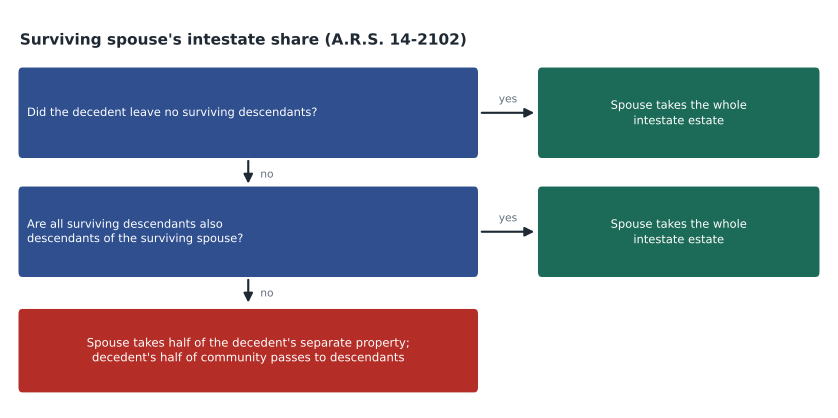
Arizona's intestacy rules reflect its community property system. Under A.R.S. section 14-2102, if a decedent dies without a will, the surviving spouse takes the entire intestate estate if there are no surviving descendants, or if all of the decedent's surviving descendants are also descendants of the surviving spouse. If the decedent has one or more surviving descendants who are not descendants of the surviving spouse, the surviving spouse takes one-half of the decedent's separate property and no interest in the one-half of community property that belonged to the decedent, which passes to the descendants. Unlike common-law states, Arizona has no elective share for a surviving spouse; community property gives the surviving spouse ownership of his or her own half without any election.
Each spouse may dispose of only his or her half of the community property by will. A spouse who leaves 'all of my property' to children from a prior marriage leaves them the decedent's separate property and half of the community, not the surviving spouse's half.
Probate
Arizona probate is relatively informal. Most estates are administered through informal probate, in which a personal representative is appointed by the probate registrar without a court hearing, and the estate is administered without continuing court supervision unless an interested person asks for it. Formal proceedings before a judge are available when a will is contested or questions arise. Small estates may avoid probate altogether: Arizona allows collection of personal property and transfer of real property by affidavit when the estate falls below statutory value limits, after a waiting period. Property held as community property with right of survivorship, in joint tenancy, in a living trust, or with a beneficiary designation passes outside probate. Arizona has adopted the Uniform Trust Code as the Arizona Trust Code, which governs the creation and administration of trusts, and revocable living trusts are widely used in Arizona estate planning.
Criminal law: features worth knowing
Arizona's criminal code, A.R.S. title 13, classifies felonies from class 1 (first degree and second degree murder) to class 6, and misdemeanors from class 1 to class 3. Sentencing depends heavily on whether an offense is classified as dangerous, involving a deadly weapon or dangerous instrument or the infliction of serious physical injury, and on prior convictions. Since 1994 Arizona has followed truth-in-sentencing principles: people sentenced to prison generally must serve at least 85 percent of the sentence before release.
Two features differ markedly from the general law tested on the MBE. First, Arizona does not use the traditional insanity verdict. Under A.R.S. section 13-502, a defendant may be found guilty except insane if, at the time of the offense, the defendant was afflicted with a mental disease or defect of such severity that the defendant did not know the criminal act was wrong. A person found guilty except insane is committed to a secure facility under the supervision of a review board rather than acquitted. Second, Arizona's justification statutes in A.R.S. title 13, chapter 4 provide that a person has no duty to retreat before using force in self-defense, if the person is in a place where he or she has a right to be and is not engaged in an unlawful act, and they place on the state the burden of proving beyond a reasonable doubt that the defendant did not act with justification once the issue is raised.
Arizona's Constitution adds two features. The Victims' Bill of Rights, Article 2, section 2.1, gives crime victims the right to be treated with fairness and dignity, to be present and heard at critical stages, to refuse interviews and depositions requested by the defense, and to receive restitution, among other rights. Prosecutors and courts must honor these rights, and defense lawyers must plan around them. And Article 2, section 8's protection of private affairs and the home has sometimes been read more broadly than the Fourth Amendment, particularly for warrantless entry into homes.
Arizona's Ethical Rules
Arizona's rules of professional conduct are the Ethical Rules, or ERs, found in Rule 42 of the Rules of the Supreme Court. They are based on the ABA Model Rules, and on the MPRE the ABA Model Rules govern, so most of what candidates learned for the MPRE carries over. But Arizona has made two significant departures.
The first is the elimination of ER 5.4. On August 27, 2020, the Arizona Supreme Court unanimously voted to eliminate the rule that barred nonlawyer ownership of law firms and fee sharing between lawyers and nonlawyers, effective January 1, 2021. In its place, the court created a licensing system for alternative business structures, or ABSs, under Rule 31.1 and section 7-209 of the Arizona Code of Judicial Administration. An ABS is an entity in which nonlawyers have an economic interest or decision-making authority and that provides legal services. Each ABS must be licensed and must designate a compliance lawyer, an Arizona lawyer responsible for the entity's compliance with the Ethical Rules and the code. By the end of 2024 Arizona had 114 active licensed ABSs, most of them traditional law firms that wanted outside investment or nonlawyer partners, according to the ABS committee's annual report.
Lawyers who work in an ABS remain bound by the Ethical Rules, including the duties of independent professional judgment, confidentiality and avoiding conflicts. The State Bar has disciplined ABS firms and compliance lawyers for violations such as improper fee agreements, advertising, inadequate supervision and unauthorized practice. A new lawyer offered a job at an ABS should understand who owns it and how the compliance lawyer supervises the legal work.
The second departure is the creation of legal paraprofessionals, discussed in Lesson 11. Their conduct is governed by their own code in section 7-210 of the Code of Judicial Administration, and lawyers who supervise or work alongside them should know its limits.
Arizona also differs from the Model Rules in smaller ways, including in its version of the confidentiality rule. ER 1.6 in Arizona goes further than the ABA model in at least one respect by requiring, not merely permitting, disclosure of information the lawyer reasonably believes necessary to prevent a client from committing a criminal act likely to result in death or substantial bodily harm. Candidates who practice in Arizona should read the Arizona text of each ER rather than assume it matches the model rule they studied.
Worked problem
Reading a handwritten will
After Dolores dies, her son finds a sheet of notebook paper in her handwriting that says: "I leave my house on Palo Verde Street to my daughter Rosa and everything else to my two sons equally. Dolores Ruiz, June 3, 2024." No one witnessed it. Dolores was married to Frank, Rosa's stepfather, and the house was bought during the marriage with both spouses' earnings. What should the estate's lawyer consider?
Show solution
- The note may be a valid holographic will under A.R.S. 14-2503 if the signature and material provisions are in Dolores's handwriting.
- The house was acquired during marriage with earnings, so it is presumptively community property; Dolores could dispose only of her half.
- Frank keeps his half of the community property in any event; Rosa may take Dolores's half of the house under the will, unless title was held as community property with right of survivorship.
- The lawyer should check the deed: survivorship title would pass the house to Frank outside probate.
Answer: The note is likely a valid holographic will, but it can pass only Dolores's separate property and her half of the community. The deed may control the house entirely.
Common mistakes
MistakeAn unwitnessed handwritten will is invalid in Arizona.
InsteadA holographic will is valid if the signature and material provisions are in the testator's handwriting.
MistakeAn Arizona surviving spouse can claim an elective share.
InsteadArizona has no elective share; the spouse owns half of the community property.
MistakeArizona uses the not guilty by reason of insanity verdict.
InsteadArizona uses guilty except insane under A.R.S. 13-502.
MistakeArizona lawyers may not share fees with nonlawyers.
InsteadArizona eliminated ER 5.4 effective January 1, 2021, and licenses alternative business structures.
Trusts and powers of attorney in Arizona practice
Revocable living trusts are common in Arizona estate planning, both to avoid probate and to manage property during incapacity. Under the Arizona Trust Code, a trust is created by a settlor with capacity who indicates an intent to create it, names a definite beneficiary (with exceptions such as charitable trusts and trusts for pets) and gives the trustee duties to perform. A revocable trust can be amended or revoked by the settlor, and the Code provides that a trust is revocable unless its terms say otherwise, for trusts created after the Code took effect. Trustees owe duties of loyalty, prudence and impartiality and must keep beneficiaries reasonably informed. Arizona also recognizes durable financial powers of attorney and health care powers of attorney, which must be signed and witnessed or notarized as Arizona statutes require.
Lawyers who prepare trusts for married clients must address community property. A couple can transfer community property into a joint revocable trust and keep its community character, which matters for tax purposes and for division if the marriage ends. Trust documents should say clearly which property is community and which is separate.
Criminal procedure features
Arizona's Rules of Criminal Procedure, substantially restyled effective 2018, govern criminal cases. Several features differ from federal practice. Arizona allows a defendant to depose witnesses in some circumstances, but the Victims' Bill of Rights lets crime victims refuse a defense interview or deposition. Arizona's speedy trial rule, Rule 8, sets time limits from arraignment to trial depending on whether the defendant is in custody, subject to excluded periods. And grand juries are used for many felony charges, though prosecutors may also proceed by complaint followed by a preliminary hearing.
Professional responsibility in the clinic
Rafael sees the Ethical Rules in action every day. His office supervises law students under the Supreme Court's rule for certified limited practice, works with a licensed legal paraprofessional on family law matters, and receives referrals from an alternative business structure that offers online document services. Each relationship has its own rules: student practitioners must be supervised by a lawyer under Rule 38; the paraprofessional may act only within the scope of her license; and fee-sharing or referral arrangements with an ABS must comply with the ABS's license terms and the Ethical Rules. 'Arizona lets more kinds of people and businesses deliver legal services than any other state,' Marchetti says. 'That makes it more important, not less, to know whose rules apply to whom.'
Putting the three areas together
Marchetti closes with a scenario that pulls the lesson together. A client's father has died leaving a handwritten will; the client's brother has been charged with a crime and wants advice about the victim's rights in his case; and the client asks whether an online legal document company she found is allowed to help her with probate forms. Rafael can now answer each question in outline: evaluate the holographic will under A.R.S. 14-2503 and the community property rules; explain the Victims' Bill of Rights and refer the brother to criminal counsel; and check whether the company is a licensed alternative business structure or a legal paraprofessional practice, or neither.
Each answer starts from an Arizona source, which is the habit this lesson is meant to build.
Summary and key terms
- Arizona follows the Uniform Probate Code: attested wills need two witnesses, and holographic wills are valid if the signature and material provisions are handwritten.
- Intestate spouses take everything unless the decedent has descendants who are not the spouse's; there is no elective share.
- Most estates use informal probate; small estates may pass by affidavit, and survivorship title avoids probate.
- Arizona uses guilty except insane, has no duty to retreat, and protects victims' rights in its constitution.
- Arizona's Ethical Rules are in Rule 42; ER 5.4 was eliminated in favor of licensed alternative business structures.
- Holographic will
- A will whose signature and material provisions are in the testator's handwriting.
- Informal probate
- Appointment of a personal representative by the registrar without a hearing.
- Guilty except insane
- Arizona's verdict for defendants who did not know their act was wrong because of severe mental disease.
- Alternative business structure
- A licensed entity with nonlawyer owners or managers that provides legal services.
- Compliance lawyer
- The Arizona lawyer responsible for an ABS's compliance with the rules.
Lesson quiz · 5 questions
Score 60% or more to complete this lesson.
Create a free account to save your progress, take quizzes and earn a certificate.