
BAR-203 · Lesson 4 of 12 · 15 min
The Arizona bar exam: format, scoring and passing score
▶ Video coming soon A video version of this lesson is on the way.
Three months before the exam, Rafael asks Marchetti for a precise picture of the two days. 'I know it is the UBE,' he says. 'But what actually happens, and how does a stack of answers become a number?' This lesson answers both questions for the legacy UBE that Arizona gives for the last time in February 2027. Lesson 5 covers the NextGen exam that replaces it in July 2027.
Two days, three tests
The Arizona bar exam through February 2027 is the Uniform Bar Examination, prepared by NCBE and administered by the Committee on Examinations. It has three parts. The Multistate Essay Examination (MEE) is six 30-minute essay questions, three hours in all. The Multistate Performance Test (MPT) is two 90-minute tasks in which the examinee works from a file of facts and a library of law to produce a lawyer's document, such as an objective memo, a persuasive brief or a letter. The Multistate Bar Examination (MBE) is 200 multiple-choice questions over six hours, in two three-hour sessions of 100 questions each. Of the 200 MBE questions, 175 are scored and 25 are unscored pretest items that are not labeled, so every question should be treated as if it counts.
Like other UBE jurisdictions, Arizona gives the written tests, the MPT and MEE, on the Tuesday and the MBE on the Wednesday of the last full week of February and July. Laptops may be used for the written portion with the approved exam software, and the admissions office's instructions say that laptops are allowed in the building on the first, written day only. Each examinee receives an admission ticket about a month before the exam that must be brought to the test site with a valid government-issued photo ID.
The MEE's subject list changed in July 2026. NCBE removed conflict of laws, family law, trusts and estates, and secured transactions from the MEE, leaving business associations and the seven MBE subjects: civil procedure, constitutional law, contracts, criminal law and procedure, evidence, real property and torts. Family law and trusts and estates may still appear on the MPT through February 2028, with the law supplied in the library. Rafael's February 2027 exam will use the reduced list. This program's BAR-120 course covers the change in detail.
How the score is built
A UBE score is built in three stages. First, NCBE scores the MBE and converts the raw number of correct answers into a scaled score through equating, a statistical process that adjusts for differences in difficulty from one exam to the next. Second, graders working for the Committee on Examinations score the MEE and MPT answers using NCBE's grading materials. Graders rank answers against each other, so written scores are relative within the group taking that exam. Third, the raw written scores are scaled to the MBE, which places them on the same scale using the mean and spread of the group's MBE scores. That step makes written scores comparable across administrations even though the graders and questions change.
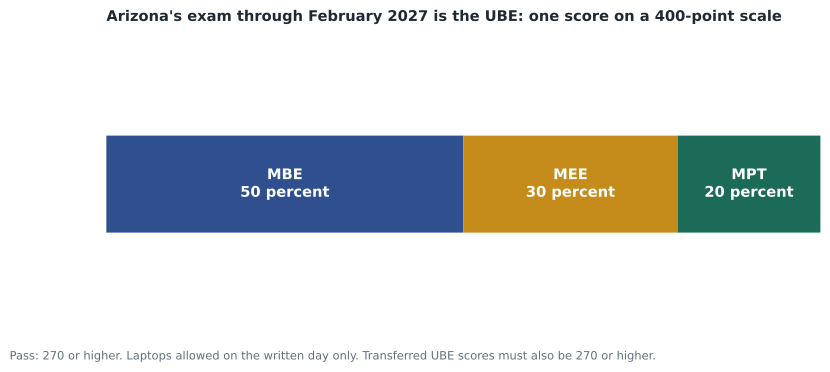
The scaled MBE score is weighted at 50 percent and the scaled written score at 50 percent, of which the MEE contributes 30 points and the MPT 20 points out of every 100. The total UBE score is reported on a 400-point scale. Arizona's passing score is 270. That is at the top of the range: UBE jurisdictions set their passing scores between 260 and 270, and Arizona shares the top figure with a few others, including Alaska. The court reached 270 by lowering Arizona's passing score from a higher figure, a change the University of Arizona's bar success office reported at the time.
Because written scores are scaled to the MBE, an examinee can pass with uneven performance, such as a modest MBE and strong essays, as long as the total reaches 270. There is no separate minimum for any one part. In practical terms, 270 corresponds to an average of 135 on the 200-point scale for each half. Many candidates aim for a scaled MBE of about 140 so that a middling written score still leaves them over the line.
| Component | Questions | Time | Weight | Who scores it |
|---|---|---|---|---|
| MEE | 6 essays | 3 hours (30 minutes each) | 30 percent | Arizona graders using NCBE materials |
| MPT | 2 tasks | 3 hours (90 minutes each) | 20 percent | Arizona graders using NCBE materials |
| MBE | 200 (175 scored) | 6 hours in two sessions | 50 percent | NCBE (machine scored and equated) |
What 270 means for portability
Arizona's high passing score cuts both ways. For someone who passes in Arizona, the score is high enough to transfer to every other UBE jurisdiction that accepts transfers, as long as the transfer is made within that jurisdiction's time limit. For someone who earned a UBE score elsewhere and wants to transfer in, Arizona requires a score of 270 or more; a 266 that admitted the examinee in another state will not do. Score transfer into Arizona also requires that the score have been earned within five years before admission in Arizona and in no more than four attempts. Lesson 11 covers transfer in detail.
Arizona's high score also explains one of its newer programs. The Arizona Lawyer Apprentice Program, created in 2024, allows examinees who score between 260 and 269, which is a passing score in many other jurisdictions, to be licensed to practice under supervision in public law offices or rural areas. It is not a second chance at the exam; it is a different route to practice. Lesson 11 explains how it works.
Worked problem
Reading Rafael's practice score
In a full simulated exam in December, Rafael scores 137 scaled on the MBE portion, and Marchetti estimates his written work at about 131 on the same scale. Would that total pass in Arizona?
Show solution
- Each half is worth half of a 400-point total, so the UBE total is roughly the scaled MBE score plus the scaled written score, each on its 200-point scale.
- 137 plus 131 gives a combined score of about 268.
- Arizona requires 270.
- A simulated estimate is only an estimate; written scores on the real exam are scaled to that group's MBE performance.
Answer: At about 268, Rafael is two points short in Arizona, though he would pass in a 260 or 266 jurisdiction. Marchetti targets his written score, where he loses the most points to unfinished MPT answers, and sets a goal of a 140 MBE.
Results
The Committee on Examinations releases results some weeks after the exam and publishes pass lists and statistics. Examinees receive their own scores, including the scaled MBE score and written scores. The breakdown is useful: a candidate who falls short can see whether the MBE or the written half was the bigger problem and which written questions dragged the score down. Applicants should check the admissions office's published materials for the current release schedule and for any procedure for reviewing written answers, since Arizona's rules on review and appeals are set by the court and the Committee.
For February 2027 examinees, a failing result has a special consequence: the next Arizona exam is the first NextGen exam in July 2027. A candidate who wants to stay on the legacy exam would have to sit a legacy UBE in another jurisdiction that still offers it, such as one of the jurisdictions whose first NextGen exam is in 2028, and then transfer a score of 270 or more to Arizona. That is possible but adds cost, travel and a second jurisdiction's rules. Most candidates will simply switch to NextGen preparation for July.
How the exam days run
Exam days are long and tightly controlled. Before the exam, the admissions office sends instructions on location, arrival times, identification and permitted and prohibited items. Expect security screening, assigned seating, and strict rules on watches, phones, food and paper. Laptop users must register, install and test the exam software before the deadline the office sets and bring a charged laptop on the written day. On the MBE day, the MBE is answered on paper or as NCBE and the Committee direct; follow the admission instructions exactly.
On Tuesday, the MPT and MEE fill the day: typically the two MPT tasks in one session and the six MEE questions in the other. On Wednesday, the MBE fills two three-hour sessions. Time management matters on both days. On the MBE the pace is 1.8 minutes per question. On the MEE it is 30 minutes per question. On the MPT it is 90 minutes per task, with roughly half of each task spent reading and organizing.
Studying for the Arizona UBE
Because the exam is the UBE, national bar review courses and NCBE's own study aids apply directly. There is nothing Arizona-specific to learn for the exam itself under the legacy format. The Arizona-specific learning comes in the course on Arizona law and in the substantive differences covered in Lessons 7 to 10, which matter for practice.
That creates a trap. Candidates who study Arizona law before the exam can confuse themselves. On the MBE and MEE, answer under the general rules that NCBE tests. In real property, for example, the MBE tests the common-law and majority rules on marital property and mortgages, not Arizona's community property statutes or its anti-deficiency rules. In torts, the MBE's default of pure comparative negligence happens to match Arizona, but its default of joint and several liability does not: NCBE's outline tells examinees to assume joint and several liability unless a question says otherwise, while Arizona has largely abolished it. An answer built on Arizona law can be wrong on the UBE.
Marchetti's study plan for Rafael follows the pattern this program uses for all UBE candidates: about ten weeks of full-time study, which for a working law clerk means a reduced schedule from early December; daily MBE practice building to more than 1,500 questions; at least two timed MEE essays and one MPT a week in the second half; and two full simulated exams. The BAR-110, BAR-111, BAR-120 and BAR-121 courses in this program cover the content and methods in detail.
Common mistakes
MistakeArizona adds its own state-law questions to the UBE.
InsteadThrough February 2027 the Arizona exam is the UBE alone; Arizona law comes in the online course.
MistakeA 266 from another UBE state will transfer to Arizona.
InsteadArizona requires 270 for transfer.
MistakeAnswer UBE questions using Arizona community property and anti-deficiency law.
InsteadThe UBE tests general and majority rules.
MistakeIf I fail in February, I can retake the same exam in July.
InsteadArizona's July 2027 exam is the NextGen exam.
What graders look for
Arizona's graders use NCBE's grading materials, which identify the issues each question raises and the analysis a strong answer should contain. Because grading is relative, a score depends on how an answer compares with the others in the same group. Answers that score well share several features: they identify the issues the question asks about and do not wander into others; they state rules accurately and concisely; they use the facts specifically, explaining why each fact matters; and they reach conclusions. Headings that track the call of the question help a grader find the analysis quickly. An answer that is organized, complete and confident, even if it misses a subtle point, usually scores better than a brilliant but disorganized one.
On the MPT, graders look first at whether the examinee completed the assigned task in the assigned format: an objective memo is not a persuasive brief, and a client letter must be written for a client, not a judge. They then look at whether the examinee extracted the rules from the library accurately, applied them to the facts in the file, and handled the details the task memo asked for. Most lost points on the MPT come from running out of time or from ignoring an instruction in the task memo.
Rafael's last ten weeks
Rafael's plan has to fit around a job. His legal aid office agrees to reduce his hours to twenty a week from December 14, and to give him the last two weeks before the exam off entirely. Marchetti builds a schedule around that: MBE practice every morning before work, building from 25 questions a day in December to 50 a day in late January; one timed MEE essay on each workday afternoon off and two on weekends; one MPT each weekend; and full simulated exams on January 16 and 17 and on February 6 and 7. Every missed MBE question goes into a miss log with the rule he got wrong and why, which he reviews each Sunday. 'You are not trying to answer more questions,' she tells him. 'You are trying to stop missing the same ones.'
Because February 2027 is Arizona's last legacy exam, Rafael has an extra reason to commit fully. A retake in July means learning a different exam's question types. Marchetti does not dwell on it. 'Prepare as if this is the only exam there is. For you, it is.'
If you are transferring a score in
Examinees who plan to sit the UBE in another jurisdiction and transfer the score to Arizona should keep Arizona's 270 in mind from the start. A candidate sitting in a 260 jurisdiction who scores 265 will be admitted there but cannot transfer to Arizona, and Arizona's apprentice program applies only to those who sat the Arizona exam. Candidates who know they will eventually practice in Arizona usually do best to sit in Arizona if they can, or to aim well above 270 elsewhere.
Summary and key terms
- Through February 2027 the Arizona exam is the UBE: MPT and MEE on Tuesday, MBE on Wednesday, at the end of February and July.
- Weights are MBE 50 percent, MEE 30 percent and MPT 20 percent; written scores are scaled to the MBE.
- Arizona's passing score of 270 is at the top of the UBE range of 260 to 270; it also governs score transfer into Arizona.
- February 2027 is the last legacy exam; a failure means a NextGen retake in July 2027 unless the candidate sits a legacy UBE elsewhere.
- Answer UBE questions under general rules, not Arizona law.
- Scaling
- Placing written scores on the MBE's scale using the group's MBE statistics.
- Equating
- NCBE's statistical adjustment of MBE scores for differences in difficulty across exams.
- Relative grading
- Grading essays by comparing answers within the group of examinees.
- Pretest questions
- Unscored, unlabeled MBE questions used to test items for future exams.
- Portability
- The ability to use a UBE score for admission in another jurisdiction.
Lesson quiz · 5 questions
Score 60% or more to complete this lesson.
Create a free account to save your progress, take quizzes and earn a certificate.