
BAR-203 · Lesson 1 of 12 · 14 min
Becoming a lawyer in Arizona
▶ Video coming soon A video version of this lesson is on the way.
Rafael Montoya joins Hollis Marchetti's study group in the late fall of 2026 with a deadline he cannot move. He finished law school in May 2026 at an Arizona law school, grew up in Yuma, and now works as a law clerk at a legal aid office in Tucson that handles housing, family and public benefits cases. He is registered for the February 2027 Arizona bar exam, which is also the last time Arizona will give the legacy Uniform Bar Examination before it switches to the NextGen exam in July 2027. If he passes in February, he never has to think about NextGen. If he does not, his retake will be on a different exam. Marchetti, who has coached candidates for fifteen years and spent six of them grading bar essays, offers to walk him through the Arizona process from start to finish. This course follows those conversations.
'Every jurisdiction does three things,' Marchetti tells him at their first session. 'It decides who may apply, it tests what you know, and it checks whether you can be trusted with other people's money and secrets. Arizona does all three. It also asks you to learn some Arizona law through a short online course before it admits you, and it has built more alternative routes into the profession than almost any other state. You should know what they are, even if you never need them.'
This first lesson maps the whole process: the authorities involved, the requirements, the order in which you usually meet them, and the places where candidates most often go wrong. Later lessons take each step in detail and then turn to the Arizona law that sets the state apart.
Who controls admission
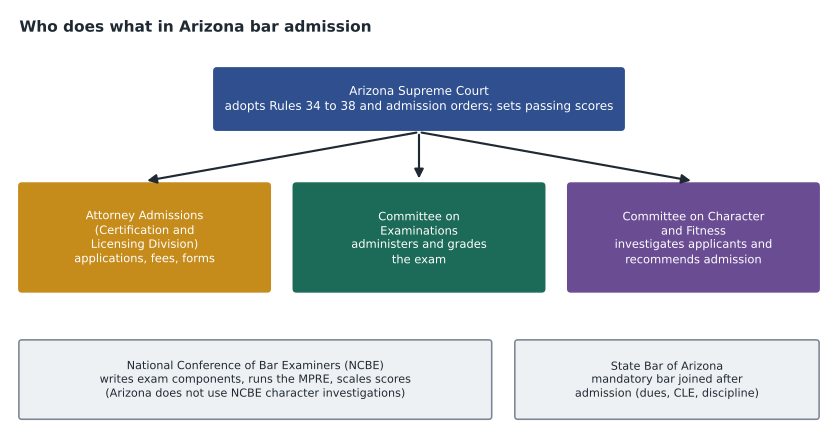
Admission to practice law in Arizona is controlled by the Arizona Supreme Court. The court's power to regulate the practice of law comes from the Arizona Constitution, and it exercises that power through the Rules of the Supreme Court of Arizona, especially Rules 34 to 38, which govern admission, and through administrative orders. When the court changes the admission rules, it does so by order after a public rules process. The most recent major amendments to Rules 34, 35 and 37 were adopted on August 28, 2025 and took effect on January 1, 2026, and an administrative order of December 16, 2025 set out the content of the NextGen exam that Arizona will give from July 2027.
Two committees appointed by the court do the detailed work. The Committee on Examinations is responsible for the bar exam: it administers it, oversees grading and reports results. The Committee on Character and Fitness investigates every applicant's background and decides whether to recommend admission. Both committees are supported by the Attorney Admissions unit of the Certification and Licensing Division of the Administrative Office of the Courts, which receives applications, collects fees, answers questions and publishes the forms and instructions. The admissions office is at 1501 West Washington Street in Phoenix, and its application portal is the court's bar admissions website.
The State Bar of Arizona is a separate body. It is a unified, or mandatory, bar: every lawyer licensed in Arizona must be a member. The State Bar handles membership, dues, continuing legal education compliance and lawyer discipline under the court's supervision, but it does not decide who passes the bar exam or who is admitted. Candidates sometimes write to the State Bar with admission questions and lose time. Questions about applications, the exam and character review go to the court's admissions office.
The National Conference of Bar Examiners, or NCBE, prepares the exam components, runs the Multistate Professional Responsibility Examination (MPRE) and scales UBE scores. NCBE does not admit anyone. Unlike many jurisdictions, Arizona does not use NCBE's character and fitness investigation service. It runs its own character investigation, so the forms and instructions come from the Arizona court, not from NCBE.
Three ways in
Rule 34(a) gives three methods of admission. The first is admission by examination: sitting and passing the Arizona bar exam. The second is admission on motion, for lawyers who have been admitted by examination elsewhere and have practiced actively for three of the last five years in a jurisdiction that offers Arizona lawyers a similar route. The third is admission by transferring a qualifying bar exam score earned in another jurisdiction, which in practice means a UBE score (and, from July 2026, a NextGen score) that meets Arizona's minimum.
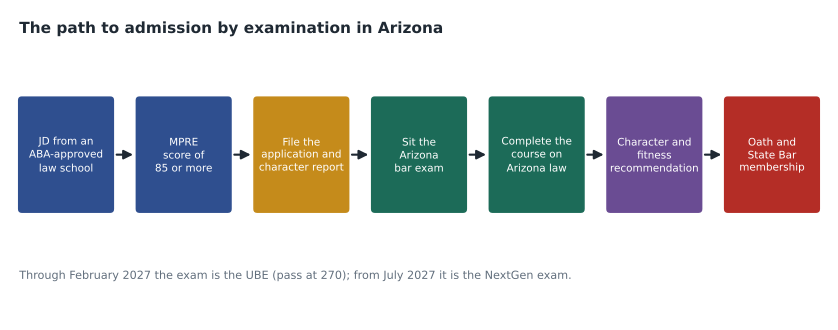
Every route shares the same core requirements. The applicant must be over 21, must hold a Juris Doctor from a law school that was provisionally or fully approved by the American Bar Association when the degree was conferred (or must have practiced actively for three of the last five years elsewhere), must have a passing score on the MPRE, must be in good standing wherever already admitted, must satisfy the Committee on Character and Fitness, and must complete the Arizona Supreme Court's course on Arizona law. An LLM alone does not qualify, and graduates of foreign law schools are not eligible to sit unless they also hold a qualifying JD.
| Route | Who uses it | Key extra requirement |
|---|---|---|
| Admission by examination | New graduates and anyone without a qualifying score elsewhere | Pass the Arizona exam (UBE 270 through February 2027; NextGen from July 2027) |
| Admission by score transfer | Examinees who earned a qualifying score in another jurisdiction | Score at or above Arizona's minimum, earned within five years of admission, in no more than four attempts |
| Admission on motion | Experienced lawyers admitted by exam elsewhere | Active practice for three of the last five years, linked to a reciprocal jurisdiction |
The usual order of steps
For a new graduate like Rafael, the steps fall into a predictable order, though several run at the same time. Most students take the MPRE during law school, often in the second or third year. The bar application is filed with the admissions office during a filing window several months before the exam, together with a character report, fingerprints and supporting documents. The character investigation runs while the candidate studies. The exam is given at the end of February and the end of July. After passing, the candidate completes the course on Arizona law, if not already done, pays the administrative fee for admission, and is recommended for admission once character review is complete. Admission becomes final when the candidate takes the oath and enrolls with the State Bar.
Rafael has done the first step already: he took the MPRE in his third year and scored above Arizona's minimum of 85. He filed his application for the February 2027 exam during the standard filing window in October. 'That leaves three things,' Marchetti says. 'Pass the exam, finish the Arizona course, and do not give the Committee any reason to delay you. The third one is the one people underestimate.'
What makes Arizona different
Arizona was one of the early adopters of the UBE, giving it for the first time in July 2012, and for more than a decade its exam has been the UBE with no added state-law test. Arizona-specific knowledge is checked instead through the online course on Arizona law, which every applicant must complete before admission, whether admitted by exam, by score transfer or on motion. Arizona's passing score of 270 is at the top of the range of UBE passing scores, which matters both for those sitting in Arizona and for those trying to transfer scores in.
The second difference is the timing of the switch to NextGen. Arizona announced in December 2023 that it would replace the UBE with the NextGen exam, and it is among the earlier jurisdictions to do so: its first NextGen exam is in July 2027, a year after the first group of jurisdictions in July 2026 and a year before the largest group in July 2028. February 2027 is therefore Arizona's last legacy UBE.
The third difference is the most unusual. Arizona has opened several new paths into legal practice since 2020. It eliminated Ethical Rule 5.4 and became the first state to license alternative business structures, in which nonlawyers may own or invest in firms that deliver legal services. It created a new licensed profession, the legal paraprofessional, who may provide limited legal services in defined areas without a law degree. And it created two programs that let some people practice under supervision without meeting the usual admission rules: the Arizona Lawyer Apprentice Program for examinees who score just below the passing score, and the Government Law Admission Program for lawyers admitted elsewhere who will work in public law offices. Lesson 11 explains each one.
The fourth difference is in the substantive law. Arizona is a community property state with a statutory structure rooted in Spanish civil law, it uses pure comparative fault and has largely abolished joint and several liability, its constitution forbids caps on damages for death or injury, and its land transactions run largely on deeds of trust with strong anti-deficiency protection for homeowners. These rules do not appear on the UBE, which tests general law, but they appear in the Arizona law course and in early practice. Lessons 7 to 10 cover them.
Where candidates go wrong
Marchetti keeps a list of the mistakes she has seen Arizona candidates make. The first is late or incomplete applications. Arizona has a standard filing window and a late filing window with a higher fee, and after the late deadline there is no filing at all for that exam. The second is incomplete disclosure on the character application. The Committee treats omissions as more serious than most of the underlying conduct, and a candidate who forgets an old citation or a closed debt collection account can spend months explaining it. The third is the Arizona law course: candidates who pass in May or October assume they can be admitted at once and then discover they still need to complete the six-hour online course, and the course evaluation, before their admission can go forward. The fourth is score transfer: lawyers who passed in a jurisdiction with a lower passing score assume their score will transfer to Arizona, when Arizona requires 270.
'None of these are about knowing the law,' Marchetti says. 'They are about reading the rules and the instructions. You would be surprised how many very smart people skip that.'
How to use this course
Each lesson ends with a short quiz, and the course ends with a twenty-question exam. Lessons 1 through 6 and 11 are about the admission process: who may sit, what the exam is, how it is scored and what comes after. Lessons 7 through 10 cover Arizona law itself. Lesson 12 pulls the substantive lessons together in original practice questions and an essay, and closes with an exam-week plan.
Facts about the admission process come from the Arizona Supreme Court's rules and administrative orders, the court's Certification and Licensing Division, and NCBE's published jurisdiction information, as they stood in November 2026. Rules change: the court amended its admission rules effective January 2026 and will change them again for NextGen. Where a fact could not be confirmed from an official source, the course says so or describes it in general terms. Always check the current rules and instructions before relying on a date or a fee.
Common mistakes
MistakeThe State Bar of Arizona decides who is admitted.
InsteadThe Arizona Supreme Court controls admission through its committees; the State Bar is the mandatory bar applicants join afterward.
MistakeArizona uses NCBE for character investigations.
InsteadArizona runs its own character and fitness investigation.
MistakePassing the exam is the last step.
InsteadThe course on Arizona law and character clearance must also be completed before admission.
MistakeAn LLM is enough to sit the Arizona exam.
InsteadRule 34 requires a JD from an ABA-approved school, or active practice for three of the last five years elsewhere.
A first planning session
At the end of the first session, Marchetti asks Rafael to write down three dates and three documents. The dates are the exam days at the end of February, the expected release of results some weeks later, and the date by which he wants to be sworn in so that his legal aid office can move him from clerk to staff attorney. The documents are his character application, his MPRE score report and his certificate of completion for the course on Arizona law. 'If you can put your hand on all six by March,' she says, 'the only thing left between you and admission is the exam.' Rafael finds that the character application is the one he has thought least about, and they agree that it will be the subject of their third session.
Rafael's calendar
Marchetti finishes by sketching Rafael's next five months on a single page. December: reduced hours at work and the start of full bar review. January: two full simulated exams and a final check that his application file shows nothing outstanding. February 23 and 24: the exam. March: the course on Arizona law and its evaluation. Spring: results, character clearance and, he hopes, the oath. 'Put it on your refrigerator,' she says. 'Every time something new lands on your plate, look at the page and ask whether it belongs there before May.'
The page also lists the people Rafael will need along the way: his supervising attorney, who will vouch for his work; two references for the character application; and a study partner from the group for timed essays.
Summary and key terms
- The Arizona Supreme Court controls admission through Rules 34 to 38 and its Committees on Examinations and on Character and Fitness.
- There are three methods of admission: by examination, by score transfer and on motion.
- All applicants need an ABA-approved JD (or qualifying practice), the MPRE at 85, good standing, character clearance and the course on Arizona law.
- Arizona gives the UBE with a passing score of 270 through February 2027 and the NextGen exam from July 2027.
- Arizona has also created alternative business structures, legal paraprofessionals and supervised-practice admission programs.
- Rule 34
- The Arizona Supreme Court rule that sets out the methods of and qualifications for admission.
- Committee on Character and Fitness
- The court-appointed committee that investigates applicants and recommends admission.
- Unified bar
- A bar association that every licensed lawyer in the state must join.
- Course on Arizona law
- The court's required online course on Arizona law, completed before admission.
- Legacy UBE
- The Uniform Bar Examination of MBE, MEE and MPT that NextGen replaces.
Lesson quiz · 5 questions
Score 60% or more to complete this lesson.
Create a free account to save your progress, take quizzes and earn a certificate.