
BAR-203 · Lesson 3 of 12 · 16 min
Character and fitness and the MPRE
▶ Video coming soon A video version of this lesson is on the way.
At their third session Rafael brings a list. 'Two speeding tickets in college, a minor-in-possession citation when I was nineteen that was dismissed, a credit card that went to collections for six months while I was between jobs, and a semester on academic probation in my first year of college,' he says. 'Do I really have to put all of that on the application?' Marchetti's answer is the core of this lesson: yes, and the way he discloses it matters more than what it is.
The standard
Rule 34(b) requires every applicant to be of good moral character and to be mentally, emotionally and physically able to engage in the active and continuous practice of law. The burden is on the applicant. The Committee on Character and Fitness does not have to prove that an applicant is unfit; the applicant has to show that he or she is fit. In 2015 the Arizona Supreme Court adopted Character and Fitness Guidelines, which the admissions office publishes as an informational resource. They explain what conduct the Committee considers relevant and how it weighs it.
The purpose of the review is to protect clients, courts and the public. Lawyers handle other people's money, confidential information and legal rights, often with little supervision. The Committee looks for conduct that shows a risk that the applicant will not be honest, diligent, reliable or respectful of the law. The most serious concern is dishonesty. Unlawful conduct, academic misconduct, false statements, neglect of financial obligations, violation of court orders and misconduct in employment are all relevant. So is conduct during the admission process itself, including failing to disclose information the application asks for.
How the Committee weighs conduct
Like other jurisdictions, Arizona considers the facts of past conduct in context. Relevant factors include the applicant's age at the time; how recent the conduct was; how serious it was; the circumstances; whether it was a single event or part of a pattern; the applicant's candor in the admission process; and evidence of rehabilitation, such as restitution, treatment, stable employment, community service and the passage of time without further problems. Rehabilitation is not just the absence of new trouble. The Committee looks for evidence that the applicant understands what went wrong and has changed.
Rafael's list is typical and, on its own, unlikely to cause a problem. Two speeding tickets in college are minor and old. A dismissed minor-in-possession citation at nineteen must be disclosed if the question asks about citations or charges regardless of outcome, but youth and the dismissal weigh in his favor. The collection account is relevant to financial responsibility, but a short delinquency during a period of unemployment that was later resolved shows a problem handled, not neglected. Academic probation for grades is different from academic misconduct; it is disclosed if asked but is not a mark against character.
| Factor | Weighs toward concern | Weighs toward approval |
|---|---|---|
| Age | Conduct as an adult professional | Conduct as a teenager or young adult |
| Recency | Within the last few years | Many years ago, with a clean record since |
| Seriousness | Dishonesty, violence, harm to others | Minor traffic or regulatory matters |
| Pattern | Repeated similar conduct | A single incident |
| Candor | Omission, minimizing, shifting blame | Full, accurate, accountable disclosure |
| Rehabilitation | No evidence of change | Restitution, treatment, steady record, references |
Disclosure: the part that decides cases
Marchetti's most important advice is simple. Answer every question fully and accurately, and when in doubt, disclose. The questions on the application are broad by design. Many ask about matters 'whether or not' they resulted in a conviction, were dismissed, sealed or expunged. An expungement or set-aside under state law may affect what an employer can see, but it does not generally excuse disclosure on a bar application that expressly asks about it. Where the application asks, the answer is yes.
The reason is practical as well as ethical. The Committee's investigators check court records, credit reports, schools and employers. When they find something the applicant left out, the question is no longer about a speeding ticket. It is about whether the applicant was truthful on a sworn application to the Supreme Court, which goes to the heart of fitness to practice. A lawyer's word to a court must be reliable. Applicants have been denied admission, or had admission long delayed, because of omissions involving conduct that would not have mattered if disclosed.
Good disclosure has three parts: the facts, stated accurately and without minimizing; the outcome, with documents; and, where relevant, a brief statement of what the applicant learned or did afterward. It does not need to be long. 'In March 2019, at age 19, I was cited in Tempe for minor in possession of alcohol. The charge was dismissed after I completed a diversion class. I have attached the court's disposition. I have had no further alcohol-related incidents' is the kind of answer that ends the inquiry.
Continuing duty to update
The duty of disclosure does not end when the application is filed. Applicants must keep their answers current and promptly report any new matter, such as a citation, a lawsuit, a change of address or employment, or a new financial delinquency, until admission. A candidate who gets a speeding ticket in the week before the exam and forgets to report it has made the same mistake as one who omitted something from the original application.
Investigation, inquiry and hearing
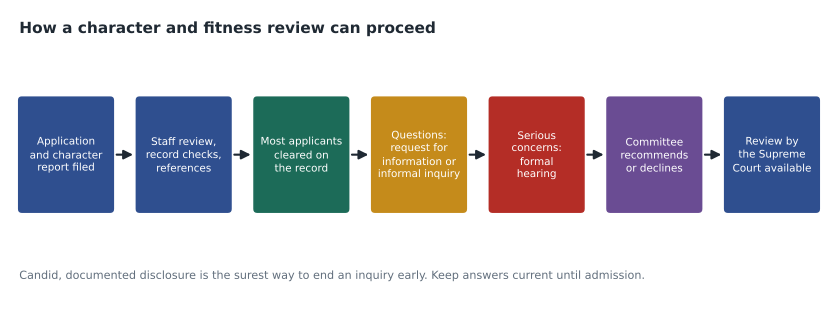
Most applicants are cleared on the paper record. The Committee's staff review the application, gather records and contact references. Where questions remain, the Committee may ask for more information or invite the applicant to an informal inquiry. If concerns are serious, the matter may proceed to a formal hearing, after which the Committee decides whether to recommend admission. An applicant who disagrees with an adverse decision may seek review by the Arizona Supreme Court under its rules. Because the process takes time, applicants with significant issues should file early and be prepared to provide documents and references promptly. Applicants facing a hearing may be represented by a lawyer, and many find it helpful.
Mental health deserves a specific note. Arizona's questions, like those of most jurisdictions, focus on conduct and current ability to practice rather than on diagnosis or treatment history. Seeking treatment is not evidence of unfitness, and the court and the State Bar encourage law students and lawyers who are struggling to get help. Applicants who are unsure how to answer a question about their health or conduct can ask the admissions office or a lawyer experienced in admissions matters before filing.
The MPRE requirement
Every applicant for admission in Arizona must pass the Multistate Professional Responsibility Examination. Arizona's minimum scaled score is 85, which is at the top of the range used by jurisdictions; most require between 75 and 86. The MPRE is a two-hour, 60-question multiple-choice test of the ABA Model Rules of Professional Conduct, the ABA Model Code of Judicial Conduct and related law. It is given several times a year at test centers by NCBE, and applicants register and pay NCBE directly.
Arizona's rules include a time limit. For exam applicants, proof of a passing MPRE score must be submitted within the period set by Rule 34 measured from the successful bar exam: the rule allows a score earned within eight years of the successful exam or within the period allowed for taking the oath. Score transfer applicants must show a passing score earned within eight years of their application or within the oath period. Applicants for admission on motion must also show a passing score. Students can take the MPRE before graduation, and most do, so the score is usually in hand before the bar exam.
Because Arizona requires 85, a score that passes elsewhere may not be enough. A lawyer moving from a jurisdiction that requires 75, with a score of 80, must retake the MPRE before admission in Arizona. Rafael's score of 88 clears the bar with room to spare. 'Good,' Marchetti says. 'That is one box you never have to open again.'
Worked problem
Two applicants, two outcomes
Applicant A did not disclose a 2018 shoplifting citation that was dismissed after a diversion program, reasoning that the record was sealed. The investigator found it in a court index. Applicant B disclosed a 2021 conviction for driving under the influence, attached the court records and proof of completed treatment, and described five years without further incident. Who is more likely to face a delayed or contested review?
Show solution
- Both matters are relevant: one involves theft, which goes to honesty, and the other involves unlawful conduct and possible substance concerns.
- Applicant B was candid, documented the outcome and showed rehabilitation.
- Applicant A's omission on a sworn application raises a new and more serious question of candor, even though the underlying citation was minor and dismissed.
Answer: Applicant A. The omission turns a minor, old matter into a question about honesty in the admission process itself, while Applicant B's full disclosure and rehabilitation evidence put the more serious conduct in context.
Common mistakes
MistakeDismissed or expunged matters do not need to be disclosed.
InsteadDisclose anything the question asks about, including dismissed, sealed or expunged matters, when the question says so.
MistakeThe Committee must prove I am unfit.
InsteadThe applicant bears the burden of showing good character and fitness.
MistakeMy 80 on the MPRE passed in another state, so it works in Arizona.
InsteadArizona requires a scaled score of 85.
MistakeOnce I file, I am done with disclosures.
InsteadApplicants must update their answers until admission.
Rafael's disclosures, drafted
Marchetti asks Rafael to draft his four disclosures before their next session, and they review them together. His first draft of the collection account reads: 'Credit card went to collections in 2023 due to the bank's error.' Marchetti stops him. 'Was it the bank's error?' It was not; he missed payments for five months after a job ended and caught up when he started at the legal aid office. The revised answer reads: 'From March to August 2023, after a temporary position ended, I fell behind on a credit card and the account was referred to a collection agency. I set up a payment plan in September 2023 and paid the balance in full in January 2024. A letter from the creditor confirming payment is attached. I have had no delinquent accounts since.' The first version blamed someone else and would have invited questions. The second states the facts, shows the resolution and ends the inquiry.
His academic probation answer is simpler. The application asks about academic discipline and probation; he was placed on academic probation for grades in his first college semester and returned to good standing the next term. He discloses it in two sentences. 'Academic probation for grades is not misconduct,' Marchetti says, 'but if the question asks about probation, answer the question. Do not decide for the Committee what it cares about.'
References and records
The application asks for references, and the Committee may contact them. Choose people who know you well and can speak to your reliability and honesty: supervisors, professors, and members of the community who have seen your work. Tell them in advance that the Committee may contact them and what the process involves. Avoid choosing references only for their titles; a judge who barely knows you is less useful than a supervising attorney who has reviewed your work every week.
Gather records before you need them. For each matter you disclose, obtain the court's disposition, proof of payment or completion, and any other document that shows the outcome. If a record cannot be found, say so and explain what you did to find it. The Committee would rather see a candid explanation of a missing record than a confident answer that turns out to be wrong.
When to get advice
Most applicants do not need a lawyer for the character process. Those with more serious matters, such as a criminal conviction, a pattern of financial problems, academic misconduct findings, or a prior bar application in another state that was denied or delayed, should consider consulting a lawyer who handles admission matters before filing. Advice at the drafting stage is far more useful than advice after an inquiry has begun, because the best way to resolve a concern is a complete and well-documented initial disclosure. Law school deans of students and the State Bar's member assistance resources can also point applicants toward help with substance use or mental health concerns, which the court encourages applicants to address.
The MPRE and the timing trap
One more timing rule deserves attention. Because Arizona requires the MPRE score to fall within a period measured from the successful bar exam or the application, candidates who took the MPRE early in law school and then delay the bar exam for several years can find that their score has aged out. The eight-year window is generous, but lawyers who passed the MPRE long ago and are now applying by transfer or motion should check that their score is still within the rule before filing, and retake the MPRE if necessary. NCBE offers the MPRE several times a year, so a retake usually fits within the character review period.
Marchetti's last word on character is about tone. 'Write it the way you would want a client to explain a problem to you: what happened, what you did about it, and what is true now. No drama, no excuses, no lawyering.'
Rafael's final versions of all four disclosures fit on one page. Marchetti reads them twice and hands them back. 'Done,' she says. 'Now forget about them and study.'
Summary and key terms
- Applicants must prove good moral character and fitness; the burden is on them.
- The Committee weighs age, recency, seriousness, pattern, candor and rehabilitation, with dishonesty the gravest concern.
- Disclose everything the questions ask about, including dismissed, sealed and expunged matters, and keep answers current until admission.
- Most applicants are cleared on the record; others may face an inquiry, a hearing and review by the Supreme Court.
- Arizona requires an MPRE scaled score of 85, earned within the time limits in Rule 34.
- Good moral character
- The honesty, trustworthiness and respect for law that the Committee requires.
- Candor
- Full and truthful disclosure on the application and in the process.
- Rehabilitation
- Evidence that an applicant has addressed past conduct and changed.
- MPRE
- NCBE's 60-question test of professional responsibility law.
- Continuing duty to update
- The obligation to report new matters to the admissions office until admission.
Lesson quiz · 5 questions
Score 60% or more to complete this lesson.
Create a free account to save your progress, take quizzes and earn a certificate.