
BAR-203 · Lesson 12 of 12 · 25 min
Capstone: Arizona practice questions and an exam-day plan
▶ Video coming soon A video version of this lesson is on the way.
Two weeks before the February 2027 exam, Marchetti gives Rafael a final assignment that has nothing to do with the UBE. 'You will pass or fail the exam on general law,' she says. 'But the morning after you are sworn in, a client will ask you an Arizona question. Let us make sure you can answer it.' This capstone has three parts: ten original questions on the Arizona law and admission rules covered in this course, an original essay problem with a model answer, and a plan for exam week and the weeks after.
Part one: ten Arizona questions
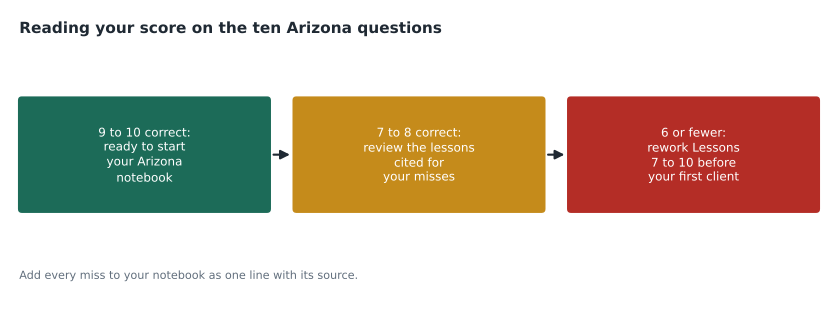
Answer each question before reading the explanation. Each draws on a specific lesson, and the explanations tell you where to look again if you miss it.
Practice problems
Work each problem on paper first, then reveal the answer to check.
1. An examinee scored 266 on the UBE in Utah in July 2025. Can she transfer that score to Arizona?
Show answer
No. Arizona requires 270 for score transfer, regardless of the score needed to pass where it was earned (Lesson 11). She could sit the Arizona exam, and if she scored 260 to 269 in Arizona and secured qualifying employment she might consider the apprentice program.
2. Rafael receives a speeding citation on February 10, 2027, after filing his application. What must he do?
Show answer
Report it promptly to the admissions office. The duty to update the application continues until admission, and failing to report even a minor matter raises a question of candor (Lesson 3).
3. A December 2026 graduate fails the February 2027 exam. What exam is her Arizona retake?
Show answer
The July 2027 NextGen exam, Arizona's first. February 2027 is the last legacy UBE (Lesson 5).
4. A client was 60 percent at fault in a car accident with damages of 50,000 dollars, and the other driver was 40 percent at fault. What can the client recover?
Show answer
20,000 dollars, reduced by her 60 percent share, under Arizona's pure comparative fault statute, unless she acted willfully or wantonly or the impairment defense applies (Lesson 8).
5. Two negligent contractors cause a tenant's injury; one is insolvent. Can the tenant collect the whole judgment from the solvent one?
Show answer
Not usually. Under A.R.S. 12-2506 liability is several; each pays its own share unless an exception, such as acting in concert or vicarious liability, applies (Lesson 8).
6. A client was hit by a county truck seven months ago and has not contacted the county. What is the urgent problem?
Show answer
The 180-day notice of claim period under A.R.S. 12-821.01 has probably run. Check the accrual date at once and consider any argument that the claim accrued later (Lesson 7).
7. During her marriage, a client inherited a cabin from her aunt and later rented it out. Who owns the cabin and the rent?
Show answer
Both are her separate property: property acquired by inheritance and its rents and profits are separate under A.R.S. 25-211 and 25-213, unless commingling or community contributions change the analysis (Lesson 9).
8. A lender sold a family's single-family home on a third of an acre at a trustee's sale and now seeks a deficiency. What is the defense?
Show answer
A.R.S. 33-814(G) bars a deficiency after a trustee's sale of qualifying residential property of two and one-half acres or less (Lesson 9).
9. The only document a decedent left is an unwitnessed note in her own handwriting, signed, leaving her car to a niece. Is it valid?
Show answer
It can be a valid holographic will under A.R.S. 14-2503 if the signature and material provisions are in her handwriting (Lesson 10).
10. A new lawyer is offered a job at a firm partly owned by an accounting company. Is that permitted in Arizona?
Show answer
Yes, if the firm is a licensed alternative business structure with a compliance lawyer. Arizona eliminated ER 5.4 effective January 1, 2021 (Lesson 10).
Part two: an Arizona essay
Write an answer in 40 minutes before reading the model answer. The facts are original and fictional.
Lucía and Mateo married in Phoenix in 2015. Before the marriage, Lucía owned a condominium in Tempe, bought with her savings, which she rented out. During the marriage, Mateo's wages paid the condominium's mortgage for six years. In 2019, Lucía inherited 80,000 dollars from her grandmother, which she deposited in a joint checking account the couple used for household bills; the account has received both spouses' paychecks since 2015. In 2021, Mateo alone signed a deed of trust on the couple's house, bought in 2017 with their wages, to secure a business loan for his landscaping company; the lender knew he was married. In 2025, Mateo was injured when a dump truck owned by Arid Hauling LLC ran a red light; Mateo was not wearing a seat belt, and a jury could find his own fault contributed to his injuries. In 2026, Lucía served Mateo with a petition for dissolution. Mateo argues that Lucía should receive less property because she had an affair.
Discuss the property issues in the dissolution and the comparative fault issues in Mateo's injury claim.
Worked problem
Model answer
The issues are the character of the condominium, the inheritance and the house; the effect of Mateo's lone signature on the deed of trust; the relevance of the affair; and the allocation of fault in Mateo's claim.
Show solution
- Condominium. Property owned before marriage is separate under A.R.S. 25-213, so the Tempe condominium remains Lucía's, along with its rents. But community funds, Mateo's wages, paid down the mortgage for six years. Arizona courts recognize a community lien or interest when community funds or effort improve or pay down separate property. The community likely has a claim measured by Arizona's case-law formulas for the principal paid and any resulting appreciation.
- Inheritance. Property acquired by inheritance is separate under A.R.S. 25-211 and 25-213. Lucía bears the burden of tracing it. Because she deposited it in a joint account used for household expenses and fed by community wages for years, it may have been commingled beyond tracing, in which case it is treated as community property. If records allow her to trace the 80,000 dollars to assets still held, she keeps it as separate.
- House. The house was bought during marriage with wages, so it is community property under A.R.S. 25-211. Under A.R.S. 25-214, both spouses must join in any transaction to encumber community real property. Mateo alone signed the deed of trust, and the lender knew he was married. Lucía can argue the encumbrance is invalid or unenforceable against the community interest; the lender will look for ratification or estoppel. The business debt itself may still be a community obligation if incurred for the community, under A.R.S. 25-215.
- The affair. A.R.S. 25-318 requires division of community property equitably, though not necessarily in kind, without regard to marital misconduct. The affair is irrelevant to division. The court could consider excessive or abnormal spending or concealment of community property, but nothing suggests that here. The court will likely divide the community property equally.
- Mateo's injury claim. Arizona uses pure comparative fault under A.R.S. 12-2505. Mateo's failure to wear a seat belt may reduce his damages if the jury finds it contributed to his injuries, but it cannot bar his claim; under Article 18, section 5 of the Arizona Constitution, the jury decides whether to apply his fault. Arid Hauling is liable for its driver's fault if the driver acted within the scope of employment, an exception to several liability under A.R.S. 12-2506. Any other contributors, such as a negligent maintenance contractor, could be named by Arid Hauling as nonparties at fault with proper notice.
- Character of the recovery. A personal injury recovery received during marriage raises its own characterization question; Arizona courts generally treat compensation for pain and suffering as the injured spouse's separate property and compensation for lost wages and medical expenses during the marriage as community. Because Lucía served the petition in 2026 and the claim arose in 2025, the court will have to address it.
Answer: The condominium is Lucía's separate property subject to a community lien; the inheritance is separate only if traceable; the house is community property, and Mateo's lone encumbrance is vulnerable; the affair does not affect division; and Mateo's claim survives his own fault, reduced in proportion, with Arid Hauling vicariously liable for its driver.
Score yourself by issues. A strong answer spots all six, states the Arizona rule for each with its source, uses the specific facts (the six years of payments, the joint account, the lender's knowledge, the seat belt) and reaches a conclusion on each. If you missed the characterization of the injury recovery, you are in good company; it is the issue most candidates miss.
Part three: exam week and after
Rafael's exam is the February 2027 legacy UBE, so the week itself is the same as for any UBE examinee. Marchetti's plan keeps it simple.
| When | What to do |
|---|---|
| The week before | Light timed MBE sets and one practice essay a day; set your sleep schedule to exam hours; confirm laptop software registration and test it |
| The day before | Travel to Phoenix if needed; print the admission ticket; check ID and the permitted items list; no new material |
| Tuesday | MPT and MEE on the laptop; eat lunch away from other examinees; do not discuss answers |
| Wednesday | MBE, 200 questions in two sessions; pace at 1.8 minutes per question; guess on every question |
| The next two weeks | Complete the course on Arizona law and its evaluation; build your Arizona practice notebook |
| Until results | Keep your application answers current; plan for July NextGen or the apprentice program only if needed |
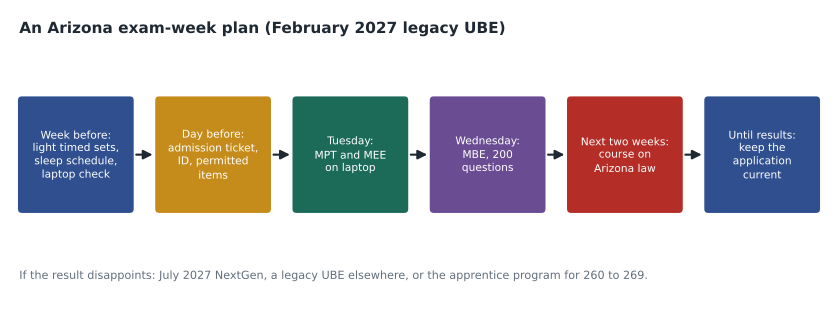
Marchetti closes the session with a reminder she gives every candidate. 'Most people who prepare the way you have prepared pass. If you do not, Arizona has given you more options than almost anywhere else: the July NextGen exam, a legacy exam elsewhere, or two years of supervised practice in the job you already have if you land between 260 and 269. None of those is a disaster. But plan to pass.'
Common mistakes
MistakeArizona law will help on the UBE essays.
InsteadAnswer UBE questions under general law; Arizona law is for the course and for practice.
MistakeThe course on Arizona law can wait until after results.
InsteadFinish it early so it never delays admission.
MistakeA misconduct argument can shift property at divorce.
InsteadArizona divides community property without regard to marital misconduct.
MistakeA plaintiff who failed to wear a seat belt cannot recover.
InsteadPure comparative fault reduces but does not bar recovery, and the jury decides.
How to use your misses
After scoring the ten questions and the essay, Rafael finds two misses. He answered question 6 by saying the client had two years to sue, forgetting the notice of claim, and in the essay he missed the characterization of Mateo's injury recovery. Marchetti does not ask him to reread the lessons. She asks him to add each miss to his Arizona notebook as a single line under the relevant module, with the source: 'Claims against public entities: notice of claim within 180 days, A.R.S. 12-821.01; suit within one year, A.R.S. 12-821.' And: 'Personal injury recovery during marriage: pain and suffering is the injured spouse's separate property; lost wages and medical expenses during marriage are community, under Arizona case law.' Two lines, two sources. That is how a notebook grows into a practice tool.
The first month after admission
The capstone ends where practice begins. In the first month after admission, Marchetti recommends that every new Arizona lawyer do five things: register for electronic filing in the courts where they will practice; set up or learn their office's trust accounting procedures; find a mentor, through their employer or the State Bar's programs, who will review their work and answer questions; schedule the professionalism course and their first year's continuing legal education; and keep the notebook open on their desk. Rafael's office already has a mentoring system, and his supervising attorney has agreed to review every filing he signs for his first three months.
Marchetti's last words to Rafael are practical. 'You will make mistakes. Make them small, catch them early and tell your supervisor the same day. That is what the character and fitness process was really asking about.'
A last word on Arizona's design
Arizona's admission system rests on a simple idea: test general competence on a national exam, then make sure every new lawyer has been introduced to Arizona law, and provide supervised alternatives for people who can serve the public well even if they fall just short on the exam. Whether a candidate agrees with every choice the court has made, understanding that design makes the rules easier to remember. The exam tests what every lawyer should know; the course and the notebook cover what every Arizona lawyer should know; and the new programs reflect the court's view that access to legal services matters as much as the gatekeeping that comes before it.
Summary and key terms
- The ten practice questions cover score transfer, character updates, NextGen timing, comparative fault, several liability, notice of claim, community property, anti-deficiency, holographic wills and ABSs.
- The essay combines community property characterization, joinder, misconduct and comparative fault.
- Arizona answers depend on statutes: A.R.S. 12-2505, 12-2506, 12-821.01, 25-211, 25-214, 25-318, 33-814 and 14-2503.
- In exam week, follow the UBE routine; afterward, complete the course on Arizona law and keep the application current.
- If the result disappoints, Arizona offers NextGen in July 2027, legacy exams elsewhere and the apprentice program.
- Commingling
- Mixing separate and community funds so that separate property can no longer be traced.
- Community lien
- The community's claim when community funds pay down or improve separate property.
- Joinder
- The requirement that both spouses sign certain community property transactions.
- Vicarious liability
- Liability for another's fault, such as an employer's for an employee acting within the scope of employment.
- Practice notebook
- A lawyer's own summary of Arizona rules and sources for early practice.
Lesson quiz · 5 questions
Score 60% or more to complete this lesson.
Create a free account to save your progress, take quizzes and earn a certificate.