
BAR-202 · Lesson 8 of 12 · 20 min
Alaska torts, damages and comparative fault
▶ Video coming soon A video version of this lesson is on the way.
In March 2025 the Alaska Supreme Court decided a case that began with a man helping his friend hang a crucifix in the friend's home. He fell and was badly hurt. A jury awarded him 1.2 million dollars in noneconomic damages and found that his friend was 25 percent at fault and he himself was 75 percent responsible. The question on appeal was which comes first: the statutory cap on noneconomic damages, or the allocation of fault. Owen's judge assigned him to write a bench memo summarizing the decision, Kisling v. Grosz, for a pending case. This lesson builds the background he needed: Alaska's comparative fault rule, its several liability statute, and its caps on damages.
Pure comparative fault
For most of American history, a plaintiff whose own negligence contributed to an injury recovered nothing at all. That rule, contributory negligence, survives in only a handful of jurisdictions. Alaska abandoned it in 1975. In Kaatz v. State, 540 P.2d 1037 (Alaska 1975), the Alaska Supreme Court declared that contributory negligence would no longer apply in Alaska and adopted pure comparative negligence. Under the pure form, a plaintiff's damages are reduced in proportion to the plaintiff's share of fault, but the plaintiff can recover something even if the plaintiff was more at fault than the defendant. The court also held that last clear chance, a doctrine that existed mainly to soften contributory negligence, no longer had a role.
Pure comparative fault is also the MBE's default when a question does not specify a rule, so on this point Alaska practice and the exam agree. The difference from many other states is that Alaska has no 50 or 51 percent bar: in Kisling, the plaintiff was 75 percent responsible and still recovered.
| System | Plaintiff 40 percent at fault | Plaintiff 60 percent at fault | Where used |
|---|---|---|---|
| Contributory negligence | Recovers nothing | Recovers nothing | A few jurisdictions |
| Modified comparative (50 or 51 percent bar) | Recovers 60 percent | Recovers nothing | Many states |
| Pure comparative | Recovers 60 percent | Recovers 40 percent | Alaska (Kaatz, 1975) and the MBE default |
Several liability: AS 09.17.080
The bigger difference between Alaska and the exam is what happens when more than one person caused the harm. Under traditional joint and several liability, each defendant whose negligence caused an indivisible injury could be required to pay the whole judgment, leaving defendants to sort out contribution among themselves. Alaska instead applies several liability by statute.
AS 09.17.080 governs any action involving the fault of more than one person, including third-party defendants and persons who have settled or been released. Unless all parties agree otherwise, the jury answers special interrogatories (or the judge makes findings in a bench trial) stating the damages each claimant would recover if contributory fault were disregarded, and the percentage of total fault allocated to each claimant, defendant, third-party defendant, released person and other responsible person. In allocating fault, the factfinder considers both the nature of each person's conduct and how much of the harm it caused.
The court then enters judgment against each liable party for that party's equitable share of each claimant's award, calculated from its percentage of fault. Each defendant is liable only for its own share. If one responsible person is insolvent or immune, the plaintiff bears that loss, not the other defendants.
The statute also addresses people who are not parties. A nonparty can be assigned a percentage of fault, so that the named parties' percentages are accurate, but the allocation does not make the nonparty liable in that case and cannot be used as evidence of liability elsewhere. There is an important exception: a person whom the parties could have joined, who was identified as potentially responsible, but whom they chose not to join, is excluded from the allocation. The statute treats a person as joinable if the person is within the court's jurisdiction, not barred by law or rule from being joined, and reasonably locatable.
Worked problem
Several liability with a settling defendant
A snowmachine collision injures a passenger, whose damages are 200,000 dollars. Before trial, the passenger settles with the snowmachine rental company. At trial, the jury allocates fault: driver 50 percent, rental company (released) 30 percent, passenger 20 percent.
Show solution
- Start with total damages disregarding the passenger's fault: 200,000 dollars.
- Include the released rental company in the allocation, as AS 09.17.080 requires.
- Enter judgment against the driver for its equitable share: 50 percent of 200,000 = 100,000 dollars.
- The rental company's 30 percent share is not added to the driver's judgment; the passenger keeps whatever the settlement paid.
- The passenger's own 20 percent reduces recovery under pure comparative fault.
Answer: The driver owes 100,000 dollars. Whether the passenger did well depends on the settlement amount, because the passenger bears the 30 percent allocated to the settling company.
The practical effects are large. Plaintiffs' lawyers investigate and join every responsible person, because an empty chair can absorb fault. Defense lawyers identify other responsible persons and ask that fault be allocated to them. Settlement strategy changes too: a plaintiff who settles cheaply with one defendant gives up that defendant's entire share of fault, not just the settlement amount.
Caps on noneconomic damages: AS 09.17.010
Alaska's legislature limits damages for noneconomic losses, which the statute describes as compensation for pain, suffering and other nonpecuniary harm. Under AS 09.17.010(b), noneconomic damages may not exceed 400,000 dollars or the injured person's life expectancy in years multiplied by 8,000 dollars, whichever is greater. Under subsection (c), when damages are awarded for severe permanent physical impairment or severe disfigurement, the limit rises to 1,000,000 dollars or life expectancy multiplied by 25,000 dollars, whichever is greater. Under subsection (d), multiple injuries a person suffers in a single incident count as a single injury.
The caps do not apply to economic losses such as medical expenses and lost earnings. Separate statutes govern punitive damages and medical malpractice claims, with their own limits and procedures, and a lawyer handling those claims needs to read them directly.
Worked problem
Which cap applies?
A 30-year-old plaintiff with a life expectancy of 48 more years suffers a severe permanent physical impairment. The jury awards 1.5 million dollars in noneconomic damages, and the defendant is 100 percent at fault.
Show solution
- General cap under (b): the greater of 400,000 dollars or 48 x 8,000 = 384,000 dollars, so 400,000 dollars.
- Severe impairment cap under (c): the greater of 1,000,000 dollars or 48 x 25,000 = 1,200,000 dollars, so 1,200,000 dollars.
- The (c) cap applies because the damages are for severe permanent physical impairment.
- Reduce the 1.5 million award to 1.2 million dollars.
Answer: The noneconomic award is limited to 1,200,000 dollars. Economic damages are added in full.
Kisling v. Grosz (2025): fault first, then the cap
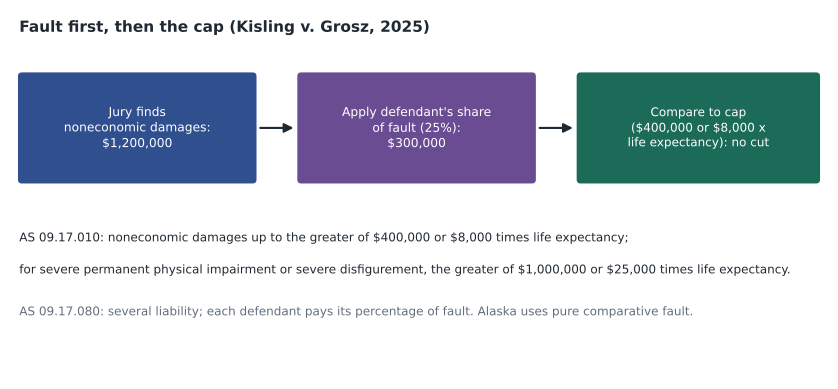
Back to the crucifix. In Kisling v. Grosz, 565 P.3d 226 (Alaska 2025), the defendant argued that the court should first cut the 1.2 million dollar noneconomic award to the 400,000 dollar cap and then apply his 25 percent share of fault, leaving the plaintiff with 100,000 dollars. The plaintiff argued for the opposite order: apply the 25 percent first, producing 300,000 dollars, and then ask whether that amount exceeds the cap. It did not.
The superior court agreed with the plaintiff, and on March 14, 2025 the Alaska Supreme Court affirmed. The court held that a court must first allocate fault and only then decide whether a damages cap applies; if the fault-based award is below the cap, no further reduction is required. The cap limits what the defendant must pay, not the jury's measure of the plaintiff's total loss. Because the affirmance resolved the case, the court did not reach the plaintiff's cross-appeal arguing for the higher 1 million dollar cap. Owen's bench memo summarizes the rule in one line: allocate fault first, compare the defendant's share to the cap second.
Time limits
Most tort claims must be filed within two years of accrual under AS 09.10.070. Alaska applies a discovery rule in appropriate cases, so that a claim may accrue when the plaintiff reasonably should have discovered the essential elements of the claim, and Alaska also has a statute of repose, AS 09.10.055, which bars many claims after a fixed period regardless of discovery, with exceptions. Calendaring the limitations date at the first client meeting is one of the most important habits a new Alaska lawyer can form.
Common mistakes
MistakeApplying a 50 or 51 percent bar in Alaska.
InsteadAlaska uses pure comparative fault (Kaatz, 1975); a plaintiff 75 percent at fault still recovers 25 percent.
MistakeHolding a solvent Alaska defendant liable for an insolvent co-defendant's share.
InsteadUnder AS 09.17.080, each defendant pays only its own percentage of fault.
MistakeApplying the noneconomic cap before allocating fault.
InsteadKisling v. Grosz (2025): allocate fault first, then compare the defendant's share to the cap.
MistakeCapping economic damages.
InsteadAS 09.17.010 limits noneconomic damages only.
Allocation to nonparties in practice
Because nonparties can be assigned fault, defendants in Alaska often identify other responsible persons early in the case and develop evidence of their fault. A plaintiff facing that strategy has a choice: join the other person as a defendant, which preserves the ability to collect that person's share, or leave them out and contest their fault at trial. The statute's exception for persons the parties could have joined but chose not to join gives both sides an incentive to bring responsible people into the case, so that the factfinder allocates fault among all of them with full participation.
Why the caps matter for settlement
The noneconomic caps shape case value long before trial. A plaintiff's lawyer evaluating a case with modest economic losses and serious pain and suffering must ask whether the injury qualifies for the higher cap for severe permanent physical impairment or severe disfigurement, because that question can more than double the maximum recovery. After Kisling, the lawyer must also consider how comparative fault will interact with the cap: where a defendant's share of fault is small, the cap may never come into play.
Defense lawyers make the mirror-image calculation. They evaluate whether the plaintiff's injury will be found severe and permanent, how much fault the jury is likely to assign to the plaintiff and to others, and how the Rule 82 schedule and any offer of judgment would affect the final number.
Constitutional challenges
Damages caps have been challenged in many states under state constitutional provisions such as the right to a jury trial, equal protection and access to the courts. The Alaska Supreme Court has heard challenges to the 1997 tort reform statutes, and a practitioner considering a new challenge should begin by reading those decisions alongside Kisling, which addressed how the cap operates rather than whether it is valid.
Practice pointers
Owen's bench memo ends with a list his judge later posts on the chambers wall: identify every potentially responsible person at the start; ask whether the injury is severe and permanent for cap purposes; compute damages in the Kisling order, fault first and cap second; remember that economic damages are not capped; and run the Rule 82 and offer-of-judgment numbers before any settlement conference.
Applying the rules to Owen's practice problem
Marchetti gives Owen a short problem. A snowmachine rider is injured when a rented machine's throttle sticks. The jury finds damages of 600,000 dollars, of which 200,000 dollars are noneconomic, and allocates fault: the rental company 60 percent, the manufacturer 30 percent and the rider 10 percent. The injury is not a severe permanent impairment. The rider's life expectancy is 50 years.
Owen works it in order. Economic damages are 400,000 dollars, uncapped. The cap on noneconomic damages for this rider is the greater of 400,000 dollars or 8,000 dollars times 50 years, which is also 400,000 dollars; the 200,000 dollars found is under it, so the cap does not bite. Each defendant then pays its own share of the total: the rental company 360,000 dollars and the manufacturer 180,000 dollars, for 540,000 dollars in all. The rider's own 10 percent share is not recovered from anyone. If the rental company were insolvent, the rider could not collect its share from the manufacturer, because Alaska liability is several.
Summary and key terms
- Kaatz v. State (1975) replaced contributory negligence with pure comparative negligence in Alaska.
- AS 09.17.080 requires fault allocation among parties, released persons and certain nonparties, and imposes several liability.
- AS 09.17.010 caps noneconomic damages at the greater of 400,000 dollars or 8,000 dollars times life expectancy, or for severe permanent impairment or disfigurement the greater of 1,000,000 dollars or 25,000 dollars times life expectancy.
- Kisling v. Grosz (2025): apply comparative fault first, then the cap.
- Most tort claims must be filed within two years (AS 09.10.070).
- Pure comparative negligence
- A rule reducing a plaintiff's recovery by the plaintiff's share of fault, with no threshold bar.
- Several liability
- Each defendant is liable only for its own share of the damages.
- Special interrogatories
- Specific questions a jury answers, here stating damages and fault percentages.
- Noneconomic damages
- Damages for pain, suffering and other nonpecuniary harm, as opposed to economic losses such as medical bills and lost wages.
- Statute of repose
- A law barring claims after a fixed period regardless of when the harm was discovered.
Practice problems
Work each problem on paper first, then reveal the answer to check.
A plaintiff with 80,000 dollars in damages is 60 percent at fault. What does she recover in Alaska?
Show answer
32,000 dollars (40 percent), because Alaska uses pure comparative fault.
Damages are 300,000 dollars; Defendant A is 70 percent at fault and insolvent, Defendant B 30 percent. What can the plaintiff collect from B in Alaska?
Show answer
90,000 dollars, B's several share.
A jury awards 900,000 dollars in noneconomic damages, the defendant is 40 percent at fault, and the general cap is 400,000 dollars. What is the defendant's noneconomic liability?
Show answer
360,000 dollars: 40 percent of 900,000, which is under the cap.
Lesson quiz · 5 questions
Score 60% or more to complete this lesson.
Create a free account to save your progress, take quizzes and earn a certificate.