
BAR-202 · Lesson 3 of 12 · 19 min
Character and fitness and the MPRE
▶ Video coming soon A video version of this lesson is on the way.
Owen's application asks about things he has not thought about in years: an unpaid parking ticket from college, a speeding citation on the Parks Highway, a semester when he dropped below full time. He calls Marchetti, worried. 'Do I really have to list all of this?' Her answer is the core of this lesson: 'List everything they ask for, completely and accurately. In character and fitness, the thing that sinks people is almost never the old ticket. It is leaving the ticket off.'
Why character and fitness review exists
Every American jurisdiction screens bar applicants for character and fitness, because a law license is a grant of public trust. Lawyers hold clients' money, keep their secrets, make representations to courts and act for people at their most vulnerable. Alaska's Bar Rule 2 requires every applicant to show conduct that justifies the trust of clients, adversaries, courts and the public. Certain matters trigger closer review, including criminal convictions, false statements and substance abuse. The burden is on the applicant to show present good character, not on the Bar to prove the opposite.
The Alaska Bar Association states the requirement plainly on its admission pages: every applicant must pass a character and fitness determination, must respond to every question with all requested detail and documents, and must keep the application current through the date of admission. Incomplete or insufficient answers may delay the application or lead to denial.
How Alaska's process works
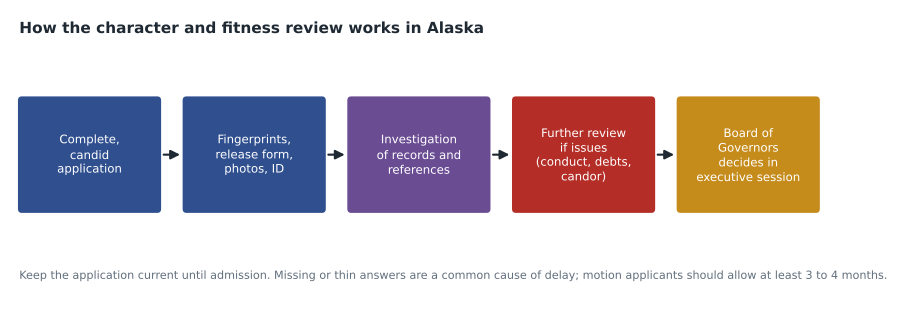
Alaska runs its own investigation. NCBE offers character and fitness investigation services to some jurisdictions, but Alaska does not use them, so applicants deal directly with the Alaska Bar Association. The process has four practical stages.
First, the application itself. It asks about education, employment, residences, other bar admissions, criminal and traffic history, civil litigation, financial obligations, academic and professional discipline and other topics. The questions are detailed, and many require documents such as court records or explanations.
Second, identity and authorization. The applicant submits a fingerprint card for a criminal history check, a notarized authorization and release that lets the Bar obtain records, photos and a copy of government identification.
Third, investigation. Staff review the answers, request records from schools, employers, courts and other bars, and follow up on anything incomplete or inconsistent.
Fourth, decision. For admission on motion, the Bar describes Board of Governors approval after the character investigation is complete, with applicants discussed only in executive session and notified of approval by email. For candidates who sit the exam, character and fitness approval must also be complete before admission. If a file raises serious concerns, the matter receives further review under the Bar Rules, and an applicant who is denied has procedures for review that ultimately lead to the Alaska Supreme Court.
The Bar advises motion applicants that processing can take at least three to four months, and that late fingerprint cards or release forms cause delays. Exam candidates should assume similar timing and file early, so that the investigation runs while they study.
What investigators look for
Bar examiners across the country tend to look at the same kinds of conduct. The question is always whether the applicant can be trusted to practice law honestly and competently today.
| Area | Examples | What helps |
|---|---|---|
| Candor | Omissions, inconsistent answers, misleading explanations | Complete, consistent answers with documents; correcting mistakes promptly |
| Criminal history | Convictions, arrests, diversion programs, DUI | Full disclosure, court records, evidence of rehabilitation and time passed |
| Financial responsibility | Unpaid debts, defaulted loans, judgments, bankruptcy | Payment plans, explanation of circumstances, steady progress |
| Academic and employment conduct | Honor code violations, terminations for cause | Records, context, references who know the full story |
| Substance use and conduct | Patterns of conduct that affect reliability | Evidence of treatment, monitoring and a sustained record of reliable conduct |
| Other bars and licenses | Discipline, unauthorized practice | Certificates of good standing and discipline histories |
One point deserves emphasis. Bar examiners generally focus on conduct, not on diagnoses. Seeking help for a health condition is not misconduct, and many jurisdictions, following national guidance, have narrowed or removed broad mental health questions in favor of questions about conduct. Read Alaska's current questions carefully and answer exactly what they ask.
Candor is the whole game
Marchetti tells every candidate the same story in different forms. An applicant has a minor shoplifting charge from age nineteen, dismissed after a diversion program. He does not list it, reasoning that a dismissed charge is not a conviction. The fingerprint check finds the arrest. Now the file contains two problems instead of one: the old incident, which by itself would probably not have mattered, and an omission on a sworn application, which looks like dishonesty in the very process meant to test honesty.
The lesson for Owen is mechanical. Read each question literally. If it asks about arrests, list arrests, even if charges were dropped. If it asks about traffic citations above a certain amount, check the amount. If you are unsure whether something is covered, disclose it with an explanation. Keep copies of everything you submit, and update the application if anything changes before admission, such as a new address, a new job or, rarely, a new citation.
Worked problem
Owen's three small items
Owen has (1) a 2019 parking ticket at college, paid late after a reminder; (2) a 2023 speeding citation on the Parks Highway, paid on time; (3) a semester in 2022 when he dropped to part-time status for a family emergency.
Show solution
- Read the questions: Does the form ask about parking tickets, or only moving violations? Above what amount? Does it ask about changes in enrollment status?
- Disclose whatever the questions cover, with dates, amounts and outcomes.
- Attach documents where helpful: a receipt for the speeding fine; a short explanation of the part-time semester, supported by the school's records if asked.
- Do not editorialize or minimize; state facts briefly and accurately.
Answer: None of the three is likely to cause concern on its own. Accurate, complete disclosure keeps them that way.
Rehabilitation and the passage of time
When an applicant does have real problems in their past, such as a criminal conviction, serious debts or past dishonesty, the question becomes rehabilitation. Bar examiners generally consider how serious the conduct was, how old the applicant was, how long ago it happened, whether it was repeated, whether the applicant took responsibility, and what the applicant has done since: treatment, restitution, years of reliable work, community service and honest references. An applicant in that position should consider consulting a lawyer who handles bar admission matters before filing, and should never assume a problem will go unnoticed.
The MPRE requirement
The Multistate Professional Responsibility Examination is NCBE's ethics exam. It is a separate test from the bar exam, given on its own dates at Pearson VUE test centers. It has 60 multiple-choice questions, of which 50 are scored and 10 are unscored pretest questions, and examinees have two hours. Scores are reported on a scale from 50 to 150.
Alaska requires a scaled score of 80 or higher. The score must come from an MPRE taken no more than eight years before the Alaska application, and NCBE sends it directly to the Bar. Unlike the application documents, the MPRE score does not have to be in hand before the exam; it may be submitted at any time before admission. Many candidates take the MPRE during law school, often in the spring or summer after their second year, so that it is done before bar study begins. The national range of required MPRE scores runs from 75 to 86, so Alaska's 80 sits in the middle; a candidate who passed with 80 elsewhere meets Alaska's requirement, while one who scored 78 for a jurisdiction requiring 75 does not.
| Fact | Alaska requirement |
|---|---|
| Minimum scaled score | 80 |
| Age of score | Taken no more than eight years before the application |
| When due | Any time before admission |
| How sent | Directly from NCBE to the Alaska Bar Association |
| Applies to | Exam applicants, transferred UBE scores and admission on motion |
Owen's score of 92, from August 2026, easily satisfies Alaska's rule, and it will remain usable until 2034 for an application filed within eight years of the test. Marchetti points out a practical benefit: if he later wants admission on motion in another state, a score that also meets a higher requirement elsewhere, such as 86, saves him from retaking the test.
Professional responsibility in Alaska practice
The MPRE tests the American Bar Association's Model Rules of Professional Conduct and related law, not Alaska's version. Alaska's Rules of Professional Conduct are based on the Model Rules, so the MPRE is good preparation, but Alaska lawyers practice under Alaska's text, comments and ethics opinions, which the Alaska Bar Association publishes. Lesson 11 describes two Alaska features that a new lawyer meets early: mandatory fee arbitration when a client requests it, and the continuing legal education requirement.
Common mistakes
MistakeLeaving off a dismissed charge because it is not a conviction.
InsteadAnswer each question literally; if it asks about arrests or charges, disclose them.
MistakeThinking the MPRE score must be filed with the application.
InsteadAlaska accepts the MPRE score any time before admission, from a test within eight years before the application.
MistakeAssuming Alaska uses NCBE for character and fitness.
InsteadAlaska conducts its own investigation; applicants deal directly with the Bar.
MistakeLetting the application go stale after filing.
InsteadApplicants must keep their answers current through the date of admission.
Timing your application around the investigation
Because the investigation runs in parallel with bar study, the best time to file is early. Owen files in late October, five weeks before the December 1 deadline. That gives investigators time to request his law school records and contact his references while he is still in the early weeks of review, and it leaves room to answer any follow-up questions before he enters the final, intense phase of study in January. An applicant who files on November 30 may find a request for an explanation arriving in mid-February, days before the exam.
Marchetti suggests a simple routine for follow-up requests: answer within a few days, in writing, with documents attached, and keep a copy. If a request asks about something you already disclosed, refer back to your answer and add whatever new detail is requested. Never treat a follow-up as an accusation; most are routine requests to complete the record.
Financial responsibility and student loans
Many applicants carry large student loan balances, and some worry that debt alone will cause problems. Debt by itself is generally not the issue. What bar examiners look for is how the applicant handles obligations: whether loans are in good standing, deferment or an income-driven repayment plan; whether the applicant has ignored judgments or collection actions; and whether the applicant was candid about financial problems. An applicant who has fallen behind should be able to show a realistic plan and steps already taken, such as a repayment agreement, before filing.
Other bar admissions and discipline
Applicants already admitted elsewhere must arrange for each bar to send a certificate of good standing and a discipline history issued within the previous three months. Those documents expire quickly in practice, so an applicant should request them close to the filing date and track their arrival. Any past discipline must be disclosed and explained; Alaska will see it in the discipline history anyway.
MPRE timing and strategy
The MPRE is given several times a year, usually in March, August and November, and registration closes weeks in advance with no late registration. NCBE's two-hour, computer-based test is offered at Pearson VUE centers, and there is no remote option. Results typically arrive several weeks after the test. A candidate who scores just under 80 can retake it after the bar exam and still be admitted, because Alaska accepts the score any time before admission, but a retake delays admission until the new score arrives. For that reason Marchetti urges candidates who have not yet passed the MPRE at 80 to take it before bar study begins, not after.
Owen's own preparation was modest: about two weeks of review using a commercial outline and practice questions, with a focus on conflicts of interest, confidentiality and the client-lawyer relationship, which together make up a large share of the test. His 92 gave him a comfortable margin.
Owen's character and fitness file
Owen's own file is ordinary. He lists every address since age eighteen, his summer jobs at a Fairbanks hardware store and a fish processor in Kodiak, his clerkship and two speeding tickets from college. He hesitates over the tickets, thinking they are too minor to matter, and Marchetti tells him to list them exactly as the form asks. Investigators do not penalize minor matters that are disclosed. What they notice is a minor matter that turns up in a records check after the applicant left it off.
Summary and key terms
- Alaska requires every applicant to show good character and fitness; the burden is on the applicant.
- The Bar runs its own investigation using the application, fingerprints, a release and records; it does not use NCBE's service.
- Candor matters most: omissions often cause more trouble than the underlying conduct.
- Rehabilitation, time passed and documented responsibility address real past problems.
- Alaska requires an MPRE score of 80 from a test within eight years before the application, filed any time before admission.
- Character and fitness
- The review of an applicant's honesty, reliability and conduct to decide whether they can be trusted with a law license.
- Candor
- Complete honesty, including disclosure of unfavorable facts when asked.
- Rehabilitation
- Evidence that an applicant has addressed past misconduct and now meets the character standard.
- MPRE
- The Multistate Professional Responsibility Examination, NCBE's two-hour, 60-question ethics exam scored from 50 to 150.
- Executive session
- A closed meeting; Alaska's Board of Governors discusses applicants only in executive session.
Practice problems
Work each problem on paper first, then reveal the answer to check.
An applicant scored 77 on the MPRE in 2021 and 82 in 2025. She applies in 2026. Does she meet Alaska's requirement?
Show answer
Yes, the 2025 score of 82 meets the 80 minimum and is within eight years.
Why might an omitted traffic ticket matter more than the ticket itself?
Show answer
Because an omission on a sworn application raises a candor problem, which goes to honesty, the core of the character inquiry.
Who decides an admission on motion application in Alaska?
Show answer
The Board of Governors, after the character investigation, discussing the applicant in executive session.
Lesson quiz · 5 questions
Score 60% or more to complete this lesson.
Create a free account to save your progress, take quizzes and earn a certificate.