
BAR-202 · Lesson 11 of 12 · 18 min
Score transfer, admission on motion and practice after admission
▶ Video coming soon A video version of this lesson is on the way.
Hollis Marchetti's study group includes people headed for many jurisdictions, and on a Tuesday call in November several of them want to know whether they could ever practice in Alaska without sitting its exam. Dana Whitfield, sitting the Texas exam in February, wonders about a future move to Anchorage. Marcus Bell already has a NextGen score from Missouri. Ngozi Adeyemi, sitting the New York exam, asks what happens if she is admitted in New York and later moves north. This lesson answers their questions: UBE and NextGen score transfer, admission on motion, other ways lawyers from elsewhere work in Alaska, and what a new Alaska lawyer must do to stay in good standing.
Transferring a UBE score
Bar Rule 2, Section 4 allows admission based on a UBE score earned elsewhere. An applicant who meets the general eligibility requirements of Section 1, or one of the Section 3 alternatives described in Lesson 2, may be admitted with a UBE scaled score of 270 or higher from an exam taken in any state, territory or the District of Columbia within five years before the application. The applicant still needs character and fitness approval and an MPRE score of 80 from a test within eight years.
Three limits trip people up. First, the score must be 270 or higher, Alaska's own passing standard, regardless of what the examinee needed where they sat. Second, the five-year window is measured to the date of the Alaska application. Third, Alaska does not accept transferred MBE scores by themselves; it is the full UBE score or nothing.
Dana does the arithmetic on the call. If she sits the Texas legacy UBE in February 2027 and scores at least 270, she can apply to transfer that score to Alaska until early 2032. A score of 266, which might pass in other UBE jurisdictions, would not be enough for Alaska.
Transferring a NextGen score
Alaska also accepts NextGen scores for transfer. The Bar described its NextGen proposal as allowing transfers beginning with the July 2026 exam, and NCBE's summary lists NextGen transfers as accepted from July 2026. The minimum is 620, the NextGen equivalent of Alaska's 270, and the same five-year limit applies. Marcus's July 2026 Missouri score of 648 qualifies, so he could seek Alaska admission by transfer until 2031, subject to character and fitness and the MPRE.
Admission on motion
A lawyer who has practiced elsewhere for several years can apply for admission on motion without any exam score at all. As amended by Supreme Court Order 2031, effective November 18, 2024, Bar Rule 2, Section 2 allows admission without examination for an applicant who meets the general requirements of Section 1 and has practiced law in one or more states, territories or the District of Columbia for three of the five years immediately preceding the application. The Bar's instructions require affidavits showing at least 750 hours of qualifying work in each of three of those five years, measured on a rolling basis from the application date. Before the amendment, the requirement was five of the last seven years and was limited to lawyers from reciprocal jurisdictions.
| Requirement | Admission on motion in Alaska |
|---|---|
| Practice | Three of the five years before applying, in any US state, territory or DC |
| Hours | At least 750 hours of qualifying work in each of the three years |
| Fee | 1,545 dollars (including a 3 percent transaction fee, effective January 15, 2026) |
| MPRE | 80 or higher, from a test within eight years before the application |
| Good standing | Certificates of good standing and discipline histories from every bar, issued within three months |
| Bar to eligibility | Unauthorized practice of law in Alaska |
| Timing | Character and fitness review typically takes at least three to four months |
An applicant who has engaged in the unauthorized practice of law in Alaska is ineligible for admission on motion. That rule has a practical edge: a lawyer who moves to Alaska and begins advising Alaska clients before admission can lose the motion route entirely. Applicants withdrawing before eligibility is determined forfeit a 200-dollar administrative fee, and the transaction fee is never refunded.
Ngozi's question has a clear answer. If she is admitted in New York in 2027 and practices there full time, she could apply for admission on motion in Alaska once she has three years of practice within the preceding five, without needing to transfer her UBE score. If she wanted to move sooner, she could transfer her New York UBE score, if it is 270 or higher and less than five years old.
Other ways lawyers from elsewhere work in Alaska
A lawyer licensed in another state who needs to appear in a single Alaska case can ask the court for permission to appear under Civil Rule 81, the Alaska rule on appearance by attorneys not admitted in Alaska, usually in association with an Alaska lawyer. The Alaska Bar Rules also contain limited categories and waivers for certain lawyers, which the Supreme Court amended in 2024 along with Bar Rule 2; anyone relying on one should read the current Bar Rules and confirm with the Bar. Federal practice is separate: admission to the United States District Court for the District of Alaska has its own rules.
Alaska does not currently offer a non-exam alternative pathway of the kind some states have adopted, such as Oregon's supervised practice portfolio or the experiential programs in Utah and Nevada. Its distinctive alternative is the clerkship route to the exam itself, described in Lesson 2.
After admission: membership and continuing legal education
Admission is the beginning, not the end. Every active Alaska lawyer must belong to the Alaska Bar Association, pay annual dues and comply with the Bar Rules and the Alaska Rules of Professional Conduct.
Continuing legal education is mandatory. Since January 1, 2025, active members must earn 12 CLE credits each calendar year, at least 3 of them in ethics, and report compliance by February 1 of the following year. The requirement increased for the 2025 reporting year; lawyers who remember a lower Alaska requirement should update their habits. New members begin reporting in the cycle after the year of admission: a lawyer admitted in 2027, for example, starts the cycle on January 1, 2028 and reports by February 1, 2029.
Fee disputes: mandatory arbitration
Alaska has an unusual fee dispute system. Under Bar Rule 34, when a client starts an arbitration of a fee dispute with an attorney through the Bar's fee dispute program, arbitration is mandatory for the attorney. A client, for this purpose, includes anyone legally responsible for paying the fees. Some disputes are excluded: those involving out-of-state attorneys who have no Alaska office and performed no material services in Alaska (unless they appeared under Civil Rule 81), claims seeking damages for malpractice or misconduct, fees fixed by statute, rule or court order, and certain stale disputes. Disputes over more than 50,000 dollars, or with complex issues or long expected hearings, can be designated complex, and the parties may then share costs.
The practical lesson for a new lawyer is to use clear written fee agreements, bill regularly and explain charges, because a dissatisfied client has a low-cost, Bar-run forum that the lawyer cannot decline.
Professional conduct
Alaska lawyers practice under the Alaska Rules of Professional Conduct, which follow the structure of the ABA Model Rules tested on the MPRE but with Alaska's own text, comments and ethics opinions. The Alaska Bar Association publishes ethics opinions and provides ethics resources for its members. When an ethics question comes up in practice, start with the Alaska rule and Alaska opinions, not the Model Rule you studied for the MPRE.
Worked problem
Three paths to Alaska
Dana (Texas UBE in February 2027, hoping for 272), Marcus (Missouri NextGen 648 in July 2026) and Ngozi (New York UBE in February 2027) each want to know their fastest route to Alaska admission in 2029.
Show solution
- Dana: if her score is 270 or more, transfer it (window open into 2032); MPRE 80 needed; character and fitness.
- Marcus: transfer his 648 NextGen score (620 needed; window open into 2031); MPRE and character and fitness.
- Ngozi: transfer her UBE score if 270 or more; or, after three years of New York practice, apply on motion.
- All three: avoid any Alaska practice before admission, which would bar the motion route and raise character questions.
Answer: Score transfer is the fastest route for all three if their scores meet Alaska's standards. Admission on motion becomes available after three years of practice.
Common mistakes
MistakeTransferring a 266 UBE score to Alaska.
InsteadAlaska requires 270 for transferred UBE scores.
MistakeRelying on the old five-of-seven-years motion rule.
InsteadSince November 18, 2024, three of the last five years of practice in any US jurisdiction suffices.
MistakeAdvising Alaska clients while a motion application is pending.
InsteadUnauthorized practice in Alaska makes an applicant ineligible for admission on motion.
MistakeAssuming CLE is still three ethics hours with a lower total.
InsteadSince 2025, Alaska requires 12 credits a year, including 3 ethics credits, reported by February 1.
Choosing between transfer and motion
For a lawyer who qualifies for both routes, the choice often comes down to timing and paperwork. Score transfer depends on a recent, high enough score and is available soon after the score is earned. Admission on motion depends on practice history and requires affidavits documenting hours over three years, but it does not depend on any exam score at all. Both require character and fitness review and the MPRE, so neither is a shortcut on those points. A lawyer whose score is about to pass the five-year mark should file for transfer before it expires; one whose score is too low or too old should build the practice record for motion.
Reporting CLE and keeping records
CLE compliance is reported each year by February 1 for the previous calendar year. Lawyers should keep certificates or records of attendance in case of audit, and should check whether a course is approved for Alaska credit and how ethics credit is designated. Live programs, recorded programs and programs from other jurisdictions may qualify under the Bar's rules and policies. A lawyer who misses the reporting deadline faces late fees and, eventually, suspension of the right to practice, so the deadline belongs on the calendar every January.
Membership status
The Alaska Bar Association distinguishes between active and inactive membership. Active members may practice and must meet the CLE requirement; inactive members pay lower dues but may not practice law in Alaska until they return to active status under the Bar's procedures. Lawyers who leave the state for a period often consider inactive status, and should understand what reinstatement requires before they choose it.
A word on unauthorized practice for new arrivals
Lawyers who move to Alaska before admission, whether to join a spouse, take a non-legal job or wait for a motion to be decided, must be careful not to practice Alaska law in the meantime. Giving legal advice to Alaska residents, drafting documents for them or holding oneself out as an Alaska lawyer can be unauthorized practice. Besides its ethical and legal risks, unauthorized practice disqualifies a lawyer from admission on motion. Working under a licensed Alaska lawyer's supervision in a non-lawyer role, with care about what one does and how one is described, is the usual safe course.
Judicial clerks and the path to practice
Many Alaska lawyers begin as law clerks to state or federal judges, as Owen has. Clerkships give new lawyers a close view of Alaska procedure and the local bar, and courts depend on clerks to keep their dockets moving. A clerk who has not yet passed the bar should check the court's policy on bar status, since some positions require admission within a set period after starting.
Back to the Tuesday call
By the end of the call, each member of the group has a plan. Dana will sit in Texas and keep the Alaska option open by aiming for 270, not just the Texas passing score. Marcus will collect his NextGen score report and his MPRE score in case he decides to file in Alaska. Ngozi will focus on New York and revisit Alaska later, knowing that admission on motion will be available after three years of practice. Owen, the only one sitting in Alaska, offers to share what he learns about Alaska practice with anyone who moves north.
Summary and key terms
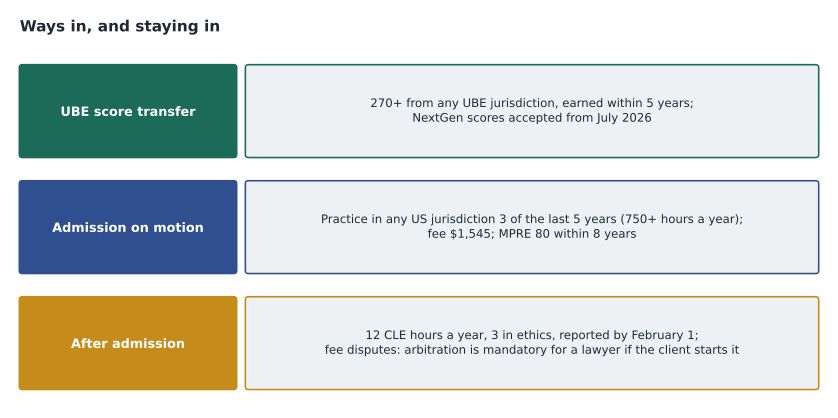
- UBE scores of 270 or more from any UBE jurisdiction, earned within five years, transfer to Alaska; MBE-only scores do not.
- NextGen scores of 620 or more transfer from July 2026 onward.
- Admission on motion requires three of the last five years of practice (750 hours a year), a 1,545-dollar fee, an MPRE of 80 and no unauthorized practice in Alaska.
- Active members must earn 12 CLE credits a year, 3 in ethics, reported by February 1.
- Fee arbitration under Bar Rule 34 is mandatory for the attorney when the client starts it.
- Score transfer
- Admission based on a UBE or NextGen score earned in another jurisdiction.
- Admission on motion
- Admission without examination based on prior practice elsewhere.
- Unauthorized practice of law
- Practicing law in a jurisdiction without a license there.
- Civil Rule 81
- The Alaska rule governing appearances by attorneys not admitted in Alaska.
- MCLE
- Mandatory continuing legal education.
Practice problems
Work each problem on paper first, then reveal the answer to check.
A lawyer licensed in Idaho practiced there 2022 to 2025 and moved to Alaska in January 2026 without working. In November 2026, may she apply on motion?
Show answer
Yes, if her 2022 to 2025 practice gives her three qualifying years within the five years before the application, at 750 hours a year.
When must an Alaska lawyer report CLE for calendar year 2027?
Show answer
By February 1, 2028.
A client disputes a 12,000-dollar bill and files with the Bar's fee dispute program. May the lawyer refuse to arbitrate?
Show answer
No; arbitration is mandatory for the attorney when the client commences it.
Lesson quiz · 5 questions
Score 60% or more to complete this lesson.
Create a free account to save your progress, take quizzes and earn a certificate.