
BAR-202 · Lesson 1 of 12 · 19 min
Becoming a lawyer in Alaska
▶ Video coming soon A video version of this lesson is on the way.
Owen Kasparek joins Hollis Marchetti's Tuesday study group in October 2026 with a question nobody else in the group has asked: 'Where do I even sit the exam?' Owen grew up in Fairbanks, finished law school in Washington State in May 2026 and came home to clerk for a superior court judge. He plans to sit the Alaska bar exam in February 2027. Marchetti, who has coached candidates for fifteen years, has prepared people for Alaska before, and she opens a separate call with him to walk through the whole path, from application to oath.
This course is that walk-through. It covers how a person becomes a lawyer in Alaska: who controls admission, who is eligible, what character and fitness review involves, what the exam looks like and what score passes, how the move to the NextGen bar exam will work, and which parts of Alaska law a new lawyer meets first. It ends with original practice questions and an exam-day plan. Every practice question in the course is written for it; none comes from the National Conference of Bar Examiners (NCBE) or from released Alaska materials.
One caution runs through every lesson. Fees, deadlines and rules change, sometimes several times a year. The facts in this course were checked against the Alaska Bar Association's admissions pages, the Alaska Bar Rules, Alaska statutes and NCBE's published charts as of November 2026. Before you rely on any number, confirm it with the Alaska Bar Association, because that office, not this course and not NCBE, decides who is admitted.
Who admits lawyers in Alaska
In every state the highest court has the final say over who may practice law, and Alaska is no exception. The Alaska Supreme Court adopts the Alaska Bar Rules, which govern admission, discipline and the bar's other functions. The Alaska Bar Association runs the admission process day to day. It is an integrated, or unified, bar: every lawyer who practices in Alaska must belong to it, and the same organization that admits lawyers also collects dues, runs continuing legal education and handles discipline.
Within the Bar Association, the Law Examiners Committee is responsible for the bar examination, and the Board of Governors makes the admission decisions after character and fitness review is complete. The admissions office is in Anchorage, at 840 K Street. The Supreme Court still acts at key points: it adopts the rule changes that shape admission, and in 2023 and 2024 it issued orders that lowered the passing score and rewrote eligibility, which later lessons describe. In 2026 it issued the order that prepares Alaska for the NextGen exam.
Marchetti puts it simply for Owen: 'The court writes the rules, the Bar runs the process, and the Board of Governors says yes or no. Your job is to give all three of them a complete, honest file.'
The path at a glance
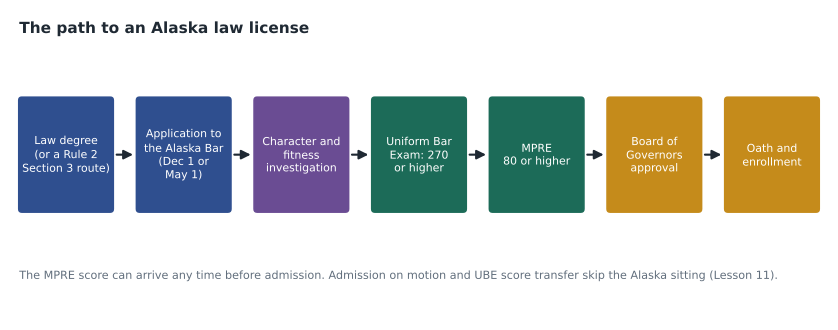
Most candidates follow the same sequence. They earn a law degree, normally a JD from a law school approved by the American Bar Association. They file an application with the Alaska Bar Association by the deadline for the exam they want, December 1 for February or May 1 for July. While they study, the Bar investigates their character and fitness. They sit the Uniform Bar Examination (UBE) in Anchorage, Fairbanks or Juneau and need a combined scaled score of 270 or higher. Separately, they take the Multistate Professional Responsibility Examination (MPRE) and need a scaled score of 80. When everything is in, the Board of Governors votes on admission, and the new lawyer takes the oath and enrolls as a member of the Bar.
Some lawyers skip the Alaska sitting entirely. A lawyer who already earned a UBE score of 270 or higher in another UBE jurisdiction within the last five years can ask to transfer it. A lawyer who has practiced for three of the last five years elsewhere can apply for admission on motion. Lesson 11 covers both routes. This course focuses mainly on the candidate who will sit the exam in Alaska.
Alaska's unusual starting point: no law school
Alaska is the only state without a law school of its own. Every Alaska lawyer who trained in a JD program earned the degree outside the state or through a program run by an out-of-state school. That fact shapes the profession in several ways.
First, most new Alaska lawyers have studied the law of some other place. Law schools teach national doctrine, and many examples in class come from the school's home state. Owen learned Washington civil procedure examples in his first year; his clerkship now runs on the Alaska Rules of Civil Procedure. Second, Alaska depends heavily on lawyers who move in from elsewhere, which is one reason admission on motion and UBE score transfer matter so much here. Third, the state has worked to create pathways closer to home. In October 2024 the University of Alaska Anchorage and Seattle University School of Law created an Alaska Hybrid Hub that supports Alaskans studying in Seattle University's part-time, largely online Flex JD program. In July 2026 the University of Alaska Southeast and Mitchell Hamline School of Law announced a direct-admission agreement and a three-plus-three program in which students begin law school in their final undergraduate year.
There is also an older path that does not run through a full JD at all. Alaska's Bar Rule 2 lets a person who has completed one academic year at an approved law school and then a law clerkship program sit for the bar exam. Lesson 2 explains that route and its limits. It is rare, but it reflects Alaska's long-standing interest in letting people train where they live.
Geography and the practice of law
Alaska is enormous and thinly populated, and much of it is not connected to the road system. Courts sit in the larger towns, and many communities are served by magistrate judges, by circuit-riding judges or by remote hearings. Lawyers in Anchorage, Fairbanks and Juneau often represent clients from villages that can be reached only by plane or boat. The state's legal community talks openly about legal deserts: places with too few lawyers to meet people's needs.
For a bar candidate, geography matters in practical ways. The exam is given in three cities, and travel in February can be unpredictable. Candidates from smaller communities budget for flights and lodging, and many arrive a day or two early. Character and fitness investigators may need records from several places. And once admitted, a new lawyer may practice in a community where the nearest colleague is hundreds of miles away, which makes professional judgment, careful file management and the support of the Bar Association's programs especially valuable.
What makes Alaska law distinctive
The Alaska bar exam is the UBE, so the exam itself does not test Alaska law. Alaska has no separate state-law component on the exam, no required Alaska law course before admission and no Alaska essay day. But a new Alaska lawyer quickly meets a body of law that looks different from what most law schools teach. This course spends four lessons on it, because it is what you will use in your first months of practice and what employers, judges and clients will expect you to know.
| Area | What is distinctive in Alaska | Lesson |
|---|---|---|
| Civil procedure | Civil Rule 82 awards partial attorney's fees to the prevailing party in most civil cases, and statutory offers of judgment shift actual fees. | 7 |
| Torts | Pure comparative fault, several liability and statutory caps on noneconomic damages, applied after fault is allocated. | 8 |
| Alaska Native law | The Alaska Native Claims Settlement Act created Native corporations instead of reservations; tribes keep inherent powers but generally lack Indian country. | 9 |
| Property and family | Opt-in community property by agreement or trust, trust-friendly statutes, and a domestic violence presumption in custody cases. | 10 |
| Constitutional law | An express right of privacy in the Alaska Constitution and independent state-law protections, such as the Ravin and Glass decisions. | 6 |
Marchetti is careful to keep the two jobs separate. 'Until February, your study plan is the UBE and nothing else,' she tells Owen. 'The Alaska material is for after the exam, or for the evenings when you need a break from the MBE. Do not let it crowd out what you will actually be scored on.'
The calendar for a February 2027 candidate
Owen's year has a clear shape. His application for the February 23 and 24, 2027 exam is due by December 1, 2026, along with any request for testing accommodations. He needs fingerprints, an authorization and release form, photos and a copy of government identification. His law school must send a certificate of graduation directly. He took the MPRE in August 2026 and plans to have the score sent before admission. If he passes in February, results usually arrive about 90 days after the exam, in late May, and admission follows once the Board of Governors approves his file.
| Date | Step | Notes |
|---|---|---|
| December 1, 2026 | Application and accommodation requests due for February 2027 | First-time application fee 876 dollars; laptop registration 129 dollars |
| February 3, 2027 | Last day to withdraw with a partial refund | A 50-dollar cancellation fee applies; later withdrawals get no refund |
| February 23 and 24, 2027 | Uniform Bar Examination | Anchorage, Fairbanks or Juneau |
| About late May 2027 | Results | Usually about 90 days after the exam |
| After results | Board of Governors approval, oath, enrollment | MPRE score of 80 must be on file before admission |
A note on terms
Alaska uses ordinary American legal vocabulary, with a few local habits. Lawyers often call the rest of the United States 'Outside' or 'the Lower 48.' The Alaska Bar Association is often just 'the Bar.' The Supreme Court's rule orders are numbered: you will see references such as SCO 2002 or SCO 2054, short for Supreme Court Order. Statutes are cited as AS followed by title, chapter and section, so AS 09.17.010 is title 9, chapter 17, section 10. Court rules are cited by name: Civil Rule 82, Bar Rule 2, Evidence Rule 803. Learn to read those citations now; they will be everywhere in your clerkship or first job.
Worked problem
Is Owen on track?
It is mid-October 2026. Owen has his JD, an MPRE score of 92 from August, and a job offer that depends on admission. He has not started his Alaska application. He assumes he can file in January because the exam is in late February.
Show solution
- Find the deadline: applications for the February 2027 exam are due December 1, 2026.
- List what takes time: fingerprints, the notarized release, photos, the law school certificate sent directly by the school, and a complete set of character and fitness answers.
- Check the MPRE: 92 exceeds Alaska's 80, and a score taken within eight years before the application is acceptable; it can arrive any time before admission.
- Plan around the job: results usually come about 90 days after the exam, so admission is unlikely before June 2027.
Answer: Owen must file by December 1, not January. He should start the application now, order fingerprints and the school certificate this month, and tell his employer that admission is likely in early summer 2027.
Common mistakes
MistakeAssuming the Alaska bar exam includes an Alaska law essay.
InsteadAlaska gives the UBE with no state-law component; Alaska law is learned for practice, not for the exam.
MistakeTreating the MPRE as part of the exam weekend.
InsteadThe MPRE is a separate exam given on its own dates; Alaska needs a scaled score of 80, which can be filed any time before admission.
MistakeThinking the Bar Association's staff make the final admission decision.
InsteadThe Board of Governors votes on admission after character and fitness review, under rules the Supreme Court adopts.
MistakeWaiting until the new year to apply for a February exam.
InsteadThe February deadline is December 1 and the July deadline is May 1.
How this course is organized
The twelve lessons follow the order in which a candidate meets each issue. Lessons 2 through 5 cover the admission process and the exam: eligibility, the application, character and fitness, the MPRE, the UBE as Alaska gives it, and the change to the NextGen exam in 2028. Lesson 6 marks the boundary between what the exam tests and what Alaska practice requires. Lessons 7 through 10 introduce the Alaska law a new lawyer needs first. Lesson 11 covers score transfer, admission on motion and the obligations that begin after admission, and Lesson 12 is a capstone. Each lesson ends with a short quiz, and the course ends with a final exam.
Owen uses the course in two passes. Before February, he reads Lessons 2 through 6 and 11 closely, because they affect his application and his exam strategy, and skims the rest. After the exam, while he waits for results, he returns to Lessons 7 through 10 and works through them with his clerkship files beside him.
Summary and key terms
- The Alaska Supreme Court adopts the Bar Rules; the Alaska Bar Association, an integrated bar, runs admission; the Board of Governors decides.
- The usual path: law degree, application by December 1 or May 1, character and fitness review, UBE score of 270 or more, MPRE score of 80, approval and oath.
- Alaska has no law school, so most new lawyers trained elsewhere; newer programs and the clerkship route offer paths closer to home.
- The exam is the UBE with no Alaska component, but Alaska law in civil procedure, torts, Native law, property and family law matters immediately in practice.
- Deadlines and fees change; confirm every number with the Alaska Bar Association.
- Integrated bar
- A bar association to which every licensed lawyer in the state must belong; also called a unified bar.
- Board of Governors
- The governing body of the Alaska Bar Association, which votes on admission after character and fitness review.
- Law Examiners Committee
- The Alaska Bar committee responsible for the bar examination.
- SCO
- Supreme Court Order; the numbered orders by which the Alaska Supreme Court adopts and amends court rules.
- Outside
- Alaskan shorthand for the rest of the United States, also called the Lower 48.
Practice problems
Work each problem on paper first, then reveal the answer to check.
Who has final authority over admission to the Alaska bar?
Show answer
The Alaska Supreme Court, which adopts the Bar Rules; the Bar Association's Board of Governors makes individual admission decisions under those rules.
Name two features of Alaska's bar exam that differ from states with a state-law component.
Show answer
There is no Alaska essay or multiple-choice component and no required Alaska law course; the exam is the UBE alone.
Why do admission on motion and score transfer matter more in Alaska than in many states?
Show answer
Alaska has no law school and relies heavily on lawyers who move in from elsewhere.
Lesson quiz · 5 questions
Score 60% or more to complete this lesson.
Create a free account to save your progress, take quizzes and earn a certificate.