
BAR-202 · Lesson 2 of 12 · 18 min
Eligibility, education and application deadlines
▶ Video coming soon A video version of this lesson is on the way.
A week after their first call, Owen sends Marchetti a screenshot of the Alaska Bar Association's application checklist with one line highlighted: 'graduates of an ABA-accredited law school unless they qualify under Bar Rule 2, Section 3.' He wants to know whether that matters to him. It does not, because his school is ABA-approved. But two people he knows from his clerkship are in different positions: a paralegal who left law school after one year to work in Fairbanks, and a lawyer trained in England who now lives in Juneau. This lesson covers eligibility for all three, then the paperwork, fees and deadlines every applicant must meet.
The general rule: Bar Rule 2, Section 1
Bar Rule 2 sets out who may be admitted. A general applicant must file the required application and supporting proof, hold a JD or LLB from a law school approved by the American Bar Association or by the Association of American Law Schools (or show that the degree will be completed before the exam), be at least 18 years old, and show conduct that justifies the trust of clients, adversaries, courts and the public. The last requirement is character and fitness, which Lesson 3 covers.
Two points about the degree requirement are worth noticing. First, the rule speaks of approval by the ABA or the AALS, not ABA approval alone. Second, the degree can be pending at the time of application, as long as it is complete before the exam; Alaska's checklist requires a certificate of graduation sent directly by the law school on its letterhead. Owen's school will send his certificate in November.
The alternatives: Bar Rule 2, Section 3
Section 3 lets some people who do not hold a qualifying law degree sit for the exam as general applicants. The Alaska Supreme Court rewrote Section 3 in Supreme Court Order 2031, effective November 18, 2024. As amended, it recognizes three routes.
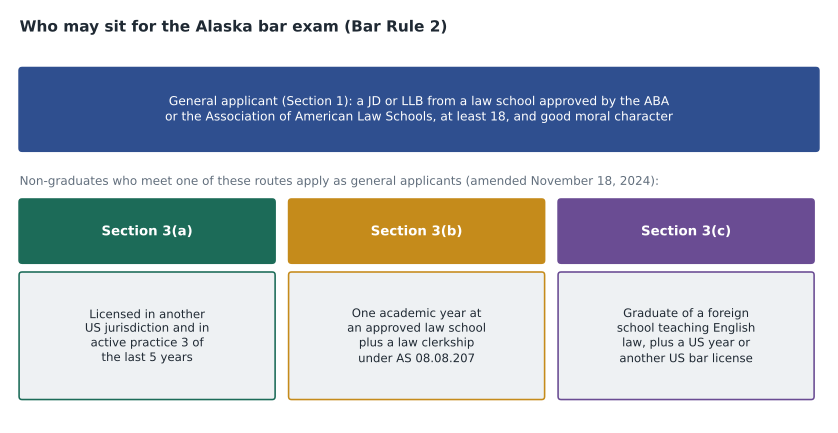
Section 3(a) covers lawyers already licensed in another United States jurisdiction who have been in active practice for three of the five years before applying. This route helps, for example, a graduate of a state-accredited but not ABA-approved school who was admitted in that state and practiced there. Before the 2024 amendment, the requirement was five of the last seven years.
Section 3(b) is Alaska's clerkship route. An applicant who has completed at least one academic year at an ABA- or AALS-accredited law school and then completed a law clerkship program under AS 08.08.207 may sit for the exam. The statute governs law clerks studying in a law office under the supervision of a lawyer. The route is demanding: the applicant has to arrange supervision, complete the program the statute and the Bar require, and then pass the same UBE as everyone else, without the structure of a full JD. Owen's paralegal friend is interested. Marchetti's advice is to read AS 08.08.207 and the current Bar Rules closely and to call the admissions office before committing years to it, because the details of the program are set by the statute and the Bar, not by this course.
Section 3(c) covers graduates of foreign law schools that teach English law, in other words common law schools, if the school meets the standards the rule describes. The applicant must also have either completed a year at an accredited United States law school, including courses in United States constitutional law and civil procedure, or be a member in good standing of the bar of another United States jurisdiction admitted after a written exam. Owen's England-trained acquaintance would need one of those two additions; an LLM year that includes the two required courses is the most common way to qualify.
Under Section 3(d), proof of graduation or attendance, and any required certificate of good standing, must reach the Bar before the exam date.
| Route | Who it fits | Key requirement |
|---|---|---|
| Section 1 | JD or LLB graduates of ABA- or AALS-approved schools | Degree complete before the exam; certificate sent by the school |
| Section 3(a) | Lawyers licensed elsewhere without a qualifying degree | Active practice in three of the last five years |
| Section 3(b) | People with one year of approved law school who train as law clerks | A clerkship program under AS 08.08.207 |
| Section 3(c) | Graduates of foreign common law schools | A US law school year with constitutional law and civil procedure, or another US bar license by written exam |
NCBE's published summary of Alaska's rules reflects the same picture: a JD from an ABA-approved school is not the only way in, and foreign law graduates can be eligible. As always, the rule itself controls, and a reader with an unusual history should ask the admissions office for a written answer before applying.
Who may not sit: no courtesy seating
Alaska does not offer courtesy seating. Every applicant must certify that the purpose of taking the exam is admission to the Alaska Bar. A candidate who simply wants a UBE score to transfer somewhere else should sit in the jurisdiction where they want to practice or in a UBE jurisdiction that allows courtesy seating. Since a UBE score earned in Alaska can be transferred elsewhere, the rule is about honest purpose, not about restricting where scores go.
What goes into an application
Alaska's application has three parts: what the applicant submits, what third parties send directly, and optional supplemental materials.
The applicant submits the application or reapplication form; the application fee; a notarized authorization and release form; a photo submission form with two passport-style photos mailed to the Bar; one fingerprint card mailed to the Bar; and, for new applications since October 1, 2025, a copy of a federal I-9 identity document, a government-issued identification card or a driver's license.
Third parties send directly to the Bar the law school's certificate of graduation; the applicant's MPRE score of 80 or higher, from an exam taken no more than eight years before the application (this can arrive any time before admission); and, for applicants already admitted elsewhere, certificates of good standing and discipline histories from each bar, issued within the previous three months.
Supplemental materials include a testing accommodations request, due December 1 for February or May 1 for July, with part of the form submitted directly by the professional who completes it; a Standard Form 180 for applicants with military service, which lets the Bar obtain military records; and, for resident aliens, an affidavit verifying status with United States Citizenship and Immigration Services.
Marchetti tells Owen to treat the checklist as a contract. 'Every item has to be there before the Bar sends exam permits, which happens several weeks before the exam. If something is missing then, the application to sit is denied. Not delayed. Denied.'
Fees
The Alaska Bar Association publishes its fees with each exam's dates, and they include a 3 percent transaction fee that is never refunded. For the February and July 2027 exams, the published fees are 876 dollars for a first-time general application, 618 dollars for a reapplicant, and 129 dollars to register to use a laptop. Applicants for admission on motion pay a separate fee, 1,545 dollars as of January 15, 2026. The Supreme Court's 2026 order preparing for the NextGen exam also authorizes the Board of Governors to set a fee for late-filed applications, so check the current schedule if you are near a deadline.
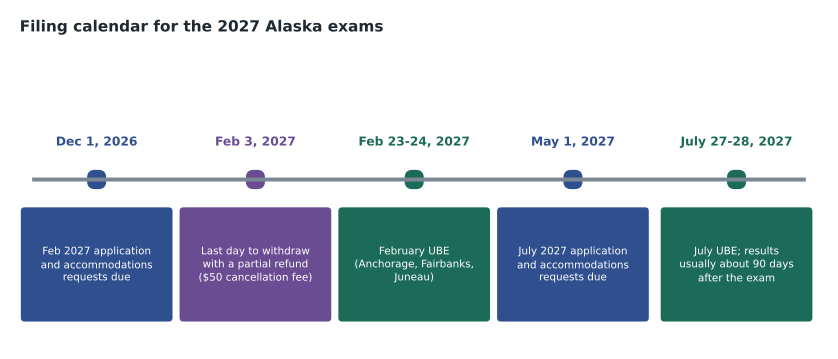
Withdrawal rules also matter. For the February 2027 exam, an applicant who withdraws by February 3, 2027 receives a partial refund less a 50-dollar cancellation fee; withdrawals after that date receive no refund. The July 2027 exam has its own withdrawal date, which candidates should confirm on the Bar's site.
Deadlines in detail
The basic deadlines are easy to remember: December 1 for the February exam and May 1 for the July exam. Reapplicants follow a slightly different schedule. For the July 2027 exam, a reapplicant who sat in July 2026 files by May 1, 2027, while one who sat in February 2027 has until May 31, 2027, because February results arrive only in late spring.
Accommodation requests share the application deadline. Candidates who need extra time, a separate room, assistive technology or other accommodations should start early, because supporting documentation from a doctor or psychologist takes time to gather.
Laptop registration is separate from the application. Most candidates type their essays and performance tests, which requires registering for the exam software and paying the laptop fee. Candidates testing in Anchorage with a laptop also complete a specific form. Read the Bar's laptop instructions when you register, not the week before the exam.
Owen's application, step by step
Worked problem
Building Owen's file
Owen holds a JD from an ABA-approved school (May 2026), has an MPRE score of 92 from August 2026, is not admitted anywhere else, has no military service, and wants to type his answers. It is October 20, 2026.
Show solution
- Eligibility: Section 1 general applicant; his degree is complete.
- Applicant items: application, 876-dollar fee, notarized release, photo form with two photos, fingerprint card, copy of his driver's license.
- Third-party items: certificate of graduation from his law school; MPRE score report from NCBE.
- Not needed: certificates of good standing (not admitted elsewhere), Standard Form 180, resident alien affidavit.
- Extras: laptop registration (129 dollars) and the Anchorage laptop form if he tests there.
- Calendar: file everything well before December 1; note February 3 as the last partial-refund date.
Answer: Owen's file is simple. The risks are timing items he does not control: the law school certificate, fingerprint processing and mail. He should request those this week.
The clerkship route in more depth
Because the clerkship route is so unusual, Marchetti spends a few minutes on it for the paralegal's sake. The route combines one year of formal law school with supervised study in a law office. The supervising lawyer takes on a real teaching responsibility, and the clerk must still master every subject the UBE tests, from civil procedure to secured transactions on the MPT, without a law school's courses, outlines or bar support. Candidates on this route often buy a commercial bar course and add months of extra study.
There are reasons to consider it. It can cost far less than a full JD, it lets a person keep working and living in their community, and Alaska's rules expressly allow it. There are also reasons for caution. A UBE score earned this way may not transfer to every jurisdiction, because some jurisdictions require a JD from an ABA-approved school for admission by transferred score or on motion. A candidate on this route should assume they are building a career in Alaska.
Foreign-educated applicants and the LLM
For lawyers trained abroad, Section 3(c) is the gateway. The applicant's foreign school must teach English law, the common law tradition, which excludes most civil law countries. The applicant then needs either a year at an accredited American law school that includes United States constitutional law and civil procedure, or membership in another American bar admitted by written exam. Many foreign-trained lawyers take an LLM that includes those two courses. If they plan to sit in Alaska, they should check before enrolling that the LLM's courses and structure meet Alaska's requirement, which is not identical to New York's or California's rules for foreign-educated applicants.
Common mistakes
MistakeAssuming only ABA graduates can sit in Alaska.
InsteadSection 3 allows certain licensed lawyers, clerkship candidates and foreign common law graduates to sit.
MistakeRelying on the old five-of-seven-years practice requirement.
InsteadSince November 18, 2024 the Section 3(a) and motion requirements are three of the last five years.
MistakeFiling the application and assuming the school will send the certificate later.
InsteadAll required items must arrive before permits issue, or the application to sit is denied.
MistakeRegistering to sit in Alaska only to obtain a transferable score.
InsteadAlaska offers no courtesy seating; applicants must certify they seek Alaska admission.
A checklist habit
Marchetti gives every applicant the same habit: keep a single page listing each required item, who sends it, the date requested, the date the Bar confirmed receipt, and any follow-up. For Owen, that page has nine lines. It turns a stressful process into a set of small, checkable tasks, and it gives him something concrete to show if anything goes missing in the mail between Washington and Anchorage.
Keeping the file current
Filing the application is not the last contact with the Bar before the exam. An applicant must update the application promptly when something changes, such as a new address, a new job, a traffic citation or a court matter. Owen sets a reminder to review his answers each month until admission, since an omission discovered later is treated far more seriously than a late update.
Summary and key terms
- General applicants need a JD or LLB from an ABA- or AALS-approved school, must be at least 18 and must show good character.
- Section 3 routes cover lawyers licensed elsewhere with three of five years of practice, clerkship candidates with one year of law school, and foreign common law graduates with a US year or another US license.
- The application includes a fee, notarized release, photos, fingerprints, identification, and directly sent school, MPRE and good-standing documents.
- Deadlines are December 1 (February) and May 1 (July); accommodations share the deadline; the 2027 fees are 876 dollars (first-time) and 618 dollars (reapplicant).
- Alaska offers no courtesy seating.
- General applicant
- An applicant who meets Bar Rule 2, Section 1, or qualifies through Section 3 and sits for the exam.
- Clerkship route
- Bar Rule 2, Section 3(b): one year at an approved law school plus a law clerkship under AS 08.08.207.
- Courtesy seating
- Letting a person sit a jurisdiction's exam without seeking admission there; Alaska does not allow it.
- Certificate of good standing
- A document from another bar confirming an applicant is licensed and not suspended.
- Standard Form 180
- The federal form used to request military service records.
Practice problems
Work each problem on paper first, then reveal the answer to check.
A lawyer admitted in California after graduating from a California-accredited, non-ABA school has practiced there for four years. May she sit in Alaska?
Show answer
Yes, under Section 3(a), if she has been in active practice for three of the five years before applying.
What happens if Owen's law school certificate has not arrived when exam permits are issued?
Show answer
His application to sit is denied for that exam.
By when must a July 2027 reapplicant who sat in February 2027 file?
Show answer
May 31, 2027.
Lesson quiz · 5 questions
Score 60% or more to complete this lesson.
Create a free account to save your progress, take quizzes and earn a certificate.