
BAR-202 · Lesson 10 of 12 · 20 min
Alaska property, trusts and family law
▶ Video coming soon A video version of this lesson is on the way.
Two weeks before Thanksgiving, Owen's aunt calls him with a question she heard at a retirement seminar in Seattle. A speaker had said that married couples from anywhere in the country could set up an 'Alaska community property trust.' She wants to know whether that is real, and whether it has anything to do with the divorce her neighbor is going through. Owen tells her, correctly, that he cannot give her legal advice and that she should talk to a lawyer licensed where she lives. But the question sends him to the Alaska statutes, and it opens this lesson on three areas where Alaska law stands out: opt-in community property, trust law, and family law, especially custody and the domestic violence presumption.
Alaska is a separate property state, unless spouses opt in
The United States has two marital property systems. Most states are common law, or separate property, states: property belongs to the spouse who acquired it, though divorce courts divide marital property equitably. Nine states are traditional community property states, where property acquired during marriage generally belongs to both spouses equally. Alaska belongs to neither group cleanly. It is a separate property state by default, but since 1998 it has allowed spouses to choose community property by agreement or trust under the Alaska Community Property Act, AS 34.77.
The basic rule is in AS 34.77.030: property of spouses is community property only to the extent provided in a community property agreement or a community property trust. Spouses may make all of their property, or only specific property, community property. When an agreement covers all property acquired during the marriage, property acquired after the agreement takes effect is presumed to be community property, and income from community property is community property. Even under an all-property agreement, some acquisitions stay individual unless the spouses expressly provide otherwise, such as gifts and inheritances to one spouse, property exchanged for individual property and certain personal injury recoveries. Property a spouse owned before the marriage is not community property unless the agreement expressly includes it. Each spouse has a present, undivided one-half interest in community property.
The community property trust
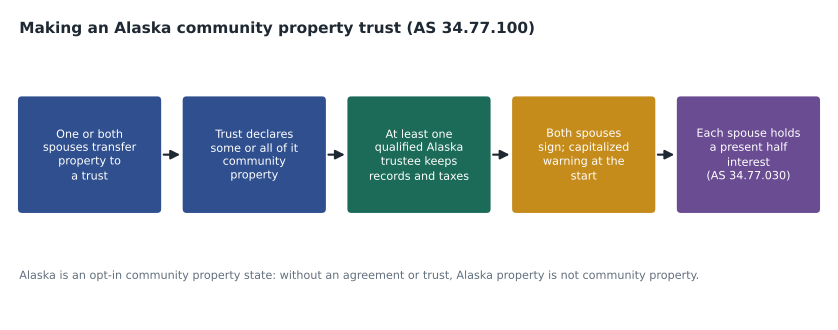
AS 34.77.100 describes the community property trust. One or both spouses transfer property to a trust that expressly declares some or all of the property to be community property under the chapter. At least one trustee must be a qualified person, meaning an individual who resides in Alaska and intends to remain, an Alaska trust company with its principal place of business in Alaska, or a bank with trust powers and its principal place of business in Alaska. That trustee's powers must include maintaining the trust's records and preparing or arranging for preparation of its income tax returns. Both spouses must sign, and either or both may also serve as trustees. The trust is enforceable without consideration.
The statute requires a warning, in capital letters, at the beginning of the trust document, telling the spouses that the consequences of the trust may be very extensive and advising them to seek competent advice. A trust made during marriage can be held unenforceable if the challenging spouse proves that it was unconscionable when made, that it was not signed voluntarily, or that the spouse did not receive adequate disclosure, did not waive disclosure in writing and lacked notice of the other spouse's property and obligations. Unconscionability is decided by the court as a matter of law. The trust cannot adversely affect a child's right to support.
This is where the retirement seminar came from. The residency requirement in the statute applies to the trustee, not to the spouses, and estate planners have used Alaska community property trusts for couples who live in other states, in part because of how federal income tax law treats community property when the first spouse dies. Whether a particular couple benefits, and whether their home state will respect the classification, are questions for a lawyer who handles estate planning and tax for them. For a new Alaska lawyer, the point is to recognize the statute and the trust's formal requirements.
Worked problem
Does this document create a community property trust?
An Anchorage couple sign a trust agreement naming themselves and an Alaska trust company as trustees. The document transfers their brokerage account to the trust and states that the account is community property under AS 34.77. It begins with the statutory warning in capital letters. The trust company is responsible for records and tax returns.
Show solution
- Transfer of property to a trust by the spouses: yes, the brokerage account.
- Express declaration that it is community property under the chapter: yes.
- Qualified person as trustee with record and tax duties: yes, an Alaska trust company.
- Both spouses sign; warning at the start: yes.
Answer: The document meets AS 34.77.100's formal requirements. Each spouse has a present one-half interest in the account.
Divorce and the division of property
In a divorce, an Alaska court divides the spouses' marital property, not their separate property, and it does so equitably, considering factors set out by statute, such as the length of the marriage, the parties' circumstances and earning capacities, and their conduct concerning the property. Classification comes first: the court decides what is marital and what is separate, and whether separate property has been transmuted into marital property through the parties' intent and conduct. The court then values the marital estate and divides it. The Permanent Fund Dividend, an annual payment to qualifying Alaska residents from the earnings of the state's oil-wealth fund (1,200 dollars in 2026, including a 200-dollar energy relief payment), can appear in divorce and support cases, as can the dividends Alaska Native corporations pay their shareholders.
Trust law: a trust-friendly state
Alaska has deliberately made itself attractive for trusts. In 1997 the legislature enacted the Alaska Trust Act. Two features drew national attention. First, it permitted self-settled spendthrift trusts, often called asset protection trusts, in which a person creates a trust for their own benefit and creditors generally cannot reach the trust assets, subject to exceptions such as fraudulent transfers, trusts the settlor can revoke, required distributions to the settlor and child support defaults. Alaska and Delaware were the first two states to allow them, both in 1997. Second, it effectively abolished the rule against perpetuities for most Alaska trusts, allowing trusts that can last for generations. The Act also lets trusts choose Alaska law and Alaska courts when some assets are held in Alaska and administered by an Alaska trustee.
These statutes have been amended since 1997, and their effect in other states' courts and in bankruptcy is a recurring question, so a practitioner must work from the current text and current case law. For bar candidates and new lawyers, the takeaway is recognition: when a client or document mentions an Alaska trust, ask whether it is a community property trust, an asset protection trust, a dynasty trust or an ordinary trust, because each raises different questions.
Probate
Alaska's probate code, in title 13 of the Alaska Statutes, is based on the Uniform Probate Code, which Alaska adopted in the 1970s. Concepts familiar from the UPC, such as informal and formal probate, the elective share, the treatment of holographic wills and nonprobate transfers, appear in Alaska law, though always with Alaska's own text and amendments. A lawyer who learned the UPC in law school has a head start, but must check the Alaska statute.
Custody: the best interests of the child
Alaska custody decisions turn on the best interests of the child under AS 25.24.150(c). The court must consider a list of factors: the child's physical, emotional, mental, religious and social needs; each parent's capability and desire to meet those needs; the child's preference, if the child is of sufficient age and capacity; the love and affection between the child and each parent; the length of time the child has lived in a stable, satisfactory environment and the desirability of continuity; each parent's willingness and ability to facilitate a close and continuing relationship between the child and the other parent (with an exception where the other parent has committed domestic violence or sexual assault that endangers the parent or child); any evidence of domestic violence, child abuse or neglect in the proposed custodial household; evidence that substance abuse by a parent or household member directly affects the child; and other pertinent factors.
The domestic violence presumption
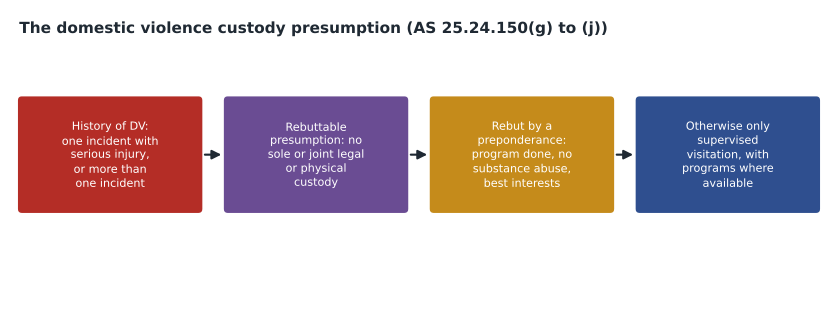
Alaska has one of the strongest statutory responses to domestic violence in custody law. Under AS 25.24.150(g), there is a rebuttable presumption that a parent who has a history of perpetrating domestic violence against the other parent, a child or a household member may not be awarded sole or joint legal custody or sole or joint physical custody. Under subsection (h), a parent has such a history if the court finds that, during one incident of domestic violence, the parent caused serious physical injury, or that the parent engaged in more than one incident of domestic violence.
The presumption may be overcome by a preponderance of the evidence that the perpetrating parent has successfully completed a batterers' intervention program, where one is reasonably available; that the parent does not engage in substance abuse; and that the best interests of the child require the parent's participation as a custodial parent, for example because the other parent is absent or suffers from a diagnosed mental illness or substance abuse that affects parenting. If the presumption is not overcome, subsection (j) limits the perpetrating parent to supervised visitation, conditioned on completing a batterers' intervention program and a parenting education program where reasonably available, with unsupervised visitation possible only under specified conditions.
Worked problem
Does the presumption apply?
In a custody case, the court finds that the father pushed the mother against a wall once, causing bruises but no serious injury, and on a separate occasion threw a phone at her, missing. The mother asks for sole custody.
Show solution
- Count incidents: two separate incidents of domestic violence.
- Apply subsection (h): more than one incident is a history of perpetrating domestic violence, even without serious injury.
- Presumption: the father may not receive sole or joint legal or physical custody unless he rebuts it.
- Rebuttal requires all three showings by a preponderance: completed program, no substance abuse, and best interests requiring his participation.
Answer: The presumption applies. Unless the father rebuts it, he is limited to supervised visitation under subsection (j).
Child support
Alaska calculates child support under Civil Rule 90.3, a court rule rather than a statute. In primary custody cases, support is a percentage of the paying parent's adjusted annual income: 20 percent for one child, 27 percent for two, 33 percent for three, and 3 percent more for each additional child, subject to a minimum monthly amount and an income ceiling set in the rule. Shared custody arrangements use a separate calculation. The rule and its commentary are detailed, and the court system publishes forms and calculators for parents.
Common mistakes
MistakeAssuming property acquired during an Alaska marriage is community property.
InsteadAlaska is separate property by default; community property exists only by agreement or trust under AS 34.77.
MistakeForgetting the qualified Alaska trustee in a community property trust.
InsteadAS 34.77.100 requires at least one Alaska-resident individual, Alaska trust company or qualifying bank as trustee.
MistakeThinking the domestic violence presumption needs a serious injury.
InsteadMore than one incident is enough; one incident suffices only if it caused serious physical injury.
MistakeGiving informal legal advice to relatives in other states.
InsteadRefer them to a lawyer licensed where they live; Alaska community property trusts raise tax and choice-of-law questions.
Advising clients across state lines
Alaska's opt-in community property law, its trust statutes and its family law often meet the law of other states, because many Alaskans move between Alaska and the Lower 48 and many families own property in more than one state. A new lawyer should ask early where the clients lived when property was acquired, where the property is located and which state's law governs, before giving any advice that depends on classification.
Planning conversations
Marchetti's former students who practice estate planning in Anchorage say clients often arrive asking about the community property trust because a friend mentioned it. The lawyer's job is to explain both the possible tax benefit and the cost: assets in the trust become community property, which affects what each spouse owns on divorce, not just at death. Clients should understand that trade before they sign.
Summary and key terms
- Alaska is a separate property state that lets spouses opt into community property by agreement or trust (AS 34.77, since 1998).
- A community property trust needs a declaration, both spouses' signatures, a qualified Alaska trustee with record and tax duties, and a capitalized warning.
- The 1997 Alaska Trust Act allowed self-settled asset protection trusts and effectively ended the rule against perpetuities for most trusts.
- Custody turns on the best interests factors in AS 25.24.150(c); a history of domestic violence creates a rebuttable presumption against custody.
- Child support follows Civil Rule 90.3: 20, 27 and 33 percent of adjusted income for one, two and three children in primary custody.
- Community property trust
- An Alaska trust under AS 34.77.100 that classifies property as community property.
- Qualified person
- For AS 34.77.100, an Alaska-resident individual, Alaska trust company or qualifying bank serving as trustee.
- Asset protection trust
- A self-settled spendthrift trust whose assets creditors generally cannot reach.
- Rebuttable presumption
- A rule that a fact is assumed unless disproved by the required evidence.
- Civil Rule 90.3
- Alaska's court rule setting child support by percentage of income.
Practice problems
Work each problem on paper first, then reveal the answer to check.
Without any agreement or trust, is a salary earned during an Alaska marriage community property?
Show answer
No; Alaska is a separate property state unless spouses opt in, though divorce courts divide marital property equitably.
A trust names only the spouses, who live in Oregon, as trustees. Can it be an Alaska community property trust?
Show answer
No; at least one trustee must be a qualified Alaska person.
What child support percentage applies to two children in primary custody?
Show answer
27 percent of the paying parent's adjusted annual income.
Lesson quiz · 5 questions
Score 60% or more to complete this lesson.
Create a free account to save your progress, take quizzes and earn a certificate.