
AWS-129 · Lesson 8 of 12 · 24 min
Domain 4 review: leadership and change
▶ Video coming soon A video version of this lesson is on the way.
The second half of Domain 4 is about people and scale: Task 4.3, leading enterprise-wide change and building an AI-ready workforce, and Task 4.4, scaling AI from pilots to enterprise-wide deployments. Andre invited Kwame Asante, the developer who had built the BookVet booking app, to this session, because Kwame had watched several technology changes at Cascade Ridge succeed or stall. "The software was never the hard part," Kwame said. "Getting people to change how they work was."
Task 4.3: sponsorship, champions and teams
Skill 4.3.1 asks you to secure executive sponsorship and leadership alignment, and to identify and empower AI champions. A sponsor is a senior leader who owns the initiative's success, removes obstacles and commits resources. Champions are respected people within teams, often not managers, who try new tools early, help colleagues and carry feedback back to the project. At Cascade Ridge, Dr. Kaur has agreed to sponsor the planned call-note pilot at the emergency hospital, and two experienced technicians have volunteered to act as champions on the night shift.
Skill 4.3.2 is about cross-functional teams with clear accountability. The guide names business, technical, legal and compliance members. An AI initiative run only by technologists tends to build something nobody uses; one run only by the business tends to underestimate data and risk work. Each team needs a named accountable lead and an agreed way of making decisions.
Communication and cultural barriers
Skill 4.3.3 is about transparent communication that addresses workforce concerns about timelines, outcomes and role changes. People's first question about AI is usually "what happens to my job?", and vague reassurance makes the fear worse. Good communication is specific and honest: what the tool will and will not do, when changes will happen, how roles will change, what training is available, and how people can raise concerns. If roles will change significantly, say so early.
Skill 4.3.4 asks you to recognize cultural barriers and apply leadership interventions. The guide names risk aversion, resistance to change and fear of failure.
| Barrier | How it shows | Leadership intervention |
|---|---|---|
| Risk aversion | Nobody wants to approve anything new; every proposal waits for more evidence | Small, well-governed pilots with clear stop conditions; leaders share accountability |
| Resistance to change | Staff keep old workarounds; tools go unused | Involve users in design, show benefits in their own work, adjust the process with them |
| Fear of failure | Teams hide problems or avoid experiments | Treat stopped pilots as learning; celebrate well-run experiments, not only successes |
| Fear of job loss | Quiet opposition; rumors | Honest communication on role changes, reskilling paths and commitments leaders can keep |
Worked problem
Responding to a rumor
Suppose technicians at Cascade Ridge's emergency hospital hear that the call-note tool is the first step toward cutting night-shift staff. Adoption in the first week is low. What should Andre recommend?
Show solution
- Identify the barrier: fear of job loss, showing as quiet non-use.
- Choose transparent communication: Dr. Kaur, as sponsor, explains in person what the tool does (drafts notes for review), what it does not do (make clinical decisions), and the actual goal (less paperwork and overtime, not fewer staff).
- Back the words with commitments the hospital can keep, such as no staffing reductions linked to the tool during the pilot, and an open session for questions.
- Use the night-shift champions to demonstrate the tool and collect concerns, then report what was changed in response.
Answer: Address the fear directly through the sponsor, with specific facts and credible commitments, and let champions carry the practical message.
Workforce capability and new roles
Skill 4.3.5 asks you to choose workforce development approaches that build AI literacy. The guide gives examples: proofs of concept, hackathons, training programs and responsible AI training. Different groups need different depths. Executives need enough literacy to make sound investment and risk decisions; front-line staff need practical skill with the tools they use and knowledge of when not to trust them; technical teams need deeper skills; everyone needs responsible AI basics.
| Approach | Best for | Watch out for |
|---|---|---|
| Proof of concept | Showing leaders and users what AI can do on a real problem | Treating a demonstration as proof of business value |
| Hackathon | Generating ideas quickly and building enthusiasm across teams | Many ideas with no route to funding or governance |
| Structured training | Building consistent skills for a role | Generic content that ignores the tools people actually use |
| Responsible AI training | Shared understanding of risks, policies and when to escalate | One-off sessions that are not refreshed |
Skill 4.3.6 asks you to identify roles that should shift from manual work to human oversight and collaboration with AI. The principle is to let AI handle what it does well (volume, speed, pattern finding, first drafts) while people handle what they do better (judgment, empathy, accountability, exceptions). At Cascade Ridge, the no-show pilot plan has reception staff moving from phoning every client to working a prioritized list from the model and handling the conversations that need a person. Their job will change shape; it will not disappear.
Task 4.4: scaling from pilot to enterprise
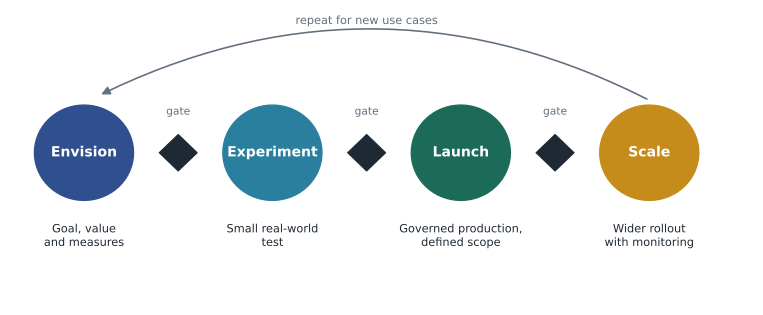
Skill 4.4.1 names an iterative set of phases: envision, experiment, launch and scale. Envision defines the goal, the value and the success measures. Experiment tests feasibility and value on a small scale with real users. Launch puts a governed version into production for a defined scope. Scale extends it across sites, functions or customers while monitoring results. Each phase ends with a decision based on evidence, and the process repeats as new use cases join.
Skill 4.4.2 recommends scaling methods that start with short-term wins and build toward enterprise-wide deployment. A quick win that shows measurable value builds credibility, funding and skills for harder initiatives. The trap is choosing quick wins that lead nowhere; the best ones also build reusable foundations, such as a cleaned dataset, a governance process or a shared integration.
Skill 4.4.3 is about establishing an AI center of excellence (COE) and cross-functional collaboration mechanisms. A COE is a small central group that sets standards, shares reusable components and lessons, provides expertise to business teams and supports governance. Organizations choose between a centralized model, where the COE does most AI work; a federated or hub-and-spoke model, where business units build with COE standards and support; and a decentralized model with light coordination. As maturity grows, many move from centralized toward hub-and-spoke.
Skills 4.4.4 to 4.4.6 complete the task. Continuous feedback and success metrics track value over time, not just at launch. Moving from experimental to production-grade adds requirements that pilots often skip: security review, monitoring, support arrangements, documentation, model operations, cost controls and a named owner. And evaluating multiple factors during scaling, such as performance at higher volumes, differences between sites, support capacity, cost at scale and business continuity, protects the organization from a rollout that works in one clinic and fails in eleven.
| Pilot habit | Production-grade requirement |
|---|---|
| A champion fixes problems informally | A support process with named owners and response times |
| Spot checks of output quality | Continuous monitoring with thresholds and alerts |
| Costs absorbed in a project budget | Costs tagged, budgeted and reported |
| Access granted to a few named users | Role-based access with reviews |
| No fallback | A documented manual fallback and continuity plan |
Practice scenarios for leadership and scaling
Kwame brought examples from previous technology changes at Cascade Ridge, and Noor turned them into exam-style items. Each tests one skill from Task 4.3 or 4.4.
Worked problem
Practice: the missing sponsor
A mid-sized manufacturer's AI quality pilot has a capable project team but no senior leader involved. Plant managers keep moving the team's staff to urgent production work, and the pilot has stalled. What should the strategist recommend?
Show solution
- The symptom (competing priorities winning every time) points to missing executive sponsorship.
- Skill 4.3.1: secure a senior sponsor who owns the outcome, protects the team's time and resolves conflicts with plant priorities.
- Better tools, more training or a larger budget would not fix the underlying problem.
Answer: Secure an executive sponsor with authority over the competing priorities, then reset the pilot's plan with their backing.
Worked problem
Practice: the wrong team
A bank's data science team built an AI tool to flag unusual transactions. Compliance staff were not involved and now refuse to use it because they cannot explain its alerts to regulators. What should have been done differently?
Show solution
- Skill 4.3.2: cross-functional teams including business, technical, legal and compliance members from the start.
- Compliance would have shaped explainability requirements, alert formats and review procedures at design time.
- Recovery now: bring compliance into the team, agree explanation requirements, and adapt the tool and its process before relaunching.
Answer: The team should have been cross-functional from the start. Bring compliance in now and redesign for explainable alerts.
Worked problem
Practice: pilot to production
An AI assistant that drafts maintenance reports worked well in a pilot at one airport hangar. Leaders want it in all twelve hangars next month. The pilot was supported informally by its designer, costs came from an innovation budget, and there is no monitoring. What must happen first?
Show solution
- Skill 4.4.5: production-grade requirements, including a support process, monitoring, cost controls, security review, documentation and a named owner.
- Skill 4.4.6: evaluate factors for scaling, such as differences between hangars, volume, support capacity and continuity.
- A staged rollout, a few hangars at a time, with feedback and metrics, reduces risk.
Answer: Put production-grade support, monitoring, ownership and cost controls in place, check differences between hangars, then roll out in stages.
Communication that works
Task 4.3 questions about communication often offer a choice between messages. The strongest options share four features. They are early: people hear about changes before rumors fill the gap. They are specific: they say what the tool does and does not do, and how roles will change. They are two-way: they invite questions and show what changed in response. And they are consistent: leaders say the same thing in town halls, team meetings and written updates, and their actions match their words. Options that delay communication until everything is final, or offer general reassurance without facts, are usually distractors.
Andre wrote a short communication plan for the no-show pilot as practice. Reception staff would hear about the pilot from their clinic manager two weeks before it started, with a one-page explanation of what the prioritized list would look like and an honest statement that their work would shift from phoning everyone to handling the most important conversations. A champion at each pilot clinic would collect questions weekly, and Andre would answer them in a short written update. After four weeks, staff would see the early results and be asked what to change before any wider rollout.
Choosing an operating model
Questions about centers of excellence often turn on fit. A centralized model suits an organization at an early stage with scarce AI skills, because it concentrates expertise and keeps standards consistent, but it can become a bottleneck. A hub-and-spoke model suits an organization with several business units that want to move at their own pace, because it combines central standards and shared platforms with local delivery. A decentralized model gives business units the most freedom but risks duplication and inconsistent governance. When a scenario describes a central team overwhelmed by requests from many units, the usual answer is to move toward hub-and-spoke, keeping standards central while building capability in the units.
Andre noticed that his own role had shifted during the autumn in exactly the way the guide describes. He had started as a manager who scheduled staff and ordered supplies; he was becoming the person who decided where AI would help, who would oversee it and how its value would be shown. That change, from doing the work to directing and overseeing it, is what Task 4.3 means by shifting roles toward human oversight and collaboration with AI.
A practical test for any scaling plan is to ask what would happen in the first week at a new site if the system stopped working. If the answer is that nobody would know what to do, the plan is not yet production-grade.
Common mistakes
MistakeExecutive sponsorship means a senior leader approved the budget.
InsteadA sponsor stays involved: owns success, removes obstacles and speaks for the change.
MistakeReassure staff that nothing will change.
InsteadBe specific and honest about how roles will change and what support is available.
MistakeA successful pilot can be copied to all sites unchanged.
InsteadScaling needs production-grade requirements and evaluation of volume, site differences, support and cost.
MistakeA center of excellence should build every AI system itself.
InsteadCOE models range from centralized to hub-and-spoke; many shift toward enabling business teams.
Summary and key terms
- Secure an executive sponsor, align leaders and empower champions.
- Build cross-functional teams with clear accountability.
- Communicate transparently about timelines, outcomes and role changes.
- Address risk aversion, resistance and fear of failure with small governed pilots, user involvement and treating stopped pilots as learning.
- Build literacy with proofs of concept, hackathons, training and responsible AI training.
- Shift roles toward oversight and collaboration.
- Scale through envision, experiment, launch and scale, starting with quick wins that build foundations, supported by a center of excellence, continuous metrics and production-grade requirements.
- Executive sponsor
- A senior leader who owns an initiative's success and removes obstacles.
- AI champion
- A respected team member who adopts AI early and helps colleagues.
- Center of excellence
- A central group that sets standards, shares components and supports AI teams.
- Hub-and-spoke model
- An operating model where business units build AI with central standards and support.
- Production-grade
- Meeting the security, monitoring, support, cost and continuity requirements of ongoing use.
Practice problems
Work each problem on paper first, then reveal the answer to check.
Name the four iterative phases in skill 4.4.1.
Show answer
Envision, experiment, launch and scale.
What makes a quick win a good choice for scaling?
Show answer
It shows measurable value soon and builds reusable foundations for later initiatives.
A pilot has no support process and no fallback. What must be added before production?
Show answer
A support process with named owners, monitoring, cost controls and a documented fallback.
Lesson quiz · 5 questions
Score 60% or more to complete this lesson.
Create a free account to save your progress, take quizzes and earn a certificate.