
AWS-129 · Lesson 6 of 12 · 24 min
Domain 3 review: governance and responsible AI
▶ Video coming soon A video version of this lesson is on the way.
Hannah Weiss, Cascade Ridge's privacy and security lead, had been part of every AI conversation since the autumn, usually as the person who asked what could go wrong. Noor invited her to the governance review. "This domain is where good business ideas meet the real world," Hannah said. Domain 3, AI Governance and Responsible AI Leadership, carries 24 of every 100 scored points and has three tasks: applying responsible AI principles to business decisions, establishing governance structures and compliance, and identifying enterprise AI risks and directing their mitigation.
Task 3.1: responsible AI in business decisions
The guide names six responsible AI principles as examples. The exam wants you to apply them to scenarios, not recite definitions, so the table pairs each with the kind of business question it raises.
| Principle | What it asks | A business example |
|---|---|---|
| Fairness | Do outcomes differ unjustly between groups of people? | Does a loan model approve applicants from some neighborhoods less often for reasons unrelated to risk? |
| Explainability | Can we explain why the system produced an output? | Can a clinic tell a client why their pet was flagged for a dental reminder? |
| Privacy | Is personal information collected, used and kept lawfully and minimally? | Are call recordings used only for the purpose clients were told about? |
| Safety | Could the system cause physical, financial or psychological harm? | Could a client assistant give dangerous medication advice? |
| Transparency | Do people know when AI is involved and what it does? | Are clients told that a reminder message was triggered by a prediction? |
| Robustness | Does the system behave reliably under unusual or adversarial inputs? | Does the assistant stay on topic when users try to make it say something harmful? |
Skill 3.1.2 is about tradeoffs when business goals conflict with these principles. A more accurate model may be less explainable; a more personalized service may need more personal data; a faster rollout may skip a fairness review. The exam's expected answer is almost never "ignore the principle" and rarely "abandon the goal". It is usually a balanced step: choose an explainable approach for high-stakes decisions, collect only the data needed, run a fairness test before rollout, or add human review where errors would harm people.
Skill 3.1.3 is about timing: responsible AI practices belong in project planning from the start, not as a review at the end. A scenario that describes a team planning to "add a fairness check after launch" is pointing at the wrong answer. Building requirements in at design time is cheaper and more effective than fixing problems once a system is in use.
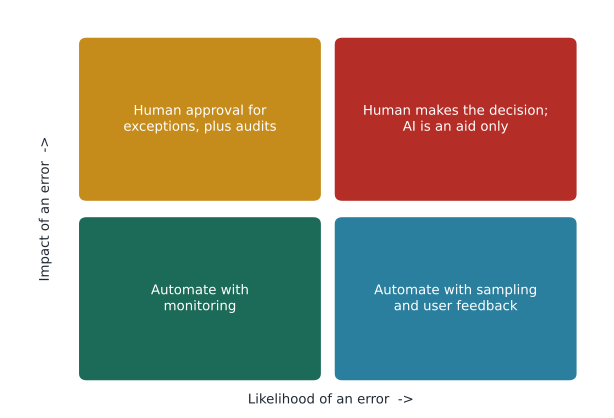
Skill 3.1.4 covers human oversight and safeguards. The more consequential the decision and the more likely an error, the stronger the oversight needed. Safeguards the guide names include hallucination detection (checking whether generated content is supported by sources), guardrails (rules that block topics, filter harmful content, remove personal information or keep answers within scope; on AWS, Amazon Bedrock Guardrails provides these), and escalation criteria that define when the system must hand over to a person.
Task 3.2: governance structures and compliance
Skill 3.2.1 asks you to set up governance with cross-functional representation and clear accountability. A typical structure has an executive sponsor accountable to the board; an AI governance council or committee with business, technology, legal, privacy, security, risk and affected-function representatives; and a named business owner for each AI system who is accountable for its outcomes. Governance that sits entirely within IT, or entirely within legal, misses half the picture.
| Role | Typical responsibility |
|---|---|
| Board or executive sponsor | Sets risk appetite and approves major AI investments |
| AI governance council | Sets policy, reviews high-risk uses, resolves conflicts between goals and principles |
| System business owner | Accountable for a system's results, risks and continued fitness for purpose |
| Technical team | Builds, monitors and maintains the system to the agreed requirements |
| Legal, privacy and compliance | Interpret obligations and review data use and contracts |
| Front-line users | Use the system, report problems and apply human judgment |
Skill 3.2.2 is about identifying and addressing regulatory compliance risks. The exam is international and will not test the details of one country's law, but it expects you to recognize when a scenario raises privacy, consumer protection, employment, financial, health or sector-specific rules, and to involve legal and compliance early.
For Cascade Ridge in the United States, there is no single federal privacy law for this sector. Obligations come from state privacy laws, the Federal Trade Commission's powers over unfair and deceptive practices, and sector rules such as those for card payments. Colorado has passed an AI law placing duties on developers and deployers of high-risk AI systems used in consequential decisions about people, such as employment, housing and lending; its requirements and dates have been revised, so check its current status.
Many organizations also look at the EU AI Act as a model of risk classification, even outside Europe, because it sorts AI uses into tiers: prohibited practices, high-risk systems with strict obligations, limited-risk systems with transparency duties (such as telling people they are talking to a chatbot), and minimal-risk systems. Skill 3.2.4 asks you to apply risk classification frameworks to prioritize governance effort across the AI life cycle. The business point is proportionality: a marketing image generator and a system that recommends treatment plans should not get the same level of review.
Skill 3.2.3 covers access controls and data security for AI systems: least-privilege access to models and data, separating environments, encrypting data, logging use, and making sure a generative AI assistant can only retrieve documents the asking user is allowed to see. On AWS, the managed services keep customer prompts and outputs within the customer's account and, for Amazon Bedrock, are not used to train the underlying models; checking such terms is part of any vendor decision.
Worked problem
Classifying uses by risk
Cascade Ridge has three AI uses: (1) a tool that suggests social media captions, reviewed by marketing staff; (2) an after-hours assistant that tells clients whether their pet's symptoms need emergency care; (3) a no-show prediction that triggers reminder calls. Assign each a risk level and a matching governance response.
Show solution
- Use 1 is minimal risk: errors are embarrassing at worst and a person reviews every caption. A light review and the approved-tools list are enough.
- Use 2 is high risk: a wrong answer could delay emergency care for an animal. It needs clinical review of the content, strict guardrails, clear escalation to a human, monitoring, and a named clinical owner, or it should be narrowed to non-clinical questions.
- Use 3 is limited risk: errors cause an unnecessary call or a missed reminder. It needs a fairness check (are some client groups contacted far more?), transparency about reminders, monitoring and an opt-out.
Answer: Minimal, high and limited risk, with governance effort scaled to match.
Task 3.3: enterprise AI risks and mitigation
The final task asks you to identify enterprise AI risks and direct mitigation. Skill 3.3.1 is the recognition that AI systems in production need risk controls and monitoring, not just pre-launch testing. The remaining skills name particular risks.
| Risk | What it looks like | Typical mitigation a strategist directs |
|---|---|---|
| Bias across the life cycle | Unfair outcomes from skewed data, design choices or changes after deployment | Fairness testing before launch, monitoring outcomes by group, periodic reviews for bias drift |
| Harmful content | Offensive, dangerous or inappropriate outputs | Guardrails and content filters, testing with difficult inputs, user reporting |
| Intellectual property | Outputs that reproduce protected material; uncertainty over who owns generated content; misuse of licensed data | Vendor indemnities and terms, review of outputs used publicly, data licensing checks |
| Hallucinations | Confident but false statements | Grounding with retrieval, citations to sources, human review for important outputs |
| Data quality degradation | Inputs become incomplete or inconsistent over time | Data quality monitoring with owners and alerts |
| Model drift | Performance falls as real-world patterns change | Performance monitoring, retraining triggers, fallbacks |
Skill 3.3.2 makes a point that exam questions like to test: bias can arise at many stages, not just in training data. It can enter through which problem is chosen, how data is collected and labeled, how the model is designed, how outputs are used by people, and how the world changes after launch. That is why one fairness test before launch is not enough, and ongoing monitoring for bias drift is required.
Practice scenarios for Domain 3
Governance questions reward balance. Hannah's advice to Andre was to look for the option that lets the business proceed safely, rather than the one that sounds strictest or the one that sounds fastest.
Worked problem
Practice: the personalization tradeoff
An online pharmacy wants to personalize product recommendations using customers' purchase histories, including prescription items. Marketing wants the richest possible profile. What should the AI strategist recommend?
Show solution
- Identify the principles at stake: privacy (health-related purchase data is sensitive) and transparency.
- Apply skill 3.1.2: neither ignoring privacy nor abandoning personalization.
- A balanced approach: exclude prescription data from marketing models unless customers give explicit consent, minimize the data used, explain personalization to customers, and have legal and privacy review the design before launch.
Answer: Proceed with personalization that excludes or separately consents to sensitive prescription data, with data minimization, transparency and privacy review at design time.
Worked problem
Practice: the agent with access
A company plans an AI agent that can read employee records and answer managers' HR questions. A test shows a manager could obtain salary details for staff outside their team. Which control is most important?
Show solution
- The risk is access: the agent retrieves data the asking user should not see.
- Skill 3.2.3 points to access controls: the agent should retrieve only records the requesting manager is authorized to view, enforced by permissions rather than by instructions in a prompt.
- Logging and periodic access reviews support the control.
Answer: Enforce least-privilege access so the agent can only retrieve records each user is permitted to see, with logging and reviews.
Worked problem
Practice: where bias entered
A city's AI tool for prioritizing road repairs relied on complaints submitted through a smartphone app. Neighborhoods with fewer smartphone users received fewer repairs. At which stage did bias enter, and what should be done?
Show solution
- The bias entered at data collection: the data measured who complained through the app, not where roads were worst.
- This shows skill 3.3.2: bias can arise at stages other than model training.
- Mitigation: add other data sources such as inspection surveys, test outcomes by neighborhood, and monitor for bias drift over time.
Answer: Bias entered through how the data was collected. Broaden the data, test outcomes across neighborhoods and monitor continuously.
Governance across the life cycle
Several governance questions ask when a control belongs. A simple life-cycle map helps. At the idea stage, classify the use by risk and decide the level of review. At design, set responsible AI requirements, data rules, access controls and the oversight model. Before launch, test for fairness, safety, robustness and accuracy against agreed thresholds, and confirm compliance. In operation, monitor performance, bias, harmful content and costs, keep logs, and review incidents. At retirement, remove access, handle data according to retention rules and record lessons learned. An option that places a control at the wrong stage, such as defining fairness requirements only after launch, is usually a distractor.
Questions on intellectual property tend to ask about practical steps rather than law: checking a vendor's terms on ownership of outputs and use of customer data, preferring providers that offer indemnity for outputs where available, reviewing generated content before public use, and confirming that any data used to adapt a model is licensed for that purpose.
One more pattern is worth knowing. When a scenario describes a harmful output that has already reached customers, the expected answer usually combines an immediate containment step, such as tightening a guardrail or adding human review, with an investigation of the cause and a report through the governance structure. Options that only apologize, or only retrain the model without containment, are incomplete.
Common mistakes
MistakeResponsible AI review is a final step before launch.
InsteadResponsible AI belongs in planning from the start; fixing problems later costs more.
MistakeGovernance is the IT department's job.
InsteadEffective governance is cross-functional with named business owners.
MistakeAll AI uses deserve the same level of review.
InsteadRisk classification scales governance effort to the potential for harm.
MistakeBias comes only from training data.
InsteadBias can arise at every stage, and can drift after deployment.
Summary and key terms
- Apply fairness, explainability, privacy, safety, transparency and robustness to business decisions, and manage tradeoffs with balanced steps rather than ignoring either side.
- Build responsible AI into planning from the start.
- Match human oversight to the impact and likelihood of errors, using guardrails, hallucination detection and escalation criteria.
- Governance needs cross-functional representation and named accountable owners.
- Recognize compliance risks and involve legal early; classify uses by risk so effort is proportional; control access and data.
- Monitor production systems for bias, harmful content, intellectual property issues, hallucinations, data degradation and drift.
- Guardrails
- Rules that limit an AI system's inputs and outputs, such as blocking topics or filtering harmful content.
- Hallucination
- A confident AI output that is not supported by facts or sources.
- Escalation criteria
- Defined conditions under which an AI system must hand a case to a human.
- Risk classification
- Sorting AI uses into tiers of risk so governance effort is proportional.
- Bias drift
- A change in a system's fairness over time after deployment.
- System business owner
- The person accountable for an AI system's results and risks.
Practice problems
Work each problem on paper first, then reveal the answer to check.
A team plans to run a fairness review three months after launch. What is wrong with this?
Show answer
Responsible AI should be built into planning from the start; a review after launch lets harm happen first and is costlier to fix.
Which safeguard checks whether generated content is supported by sources?
Show answer
Hallucination detection, often combined with grounding through retrieval.
Why is a single fairness test before launch insufficient?
Show answer
Bias can arise at many stages and can drift after deployment, so ongoing monitoring is needed.
Lesson quiz · 5 questions
Score 60% or more to complete this lesson.
Create a free account to save your progress, take quizzes and earn a certificate.