
AWS-129 · Lesson 1 of 12 · 22 min
How the AI Business Strategist exam works
▶ Video coming soon A video version of this lesson is on the way.
Andre Leclerc closed the board's AI roadmap folder on a Thursday in mid-November and opened a new one labeled "AIB-C01". Over the autumn he had worked through the AWS courses on AI fundamentals, responsible AI, strategy and transformation with Noor Siddiqui, the data scientist who had become his mentor. He could build a business case, run a prioritization workshop and explain to the board why the no-show model deserved a pilot and the marketing image generator did not. What he could not yet do was walk into a testing room and answer 85 questions in a row under time pressure. This course is about closing that gap.
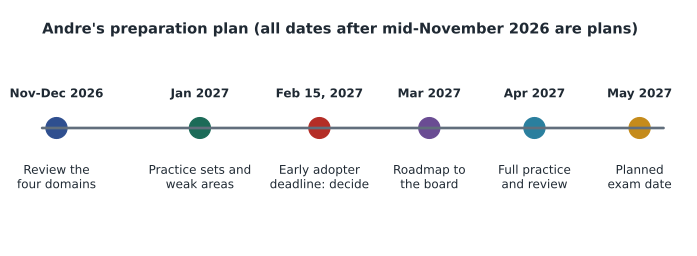
Andre's goal is the AWS Certified AI Business Strategist certification, exam code AIB-C01. His plan is to sit it in May 2027, after the roadmap goes to the board at the end of the first quarter. Noor has agreed to keep their Thursday-morning sessions going, but with a different focus: less new material, more practice at reading questions, spotting traps and managing time. Lorraine Beaudry, the CFO, has offered to approve the exam fee as professional development, on one condition. "Tell me what the exam actually tests," she said, "so I know it's worth the time."
This first lesson answers Lorraine's question. It covers who the exam is for, what it covers, how it is delivered and scored, and the facts every candidate should check on the official pages before booking. The rest of the course follows the exam itself: how to read scenario questions, one review lesson for each part of the four domains, the traps that catch strong candidates, a study plan, how to analyze practice results, and a final review with an exam-day strategy.
Who the exam is for
The AI Business Strategist certification is aimed at business professionals who evaluate, champion or scale AI initiatives, either inside their own organization or for clients. AWS names roles such as product and program managers, sales professionals, line-of-business managers, consultants, marketers and business analysts. Andre fits squarely: he runs operations for eleven clinics and an emergency hospital, and the board now expects him to decide which AI ideas get money.
The exam does not test coding or hands-on AWS work. AWS recommends a basic familiarity with AI, a business-level understanding of what AWS AI services do, and about six months of experience working with or alongside teams that are adopting AI. There are no formal prerequisites: no earlier certification is required, and nobody checks your experience before you sit.
The exam guide is explicit about what is out of scope. You will not be asked to develop or code models, engineer data or features, tune hyperparameters, build pipelines or infrastructure, perform statistical analysis of models, implement security protocols, configure or administer AWS services, choose specific algorithms or architectures, clean or label data, or troubleshoot production AI operations. That list is useful in two ways. It tells you what not to study, and it warns you that an answer option describing a hands-on technical task is often a distractor, because the exam is asking what a business leader should decide, not what an engineer should configure.
"So it's my job, not Noor's," Andre said. Noor laughed. "It's the part of my job I need you to do," she said. "Deciding whether a model is worth building, who is accountable for it and how we know it worked."
What the exam covers: four domains
The exam guide divides the content into four domains, each with a weight that tells you what share of the scored questions comes from it.
| Domain | Weight (out of 100) | Main tasks | Reviewed in |
|---|---|---|---|
| 1. AI Fundamentals and Literacy | 24 | Core AI concepts and vocabulary; choosing the right solution type; applying generative AI techniques | Lesson 3 |
| 2. AI Strategy and Business Value Creation | 28 | Strategies aligned to objectives; measuring and demonstrating value; positioning AI for competitive advantage | Lessons 4 and 5 |
| 3. AI Governance and Responsible AI Leadership | 24 | Responsible AI principles in decisions; governance structures and compliance; enterprise AI risks and mitigation | Lesson 6 |
| 4. Business Readiness, Leadership, and AI Transformation | 24 | Readiness and maturity; data and infrastructure foundations; leading change and building workforce capability; scaling from pilots | Lessons 7 and 8 |
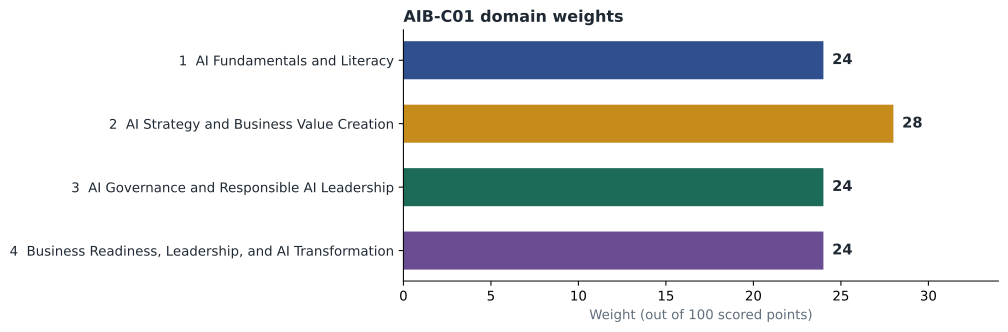
Two things stand out. Domain 2, strategy and business value, is the largest at 28, which matches the exam's name. But the other three domains together carry 72 of every 100 scored points, so a candidate who knows business cases thoroughly and governance only vaguely will struggle. The weights are close enough that no domain can be skipped.
The domains are also connected. A single scenario about a hospital's AI scheduling assistant can touch fundamentals (is generative AI the right tool?), strategy (what is the value?), governance (who reviews its outputs?) and readiness (are the staff ready to use it?). The exam places each question in one domain for scoring, but in practice you will draw on all four. That is why the review lessons in this course keep returning to the same Cascade Ridge examples from different angles.
The question formats
The exam uses two question formats. A multiple choice question has one correct answer and three distractors. A multiple response question has two or more correct answers among five or more options, and the question tells you how many to choose. You get credit for a multiple response question only if you select all the correct options and no wrong ones; there is no partial credit.
Unanswered questions are scored as incorrect, and there is no penalty for guessing. The practical rule follows directly: never leave a question blank. If you run short of time, choose an answer for every remaining question before the clock ends, even if it is an educated guess.
Most questions are short business scenarios. A typical stem describes an organization, a goal or problem, one or two constraints, and then asks what the strategist should do, recommend or consider first. The options are often all reasonable-sounding actions, and the skill being tested is choosing the best one for the situation described. Lesson 2 is devoted to reading these scenarios well.
Length, time and the beta
Here Andre found the first fact that needed care. When he checked the official pages in November 2026, the certification was still in its beta period. A beta exam is the first public version of a new exam. AWS uses the results from beta candidates to check which questions work well and to set the passing standard, so beta exams usually have more questions and more time than the version that follows.
| Fact | As shown by AWS in November 2026 | Note |
|---|---|---|
| Status | Beta | Delivery of the beta began in late September 2026 |
| Number of questions (beta) | 85 | Includes unscored questions that AWS is evaluating |
| Time (beta) | 170 minutes | Shown on the certification page for the beta |
| Time (exam guide) | 130 minutes | The figure in the exam guide, which describes the standard exam |
| Fee | 50 US dollars during the beta; 100 US dollars standard | Taxes and currency conversion may apply |
| Languages | English and Japanese | |
| Delivery | Pearson VUE testing center or online proctored | Online delivery has its own room and equipment rules |
| Early adopter badge | For those certified by February 15, 2027 | An extra digital badge for beta-period candidates |
The two time figures are not a contradiction once you know the difference between the beta and the standard exam. The certification page described the beta: 85 questions in 170 minutes. The exam guide gives 130 minutes, which is the figure for the standard version that follows the beta. At the time of writing, AWS had not published the number of questions in the standard version. For comparison, the other foundational-style AWS exams use 65 questions, of which 50 are scored, in 90 minutes. Do not assume the AIB-C01 standard exam will match those numbers; check the exam page when you book.
Worked problem
Time per question on each version
Andre wants to know how much time he will have per question. Work it out for the beta, and explain what he can say about the standard version.
Show solution
- Beta: divide the time by the number of questions.
- \[\frac{170 \text{ min}}{85 \text{ questions}} = 2.0 \text{ min per question}\]
- Standard: the guide gives 130 minutes, but AWS has not yet published the question count, so the time per question cannot be calculated yet.
- If the standard version had, say, 65 questions, the time per question would also be 2.0 minutes, because 130 divided by 65 is 2. That is an illustration, not a published figure.
Answer: The beta allows 2 minutes per question. For the standard exam, Andre should check the question count when he books, then set his pacing plan from the real figure.
Andre's planned date, May 2027, is likely to fall after the beta has ended. That has three consequences. The early adopter badge, which requires certification by February 15, 2027, would not apply. The fee would probably be the standard 100 US dollars rather than the beta price. And his exam would probably be the standard version, with the timing in the exam guide. Lesson 10 returns to this choice, because there is a real decision to make: sit the beta early for the lower fee and the badge, or sit later with more preparation.
One more feature of beta exams matters if you take one. Because AWS sets the passing standard from beta results, beta candidates do not get their result at the end of the exam. Results arrive after the beta closes and the standard has been set, which can be weeks or months later. Candidates on the standard version normally receive their result within a few business days.
Scoring
Results are reported as a scaled score from 100 to 1,000, and the passing score is 700. A scaled score is not the share of questions you got right. AWS converts the number of correct scored answers into the scale so that results from different versions of the exam, which may differ slightly in difficulty, mean the same thing. A 700 on one version represents the same standard as a 700 on another.
Scoring is compensatory. You do not have to pass each domain separately; you pass or fail on the overall score. A strong performance in strategy can make up for a weaker one in governance. Your score report shows how you did in each domain, but because domains have different numbers of questions, AWS advises using that section feedback with caution. A weak band in a small domain may reflect only a few questions.
Some questions on every exam are unscored. AWS includes them to test new questions for future use. They are not marked, and you cannot tell which ones they are, so every question deserves your full effort.
Common mistakes
MistakeA score of 700 means 70 correct answers out of every 100.
InsteadThe scaled score converts correct answers to a 100 to 1,000 scale; 700 is the passing standard, not a share of questions answered.
MistakeYou must pass every domain to pass the exam.
InsteadScoring is compensatory: only the overall score decides pass or fail.
MistakeBlank answers are safer than guesses.
InsteadBlank answers are scored as wrong and there is no penalty for guessing, so answer every question.
MistakeThe 130-minute and 170-minute figures contradict each other.
InsteadThe longer time is for the beta, which has more questions; the exam guide figure is for the standard version.
Booking and the official sources
Candidates book through their AWS Certification account, which hands off to Pearson VUE for scheduling at a testing center or for an online proctored session. Online proctoring requires a quiet private room, a clean desk, a webcam and a system check beforehand. Candidates whose first language is not English can request an accommodation that adds 30 minutes; it must be requested before booking.
Exam details change, especially for new certifications. Noor's rule was that every fact in Andre's study notes should be traceable to one of three official sources: the certification page on the AWS website, the exam guide on the AWS documentation site, and the scheduling pages in his certification account. Blogs and practice-test sellers can be helpful, but when they disagree with AWS, AWS wins. Andre added a line at the top of his notes: "Facts checked November 12, 2026. Recheck when booking."
Why the certification matters to Cascade Ridge
Andre wrote Lorraine a short note. The exam tests the same decisions the board has asked him to make: where AI creates value, how to build and measure a business case, how to govern AI responsibly, and how to prepare people and data for it. Preparing for it would make the roadmap better, not just add a line to his résumé. The fee was modest. The real cost was about six hours a week of study until May, most of it on his own time.
Lorraine approved it. "If it makes the roadmap better," she wrote back, "it's the cheapest consultant we'll hire this year."
Worked problem
Checking a fact sheet
A colleague's study notes say: "AIB-C01: 65 questions, 90 minutes, pass mark 70 out of 100, must pass each domain." Identify each error using the official facts.
Show solution
- Question count and time: the beta has 85 questions in 170 minutes; the exam guide gives 130 minutes for the standard version. The 65 questions and 90 minutes belong to other foundational AWS exams.
- Pass mark: the passing score is 700 on a scaled range of 100 to 1,000. It is not the share of questions answered correctly.
- Domains: scoring is compensatory, so you need the overall passing score, not a pass in every domain.
Answer: All three statements are wrong. The notes have mixed up this exam with others and misunderstood scaled and compensatory scoring.
Summary and key terms
- AIB-C01 is for business professionals who evaluate, champion or scale AI initiatives; it does not test coding or AWS configuration.
- Four domains are weighted 24, 28, 24 and 24, with strategy and business value the largest.
- Questions are multiple choice or multiple response; multiple response needs every correct option.
- Blank answers count as wrong and guessing is not penalized.
- The beta had 85 questions in 170 minutes; the exam guide gives 130 minutes for the standard exam.
- Scores are scaled from 100 to 1,000 with 700 to pass, and scoring is compensatory.
- Check every fact on the official AWS pages before booking.
- Beta exam
- The first public version of a new exam, used to evaluate questions and set the passing standard.
- Scaled score
- A score converted to a common 100 to 1,000 scale so different exam versions are comparable.
- Compensatory scoring
- Pass or fail is decided by the overall score, not by each domain separately.
- Multiple response
- A question with two or more correct answers among five or more options; all must be chosen.
- Unscored question
- A question being trialled for future use; it does not count toward the score.
- Out of scope
- Tasks the exam guide says are not tested, such as coding models or configuring AWS services.
Practice problems
Work each problem on paper first, then reveal the answer to check.
Why might a beta exam have more questions than the standard version?
Show answer
It includes extra questions AWS is evaluating so it can choose good questions and set the passing standard.
A candidate leaves five questions blank to avoid guessing wrongly. What is the effect?
Show answer
All five are scored as incorrect; guessing would have given a chance of credit at no cost.
Which three official sources should a candidate trust for exam facts?
Show answer
The AWS certification page, the exam guide on the AWS documentation site, and the scheduling pages in the AWS Certification account.
Lesson quiz · 5 questions
Score 60% or more to complete this lesson.
Create a free account to save your progress, take quizzes and earn a certificate.