
AWS-129 · Lesson 4 of 12 · 26 min
Domain 2 review: use cases and value
▶ Video coming soon A video version of this lesson is on the way.
Domain 2, AI Strategy and Business Value Creation, is the largest domain at 28 of every 100 scored points, and it is the one Andre had lived for three months. That made reviewing it strangely difficult. "You know what we decided," Noor said. "The exam wants to know whether you know why, and whether you'd decide the same way for a bank or a retailer." This lesson reviews the strategy side of Domain 2: finding and prioritizing use cases, recognizing when AI is the wrong answer, build, buy or partner decisions, transitions, and competitive advantage. Lesson 5 covers measurement, business cases and cost control.
Task 2.1: strategies aligned with objectives
Every Domain 2 question rests on one habit: start from business objectives, not technology. A strategy that begins "we need a chatbot" has skipped the step the exam tests most. The sound sequence is objective, then the drivers that move it, then the specific problems or opportunities, and only then the AI capability that might help. Andre's value tree for Cascade Ridge, which linked the goal of more revenue per clinic to fewer no-shows and then to a no-show prediction model, is the pattern.
The guide asks you to identify high-impact use cases across business functions and names customer operations, sales and marketing, research and development, and software development as examples. You should be able to suggest typical capabilities and outcomes for each.
| Function | Typical AI use cases | Outcome measures |
|---|---|---|
| Customer operations | Self-service assistants, routing and summarizing requests, agent assist, call transcription | Wait time, resolution without escalation, cost per contact, satisfaction |
| Sales and marketing | Churn and propensity prediction, personalization, content drafts, lead scoring | Conversion, retention, cost per acquisition, campaign speed |
| Research and development | Literature summarization, pattern finding, simulation, image analysis | Time to insight, experiments avoided, product quality |
| Software development | Code suggestions, test generation, documentation, modernizing old code | Delivery speed, defect rates, developer time on routine work |
Prioritizing initiatives
Organizations always have more AI ideas than money and people. The guide asks you to prioritize by business value, feasibility, sustainability and strategic alignment, and to decide whether initiatives should scale, pause or terminate. A weighted scoring model is the usual tool: score each idea on each criterion, multiply by agreed weights and rank the totals. Cascade Ridge used five criteria.
| Criterion | Weight | What a high score means |
|---|---|---|
| Business value | 0.35 | Large, measurable benefit tied to an objective |
| Feasibility | 0.25 | Data, skills, technology and time are available |
| Risk (scored so that low risk earns a high score) | 0.15 | Little potential for harm, legal exposure or reputational damage |
| Strategic alignment | 0.15 | Directly serves a board priority |
| Sustainability | 0.10 | Can be run, supported and paid for over years |
Worked problem
Scoring one idea
The pharmacy demand forecast scored value 3, feasibility 4, risk 4, alignment 3 and sustainability 3 (each out of 5). Calculate its weighted score with the weights above.
Show solution
- \[3(0.35) + 4(0.25) + 4(0.15) + 3(0.15) + 3(0.10)\]
- \[= 1.05 + 1.00 + 0.60 + 0.45 + 0.30 = 3.40\]
Answer: The weighted score is 3.40, which placed the pharmacy forecast third, level with the review-response idea, behind the no-show model (4.15) and lab result extraction (3.50).
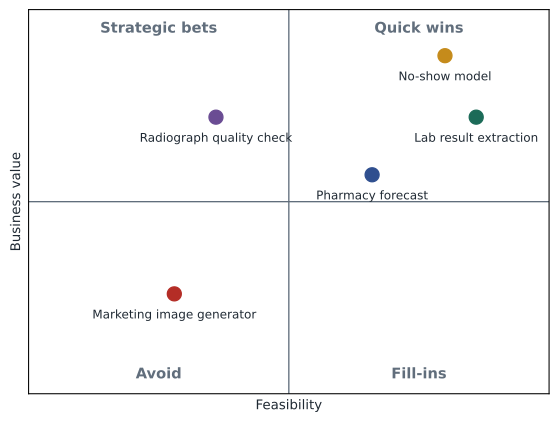
Three decision rules after scoring are worth remembering. Scale when a pilot meets its success criteria and the organization is ready to support it. Pause when the idea is still sound but something it depends on is missing, such as clean data, a regulation not yet clarified or a team at capacity. Terminate when evidence shows the value will not arrive, the risk is unacceptable or a better option exists. AWS-121 also discussed pivoting: changing the approach while keeping the goal. Exam questions often describe pilot evidence and ask which of these decisions fits.
When AI is not the answer
Skill 2.1.4 asks you to recognize when AI is not the right solution. Questions on this are some of the easiest marks for a careful reader, because the scenario usually contains a clear clue. Common clues are that the problem is really a broken process, a missing policy or a staffing gap; that a simple rule would do; that there is no relevant data; that every error is unacceptable and no human review is possible; or that the cost of building and running AI exceeds the value at stake.
| Clue in the scenario | Better first move |
|---|---|
| Most delays come from one manual hand-off | Fix the process step |
| The decision follows a short fixed policy | Rules-based automation |
| No historical data exists for the outcome | Collect data first, or use a non-AI approach |
| The problem is unclear ownership or conflicting goals | Resolve ownership and goals before any technology |
| The benefit is a few thousand dollars a year; the solution costs far more | Do not proceed |
Build, buy or partner
Skill 2.1.2 asks you to evaluate build, buy or partner decisions against five named factors: budget, timelines, capabilities, vendor proposals and regulatory compliance. Buying a ready-made product or managed service is usually fastest and cheapest to start, but offers less control and differentiation. Building on a platform such as Amazon Bedrock gives control and can create advantage, but needs skills and time. Partnering with a specialist firm adds skills the organization lacks, at the cost of dependence on the partner. Lock-in, data ownership and exit terms belong in every comparison.
On AWS, AWS Marketplace is where organizations can buy third-party software, data products and models billed through their AWS account, and the AWS Partner Network lists consulting and technology partners with validated expertise. Managed AWS AI services such as Amazon Textract for document extraction, Amazon Transcribe for speech to text and Amazon Comprehend for text analysis are the "buy" end of the spectrum within AWS, while Amazon Bedrock and Amazon SageMaker AI support building.
Worked problem
Reading a build-buy-partner scenario
A mid-sized law firm wants a tool to summarize discovery documents within six months. It has two IT staff and no machine learning experience. Client confidentiality rules forbid sending documents to services that train on customer data. Which option fits best?
Show solution
- Timeline: six months rules out a long custom build by an inexperienced team.
- Capabilities: two IT staff and no machine learning experience make building risky.
- Compliance: any option must contractually exclude training on the firm's data and keep data within approved locations.
- A purchased product or a partner-built solution on a managed service can meet the timeline. The deciding test is the vendor's data terms.
Answer: Buy, or partner with a specialist, choosing only a provider whose terms guarantee that client documents are not used for training and stay where the rules require.
Transitions between processes and platforms
Skill 2.1.5 covers moving a business process onto AI, or from one AI platform to another. The guide names four considerations: business continuity (can the business keep running if the new system fails, and is there a fallback?), cost implications (including migration, retraining and running two systems in parallel), data readiness (is the data available, clean and lawful in the new setting?) and performance impact (will accuracy, speed or user experience change?). Sound transitions run old and new in parallel for a period, compare results, keep a fallback and move in stages.
Task 2.3: competitive advantage
The third Domain 2 task is about positioning AI for advantage. The key distinction is between parity uses, which everyone can buy and which keep you level with competitors, and sources of sustainable advantage, which competitors cannot easily copy. Sustainable advantage usually comes from proprietary data that keeps improving, from AI embedded deeply in a process others cannot replicate, from speed of learning, or from customer relationships strengthened by AI. Using the same off-the-shelf assistant as every competitor may be necessary, but it is rarely an advantage on its own.
The guide also asks you to identify opportunities to transform business models with AI, for example turning a product into a service, offering new data-based services, or reaching customers who were too costly to serve before. And it asks you to set investment levels according to industry maturity and competitive dynamics.
| Industry AI maturity | Competitive pressure from AI | Usual investment posture |
|---|---|---|
| Low | Low | Watch, learn and run low-cost experiments |
| Low | High | Move early on selected bets to gain a lead |
| High | Low | Adopt proven tools for efficiency and parity |
| High | High | Invest strongly; parity is essential and advantage must be earned |
Practice scenarios for Domain 2 strategy
Strategy questions often look as if they need specialist industry knowledge. They do not. The same handful of principles works for a bank, a manufacturer or a clinic group. Noor chose three industries Andre knew nothing about to prove the point.
Worked problem
Practice: a manufacturer's wish list
A furniture manufacturer has ten AI ideas and budget for two. Its stated objective for the year is to reduce defects that cause customer returns. The ideas include a marketing copy generator, an image-based inspection of finished pieces, a chatbot for dealers and a forecast of raw material prices. Which ideas should rank highest, and why?
Show solution
- Start from the objective: reducing defects that cause returns.
- Strategic alignment: image-based inspection serves the objective directly; the others serve other goals.
- Value and feasibility: inspection can be piloted on one line with photos of known good and defective pieces, and its value can be measured in returns avoided.
- The remaining slot should go to the idea with the next best weighted score, which requires scoring the others on the agreed criteria.
Answer: Image-based inspection should rank first because it aligns directly with the objective; the second slot is decided by weighted scores, not by enthusiasm.
Worked problem
Practice: a platform switch
A bank wants to move its customer service assistant from one AI provider to another to cut costs by about a third. The assistant handles thousands of conversations a day. What should the strategist require before the switch?
Show solution
- Apply skill 2.1.5: continuity, cost, data readiness and performance.
- Continuity: a fallback to the old provider or to human agents, and a staged move by customer segment.
- Cost: include migration work, retesting, staff retraining and a period of running both systems, not only the lower run rate.
- Data readiness: confirm conversation histories, knowledge articles and logs can move lawfully and in usable form.
- Performance: compare answer quality, speed and escalation rates on the same test conversations before switching.
Answer: A transition plan covering continuity, full costs, data readiness and side-by-side performance testing, with a staged rollout and fallback.
Worked problem
Practice: when to stop
A retailer's pilot of an AI demand forecast met its accuracy target, but store managers ignored the forecasts and kept ordering by habit. Inventory did not improve. The vendor recommends scaling to all stores. What should the strategist recommend?
Show solution
- The pilot proved technical feasibility but not business value: the target outcome, inventory, did not move.
- The leading indicator, managers acting on forecasts, was weak.
- Scaling now would spread a tool that people do not use.
- A pivot fits: keep the goal, change the approach, for example by building the forecast into the ordering screen and involving managers in setting override rules, then re-run the pilot with adoption as a success criterion.
Answer: Do not scale yet. Pivot the approach to address adoption, and judge the next pilot on inventory and on how often managers follow the forecast.
Across all three items the deciding question was the same: does this choice move the objective the organization actually stated? Andre began writing that question at the top of his scratch paper before every strategy item.
Reading competitive advantage questions
Questions on Task 2.3 often describe two competitors and ask which approach creates lasting advantage. Look for proprietary assets that improve with use, such as a growing dataset of outcomes no one else has, or a process redesigned around AI that would take a competitor years to copy. Options that describe buying a popular tool, matching a competitor's announcement or running a marketing campaign about AI usually describe parity at best. Options about business model change, such as offering a subscription service built on AI monitoring, should be judged on whether the organization has the data, trust and capabilities to deliver them.
Common mistakes
MistakeRank use cases by how impressive the technology is.
InsteadRank by business value, feasibility, risk, alignment and sustainability.
MistakeA paused initiative is a failed one.
InsteadPause means the idea is sound but a dependency is missing; it can resume when that is fixed.
MistakeBuying an AI tool everyone else uses creates competitive advantage.
InsteadWidely available tools usually give parity; advantage comes from proprietary data and deep integration.
MistakeMoving to a new AI platform is just a technical migration.
InsteadTransitions need plans for continuity, cost, data readiness and performance.
Summary and key terms
- Domain 2 strategy questions start from business objectives.
- Use cases are found across functions such as customer operations, sales and marketing, research and development, and software development.
- Prioritize with weighted criteria, then decide to scale, pause, terminate or pivot.
- Recognize when a process fix, rules or doing nothing beats AI.
- Build, buy or partner decisions weigh budget, timelines, capabilities, vendor proposals and compliance.
- Transitions need continuity, cost, data and performance planning.
- Advantage comes from what competitors cannot copy; set investment by industry maturity and pressure.
- Weighted scoring
- Ranking options by scoring each criterion and multiplying by agreed weights.
- Pause
- Stopping work temporarily because a dependency is missing while the idea remains sound.
- Parity
- Using AI to stay level with competitors rather than to gain an advantage.
- Sustainable advantage
- An advantage competitors cannot easily copy, such as proprietary data or deep integration.
- AWS Marketplace
- A catalog for buying third-party software, data and models through an AWS account.
Practice problems
Work each problem on paper first, then reveal the answer to check.
What are the four prioritization factors named in skill 2.1.3?
Show answer
Business value, feasibility, sustainability and strategic alignment.
Most claim delays come from one manual approval step. What should a strategist recommend first?
Show answer
Fix the process step; AI is not needed for that problem.
Name the four considerations for transitioning processes to AI or between platforms.
Show answer
Business continuity, cost implications, data readiness and performance impact.
Lesson quiz · 5 questions
Score 60% or more to complete this lesson.
Create a free account to save your progress, take quizzes and earn a certificate.