
AWS-129 · Lesson 2 of 12 · 23 min
Reading business scenario questions
▶ Video coming soon A video version of this lesson is on the way.
At their second session Noor put a single practice question on the table and asked Andre to answer it out loud. He read it twice, chose an answer, and was wrong. The problem was not knowledge. He knew perfectly well what a baseline was. He had simply answered the question he expected rather than the one on the page. "That's the most common way strong candidates lose points," Noor said. "Not ignorance. Misreading."
Most AIB-C01 questions are business scenarios: a few sentences about an organization and a situation, followed by a question and four or more options. This lesson is about reading those scenarios accurately and choosing among options that all sound sensible. The method here is used in every later lesson.
The anatomy of a scenario question
A well-built scenario question has four parts, and it helps to name them as you read.
| Part | What it contains | Why it matters |
|---|---|---|
| Context | Who the organization is and what is happening: a retailer, a hospital group, a bank; a pilot, a proposal, a problem | Sets the industry, scale and stage, which can change the best answer |
| Goal or problem | What the organization wants or what has gone wrong | The correct answer must serve this goal, not a different one |
| Constraints | Limits and signals: budget, deadline, regulation, data quality, staff skills, risk tolerance, words such as "first", "most cost-effective" or "least effort" | Usually decide between two plausible options |
| The ask | The actual question, usually in the last sentence | Tells you what kind of answer is wanted: an action, a reason, a risk, a metric |
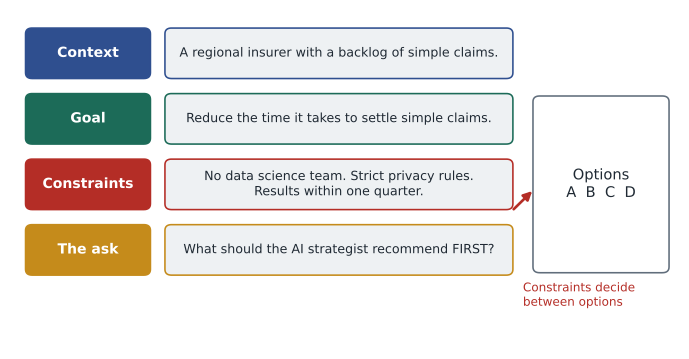
Consider this practice stem, written in the style of the exam:
Practice stem: a regional insurer wants to reduce the time it takes to settle simple claims. It has no data science team and strict privacy obligations for customer records. Leadership wants visible results within one quarter. What should the AI strategist recommend first?
The context is a regional insurer. The goal is faster settlement of simple claims. The constraints are no data science team, strict privacy obligations and a one-quarter deadline. The ask is what to recommend first. An option such as "Build a custom claims-scoring model on the company's historical data" fails on two constraints: there is no team to build it, and it will not show results in a quarter. An option such as "Use a managed document-processing service to extract fields from simple claims, with human review, after confirming it meets privacy requirements" fits all three. The constraints did the work.
A five-step reading method
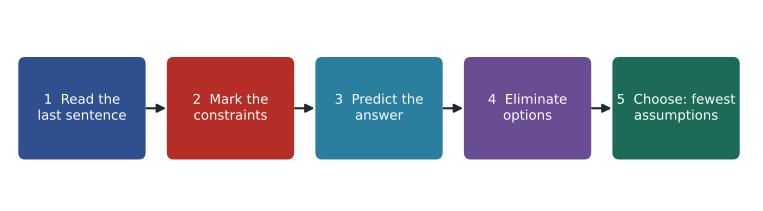
Noor gave Andre a method to use on every question until it became habit.
- Read the last sentence first. The ask tells you what you are looking for: an action, a first step, a metric, a risk, a reason. Knowing this before you read the scenario stops you collecting the wrong details.
- Read the scenario once, marking the constraints. On a testing center whiteboard or in your head, note every limit and signal word: budget, timeline, regulation, data, skills, risk appetite, "first", "best", "most", "least".
- Predict the shape of the answer before reading the options. If the ask is about measuring value and nothing has been measured yet, you might predict "establish a baseline". Predicting protects you from attractive distractors.
- Eliminate options that break a constraint or answer a different question. Most questions have one or two options that can be removed quickly. Then compare the remaining options against the goal.
- Choose the option that fully satisfies the ask with the fewest assumptions. If an option is only correct when you imagine extra facts that are not in the scenario, it is probably wrong.
Signal words and what they ask for
Small words in the ask change the correct answer. The same scenario can have different correct answers depending on whether it asks for the first step, the best long-term approach or the cheapest option.
| Signal in the ask | What it usually means | Typical correct answer shape |
|---|---|---|
| "First" or "initial step" | Sequence matters; something must happen before anything else | Clarify the objective, establish a baseline, assess readiness, engage stakeholders, check data |
| "Most cost-effective" or "least effort" | The simplest adequate option wins, not the most powerful | A managed service, a process fix, rules, or an existing tool rather than a custom build |
| "Best" or "most appropriate" | Weigh all the constraints; the balanced option wins | The option that meets the goal and respects every constraint |
| "Primary benefit" or "main reason" | One cause or effect is central; others are secondary | The benefit tied most directly to the stated goal |
| "Mitigate the risk" | A control is wanted, matched to the specific risk named | Human review, guardrails, monitoring, access controls, policy |
| "Which metric" | A measure tied to the goal, ideally before and after | An outcome KPI with a baseline, plus a guardrail measure |
Andre noticed how often "first" appeared in Noor's practice questions. She explained why. Business strategy has a natural order: objective before solution, baseline before measurement, readiness before rollout, governance before scale. Many exam questions test whether you know that order. An answer can be a good idea and still be wrong because it comes too early. Buying licenses for every employee is not wrong in itself, but it is wrong as the first step when nobody has decided what the tool is for.
Why distractors are attractive
Exam distractors are not random wrong answers. They are written to be tempting, usually in one of a small number of ways. Knowing the patterns makes them easier to set aside.
| Distractor pattern | What it looks like | How to spot it |
|---|---|---|
| True but irrelevant | A correct statement that does not answer the ask | Ask: does this serve the stated goal? |
| Right action, wrong time | A sensible step that belongs later in the sequence | Ask: what must happen before this? |
| Too technical | A hands-on engineering task offered to a business leader | Remember the out-of-scope list; the strategist decides, the engineers configure |
| Too big | An enterprise-wide program when the scenario needs a pilot or a fix | Check budget, timeline and risk appetite |
| Absolute language | Words such as always, never, guarantees, eliminates | AI rarely guarantees anything; absolute claims are usually wrong |
| Ignores a constraint | An option that would work if the regulation, budget or skills limit were not there | Re-read your marked constraints |
The "too technical" pattern is especially common on this exam. An option such as "Tune the model's hyperparameters to improve accuracy" may be technically sensible, but the exam is asking what a business strategist should do. In most scenarios the strategist's move is to clarify the requirement, set the success measure, involve the right people or decide whether to proceed, and leave the tuning to the technical team.
Worked problem
Applying the method
A practice question reads: "A retail chain piloted a generative AI assistant that drafts product descriptions. Staff say it saves time, but leadership cannot tell whether the pilot succeeded. What should the AI strategist have done before the pilot began?" The options are: (A) chosen a larger foundation model; (B) defined success metrics and measured the current time per description; (C) trained all staff on prompt engineering; (D) negotiated an enterprise license. Work through the five steps.
Show solution
- Read the last sentence: the ask is what should have been done before the pilot began, so the answer is a preparatory step.
- Mark constraints: staff report time savings, but leadership cannot judge success. The gap is evidence, not capability.
- Predict: success could not be judged because nothing was defined or measured beforehand, so the answer is likely "define metrics and set a baseline".
- Eliminate: (A) is too technical and does not address evidence. (D) is a commercial step, and premature. (C) might help adoption but does not let leadership judge success.
- Choose: (B) answers the ask directly and needs no extra assumptions.
Answer: The answer is (B). Without success metrics and a baseline before the pilot, there was no way to show its effect.
Multiple response questions
Multiple response questions need a slightly different approach because every option must be judged on its own. A good technique is to treat each option as a true-or-false statement about the scenario. Read option A and decide: is this correct for this scenario? Then B, and so on. Only after judging all of them do you count how many you marked true. If you have more or fewer than the question asks for, go back to the options you were least sure about.
Two traps are specific to this format. The first is choosing the right number of options but including one that is true in general and not for this scenario. The second is assuming that because two options seem similar, both must be right or both wrong. They may differ in one important word. Since there is no partial credit, a multiple response question is worth the extra minute it takes to judge every option carefully.
Using the scenario, and only the scenario
A final rule ties the method together: answer from the facts given. Candidates with real experience sometimes bring in their own organization's situation, which leads them to an answer that would be right at their workplace but is wrong for the scenario. If the scenario says the company has clean, well-labeled data, believe it. If it says nothing about budget, do not invent a budget problem. The exam rewards the best answer to the case as written.
Andre found this hardest of all. Every scenario reminded him of something at Cascade Ridge. Noor suggested a habit: before choosing, say in one sentence what the scenario's organization needs, using only words from the question. If the sentence contains an idea that is not in the question, it came from his own experience, and he should check whether it is leading him astray.
Practicing the method on a full item
Noor ended the session with a second practice item, this time a multiple response question, and asked Andre to narrate each step aloud. Narrating feels slow at first, but it exposes the moment where a reading goes wrong, which silent practice hides.
Worked problem
A multiple response item
A logistics company is planning its first generative AI project, a tool that drafts replies to customer delivery complaints. Leaders want to show value within six months and avoid reputational harm. Which TWO actions should the AI strategist recommend? Options: (A) measure current reply time and customer satisfaction before launch; (B) let the tool send replies automatically to save the most time; (C) have agents review and edit drafts before sending during the pilot; (D) fine-tune a custom model before testing any managed service; (E) postpone the project until a company-wide AI platform is built.
Show solution
- Ask: two actions the strategist should recommend for a first project with a six-month goal and reputational risk.
- Constraints: six months to show value, avoid reputational harm, first project.
- Judge each option: (A) true, because value cannot be shown without a baseline. (B) false, because automatic sending of complaint replies risks exactly the harm leaders want to avoid. (C) true, because human review controls reputational risk in a pilot. (D) false, because it is slow and skips the cheaper levers. (E) false, because it breaks the six-month constraint.
- Count: two options marked true, which matches the ask.
Answer: The answers are (A) and (C): a baseline to show value, and human review to protect the company's reputation.
Andre noticed that each wrong option failed for a different reason: one ignored risk, one ignored time and cost, one ignored the deadline. That is typical of well-written multiple response items. If two of your chosen options fail for the same reason, check them again.
Common mistakes
MistakeRead the options first to save time.
InsteadRead the ask first, then the scenario, then predict the answer before reading the options.
MistakeIf an answer is a good idea, it must be correct.
InsteadA good idea can be wrong if it comes too early, answers a different question or breaks a constraint.
MistakeThe most advanced or comprehensive option is usually best.
InsteadThe best option fits the constraints; often that is the simpler, cheaper or earlier step.
MistakeUse your own workplace experience to fill gaps in the scenario.
InsteadAnswer from the facts given; invented facts lead to the wrong answer.
Worked problem
Spotting the signal word
Two practice questions share the same scenario: a hospital group wants to use AI to summarize discharge notes. Question 1 asks what to do first; question 2 asks for the most important control once the tool is in use. Suggest the shape of each answer.
Show solution
- Question 1 asks for a first step. Before any tool is chosen, the strategist should confirm the objective and its measure, and involve clinical, privacy and legal stakeholders, because the notes are sensitive health information.
- Question 2 asks for a control in use. The key risk with summaries is that they omit or invent clinical details, so the shape of the answer is human review of every summary by a clinician before it enters the record, with monitoring of error rates.
Answer: The same scenario gives two different correct answers because the asks differ: first step versus control in operation.
Summary and key terms
- Scenario questions have a context, a goal, constraints and an ask.
- Read the ask first, mark the constraints, predict the answer, eliminate, then choose the option with the fewest assumptions.
- Signal words such as first, most cost-effective and best change the correct answer.
- Distractors are often true but irrelevant, right but too early, too technical, too big, absolute, or blind to a constraint.
- Judge each multiple response option separately.
- Answer from the scenario as written, not from your own experience.
- Stem
- The scenario and question before the options.
- Constraint
- A limit or signal in the scenario, such as budget, time, regulation or skills, that rules options in or out.
- Distractor
- A wrong option written to look plausible.
- Signal word
- A word in the ask, such as first or most cost-effective, that changes what the correct answer must be.
- Prediction
- Forming an expected answer before reading the options, to resist attractive distractors.
Practice problems
Work each problem on paper first, then reveal the answer to check.
Why read the last sentence of a scenario first?
Show answer
It tells you what kind of answer is wanted, so you collect the right details as you read.
An option says the AI model will eliminate all errors. What pattern is this?
Show answer
Absolute language; AI rarely guarantees or eliminates anything, so the option is probably wrong.
How should you approach a multiple response question?
Show answer
Judge each option as true or false for the scenario, then check that you have chosen the number asked for.
Lesson quiz · 5 questions
Score 60% or more to complete this lesson.
Create a free account to save your progress, take quizzes and earn a certificate.