
AUTO-320 · Lesson 8 of 12 · 21 min
HVAC air distribution, blend doors and actuators
Two jobs on Kiran's list this week have nothing to do with refrigerant or coolant. The first is the one she found in Lesson 1: courier van 2's fresh-recirculation door is stuck in recirculation, which is why Marcus's windshield fogged on wet mornings. The second is the Lindqvists' minivan. Erik Lindqvist describes it carefully: "There's a clicking from behind the dashboard on the driver's side, like a playing card in bicycle spokes, for a few seconds after I start the van. And the driver's side blows warm air even when I turn it all the way to cold. The passenger side is fine."
Both complaints live in the HVAC module, the plastic case behind the dashboard that houses the blower, the evaporator, the heater core and the doors that blend and direct the air. This lesson explains how air moves through that case, how the blower's speed is controlled, how the doors decide the air's temperature and where it goes, how electric door actuators work and report their position, and how to diagnose them with a scan tool before taking a dashboard apart.
The path of the air
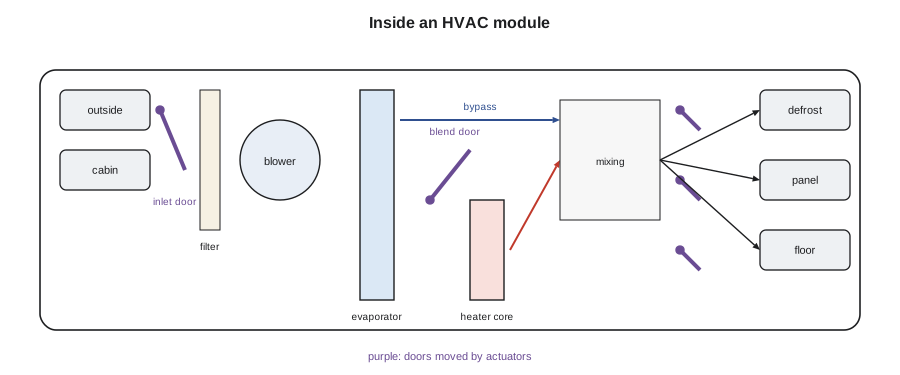
Air enters the HVAC module through one of two inlets: the fresh-air inlet, usually at the cowl below the windshield, or the recirculation inlet, which draws air from the passenger footwell. A fresh-recirculation door selects between them. The air passes through the cabin air filter and into the blower, a squirrel-cage fan driven by an electric motor, which pushes it through the evaporator. Every bit of air that enters the case passes through the evaporator, so it is always cooled and dried when the air conditioning is running.
After the evaporator, the air reaches the blend door, also called the temperature door. The blend door divides the air between a path through the heater core and a path that bypasses it, and the two streams mix in a chamber beyond. With the door fully one way, all the air bypasses the core and the outlet temperature is as cold as the evaporator makes it; fully the other way, all of it passes through the core; in between, the mix sets any temperature in the range. This is called reheat control, and it is why the heater core on most vehicles carries hot coolant all year: the temperature is set by the door, not by shutting off the coolant.
Finally the mixed air reaches the mode doors, which send it to the panel outlets on the dashboard, the floor outlets, the defrost outlets at the base of the windshield, the side window demisters, or a combination. A dual-zone system has two blend doors, one for each side, with a divider in the case so the driver and passenger can choose different temperatures. A three-zone or four-zone system, like the Lindqvists' minivan, adds a rear HVAC unit or separate rear blend doors. Many cases also have small doors or vents that route air to the rear seat ducts under the floor.
Blower speed control
Blower motors are permanent-magnet motors, and their speed is controlled in one of two ways. Older and simpler systems use a blower resistor block: on low speeds, current passes through one or more resistors in series with the motor, which reduce the voltage across it; on high, a relay bypasses the resistors and the motor gets full battery voltage. A failing resistor block is the classic cause of a blower that works only on high, because the high speed does not use it. Resistor blocks sit in the airstream to keep them cool, and a corroded connector or a seized blower motor drawing too much current can overheat them.
Most modern systems use a blower control module, a power transistor circuit, usually also mounted in the airstream, that varies the motor's voltage or switches it on and off rapidly with a pulse-width modulated signal from the climate control module. That allows many speeds and smooth automatic control. Diagnosing either type starts with the scan tool's commanded blower speed, then the voltage across the motor, and the motor's current draw. A motor whose brushes or bearings are worn draws more current than it should and can make a speed control fail repeatedly; replacing the resistor block or control module without checking the motor's current is a common way to replace it twice.
# Blower resistor block: motor voltage and speed on each setting (illustrative values)
battery = 13.8
motor_ohms = 0.95          # effective motor resistance when running at speed (simplified)
settings = {"1": 1.60, "2": 0.85, "3": 0.35, "4 (high)": 0.0}   # series resistance in ohms
for name, r in settings.items():
    amps = battery / (motor_ohms + r)
    motor_volts = amps * motor_ohms
    print(f"speed {name:<9} resistor {r:4.2f} ohm: {amps:4.1f} A, motor sees {motor_volts:4.1f} V")
print("speed 4 bypasses the resistors, so a blower that works only on high points to the resistor block or its circuit")speed 1 resistor 1.60 ohm: 5.4 A, motor sees 5.1 V speed 2 resistor 0.85 ohm: 7.7 A, motor sees 7.3 V speed 3 resistor 0.35 ohm: 10.6 A, motor sees 10.1 V speed 4 (high) resistor 0.00 ohm: 14.5 A, motor sees 13.8 V speed 4 bypasses the resistors, so a blower that works only on high points to the resistor block or its circuit
Door actuators
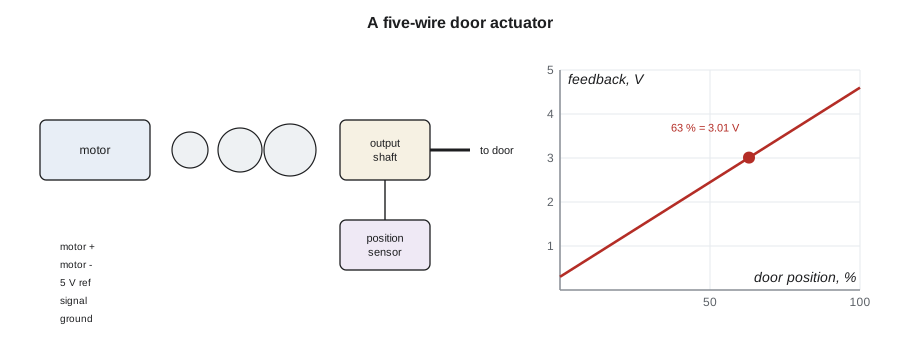
Doors are moved by cables on simple manual systems, by vacuum diaphragms on many older vehicles, and by small electric actuators on almost all current ones. An electric actuator is a small motor driving a gear train, with an output shaft that turns the door. The actuators come in several designs, and the service information tells which a vehicle uses.
- Two-wire actuators simply drive the door in one direction or the other by reversing the motor's polarity, and run to the door's mechanical stop. They are common for doors with only two positions, such as the fresh-recirculation door.
- Five-wire actuators have a reversible motor plus a position sensor, a potentiometer with a 5 volt reference, a ground and a signal wire. The module drives the motor and watches the feedback voltage, stopping when it reaches the target. The feedback voltage typically runs from a few tenths of a volt at one end of travel to around 4.5 volts at the other.
- Stepper-motor actuators move in precise steps without a feedback sensor. The module counts the steps from a known position, which it learns during a calibration routine by driving the door to its stops.
- Networked, or smart, actuators share a three-wire circuit of power, ground and a LIN data line. Each actuator has its own address, receives position commands as messages and reports its position and any faults back to the module. Many actuators can share one circuit.
Because the module knows where each door should be only from its feedback or its step count, most systems run a calibration after a battery disconnect, an actuator replacement or a module replacement. In a calibration the module drives each door to both of its stops and records the end positions. A calibration that is skipped, or that cannot complete because a door is binding, leaves the door in the wrong place and often sets a code.
Diagnosing the minivan's driver-side door
The Lindqvists' clicking is a well-known sound. When an actuator's gear train has a broken or stripped tooth, the motor keeps turning, the gears skip at the damaged tooth, and the actuator clicks as it tries to reach a position it cannot hold. It usually happens at start-up, when the module checks or moves the doors, and it often stops after a few seconds when the module times out. The door is then left wherever it happened to stop.
Kiran connects the scan tool. The minivan uses five-wire actuators for its blend doors, and the scan tool shows each door's commanded position and actual position, read from the feedback voltage. With the driver's temperature set to full cold, the passenger door's actual position follows its command to within a percent or two. The driver's door is commanded to zero percent, full cold, and reports about 63 percent, warm, and the feedback voltage barely moves when she commands it back and forth. A door stuck in one place while the motor is being driven, with clicking, means the motor and its feedback are probably fine and the gears or the door's linkage are broken.
# Blend door actuator: feedback voltage to door position, compared with the command
v_low, v_high = 0.30, 4.60      # feedback voltage at each end of travel, learned during calibration
def position(volts):
    return 100 * (volts - v_low) / (v_high - v_low)
doors = [("passenger blend", 0, 0.36), ("driver blend", 0, 3.01), ("driver blend", 100, 3.05)]
for name, commanded, feedback in doors:
    actual = position(feedback)
    error = actual - commanded
    status = "follows command" if abs(error) <= 5 else "not following: check gears, linkage or binding"
print(f"{name:<16} commanded {commanded:3} %, feedback {feedback:4.2f} V = {actual:5.1f} %: {status}")passenger blend commanded 0 %, feedback 0.36 V = 1.4 %: follows command driver blend commanded 0 %, feedback 3.01 V = 63.0 %: not following: check gears, linkage or binding driver blend commanded 100 %, feedback 3.05 V = 64.0 %: not following: check gears, linkage or binding
On the minivan, the driver's blend door actuator is reachable from under the dashboard with a lower panel removed, so the repair is quick; on some vehicles it means removing much of the dash, which Simone always checks in the labor guide before quoting. Kiran removes the actuator and turns the door by hand through its travel. The door moves freely, with no binding, so the door and its shaft are not the cause and a new actuator will not fail again for the same reason. Inside the old actuator, one tooth on the output gear is sheared. She installs the new actuator, which the service information says must be fitted with the door in a particular position, connects it, and runs the calibration with the scan tool. The module drives each door to its stops and records new end positions, and the driver's side now blows cold when cold is selected.
The sheared tooth has a likely cause. The service history shows the van had a battery replaced at another shop the year before, and the calibration was not run afterwards. With its stored end positions slightly wrong, the module drove the driver's actuator hard against the door's stop every time it commanded full heat, until the gear gave out. Marty adds that to Kiran's list of reasons to run a calibration whenever the service information calls for one.
The van's fresh-recirculation door
Courier van 2's fresh-recirculation door uses a networked actuator on a shared three-wire LIN circuit with the mode actuator and the blend actuator. The scan tool shows the climate module sending fresh-air commands, but the actuator's reported position never changes, and a code records that the actuator is responding on the network but cannot reach its target. With the actuator removed, the door is stiff: a leaf and a wad of soggy debris that got past the cowl screen have jammed it, the same debris that soaked the cabin air filter. The actuator's motor was driving against a jammed door every time Marcus pressed the button. Kiran cleans out the inlet, clears the cowl drains, which were also partly blocked, and checks that the door moves freely. Because the actuator still works when tested on the bench, and its gears are undamaged, she refits it and runs the calibration. Fresh air works again, and Marcus's windshield should stay clear.
# Networked (LIN) actuators: which responded, and did they reach their targets?
replies = [  # (address, name, target %, reported %, fault flag)
    (0x31, "mode", 40, 41, 0),
    (0x32, "blend", 75, 74, 0),
    (0x33, "fresh-recirc", 0, 100, 1),
]
for addr, name, target, reported, fault in replies:
    ok = abs(target - reported) <= 3 and not fault
    note = "ok" if ok else "cannot reach target: check the door for a jam or binding before replacing the actuator"
print(f"actuator 0x{addr:02X} {name:<13} target {target:3} %, reports {reported:3} %, fault {fault}: {note}")actuator 0x31 mode target 40 %, reports 41 %, fault 0: ok actuator 0x32 blend target 75 %, reports 74 %, fault 0: ok actuator 0x33 fresh-recirc target 0 %, reports 100 %, fault 1: cannot reach target: check the door for a jam or binding before replacing the actuator
Leaks, ducts and noises
Not every airflow complaint is a door. A duct that has fallen off its outlet behind the dashboard sends air into the dashboard instead of the cabin. A missing foam seal around a door in the case lets air leak past it, so a system set to full cold leaks a little warm air past the blend door, or a defrost door leaks air onto the windshield when panel is selected. Water leaks into the case through a damaged cowl seal or a blocked cowl drain can corrode the blower motor and the actuators. A blower motor that whistles or rattles may have debris in its fan, often leaves or a parking ticket, and an HVAC module that smells of mildew may have a blocked evaporator drain. A careful technician checks the airflow from every outlet in every mode, feels for air where none should be, and listens before deciding a part has failed.
Worked problem
Blower works only on high
A blower runs on high but not on speeds 1, 2 or 3. The motor's current on high is normal. Where is the fault most likely?
Show solution
- Speed 4 usually bypasses the resistors through a relay, so the motor and its feed are proved good.
- The lower speeds all pass through the resistor block.
- A thermal fuse or open resistor in the block, or its connector, would stop all the lower speeds.
- Check the block and its connector for heat damage, and check the motor's current so the new block does not fail too.
Answer: The resistor block or its connector; the motor is proved good on high.
Common mistakes
MistakeReplacing an actuator without checking that the door moves freely.
InsteadTurn the door by hand; a binding door will break the new actuator too.
MistakeSkipping the calibration after a battery or actuator replacement.
InsteadRun the calibration so the module learns the door end positions.
MistakeReplacing a blower resistor without checking the motor's current.
InsteadA worn motor drawing too much current will burn out the new resistor.
MistakeAssuming a stuck door means a dead actuator.
InsteadRead commanded and actual positions and check for jams first.
MistakeIgnoring leaks past doors and loose ducts.
InsteadCheck airflow at every outlet in every mode before replacing parts.
Summary and key terms
- Air passes the inlet door, filter, blower and evaporator, then the blend door and heater core, then the mode doors.
- The blend door sets temperature by mixing air that passes through and around the heater core.
- Blowers are controlled by resistor blocks or blower control modules.
- Actuators may be two-wire, five-wire with feedback, stepper or networked.
- The module calibrates door end positions and needs a calibration after battery or part replacement.
- Clicking behind the dash usually means stripped actuator gears.
- Diagnose with commanded and actual positions, and check doors for binding before replacing actuators.
- Blend door
- A door that mixes air through and around the heater core to set the outlet temperature.
- Mode door
- A door that directs air to the panel, floor or defrost outlets.
- Fresh-recirculation door
- A door that selects outside air or recirculated cabin air.
- Actuator
- A small motor and gear train that moves an HVAC door.
- Feedback potentiometer
- A position sensor in an actuator that reports the door position as a voltage.
- Calibration
- A routine in which the module drives each door to its stops and learns their positions.
- Blower resistor block
- Resistors in series with the blower motor that reduce its speed on lower settings.
- LIN
- A low-speed, single-wire data network used for actuators and other simple devices.
Practice problems
Work each problem on paper first, then reveal the answer to check.
Why does a heater core usually carry hot coolant even when the A/C is on full cold?
Show answer
Temperature is set by the blend door, not by shutting off coolant.
An actuator clicks at start-up and the door does not move. What is the likely cause?
Show answer
Stripped or broken gears in the actuator, or a door that is jammed.
What does a calibration teach the module?
Show answer
The end positions of each door's travel.
Why check the blower motor's current when replacing a failed resistor block?
Show answer
A motor drawing excessive current can overheat and ruin the new block.
Lesson quiz · 5 questions
Score 60% or more to complete this lesson.
Create a free account to save your progress, take quizzes and earn a certificate.