
AUTO-320 · Lesson 5 of 12 · 22 min
Compressors, clutches and variable displacement
Theo Banks brings his own compact car in on Thursday with a complaint he is slightly embarrassed about, given that he works at a repair shop. "The A/C works in the morning," he says, "and after twenty minutes in traffic on a hot afternoon it quits. Then it comes back on the highway. I can hear the compressor clutch clicking in and out." His car is older, uses R-134a and has a belt-driven compressor with an electromagnetic clutch. Kiran gets the job, and Marty uses it to teach her how compressors work, how they are controlled and how they fail.
The compressor is the heart of the system. It creates the pressure difference between the low side and the high side, it moves the refrigerant around the loop, and it is the part that uses the power. This lesson explains the main compressor types, how fixed and variable displacement compressors control their output, how a clutch engages and disengages a belt-driven compressor, how the system protects the compressor, and how to diagnose compressors and clutches without replacing parts that are not faulty.
What the compressor does
The compressor draws refrigerant vapor from the evaporator, compresses it and pushes it into the condenser. Pulling vapor out of the evaporator keeps the evaporator's pressure low, so the refrigerant there boils at a low temperature. Pushing vapor into the condenser raises its pressure, so the refrigerant condenses at a temperature above the outside air. The compressor must only ever handle vapor. Liquid does not compress, so liquid refrigerant or a large slug of oil reaching the compressor can break valves and pistons. That is the reason the system keeps some superheat at the evaporator outlet and, on orifice tube systems, has an accumulator ahead of the compressor to catch liquid.
The compressor also depends on the refrigerant for lubrication and cooling. Its oil travels around the system mixed with the refrigerant, and the cool returning vapor carries heat away from the compressor's working parts. A system that is low on refrigerant therefore starves the compressor of both oil and cooling, which is why a slow leak left alone often ends with a failed compressor and a much larger repair bill, as Harold Kemp found out in Lesson 3.
Compressor types
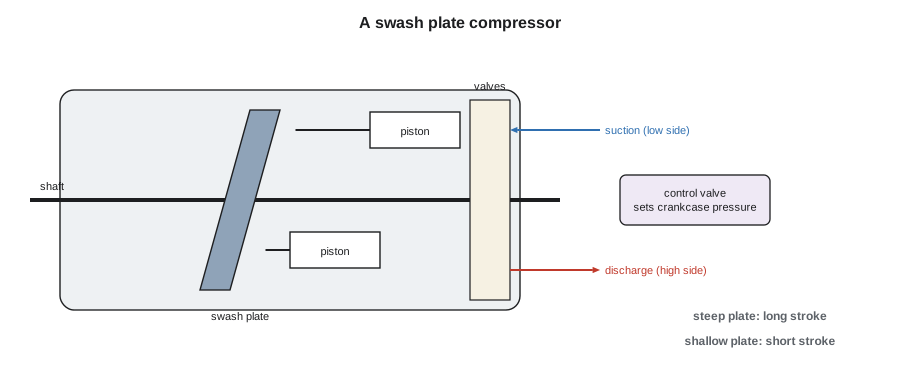
Most belt-driven vehicle compressors are piston compressors. In a swash plate compressor, the shaft turns an angled plate, and the plate pushes a ring of pistons back and forth in their cylinders as it rotates, like a hand pushing down on the edge of a tilted plate. Each piston draws vapor in through a reed valve on its suction stroke and pushes it out through another reed valve on its compression stroke. The angle of the plate sets how far the pistons travel, and therefore how much vapor the compressor moves each revolution, called its displacement. Scroll compressors use two interleaved spirals, one fixed and one orbiting, which trap pockets of vapor and squeeze them toward the center. They are smooth and efficient, and they are the usual design for electric compressors. Rotary vane compressors use sliding vanes in an off-center rotor, and appear on some smaller vehicles.
Fixed and variable displacement
A fixed displacement compressor always moves the same volume of vapor per revolution, so its output rises and falls with engine speed. The system controls it by switching it on and off with the clutch: when the evaporator gets cold enough to risk freezing, a pressure switch or an evaporator temperature sensor opens the clutch circuit, and when the evaporator warms up again the clutch re-engages. That is called a cycling clutch system, and the clicking Theo hears every half minute or so on a mild day is normal for one.
A variable displacement compressor changes the swash plate angle while it runs, so it can match its output to the load without cycling. The plate angle is set by the pressure in the compressor's crankcase, the space behind the pistons, which a control valve adjusts by letting discharge pressure into the crankcase or bleeding it to the suction side. Older variable compressors use a mechanical control valve that senses suction pressure directly. Newer ones use an electronic control valve, a solenoid that the engine or climate control module operates with a varying duty cycle, so the module can command exactly the evaporator temperature it wants and can reduce the compressor's load when the engine needs full power. Many variable compressors have no clutch at all; they turn whenever the engine runs and simply reduce their stroke to almost zero when no cooling is needed. Those clutchless compressors have a pulley with a torque limiter that breaks away if the compressor seizes, so that the drive belt, which also turns the alternator and water pump, keeps running.
# Variable displacement compressor: electronic control valve duty cycle against displacement (illustrative)
max_cc = 160               # displacement per revolution at full stroke, cubic centimeters
curve = [(0, 0.03), (20, 0.10), (40, 0.35), (60, 0.65), (80, 0.92), (100, 1.00)]   # duty %, fraction of full stroke
def fraction(duty):
    for (d1, f1), (d2, f2) in zip(curve, curve[1:]):
        if d1 <= duty <= d2:
            return f1 + (f2 - f1) * (duty - d1) / (d2 - d1)
for duty in (10, 30, 50, 70, 90):
    f = fraction(duty)
print(f"control valve {duty:3} % duty: stroke {100 * f:4.0f} % of full, displacement {max_cc * f:5.1f} cc per revolution")control valve 10 % duty: stroke 6 % of full, displacement 10.4 cc per revolution control valve 30 % duty: stroke 22 % of full, displacement 36.0 cc per revolution control valve 50 % duty: stroke 50 % of full, displacement 80.0 cc per revolution control valve 70 % duty: stroke 78 % of full, displacement 125.6 cc per revolution control valve 90 % duty: stroke 96 % of full, displacement 153.6 cc per revolution
How much the compressor can pump
A compressor's cooling capacity depends on how much refrigerant it moves each second and how much heat each kilogram picks up in the evaporator. Mass flow is the displacement times the compressor speed times the density of the vapor it draws in, reduced by a volumetric efficiency because some vapor is left in the cylinders and some leaks back. The compressor turns faster than the engine on most vehicles, through a smaller pulley. The calculation shows why a car cools better on the highway than at idle: at idle the compressor turns slowly and moves far less refrigerant, at the same time as the condenser gets less air. Variable compressors and electric compressors reduce this problem but do not remove it.
# Compressor cooling capacity at idle and at cruise (illustrative R-134a values)
displacement_cc = 160          # full stroke
pulley_ratio = 1.30            # compressor turns faster than the crankshaft
vol_eff = 0.75                 # volumetric efficiency
suction_density = 15.5         # kg per cubic meter of vapor at the compressor inlet
effect_kj_per_kg = 140         # heat picked up per kg in the evaporator
for label, engine_rpm in (("idle", 650), ("town", 1500), ("highway", 2200)):
    comp_rpm = engine_rpm * pulley_ratio
    mass_flow = displacement_cc * 1e-6 * comp_rpm / 60 * vol_eff * suction_density   # kg/s
    capacity_kw = mass_flow * effect_kj_per_kg
print(f"{label:<8} engine {engine_rpm:5} rpm: compressor {comp_rpm:5.0f} rpm, {mass_flow * 7936.6:4.0f} lb/h, about {capacity_kw * 3412:6,.0f} BTU/h of cooling")idle engine 650 rpm: compressor 845 rpm, 208 lb/h, about 12,513 BTU/h of cooling town engine 1500 rpm: compressor 1950 rpm, 480 lb/h, about 28,876 BTU/h of cooling highway engine 2200 rpm: compressor 2860 rpm, 704 lb/h, about 42,351 BTU/h of cooling
In practice a variable compressor runs at less than full stroke on the highway, because it does not need that much capacity, and the expansion device and the evaporator limit how much refrigerant can usefully circulate. The point stands: at idle, the compressor's capacity falls to well under half its highway value, so anything else that weakens the system, such as a slightly low charge, a dirty condenser or a slipping clutch, shows up first in traffic.
The compressor clutch
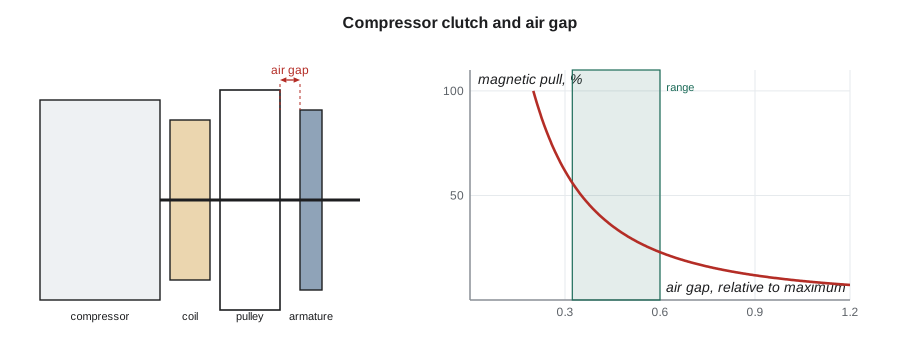
A clutch-type compressor has a pulley that spins freely on a bearing on the compressor's nose whenever the engine runs. Behind the pulley is a stationary electromagnet coil. In front of it is an armature plate, also called the hub or drive plate, splined to the compressor shaft and held a small distance from the pulley's face by springs. When the system calls for cooling, the coil is energized, its magnetic field pulls the armature plate against the pulley's face, and friction drives the compressor. When the coil is switched off, the springs pull the plate back and the compressor stops while the pulley keeps spinning.
The small space between the armature plate and the pulley face when the clutch is released is the air gap. It is set with shims, and makers give a range, often about 0.014 to 0.026 in. A gap that is too small lets the plate drag on the pulley when it should be released, causing noise and wear. A gap that is too large means the magnet must pull the plate across a wide gap, and the magnetic force falls steeply as the gap grows, so the clutch may engage weakly, slip, or not engage at all. The gap grows as the friction faces wear. A clutch coil's resistance also rises as it gets hot, which reduces its current and its pull, so a clutch with a borderline gap often works when cool and fails when hot.
Protecting the compressor and the system
Several devices protect the compressor and the system, and any of them can stop the compressor. A low-pressure cut-out, or the module reading a pressure sensor, prevents the compressor from running when the system pressure is too low, which usually means the system is empty or nearly so and has no oil circulating. A high-pressure cut-out, or the module reading the high-side pressure transducer, switches the compressor off before the pressure gets dangerous, for example when the cooling fan has failed. An evaporator temperature sensor or a low-side pressure switch prevents the evaporator from freezing. The engine control module may also switch the compressor off at wide-open throttle, when the engine is very hot, or when the engine speed is very low. Most systems have a mechanical high-pressure relief valve on the compressor as a last line of defense; if it ever opens, it vents refrigerant, so a vehicle whose relief valve has opened must have the cause found, usually a cooling fan or condenser airflow problem.
Modern systems control the compressor through modules. The climate control module receives the driver's request, checks the evaporator temperature and the high-side pressure, and asks the engine control module for the compressor. The engine control module decides whether the engine can accept the load and then energizes the clutch relay or commands the control valve. A scan tool shows each step: the request, the high-side pressure reading, the evaporator temperature, the command and any reason the compressor is being held off. Reading those values is the first step in any no-compressor diagnosis, because it quickly separates a compressor or clutch fault from a control or sensor fault.
Diagnosing Theo's clutch
Kiran starts with the scan tool. With the car cold, the climate control module requests the compressor, the engine control module commands the clutch relay on, and the clutch engages; the pressures look normal. She takes the car out in traffic for twenty minutes with the scan tool recording. When the cooling fails, the command is still on, the relay output is still on, and the clutch is still being powered, but the low-side pressure rises and the high-side pressure falls toward each other, as if the compressor had stopped pumping. Looking at the clutch with the engine idling, she sees why: the pulley is spinning and the armature plate is turning slowly and unevenly, slipping against the pulley face.
Back in the bay, with the engine off and cooled, she measures the coil resistance at its connector and the air gap with a feeler gauge at three points around the plate. The coil reads about 3.4 ohms cold; she rechecks it hot after a run and it reads about 4.1 ohms. The air gap is about 0.040 in, well above the maximum.
# Clutch coil: resistance rises with temperature, so current and pull fall (copper, about 0.393 % per degree C)
r_cold, t_cold = 3.4, 20         # ohms at 20 C
alpha = 0.00393
volts = 13.8
for t in (20, 60, 100, 120):
    r = r_cold * (1 + alpha * (t - t_cold))
    amps = volts / r
    print(f"coil at {t * 9 / 5 + 32:3.0f} F: {r:4.2f} ohm, {amps:4.2f} A")
gap_spec = (0.014, 0.026)
gap_measured = [0.039, 0.04, 0.04]
avg = sum(gap_measured) / 3
print(f"air gap average {avg:.3f} in against {gap_spec[0]} to {gap_spec[1]} in: {'within range' if gap_spec[0] <= avg <= gap_spec[1] else 'out of range'}")coil at 68 F: 3.40 ohm, 4.06 A coil at 140 F: 3.93 ohm, 3.51 A coil at 212 F: 4.47 ohm, 3.09 A coil at 248 F: 4.74 ohm, 2.91 A air gap average 0.040 in against 0.014 to 0.026 in: out of range
The coil itself is healthy; its hot resistance rise is normal for copper. The problem is the gap. With the clutch hot, its current falls by about a fifth, and across a gap almost twice the maximum the magnet can no longer clamp the plate firmly enough to drive the compressor against high pressure. On the highway the cooler under-hood air keeps the coil a little cooler and the higher compressor speed and lower head pressure reduce the load, so the clutch holds.
On many compressors the air gap can be reset by removing a shim behind the armature plate, provided the friction faces are not glazed, scored or blued from heat. Theo's are worn but not damaged. Kiran removes the plate with the clutch puller, removes one shim to bring the gap to about 0.020 in, checks that the plate turns freely without drag, and reinstalls it. On the road test, the compressor stays engaged through forty minutes of traffic. Marty adds a note that a clutch worn this far will need replacing within a season or two; Theo, being Theo, decides to wait.
Worked problem
No compressor: clutch or control?
A compressor does not engage. The scan tool shows the climate module requesting the compressor and the engine module holding it off, with the reason 'high-side pressure too low'. The high-side sensor reads zero. What next?
Show solution
- A reading of zero on a vehicle that has been parked is unusual unless the system is empty.
- Connect gauges or a service machine to read the actual static pressure.
- If the actual pressure is normal, the sensor or its circuit is at fault; check its 5 volt reference, signal and ground.
- If the system is empty, find the leak; the module is protecting the compressor correctly.
Answer: Confirm the real pressure before blaming the sensor or the compressor.
Common mistakes
MistakeReplacing a compressor because the clutch will not engage.
InsteadCheck the command, the power and ground at the coil, the coil resistance and the air gap first.
MistakeTreating normal clutch cycling as a fault.
InsteadA cycling clutch system switches on and off to stop the evaporator freezing.
MistakeForgetting that coil resistance rises when hot.
InsteadTest hot and cold when a clutch fails only after warming up.
MistakeIgnoring a slow leak because the A/C still works.
InsteadA low charge starves the compressor of oil and cooling.
MistakeIgnoring the reason the module is holding the compressor off.
InsteadRead the request, the command and the inhibit reason on the scan tool.
Summary and key terms
- The compressor creates the pressure difference and must handle only vapor.
- Swash plate piston compressors are common; scroll compressors are usual in electric compressors.
- Fixed compressors cycle their clutch; variable compressors change their stroke, often with an electronic control valve.
- Compressor capacity rises with speed, so cooling is weakest at idle.
- A clutch's air gap must be within specification; a wide gap causes slipping, especially when hot.
- Pressure sensors, switches and the engine module protect the compressor and can hold it off.
- Diagnose with scan data, coil resistance and air gap before replacing parts.
- Displacement
- The volume of vapor a compressor moves per revolution.
- Swash plate
- An angled plate that drives the pistons of a compressor as it turns.
- Variable displacement compressor
- A compressor that changes its stroke to match the cooling load.
- Electronic control valve
- A solenoid that sets a variable compressor's stroke by controlling crankcase pressure.
- Air gap
- The space between a compressor clutch's armature plate and pulley when the clutch is released.
- Cycling clutch system
- A system that switches a fixed compressor on and off to control evaporator temperature.
- Torque limiter
- A device in a clutchless compressor pulley that breaks away if the compressor seizes.
Practice problems
Work each problem on paper first, then reveal the answer to check.
Why must a compressor never receive liquid refrigerant?
Show answer
Liquid does not compress and can break valves and pistons.
Why is a car's cooling weakest at idle?
Show answer
The compressor turns slowly and the condenser gets less air.
A clutch engages when cold and slips when hot. What two measurements should be taken?
Show answer
Coil resistance, cold and hot, and the air gap.
What does a clutchless variable compressor do when no cooling is needed?
Show answer
It reduces its stroke to nearly zero while still turning.
Lesson quiz · 5 questions
Score 60% or more to complete this lesson.
Create a free account to save your progress, take quizzes and earn a certificate.