
AUTO-320 · Lesson 6 of 12 · 20 min
Condensers, evaporators, expansion devices and receivers
Gord Haney's pickup is back in the bay, and this time Kiran knows what the gauges told her in Lesson 2: the low side was normal, but the high side climbed at idle to a condensing temperature far above the outside air, and fell as soon as the engine speed rose. The system was not short of refrigerant. It was failing to get rid of heat. That puts the condenser and its airflow under suspicion, and this lesson takes the story from there. It also introduces the other heat exchanger, the evaporator, the two kinds of expansion device that sit between them, and the receiver-drier and accumulator that store refrigerant and remove moisture.
Later in the week the Lindqvists' minivan gives Kiran a second puzzle in the same family of parts. Its front air conditioning is cold, but the rear system that cools the second and third rows blows air that is barely cool. Both systems share one compressor and one condenser, so the fault must be somewhere in the rear system's own parts. By the end of the lesson she will find both faults with two measurements Marty calls the technician's best friends: superheat and subcooling.
The condenser
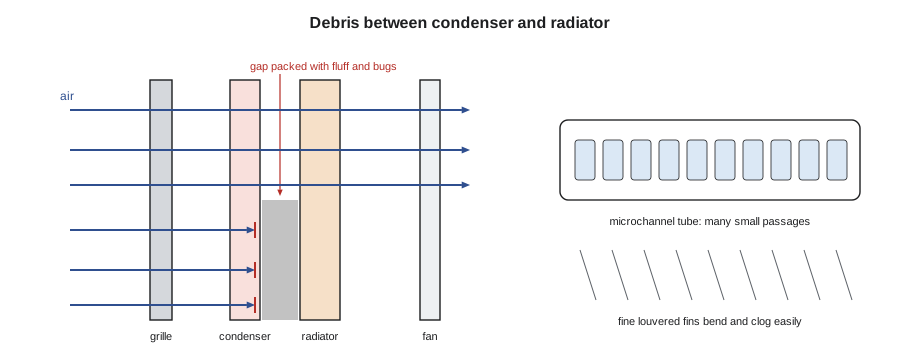
The condenser sits in front of the radiator, where it gets the coolest air. Hot, high-pressure vapor from the compressor enters at the top. As outside air flows through the condenser's fins, the vapor cools to its condensing temperature, condenses into liquid, and then cools a little further before it leaves at the bottom. Older condensers were serpentine designs, one long tube snaking back and forth. Modern condensers are parallel flow or microchannel designs: flat aluminum tubes with many tiny internal passages, connected by headers at each end, with very fine fins between them. They are lighter and more efficient, but their fins bend and clog easily and their thin tubes cannot be repaired; a leaking condenser is replaced.
A condenser can only work as well as the air that flows through it. On the highway, ram air does most of the work. At idle or in slow traffic, the cooling fan, electric on most vehicles and a viscous fan clutch on many trucks, must pull enough air through both the condenser and the radiator. Anything that blocks the air raises the condensing pressure and temperature: leaves, bugs, road grime, cottonwood fluff, bent fins, a missing air dam or seal that lets hot air recirculate around the condenser, a weak fan or a fan that does not run. A higher condensing temperature means less subcooling, less cooling capacity, higher compressor load, and eventually the high-pressure cut-out switching the compressor off.
Kiran shines a light through the grille of Gord's truck and sees nothing wrong; the front of the condenser looks clean. Marty tells her to look between the condenser and the radiator. With the upper radiator cover removed, she finds the gap packed with a gray felt of cottonwood fluff, bugs and dust, almost solid across the lower half. Cottonwood trees along the rivers in Denver release their seeds in early summer, and the fluff collects exactly there, where nobody sees it.
Subcooling: reading the condenser
Subcooling is the number of degrees by which the liquid leaving the condenser is cooler than its condensing temperature. To measure it, read the high-side pressure, convert it to the condensing temperature using the pressure-temperature chart, and measure the actual temperature of the liquid line near the condenser outlet with a clamp-on thermometer. The difference is the subcooling. A healthy condenser on a correctly charged system delivers some subcooling, often in the range of about 5 to 18 °F, though the maker's figure governs. Too little subcooling means the condenser is not fully condensing the refrigerant, usually because the system is low on charge or the condenser cannot reject enough heat. Too much often means an overcharge, with liquid backing up in the condenser, or a restriction downstream holding liquid back.
A second check is the condenser's approach temperature: how far the condensing temperature is above the outside air. A clean condenser with good airflow typically condenses about 20 to 30 °F above the outside air at a fast idle, more at a slow idle. Gord's truck is condensing far higher than that.
def sat_temp(p_abs, table):
    for (t1, p1), (t2, p2) in zip(table, table[1:]):
        if p1 <= p_abs <= p2:
            return t1 + (t2 - t1) * (p_abs - p1) / (p2 - p1)
    raise ValueError("outside table")
table = [(14, 29.1), (23, 35.3), (32, 42.5), (41, 50.7), (50, 60.1), (59, 70.8), (68, 82.9), (77, 96.6), (86, 111.7), (95, 128.6), (104, 147.4), (113, 168.2), (122, 191.1), (131, 216.3), (140, 243.9)]             # R-134a saturation (temperature, absolute pressure), rounded
atm = 12.1               # local air pressure at Ridgeline
ambient = 88
for label, gauge_high, liquid_line in (("before cleaning", 210, 130), ("after cleaning", 154, 102)):
    t_cond = sat_temp(gauge_high + atm, table)
    subcool = t_cond - liquid_line
    approach = t_cond - ambient
print(f"{label:<16} high {gauge_high} psi: condensing {t_cond:5.1f} F, liquid {liquid_line} F, subcooling {subcool:4.1f} F, approach {approach:4.1f} F")before cleaning high 210 psi: condensing 132.9 F, liquid 130 F, subcooling 2.9 F, approach 44.9 F after cleaning high 154 psi: condensing 112.1 F, liquid 102 F, subcooling 10.1 F, approach 24.1 F
Before cleaning, Gord's condensing temperature is about 45 °F above the outside air at idle, and the liquid leaving the condenser is barely cooler than its condensing temperature: the condenser is too hot to finish its job. Kiran removes the fluff with a soft brush and low-pressure water sprayed from the engine side toward the front, the opposite direction to the airflow, so that the debris is pushed out the way it came in rather than deeper into the fins. Marty warns her never to use a pressure washer close to a microchannel condenser, because it flattens the fins. With the gap clean, the same idle test gives a condensing temperature about 24 °F above ambient, healthy subcooling, and vent air that stays cold at idle. Gord's "cools on the highway and not in town" is fixed without a drop of refrigerant.
The evaporator
The evaporator, inside the HVAC module, is built much like a condenser but works in reverse. Cold liquid and vapor from the expansion device enter it, and the warm cabin air blown across its fins makes the refrigerant boil. Most modern evaporators are plate-and-fin designs, stacked pairs of formed aluminum plates with passages between them. The evaporator also dries the air: it runs below the dew point of the incoming air, so water condenses on its fins and drains out of the HVAC case through a drain tube. If the drain clogs, water collects in the case and can spill onto the passenger floor or grow mold, which smells.
The evaporator must be kept just above freezing. If its surface falls below 32 °F, the condensed water freezes on the fins, ice blocks the airflow, and the vents slowly lose their airflow and their cooling, usually after a long drive on a humid day. The control system prevents that by watching an evaporator temperature sensor, or the low-side pressure, and reducing the compressor's output or cycling it off when the evaporator gets too cold. A faulty sensor, a stuck control valve or very low airflow from a clogged cabin air filter can all let an evaporator freeze.
Expansion devices: orifice tube and expansion valve
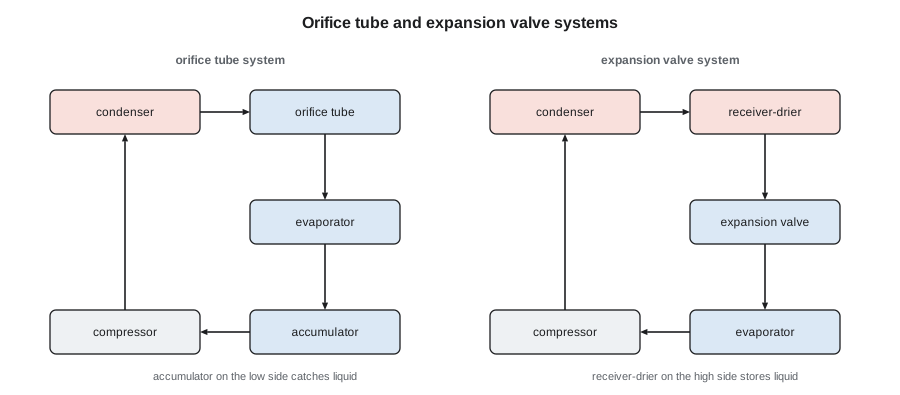
The expansion device divides the high side from the low side and meters refrigerant into the evaporator. There are two main types, and a system is designed around one or the other. An orifice tube is a short plastic tube with a small brass or copper passage, held in the liquid line near the evaporator inlet, with fine screens on each side. Its opening is fixed, so the flow through it depends on the pressure difference across it. An orifice tube system cannot control superheat precisely, so it always has an accumulator at the evaporator outlet to catch any liquid that did not boil, and it usually controls the evaporator temperature by cycling the compressor or with a variable compressor. Orifice tubes can clog with debris from a failing compressor, and they are replaced whenever the system is opened for a major repair.
A thermostatic expansion valve, or TXV, adjusts its opening to keep a set superheat at the evaporator outlet. A sensing element, either a bulb clamped to the outlet line or, in the common block-type valve, built into the valve itself in the outlet passage, contains a charge that expands as the outlet warms. If the evaporator outlet gets warmer, meaning the refrigerant boiled away too early and is starving the end of the evaporator, the valve opens further. If the outlet gets colder, meaning liquid is reaching the outlet, it closes. A TXV system therefore uses all of its evaporator efficiently and usually has a receiver-drier on the high side instead of an accumulator. Electric vehicles and heat pumps increasingly use electronic expansion valves, stepper-motor valves that a module positions precisely; Lesson 10 returns to them.
Superheat: reading the evaporator
Superheat is the number of degrees by which the vapor leaving the evaporator is warmer than its boiling temperature. Measure the low-side pressure, convert it to the boiling temperature, and measure the evaporator outlet line temperature. A TXV system holds a fairly steady superheat, often about 7 to 14 °F. High superheat means the evaporator is starved: too little refrigerant is reaching it, because the system is low on charge, the expansion valve is stuck mostly closed or its screen is blocked, or there is a restriction ahead of it. Very low superheat means liquid is flooding through the evaporator, from an overcharge or a valve stuck open. On orifice tube systems, superheat at the evaporator outlet is normally small and the accumulator hides it, so technicians use the maker's charging chart instead.
The Lindqvists' minivan has a TXV at each evaporator. Kiran measures the low-side pressure at the service port and the outlet line temperatures at the front and rear evaporators, reachable from underneath. The front shows a normal superheat. The rear outlet line is much warmer than the boiling temperature, a superheat of more than 36 °F, and the rear valve body itself is frosting at its inlet. That frost is a strong clue: refrigerant is dropping in pressure and chilling at a restriction right at the valve.
def sat_temp(p_abs, table):
    for (t1, p1), (t2, p2) in zip(table, table[1:]):
        if p1 <= p_abs <= p2:
            return t1 + (t2 - t1) * (p_abs - p1) / (p2 - p1)
    raise ValueError("outside table")
table = [(14, 32.1), (23, 38.4), (32, 45.8), (41, 54.2), (50, 63.6), (59, 74.2), (68, 85.8), (77, 99.0), (86, 113.5), (95, 129.5), (104, 147.6), (113, 167.2), (122, 188.9), (131, 212.5), (140, 238.1)]             # R-1234yf saturation (temperature, absolute pressure), rounded
atm = 12.1
gauge_low = 35.5
t_boil = sat_temp(gauge_low + atm, table)
for name, outlet in (("front evaporator", 49), ("rear evaporator", 73)):
    superheat = outlet - t_boil
    verdict = "normal" if superheat <= 16 else "starved: too little refrigerant reaching it"
print(f"{name}: boiling {t_boil:4.1f} F, outlet {outlet} F, superheat {superheat:4.1f} F -> {verdict}")front evaporator: boiling 33.9 F, outlet 49 F, superheat 15.1 F -> normal rear evaporator: boiling 33.9 F, outlet 73 F, superheat 39.1 F -> starved: too little refrigerant reaching it
With the front evaporator normal and the system's subcooling also normal, the charge is correct; a low charge would starve both evaporators. The fault is in the rear circuit. The service information shows the rear valve has a fine inlet screen. After recovering the system, Kiran removes the valve and finds the screen partly blocked with a dark, gritty paste. The rear system was opened years ago for a line repair at another shop, and debris got in. She replaces the valve and its seals, flushes the rear liquid line with the maker-approved flush, replaces the receiver-drier as the service information requires when the system has been contaminated, then evacuates and charges by weight as Lesson 11 explains. The third row cools again.
Receiver-driers and accumulators
Every system has a container that stores some spare refrigerant and holds a desiccant, a material that absorbs moisture. Moisture is the enemy of an air conditioning system: it reacts with refrigerant and oil to form acids that corrode aluminum, it can freeze in the expansion device, and it breaks down PAG oil. On a TXV system the container is a receiver-drier on the high side, between the condenser and the valve, and on most modern condensers it is built into the condenser's side header as a replaceable desiccant cartridge. It stores liquid so that the valve always receives a solid column of liquid. On an orifice tube system the container is an accumulator on the low side, at the evaporator outlet. It catches liquid refrigerant and oil, lets the vapor pass to the compressor, and meters a small amount of oil back through a bleed hole.
A desiccant can absorb only so much moisture, and it absorbs moisture from the air within minutes when a system is open. Makers therefore specify when the receiver-drier, accumulator or desiccant cartridge must be replaced: often whenever the system has been open for more than a short time, whenever a major component such as the compressor is replaced, and always after contamination. The replacement part should be kept capped until the moment it is installed. Some service information also calls for replacing it at set intervals.
Worked problem
High subcooling and high superheat together
A TXV system shows high subcooling and high superheat, with low low-side pressure. What does that pattern suggest?
Show solution
- High superheat says the evaporator is starved of refrigerant.
- If the charge were low, subcooling would also be low; here it is high.
- High subcooling with a starved evaporator means liquid is being held back between the condenser and the evaporator.
- Look for a restriction: a stuck or blocked expansion valve, a blocked screen or a kinked liquid line, often shown by frost or a temperature drop at the restriction.
Answer: A restriction on the high side or at the valve, not a charge problem.
Common mistakes
MistakeAdding refrigerant to a system with high head pressure.
InsteadCheck condenser airflow, debris between the heat exchangers and the fan first.
MistakeLooking only at the front of the condenser.
InsteadCheck between the condenser and the radiator, where debris collects.
MistakePressure-washing a microchannel condenser at close range.
InsteadUse a soft brush and low-pressure water from the engine side.
MistakeJudging the charge from pressures alone.
InsteadMeasure superheat and subcooling with line temperatures.
MistakeReusing a saturated receiver-drier after contamination.
InsteadReplace the drier or desiccant as the service information requires.
Summary and key terms
- The condenser rejects heat to outside air and needs clean fins and strong airflow.
- Subcooling and the condenser approach temperature show how well the condenser is working.
- The evaporator absorbs cabin heat, dries the air and must be kept just above freezing.
- Orifice tube systems use a fixed restriction and an accumulator; TXV systems control superheat and use a receiver-drier.
- High superheat means a starved evaporator; frost at a component often marks a restriction.
- Desiccants absorb moisture and must be replaced when the maker requires.
- Superheat and subcooling together separate charge problems from restrictions and airflow problems.
- Condenser
- The high-side heat exchanger where refrigerant gives up heat and condenses.
- Evaporator
- The low-side heat exchanger where refrigerant boils and absorbs cabin heat.
- Orifice tube
- A fixed restriction that meters refrigerant into the evaporator.
- Thermostatic expansion valve (TXV)
- A valve that adjusts its opening to hold a set evaporator superheat.
- Receiver-drier
- A high-side container that stores liquid refrigerant and holds desiccant.
- Accumulator
- A low-side container that catches liquid and oil ahead of the compressor.
- Desiccant
- A material that absorbs moisture from the refrigerant.
- Approach temperature
- How far the condensing temperature is above the outside air temperature.
Practice problems
Work each problem on paper first, then reveal the answer to check.
Where does cottonwood fluff often collect, unseen?
Show answer
Between the condenser and the radiator.
A TXV system shows normal subcooling and high superheat at one evaporator only. Where is the fault?
Show answer
In that evaporator's own circuit, such as its expansion valve or screen.
Why must an evaporator be kept above freezing?
Show answer
Ice on its fins blocks airflow and cooling.
Name two jobs of an accumulator.
Show answer
Catch liquid refrigerant so only vapor reaches the compressor, and return oil through its bleed hole; it also holds desiccant.
Lesson quiz · 5 questions
Score 60% or more to complete this lesson.
Create a free account to save your progress, take quizzes and earn a certificate.