
AUTO-320 · Lesson 3 of 12 · 21 min
Refrigerants: R-134a, R-1234yf and R-744
Harold Kemp's SUV arrives on Tuesday with a story Kiran will hear many times. The air conditioning stopped cooling last summer, so Harold bought a recharge can at a parts store, "the kind with the gauge on top and the leak stop in it", and emptied it into the low-side port. The system cooled for a few weeks and then quit again. This year he tried a second can from a different brand. Now it blows warm and the compressor makes a groaning noise. He wants it fixed properly this time.
Before Kiran connects anything, Marty hands her the shop's refrigerant identifier. "Nothing goes into our recovery machine until we know what's in that system," he says. "Those cans aren't all the same refrigerant, some of them have sealer in them, and a few have had flammable hydrocarbons. If we pull a mixture into our machine, we contaminate our whole supply and maybe the next customer's car too." This lesson explains the refrigerants found in vehicles today, why they changed, how they differ in pressure, safety and oil, how they are identified, and what a shop does with refrigerant that is not what it should be.
Why refrigerants keep changing
Vehicle air conditioning used R-12, a chlorofluorocarbon, until the 1990s. Chlorine from R-12 and similar chemicals released into the atmosphere was found to destroy the stratospheric ozone layer, which shields the earth from ultraviolet radiation. Under the Montreal Protocol, an international agreement signed in 1987, production of these chemicals was phased out in the developed world, and vehicles switched to R-134a, a hydrofluorocarbon that contains no chlorine and does not harm the ozone layer. Most vehicles built from the mid-1990s until the late 2010s use R-134a, including Gord's 2013 pickup and Harold's SUV.
R-134a has its own problem. It is a powerful greenhouse gas. Its global warming potential, or GWP, a measure of how much heat a kilogram of a gas traps in the atmosphere over a hundred years compared with a kilogram of carbon dioxide, is about 1,430 in the values used by most regulations. A typical car charge of under a kilogram, leaked to the atmosphere, has roughly the same warming effect as a ton of carbon dioxide. Vehicle makers and governments have therefore moved to refrigerants with a very low GWP. In the United States, rules under the American Innovation and Manufacturing Act restrict refrigerants with a GWP of 150 or more in newly made light-duty vehicles from the 2025 model year, and in larger vehicles a few years later; existing vehicles can still be serviced with the refrigerant they were built with. In Canada, federal rules on halocarbons and vehicle greenhouse gas standards have pushed new vehicles in the same direction. The result is that nearly all new light vehicles in both countries now use R-1234yf, and a few use carbon dioxide, R-744.
# Global warming effect of a refrigerant charge if it all leaks out (100-year GWP values)
refrigerants = {"R-134a": 1430, "R-1234yf": 1, "R-744 (CO2)": 1}
charge_kg = 0.65        # typical car charge
for name, gwp in refrigerants.items():
    co2e = charge_kg * gwp
print(f"{name:<12} GWP {gwp:5,}: {charge_kg * 2.2046:.2f} lb leaked = {co2e * 2.2046:7.1f} lb CO2-equivalent")R-134a GWP 1,430: 1.43 lb leaked = 2049.2 lb CO2-equivalent R-1234yf GWP 1: 1.43 lb leaked = 1.4 lb CO2-equivalent R-744 (CO2) GWP 1: 1.43 lb leaked = 1.4 lb CO2-equivalent
The GWP of R-1234yf is listed as less than 1 in the most recent scientific assessments and about 4 in older tables still found in some service material; either way it is a tiny fraction of R-134a's. The figure below compares the three. A shop that recovers refrigerant instead of venting it, and fixes leaks instead of topping systems up every summer, prevents a large amount of warming over a year, which is the reason behind the handling rules in Lesson 4.
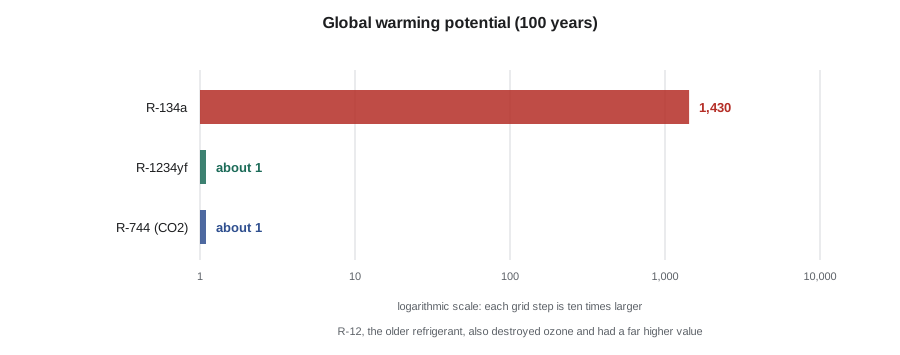
R-134a and R-1234yf compared
R-1234yf, a hydrofluoroolefin, was chosen partly because it behaves almost like R-134a. Its pressures at normal operating temperatures are close, so system designs carried over with only small changes, and the same basic service methods apply. It is not a drop-in replacement, though. Its pressure-temperature curve differs slightly: it is a little higher than R-134a at evaporator temperatures and a little lower at high condensing temperatures. It carries a little less heat per kilogram, so systems often have a more efficient design, such as an internal heat exchanger between the liquid and suction lines, to keep cooling the same. And a different charge amount and a different oil are specified. The two must never be mixed, and converting an R-134a system to R-1234yf, or the reverse, is not an accepted repair.
# Saturation pressure of R-134a and R-1234yf at the same temperatures (rounded values)
r134a = {32: 42.5, 50: 60.2, 104: 147.5, 140: 243.9}
r1234yf = {32: 45.8, 50: 63.7, 104: 147.6, 140: 238.1}
for t in r134a:
    a, b = r134a[t], r1234yf[t]
print(f"{t:3} F: R-134a {a:5} psia, R-1234yf {b:5} psia, difference {100 * (b - a) / a:+5.1f} %")32 F: R-134a 42.5 psia, R-1234yf 45.8 psia, difference +7.8 % 50 F: R-134a 60.2 psia, R-1234yf 63.7 psia, difference +5.8 % 104 F: R-134a 147.5 psia, R-1234yf 147.6 psia, difference +0.1 % 140 F: R-134a 243.9 psia, R-1234yf 238.1 psia, difference -2.4 %
The most important difference is safety. Refrigerants are classified by toxicity and flammability. R-134a is class A1: low toxicity and no flame propagation. R-1234yf is class A2L: low toxicity and mildly flammable. It is hard to ignite and burns slowly, but under the right conditions, such as a large release onto a very hot surface, it can burn, and burning produces hydrogen fluoride, a corrosive gas. Vehicle makers design systems with that in mind, and service equipment for R-1234yf is built to avoid sparks and to detect leaks inside the machine. For the technician, the rules are practical: use only equipment rated for R-1234yf, never use compressed air or open flames near an open system, work in a ventilated area, and never mix in any other refrigerant or a hydrocarbon. Lesson 11 covers the service procedures.
The two refrigerants also use different, deliberately incompatible service fittings, so a hose for one cannot be connected to the other. The low-side and high-side fittings are different sizes from each other as well. Every vehicle carries an under-hood label giving the refrigerant type, the charge amount, the oil type and, on newer vehicles, a warning symbol for a flammable refrigerant. Kiran makes reading that label her first step on every job. Hal's 2020 vans, the Lindqvists' 2017 minivan, Ines Moreau's 2019 hybrid and Dr. Singh's 2022 electric car all use R-1234yf. Gord's pickup, Harold's SUV and Theo's compact use R-134a.
R-744: carbon dioxide
A small number of vehicles, mainly some European electric models, use carbon dioxide, R-744, as their refrigerant. Carbon dioxide is non-flammable, cheap and has a GWP of 1, and it works well in heat pumps at very low outside temperatures. Its pressures, though, are many times higher than those of R-134a or R-1234yf. At 32 °F its saturation pressure is about 505 psia, and on a hot day its high side can run above 1,450 psi. Above about 88 °F, its critical temperature, carbon dioxide cannot be condensed into a liquid at all, so the high-side heat exchanger is called a gas cooler instead of a condenser, and the system controls its pressure differently.
# Why R-744 is different: saturation pressure and the critical point (rounded values)
co2 = [(14, 384), (32, 505), (50, 653), (68, 831)]
critical_t, critical_p = 87.8, 1070
for t, p in co2:
    print(f"{t:4} F: {p:5,} psia, about {p / 42.5:.0f} times R-134a at 32 F")
print(f"above {critical_t} F (critical point, {critical_p:,} psia) CO2 cannot condense: the high side is a gas cooler")14 F: 384 psia, about 9 times R-134a at 32 F 32 F: 505 psia, about 12 times R-134a at 32 F 50 F: 653 psia, about 15 times R-134a at 32 F 68 F: 831 psia, about 20 times R-134a at 32 F above 87.8 F (critical point, 1,070 psia) CO2 cannot condense: the high side is a gas cooler
R-744 systems need their own service equipment, hoses and training, and their very high pressures demand respect: a hose or fitting failure releases energy violently, and carbon dioxide displaces oxygen in a closed space such as a pit. Releasing R-744 is not restricted the way releasing R-134a or R-1234yf is, because its warming effect is so small, but the technician-certification and equipment rules still apply. Ridgeline sees very few R-744 vehicles, and Bev's policy is to refer them to the dealer unless the shop has the specific equipment.
Oils: every system has its own
The compressor's oil travels around the system with the refrigerant, and the two must be compatible. R-134a and R-1234yf systems with belt-driven compressors use polyalkylene glycol oils, called PAG oils, in specified viscosity grades, and R-1234yf systems often use a PAG specially formulated for it. Electric compressors in hybrids and electric vehicles use a polyolester oil, called POE, or a special PAG, because the oil touches the compressor's high-voltage motor windings and must insulate them. Putting ordinary PAG oil into an electric compressor can reduce the electrical insulation of the high-voltage system enough to set a fault and, worse, create a shock hazard. PAG oils also absorb moisture from the air rapidly, so containers must be kept sealed. The under-hood label and the service information give the oil and its amount; Lesson 11 explains how much to add when parts are replaced.
Identifying refrigerant and dealing with contamination
A refrigerant identifier draws a small sample of vapor from a service port and tests it, usually with an infrared sensor, reporting the percentage of R-134a, R-1234yf, R-12, other refrigerants, hydrocarbons and air. Standards for service equipment call for the refrigerant to be identified before it is recovered, and identifiers built to the relevant SAE standard typically report a sample as pure when it is at least 98 percent the expected refrigerant. Anything else is contaminated.
Harold's SUV fails badly. The identifier shows about 71 percent R-134a, 22 percent hydrocarbon and 7 percent air. The hydrocarbon is almost certainly from one of the recharge cans: some products sold as "replacements" are mostly propane or butane, which are flammable and not approved for vehicle air conditioning. The air came in through the cans' hoses. The groaning compressor makes sense now too. Kiran checks the low-side port and finds a sticky residue around the valve, a sign of the sealer that was in one can.
# Refrigerant identifier result: is the sample pure enough to recover into the shop's machine?
expected = "R-134a"
sample = {"R-134a": 71.0, "R-1234yf": 0.0, "hydrocarbon": 22.0, "air": 7.0}
pure_limit = 98.0          # typical identifier pass threshold, percent of the expected refrigerant
purity = sample[expected] / (100 - sample["air"]) * 100
print(f"expected {expected}: purity {purity:.1f} % (air excluded), hydrocarbon {sample['hydrocarbon']} %")
if purity >= pure_limit and sample["hydrocarbon"] == 0:
    print("pure: recover into the shop's recovery and recycling machine")
else:
    print("contaminated: do not recover into the shop's machine; use a dedicated recovery unit and cylinder for disposal")
if sample["hydrocarbon"] > 0:
print("flammable contaminant: no sparks or open flames; tell the customer and note it on the repair order")expected R-134a: purity 76.3 % (air excluded), hydrocarbon 22.0 % contaminated: do not recover into the shop's machine; use a dedicated recovery unit and cylinder for disposal flammable contaminant: no sparks or open flames; tell the customer and note it on the repair order
Contaminated refrigerant must never go into the shop's recovery and recycling machine, which would then charge the mixture into the next vehicle it services. Ridgeline keeps a separate recovery unit and a clearly labeled cylinder for contaminated refrigerant. Kiran recovers Harold's system with it, and the cylinder will go to a refrigerant reclaimer or disposal company, which charges a fee. Sealants are a second problem: they harden when they meet air and moisture, and they can clog the passages of a recovery machine, the expansion device and the compressor's valves. Some shops refuse to service sealed systems at all, and many use a sealant detector before connecting their machine. Simone explains all of this to Harold and adds a line to the estimate for disposal and for the parts the sealer may have ruined. When the system is opened, the orifice tube is found partly blocked and the compressor is noisy enough to need replacing, so the repair becomes a compressor, accumulator, orifice tube and flush, plus finding the original leak that started it all, a cracked condenser. It is the most expensive way to fix a small leak.
Harold asks the obvious question: if the cans are sold in stores, why are they so bad? Marty's answer is careful. Some cans contain only the correct refrigerant and are legal to sell, subject to the rules in Lesson 4. The problems are that adding refrigerant without finding the leak lets the next can leak out too, that the gauge on a can reads only the low side and cannot tell whether a system is overcharged, that some products contain sealers or the wrong refrigerant, and that every can's contents eventually end up in the atmosphere. A professional repair finds and fixes the leak, removes the old refrigerant properly, evacuates the system and charges an exact weight.
Worked problem
Is the sample usable?
An identifier reports 96.5 percent R-1234yf, 0 percent hydrocarbon and 3.5 percent air on a system labeled R-1234yf. Is it pure?
Show solution
- Exclude air, which identifiers report separately and recovery machines can remove.
- With air excluded, the refrigerant is 100 percent R-1234yf.
- There is no hydrocarbon or other refrigerant.
- The sample passes; recover it into the R-1234yf machine, which will purge the air.
Answer: It is pure R-1234yf with some air; it can be recovered normally.
Common mistakes
MistakeRecovering a system without identifying its refrigerant.
InsteadIdentify first; a contaminated sample can ruin the shop's machine and supply.
MistakeTreating R-1234yf as a drop-in for R-134a, or the reverse.
InsteadUse only the refrigerant, oil and charge on the label; never mix or convert.
MistakeUsing PAG oil in an electric compressor.
InsteadElectric compressors need the specified insulating oil, often POE.
MistakeIgnoring the flammability of R-1234yf and hydrocarbon contaminants.
InsteadUse rated equipment, ventilation and no ignition sources.
MistakeTopping up a system with a can instead of fixing the leak.
InsteadFind and repair the leak, then evacuate and charge by weight.
Summary and key terms
- R-12 was phased out to protect the ozone layer; R-134a replaced it.
- R-134a has a GWP of about 1,430; new vehicles now use R-1234yf or R-744.
- R-1234yf behaves much like R-134a but is mildly flammable (A2L) and needs its own equipment, fittings and oil.
- R-744 runs at far higher pressures and uses a gas cooler instead of a condenser.
- Each system uses a specified oil; electric compressors need an insulating oil.
- Identify the refrigerant before recovery; typical identifiers call 98 percent or more pure.
- Recover contaminated refrigerant with separate equipment and send it for disposal.
- Global warming potential (GWP)
- How much heat a gas traps over 100 years compared with the same mass of carbon dioxide.
- A2L
- A safety class for refrigerants of low toxicity and low flammability, such as R-1234yf.
- Refrigerant identifier
- An instrument that tests a refrigerant sample and reports its purity and contaminants.
- PAG oil
- Polyalkylene glycol oil used in most belt-driven R-134a and R-1234yf compressors.
- POE oil
- Polyolester oil, often used in electric compressors because it insulates well.
- Gas cooler
- The high-side heat exchanger in an R-744 system, which cools the gas without condensing it.
- Contaminated refrigerant
- Refrigerant mixed with other refrigerants, hydrocarbons or sealers, which must not be recycled into service.
Practice problems
Work each problem on paper first, then reveal the answer to check.
Why did vehicles move from R-12 to R-134a?
Show answer
R-12 destroys stratospheric ozone; R-134a does not.
Why are vehicles moving from R-134a to R-1234yf?
Show answer
R-134a has a high global warming potential; R-1234yf's is very low.
Where is the refrigerant type and charge amount found?
Show answer
On the under-hood label and in the service information.
What should be done with refrigerant that contains hydrocarbons?
Show answer
Recover it with a dedicated unit into a labeled cylinder for disposal, never into the shop's recycling machine.
Lesson quiz · 5 questions
Score 60% or more to complete this lesson.
Create a free account to save your progress, take quizzes and earn a certificate.