
AUTO-320 · Lesson 2 of 12 · 20 min
Heat, pressure and the refrigeration cycle
Gord Haney's complaint sounds simple. His pickup's air conditioning blows cold on the highway, but in town traffic on a hot afternoon the vents slowly warm up until the air is barely cooler than outside, and when he speeds up again it recovers. Kiran wants to connect a gauge set to it right away. Marty wants her to understand what the gauges will be telling her first. "Those two needles are pressures," he says, "but what they really show you is temperatures. If you can't read a pressure as a temperature, the gauges are just two numbers."
This lesson explains how an air conditioning system moves heat. It covers heat and temperature, why a liquid absorbs a great deal of heat when it boils, how pressure sets the temperature at which a refrigerant boils and condenses, and how the four stages of the refrigeration cycle use that to pump heat from the cabin to the outside air. It ends with the pressure-temperature chart and the correction Ridgeline has to make for its altitude.
Heat, temperature and the direction heat moves
Temperature is a measure of how hot something is; heat is energy moving from one thing to another because of a temperature difference. Heat always moves by itself from the hotter object to the colder one, never the other way. A cold drink warms up in a hot car; it never becomes colder by giving its heat to the warmer air. An air conditioner appears to break that rule, because it takes heat out of a cabin that is cooler than the outside air and puts it into the hotter air outside. It does so by doing work: the compressor uses engine or battery power to push the heat uphill, much as a water pump pushes water up to a higher tank. That is why an air conditioner is properly called a heat pump, and why it uses power.
Heat moves in three ways. Conduction moves it through solid materials, such as through the metal walls of an evaporator tube. Convection moves it with a moving fluid, such as the cabin air blown across the evaporator's fins, or the outside air pulled through the condenser by a fan. Radiation moves it as infrared energy, such as the sun's heat through a windshield. An air conditioning system depends on conduction and convection. Anything that blocks them, such as a condenser plugged with leaves, a stopped cooling fan or a dirty evaporator, reduces the heat the system can move no matter how much refrigerant it contains.
Sensible heat and latent heat
Heat that changes a substance's temperature is called sensible heat, because a thermometer senses it. Heat that changes a substance's state, from liquid to vapor or solid to liquid, without changing its temperature is called latent heat, meaning hidden heat. A pot of water on a stove shows both. Heat raises the water's temperature until it reaches its boiling point; after that, all the heat goes into turning water into steam, and the temperature stays at the boiling point until the water is gone. Turning water into steam takes more than five times as much heat as warming it from freezing to boiling.
Refrigeration uses latent heat because it is so large. A refrigerant absorbs a great deal of heat from the cabin air as it boils in the evaporator, at a low, constant temperature, and gives that heat up again as it condenses back to a liquid in the condenser, at a higher, constant temperature. A few hundred grams of refrigerant circulating through the system can move several kilowatts of heat because each gram picks up its latent heat every time it boils.
# Sensible heat versus latent heat, using water as the example
c_water = 4.19       # specific heat of water, SI units
h_boil = 2257        # latent heat of boiling water at atmospheric pressure, SI units
mass = 1.0
warm = mass * c_water * (100 - 0)
boil = mass * h_boil
print(f"warming 2.2 lb of water 32 to 212 F: {warm * 0.9478:6.0f} BTU")
print(f"boiling it all to steam: {boil * 0.9478:6.0f} BTU ({boil / warm:.1f} times as much)")warming 2.2 lb of water 32 to 212 F: 397 BTU boiling it all to steam: 2139 BTU (5.4 times as much)
Pressure sets the boiling point
A liquid's boiling point depends on the pressure on it. Water boils at 212 °F at sea level, but at a lower temperature in Denver, because the air pressure is lower, and at a much higher temperature inside a pressurized radiator. The same is true of every refrigerant. If its pressure is low, it boils at a low temperature; if its pressure is high, it condenses at a high temperature. Every refrigerant has its own pressure-temperature relationship. As long as the refrigerant is a mixture of liquid and vapor, as it is inside the evaporator and the condenser, its pressure and temperature are locked together: know one and you know the other.
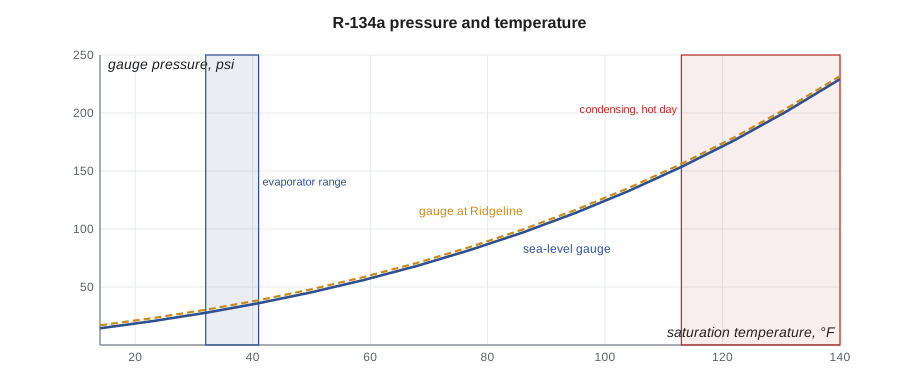
That is the key to the whole cycle. The air conditioning system keeps the refrigerant in the evaporator at a low pressure, so that it boils at a temperature below the cabin air, around 32 to 41 °F, and absorbs heat from it. The system keeps the refrigerant in the condenser at a high pressure, so that it condenses at a temperature above the outside air, often 120 to 140 °F on a hot day, and gives its heat to it. The compressor creates the pressure difference, and an expansion device holds it.
The four stages of the refrigeration cycle
Kiran traces the cycle on the whiteboard as Marty describes it. Start at the compressor. It draws in cool, low-pressure refrigerant vapor from the evaporator and squeezes it. Compressing a gas heats it, so the vapor leaves the compressor hot and at high pressure, often 160 to 195 °F. This hot vapor flows to the condenser, a heat exchanger in front of the radiator. Outside air flowing through the condenser cools the vapor until it reaches its condensing temperature for that pressure, and then the vapor gives up its latent heat and condenses into a liquid. By the time it leaves the condenser it is a warm, high-pressure liquid, slightly cooler than its condensing temperature.
The liquid then flows to the expansion device, either a fixed orifice tube or a thermostatic expansion valve. This is a restriction. On one side the pressure is high; on the other, it is low. As the liquid passes through, its pressure drops suddenly, and a small part of it flashes into vapor, which chills the rest. A cold, low-pressure mixture of liquid and vapor enters the evaporator, the heat exchanger inside the HVAC module. Warm cabin air blown across the evaporator gives heat to the refrigerant, which boils into vapor at a low, steady temperature. The vapor, now slightly warmer than its boiling point, returns to the compressor, and the cycle begins again.
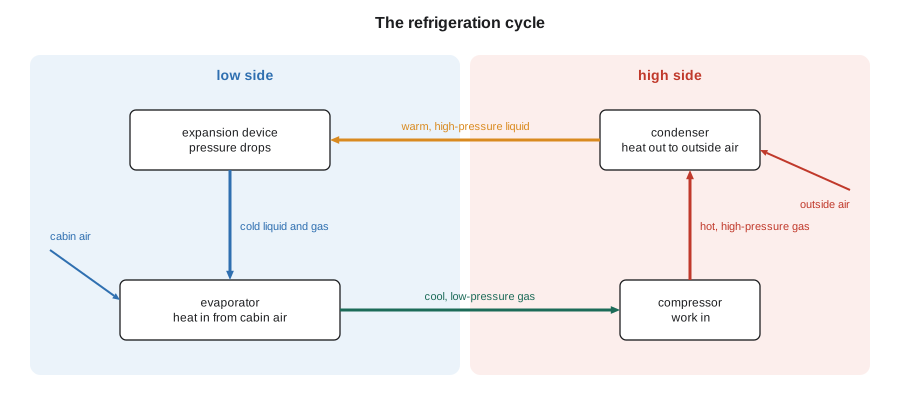
The system is divided into two halves. The high side runs from the compressor outlet through the condenser to the expansion device; it holds high-pressure vapor and liquid. The low side runs from the expansion device through the evaporator back to the compressor inlet; it holds low-pressure liquid and vapor. Service ports on each side let a technician measure both pressures. Each port has a different fitting size so the gauge hoses cannot be connected to the wrong side.
The heat that leaves at the condenser is always greater than the heat picked up at the evaporator, because it also includes the work the compressor did. A system that removes 17,000 BTU per hour from the cabin with 6,800 BTU per hour of compressor work must reject about 24,000 BTU per hour at the condenser. That is why the condenser needs so much airflow, and why a car's air conditioning struggles most when the vehicle is stopped in traffic on a hot day and only the cooling fan moves air through it.
# Energy balance: heat rejected at the condenser = heat absorbed in the evaporator + compressor work
evap_kw = 5.0
compressor_kw = 2.0
cond_kw = evap_kw + compressor_kw
cop = evap_kw / compressor_kw
print(f"evaporator {evap_kw * 3412:,.0f} BTU/h + compressor {compressor_kw * 3412:,.0f} BTU/h = condenser {cond_kw * 3412:,.0f} BTU/h")
print(f"coefficient of performance: {cop:.1f} (heat moved per unit of work)")evaporator 17,060 BTU/h + compressor 6,824 BTU/h = condenser 23,884 BTU/h coefficient of performance: 2.5 (heat moved per unit of work)
The pressure-temperature chart
Because pressure and temperature are locked together while a refrigerant is boiling or condensing, each refrigerant has a pressure-temperature chart. To use it, read a pressure on the gauge and look up the matching saturation temperature, the temperature at which the refrigerant boils or condenses at that pressure. The low-side gauge then tells the technician the evaporator's refrigerant temperature, and the high-side gauge tells the condensing temperature. Comparing those with the air temperatures around them says how well each heat exchanger is working.
There is a catch that matters at Ridgeline. Gauges read gauge pressure, the pressure above the air around them, not absolute pressure, the pressure above a perfect vacuum. Refrigerant tables are based on absolute pressure, and charts printed in gauge units assume sea-level air pressure, about 14.7 psi. In Denver the air pressure is only about 12.1 psi, so a gauge reads about 2.6 psi higher than it would at sea level for exactly the same refrigerant condition. A technician who reads a sea-level chart in gauge units without correcting will think the refrigerant is slightly warmer than it really is. The error is small on the high side but matters on the low side, where a few degrees can separate a correct reading from a low charge or a freezing evaporator.
# R-134a: gauge reading to saturation temperature, corrected for altitude (rounded table values)
table = [(14, 29.1), (23, 35.3), (32, 42.5), (41, 50.7), (50, 60.1), (59, 70.8), (68, 82.9), (77, 96.6), (86, 111.7), (95, 128.6), (104, 147.4), (113, 168.2), (122, 191.1), (131, 216.3), (140, 243.9)]          # (saturation temperature, absolute pressure)
atm_sea, atm_here = 14.7, 12.1
def sat_temp(p_abs):
    for (t1, p1), (t2, p2) in zip(table, table[1:]):
        if p1 <= p_abs <= p2:
            return t1 + (t2 - t1) * (p_abs - p1) / (p2 - p1)
    raise ValueError("outside table")
for side, gauge in (("low side", 33), ("high side", 210)):
    t_here = sat_temp(gauge + atm_here)
    t_wrong = sat_temp(gauge + atm_sea)
print(f"{side}: gauge {gauge} psi -> {t_here:5.1f} F at this altitude ({t_wrong:5.1f} F if read on a sea-level chart)")low side: gauge 33 psi -> 34.9 F at this altitude ( 37.7 F if read on a sea-level chart) high side: gauge 210 psi -> 132.9 F at this altitude (133.7 F if read on a sea-level chart)
Many modern service machines and digital gauges handle this automatically by measuring the local air pressure and showing saturation temperatures directly. Marty still wants Kiran to know the correction, because analog gauges, older machines and printed charts are everywhere, and because knowing the physics is what tells her when a digital tool is set up wrong.
Superheat and subcooling, a first look
Two more temperature differences tell a technician what the refrigerant is doing. Superheat is how much warmer the vapor leaving the evaporator is than its boiling temperature. A little superheat means all the liquid has boiled away just before the outlet, which protects the compressor from liquid. Too much superheat means the evaporator is starving, often because the system is low on refrigerant or the expansion device is restricted. Subcooling is how much cooler the liquid leaving the condenser is than its condensing temperature. Some subcooling means the condenser is delivering a solid column of liquid to the expansion device. Lesson 6 explains how to measure both and what they say about the charge and the components. For now, Kiran learns that a pressure alone is never the whole story: she needs temperatures too.
With that in mind she connects the gauges to Gord's truck, idling in the bay with the air conditioning on maximum and the shop doors open on a 88 °F afternoon. The low side reads 33 psi and the high side 210 psi, climbing slowly. The calculation above turns those into an evaporator temperature of about 35 °F, which is normal, and a condensing temperature of about 133 °F, which is high for that outside temperature. When Marty raises the engine speed to 1,500 rpm, the high side falls and the vents cool. The system is not short of refrigerant; it is struggling to get rid of heat at idle. That points at the condenser and its airflow, which is where Lesson 6 picks up the story.
Worked problem
Reading the gauges as temperatures
At Ridgeline's altitude the high-side gauge on an R-134a system reads 174 psi. About what is the condensing temperature?
Show solution
- Add the local air pressure to get absolute pressure: 174 + 12.1 = 186 psi absolute.
- Find that pressure on the R-134a table between its neighboring entries.
- It lies between 113 °F (168 psia) and 122 °F (191 psia), about 120 °F.
Answer: About 120 °F: compare that with the outside air temperature to judge the condenser.
Common mistakes
MistakeReading gauge pressures as if they were the refrigerant's whole story.
InsteadTurn pressures into saturation temperatures and compare them with air temperatures.
MistakeUsing a sea-level gauge chart without correcting for altitude.
InsteadAdd the local air pressure, or use a tool that corrects for it.
MistakeThinking the A/C makes cold.
InsteadIt moves heat; the condenser must reject the cabin's heat plus the compressor's work.
MistakeExpecting the same pressures at idle and at speed.
InsteadCondenser airflow and compressor speed change both pressures.
MistakeIgnoring airflow when pressures look wrong.
InsteadA blocked condenser or stopped fan raises high-side pressure without any charge problem.
Summary and key terms
- Heat moves from hot to cold; an air conditioner uses work to pump it the other way.
- Latent heat, absorbed when a liquid boils, is much larger than sensible heat.
- Pressure sets the temperature at which a refrigerant boils and condenses.
- The cycle: compress, condense, expand, evaporate; high side and low side.
- The condenser rejects the cabin heat plus the compressor's work.
- A pressure-temperature chart turns gauge readings into refrigerant temperatures.
- At altitude, gauges read higher than a sea-level chart for the same condition.
- Sensible heat
- Heat that changes temperature without changing state.
- Latent heat
- Heat absorbed or released when a substance changes state at constant temperature.
- Saturation temperature
- The temperature at which a refrigerant boils or condenses at a given pressure.
- High side
- The part of the system from the compressor outlet to the expansion device.
- Low side
- The part of the system from the expansion device to the compressor inlet.
- Gauge pressure
- Pressure measured above the surrounding air pressure.
- Absolute pressure
- Pressure measured above a perfect vacuum.
- Superheat
- How much warmer a vapor is than its saturation temperature.
- Subcooling
- How much cooler a liquid is than its saturation temperature.
Practice problems
Work each problem on paper first, then reveal the answer to check.
Why does a refrigerant absorb so much heat in the evaporator?
Show answer
It boils there, absorbing latent heat.
What is the job of the expansion device?
Show answer
To drop the pressure between the high side and the low side and meter refrigerant into the evaporator.
Why do gauges at Ridgeline read higher than a sea-level chart predicts?
Show answer
The local air pressure is lower, so the same absolute pressure shows as a higher gauge pressure.
A system's high side falls and the vents cool when engine speed rises. What does that suggest?
Show answer
Heat rejection at idle is the problem: condenser airflow, not charge.
Lesson quiz · 5 questions
Score 60% or more to complete this lesson.
Create a free account to save your progress, take quizzes and earn a certificate.