
AUTO-220 · Lesson 7 of 12 · 20 min
Starting systems
Two days after the first cold snap, Gord Haney calls from his driveway. His pickup will not start: when he turns the key, he hears a single click from under the hood and the dash lights dim, and then nothing. A neighbor gave him a boost and it started, so he drove it straight to Ridgeline and left it running in the lot. "Probably just needs a battery," he says. Kiran tests the battery and finds it healthy. Marty is not surprised. "Half the no-cranks I see are not batteries," he says. "Let's find out where the cranking current is going."
This lesson explains how the starting system works, the parts of a starter motor and its solenoid, the control circuit and its safety interlocks, stop-start systems, and the tests that separate a weak battery from a bad cable, a failing starter or an engine that is hard to turn.
What the starting system must do
To start a cold engine, the starting system must turn the crankshaft fast enough, typically 150 to 250 revolutions per minute, for the engine to draw in air, build compression and fire. A starter motor drives a small pinion gear that meshes with a large ring gear on the engine's flywheel or flexplate, giving a gear reduction of roughly 10 to 20 to 1. On a cold morning, with thick oil and a cold battery, the starter may draw 150 to 300 amps or more from the battery, which is why the starting circuit uses the heaviest cables in the vehicle.
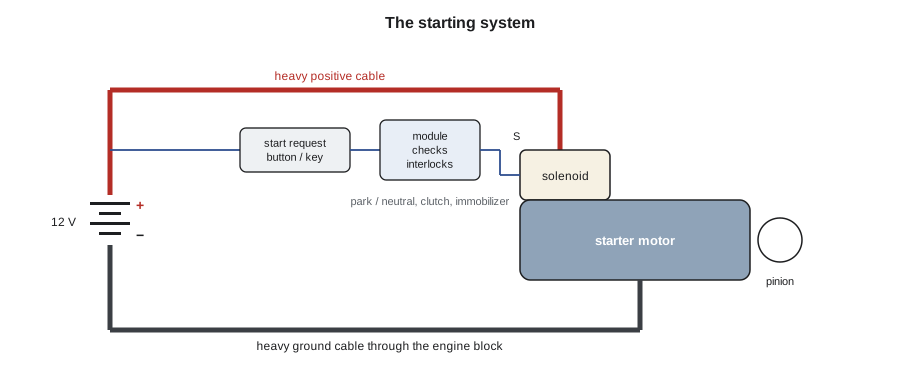
The system has two circuits. The high-current circuit runs from the battery positive post through a heavy cable to the starter solenoid and motor, and back through the engine block and the ground cable to the battery negative. The control circuit is a light-gauge circuit that energizes the solenoid when the driver turns the key or presses the start button; on most modern vehicles, the powertrain or body control module decides when to energize a starter relay, after checking that the transmission is in park or neutral, or the clutch pedal is pressed, and that the immobilizer has recognized the key.
The starter motor
A starter is a DC motor designed to produce high torque for a short time. Most modern starters are permanent magnet gear-reduction starters: the motor's field comes from permanent magnets instead of field windings, and a small planetary gear set inside the starter multiplies the motor's torque, so the motor can be smaller, lighter and faster. Current reaches the spinning armature through carbon brushes running on a segmented commutator. Older and heavy-duty starters use wound field coils, and some diesel starters are very large direct-drive units.
The starter drive includes an overrunning clutch, a one-way clutch that lets the pinion drive the ring gear but lets the pinion spin freely when the engine starts and turns the ring gear faster than the starter. Without it, an engine at 2,000 revolutions per minute driving the pinion at a 15 to 1 ratio would spin the starter's armature at 30,000 revolutions per minute and throw its windings apart. A failing overrunning clutch slips, so the starter spins with a whir but the engine does not turn.
The solenoid
The starter solenoid, mounted on top of most starters, does two jobs. When its windings are energized, it pulls a plunger that moves a shift fork, sliding the pinion into mesh with the ring gear. At the end of its travel, the plunger closes a heavy copper contact disc across two large terminals, connecting the battery cable to the motor. The solenoid has two windings: a pull-in winding that helps pull the plunger in and a hold-in winding that keeps it there once the contacts close. A single loud click with no cranking often means the solenoid is engaging but current is not reaching the motor, either because the battery or cables cannot supply it, or because the solenoid's contacts are burnt. Rapid repeated clicking usually means the battery voltage collapses each time the solenoid engages, so the solenoid drops out and pulls in again.
The control circuit and interlocks
On older vehicles, the ignition switch fed the solenoid through a neutral safety switch or clutch switch. On most current vehicles, the start request is an input to a module. The module checks the transmission range, the brake or clutch pedal, the immobilizer status and sometimes the battery state, and then energizes a starter relay, often for a fixed time, so that a quick press of the button still gives a full crank. Some vehicles have two relays in series for redundancy. When the control side fails, the symptom is a no-crank with no click; the scan tool's live data shows whether the module sees the start request and whether it is commanding the relay.
Stop-start systems
Many vehicles shut off the engine at stops to save fuel and restart it when the driver releases the brake. Stop-start puts far more starts on the starter and battery than a conventional vehicle, so these systems use heavy-duty starters with stronger brushes and drives, an EFB or AGM battery, a battery monitoring sensor and sometimes a second battery or a capacitor to hold the voltage up for the modules during a restart. The battery management function disables stop-start when the battery is weak, the cabin needs heat or cooling, or the engine is cold. A customer complaint that stop-start has stopped working is often a battery that needs registration, as described in Lesson 6, or a battery that is aging, not a fault in stop-start itself.
Testing the starting system
Kiran's test sequence starts with the battery, because nothing else can be judged with a weak one. She confirms Gord's battery is charged and passes a conductance test: 12.58 volts at rest, 731 measured CCA against a rating of 750. Next is a cranking test. She disables the engine from starting by removing the fuel pump relay, as the service information allows, connects an amp clamp around the battery negative cable and a meter across the battery posts, and cranks for no more than 15 seconds. A healthy system on a warm engine typically keeps the battery above about 9.6 to 10 volts while cranking, with a current draw in the range the manufacturer specifies.
Gord's truck shows something different. The battery voltage stays high, at 11.3 volts, and the current is only 64 amps, much lower than the 150 to 200 amps expected for that engine in the cold, while the starter turns slowly and then stops. High battery voltage with low current means the battery is willing, but the current is being blocked somewhere between the battery and the starter. That points straight at resistance in the cables or connections, and the voltage drop test finds it.
# Interpreting a cranking test (typical patterns; always compare with the specification)
def verdict(volts, amps, spec_lo, spec_hi):
    if volts < 9.6 and amps > spec_hi:
        return "high current, low voltage: tight engine or shorted starter, after a good battery test"
    if volts < 9.6:
        return "low voltage at normal current: weak battery, retest it"
    if amps < spec_lo:
        return "high voltage, low current: resistance in cables, connections or starter"
    return "within normal range"
tests = [("Gord's pickup, as found", 11.3, 64), ("Gord's pickup, after cable repair", 10.2, 186),
         ("courier van 3, high draw", 8.9, 320), ("minivan, weak battery", 8.7, 175)]
for name, v, a in tests:
print(f"{name:<34} {v:4.1f} V, {a:3d} A -> {verdict(v, a, 140, 220)}")Gord's pickup, as found 11.3 V, 64 A -> high voltage, low current: resistance in cables, connections or starter Gord's pickup, after cable repair 10.2 V, 186 A -> within normal range courier van 3, high draw 8.9 V, 320 A -> high current, low voltage: tight engine or shorted starter, after a good battery test minivan, weak battery 8.7 V, 175 A -> low voltage at normal current: weak battery, retest it
Voltage drop testing the starter circuit
A starter circuit's voltage drop test is done while cranking, with the engine disabled. Kiran tests the positive side with the meter's red lead on the battery positive post itself, not the cable clamp, and the black lead on the starter's battery terminal. Then she tests the ground side with the red lead on the starter body or engine block and the black lead on the battery negative post. Common guidelines are no more than about 0.5 volts on the positive side, no more than about 0.3 volts on the ground side, and about 0.2 volts across the solenoid's contacts, from its battery terminal to its motor terminal. Manufacturers' specifications take priority.
# Starter circuit voltage drops while cranking, compared with common guidelines
limits = {"positive cable, battery post to starter terminal": 0.5,
          "solenoid contacts, battery terminal to motor terminal": 0.2,
          "ground side, engine block to battery post": 0.3,
          "battery post to its own cable clamp": 0.1}
found = {"positive cable, battery post to starter terminal": 1.94,
         "solenoid contacts, battery terminal to motor terminal": 0.11,
         "ground side, engine block to battery post": 0.22,
         "battery post to its own cable clamp": 0.03}
for name, limit in limits.items():
    v = found[name]
print(f"{name:<54} {v:4.2f} V (limit {limit:3.1f}) {'ok' if v <= limit else 'HIGH'}")positive cable, battery post to starter terminal 1.94 V (limit 0.5) HIGH solenoid contacts, battery terminal to motor terminal 0.11 V (limit 0.2) ok ground side, engine block to battery post 0.22 V (limit 0.3) ok battery post to its own cable clamp 0.03 V (limit 0.1) ok
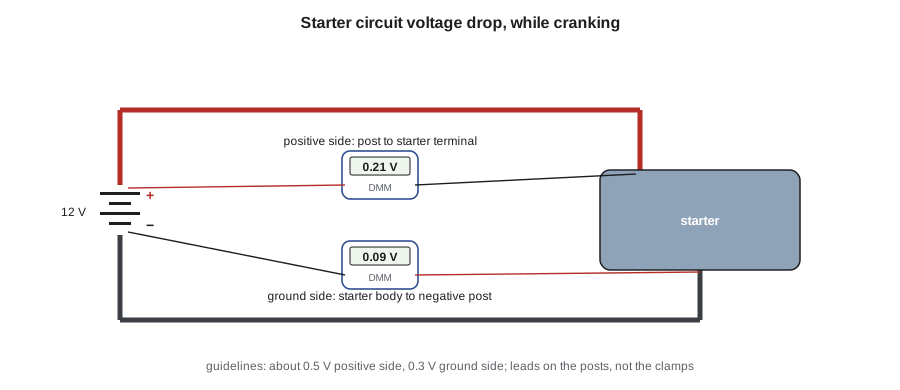
Gord's positive side drops 1.94 volts, almost four times the guideline. Kiran splits the cable into sections with the meter while cranking: 0.03 volts from the battery post to its clamp, 0.08 volts across the junction block in the fuse box, and 1.79 volts along the cable from the junction block to the starter. Where the cable passes under the engine near the exhaust, its insulation is cracked, and when she peels the jacket back the copper underneath is black and green, corroded along several centimeters by salt water that had wicked in through the crack. The cable looks fine at both ends, which is why nobody had noticed it.
She replaces the cable with the correct part, routes it with the heat shield and clips the factory used, and retests: 0.21 volts on the positive side and 186 amps of cranking current with the battery holding 10.2 volts. The truck cranks briskly and starts at once. On the repair order she records the as-found and final readings, so that if Gord asks why he did not need a battery, the numbers answer for her.
Starter faults and replacement
When the battery and cables test good but cranking is still poor, the starter itself is suspect. High current with slow cranking can mean a dragging armature, worn bushings or a shorted winding, but it can also mean the engine is hard to turn, from thick oil, a seized accessory or, rarely, internal engine damage or fluid in a cylinder. Before condemning the starter, Kiran makes sure the engine turns freely by hand with a breaker bar on the crankshaft bolt, with the battery disconnected. A starter that spins without turning the engine has a failed overrunning clutch or drive; one that grinds may have damaged pinion or ring gear teeth, and the ring gear must be inspected through the inspection opening before a new starter goes in.
Starter replacement begins with disconnecting the battery negative cable, because the starter's battery terminal is always live. The mounting bolts, shims if any, and the cable terminals are fitted exactly as specified; a loose starter bolt or a wrong shim changes the pinion's mesh with the ring gear, causing noise and damage. The cable nut on the starter terminal is torqued to specification, and the terminal is protected with its rubber boot, so that a dropped wrench cannot short it to the engine.
Worked problem
Is the cable or the starter at fault?
While cranking, a starter draws 165 A. The positive side voltage drop is 1.6 V. What resistance does the positive side have, and how much power is lost there?
Show solution
- R = V / I = 1.6 / 165 ≈ 0.0097 Ω, almost 10 milliohms.
- P = V × I = 1.6 × 165 ≈ 264 W lost as heat in the cable and connections.
- A good positive side at 0.5 V would be about 3 milliohms and lose about 83 W.
- The extra resistance, not the starter, is starving the motor.
Answer: About 10 milliohms and 264 W lost; repair the cable before suspecting the starter.
Common mistakes
MistakeReplacing a battery for a no-crank without testing it.
InsteadTest the battery first; many no-cranks are cables, connections or controls.
MistakeCranking for more than 15 seconds during tests.
InsteadStarters overheat; crank briefly and allow time to cool.
MistakePutting the meter lead on the cable clamp instead of the battery post.
InsteadMeasure from the post itself so the clamp's resistance is included.
MistakeReplacing a starter that grinds without checking the ring gear.
InsteadInspect the ring gear teeth; a damaged ring gear destroys the new starter's pinion.
MistakeWorking on the starter with the battery connected.
InsteadThe battery terminal is always live; disconnect the negative cable first.
Summary and key terms
- The starter turns the engine through a pinion and ring gear at about 150 to 250 revolutions per minute.
- Modern starters are permanent magnet gear-reduction motors with an overrunning clutch.
- The solenoid moves the pinion into mesh and closes the heavy contacts to the motor.
- Modules control the starter relay after checking range, pedal and immobilizer inputs.
- Stop-start vehicles use heavy-duty starters, EFB or AGM batteries and battery monitoring.
- A cranking test reads voltage and current; high voltage with low current points to resistance.
- Starter circuit voltage drop: about 0.5 V positive side, 0.3 V ground side, while cranking.
- Starter solenoid
- An electromagnetic switch that engages the pinion and connects battery current to the starter motor.
- Overrunning clutch
- A one-way clutch that lets the starter pinion freewheel once the engine starts.
- Ring gear
- The large gear on the flywheel or flexplate that the starter pinion drives.
- Gear-reduction starter
- A starter with internal gears that multiply the motor's torque.
- Cranking test
- A measurement of battery voltage and starter current while the engine is cranked.
- Stop-start
- A system that shuts off the engine at stops and restarts it automatically.
- Starter relay
- A relay, usually module-controlled, that energizes the solenoid.
Practice problems
Work each problem on paper first, then reveal the answer to check.
A starter clicks once and the dash lights dim heavily. What should be tested first?
Show answer
The battery's state of charge and health.
A starter spins with a whir but the engine does not turn. What is the likely fault?
Show answer
The overrunning clutch or drive is slipping.
Cranking voltage is 11.5 V and current is very low. What does this suggest?
Show answer
Resistance in the cables, connections or starter blocking current.
Why must the engine be turned by hand before a high-draw starter is condemned?
Show answer
A tight or seized engine also causes high current and slow cranking.
Lesson quiz · 5 questions
Score 60% or more to complete this lesson.
Create a free account to save your progress, take quizzes and earn a certificate.