
AUTO-220 · Lesson 4 of 12 · 19 min
Wiring, connectors and wiring repair
Hal Osei's courier fleet keeps Ridgeline busy, and this time it is van 2 with a trailer-lighting problem. A previous owner had added a trailer connector, and the left turn signal on the trailer works only when it feels like it. When Kiran pulls back the trim, she finds the reason in less than a minute: the add-on wiring is joined to the van's harness with a twist of bare copper and a wrap of electrical tape, and the tape has slipped off. Marty looks over her shoulder. "That's what happens when somebody treats wiring like string," he says. "Today you learn to do it properly."
This lesson covers wire construction and sizes, how to choose a wire for a load and a length, fuses and other circuit protection, the connectors and terminals found on modern vehicles, and the approved ways to repair wiring so that the repair lasts as long as the vehicle.
Wire construction and sizes
Automotive wire is stranded copper with a plastic insulation, usually PVC or cross-linked polyethylene. Stranded wire is used instead of solid because it survives vibration and bending; a solid wire flexed repeatedly work-hardens and cracks. Insulation is rated for temperature: wire under the hood near the exhaust must withstand far more heat than wire inside the cabin. Some circuits use shielded or twisted pairs to keep electrical noise out of sensitive signals, such as network wires and crankshaft sensor leads.
Wire size is given in two systems. Vehicles designed in North America have historically used the American Wire Gauge, or AWG, in which a smaller gauge number means a thicker wire: 18 AWG is common for lamps and signals, 12 or 10 AWG for heavy loads, and 4 to 1/0 AWG for battery cables. Vehicles designed elsewhere, and more and more North American designs, use metric sizes in square millimeters of copper cross-section, such as 0.35, 0.5, 0.75, 1.5, 2.5 and 4 mm², and 16 to 50 mm² for battery cables. The two do not line up exactly; 18 AWG is about 0.82 mm², 14 AWG about 2.1 mm² and 10 AWG about 5.3 mm². A repair always uses wire at least as large as the original, never smaller.
Choosing a wire for the load and length
A wire must do two things: carry its current without overheating, and carry it without wasting too much voltage. For short wires, heat is the limit; for long wires, voltage drop usually is. A trailer circuit running from the front of a van to its rear bumper and then to the trailer may be 6 to 8 meters long, so a size that would be fine for a short run may lose too much voltage. Wire size charts give both limits; the code below makes the same calculation from the resistance of copper, using a voltage-drop target of 3 percent of 12.6 volts, about 0.4 volts, for each side of the circuit.
# Smallest wire that keeps the one-way voltage drop under a target (copper at 20 C)
RHO = 0.0175                             # ohm mm2 per meter
UNITS = "US"
sizes_mm2 = [0.5, 0.75, 1.0, 1.5, 2.5, 4.0, 6.0]
awg = {20: 0.52, 18: 0.82, 16: 1.31, 14: 2.08, 12: 3.31, 10: 5.26}
target = 0.03 * 12.6                     # volts lost on the feed
for amps, length in [(2.1, 25.0), (8.0, 25.0), (15.0, 6.5)]:
    meters = length if UNITS == "metric" else length * 0.3048
    need = RHO * meters * amps / target   # mm2 of copper needed
    if UNITS == "metric":
        pick = next(s for s in sizes_mm2 if s >= need)
        print(f"{amps:4.1f} A over {length:4.1f} m: needs {need:4.2f} mm2, use {pick} mm2")
    else:
        pick = max(g for g, a in awg.items() if a >= need)
print(f"{amps:4.1f} A over {length:4.1f} ft: needs {need:4.2f} mm2, use {pick} AWG")2.1 A over 25.0 ft: needs 0.74 mm2, use 18 AWG 8.0 A over 25.0 ft: needs 2.82 mm2, use 12 AWG 15.0 A over 6.5 ft: needs 1.38 mm2, use 14 AWG
The calculation also explains why the return path matters. On a trailer, the ground wire carries the current of every lamp that is on at the same time, so it is often the largest wire in the trailer connector. Many trailer lighting complaints, such as lamps that light dimly or light together when they should not, are poor trailer grounds; the lamps find a return path through each other's filaments instead.
Fuses, fusible links and circuit breakers
Circuit protection exists to protect the wire, not the load. A fuse contains a metal link sized to melt when the current exceeds its rating for long enough, opening the circuit before the wire's insulation overheats. Blade fuses come in micro, mini, standard and maxi sizes, with ratings from 2 to 80 amps and color-coded bodies; cartridge fuses and bolt-in high-current fuses protect the main feeds. A fusible link is a short length of wire, several sizes smaller than the circuit it protects, with special insulation that does not burn; it melts under a severe overload, such as a battery cable shorting to the frame. Circuit breakers open with a bimetal strip that bends when it heats; some reset themselves when they cool, which suits motors such as power windows that can stall against a stop. Many newer vehicles replace some fuses with electronic protection inside a module, which shuts off an output when it senses too much current and may set a trouble code instead of blowing.
A fuse is chosen so that it carries the circuit's normal current without blowing, including any inrush when a motor starts or a cold lamp filament first lights, but blows well before the wire's limit. Kiran's rule is simpler: the fuse is whatever the manufacturer specified. A fuse that blows has done its job, and the question is why the current was too high, not how to fit a bigger fuse.
# Fuse check: the fuse must carry the normal load with margin but stay below the wire's rating
fuses = [5, 7.5, 10, 15, 20, 25, 30]
def pick(load_a, wire_limit_a, margin=1.25):
    for f in fuses:
        if f >= load_a * margin and f <= wire_limit_a:
            return f
    return None
jobs = [("trailer lamps, one side", 2.1, 13), ("trailer brake controller feed", 8.0, 21), ("added work light", 12.5, 13)]
for name, load, wire_limit in jobs:
    f = pick(load, wire_limit)
print(f"{name:<32} load {load:4.1f} A, wire good to {wire_limit:2d} A -> " + (f"{f:g} A fuse" if f else "wire too small, upsize it"))trailer lamps, one side load 2.1 A, wire good to 13 A -> 5 A fuse trailer brake controller feed load 8.0 A, wire good to 21 A -> 10 A fuse added work light load 12.5 A, wire good to 13 A -> wire too small, upsize it
Connectors and terminals
Modern vehicles use many hundreds of connectors. Most are sealed, with a rubber seal on each wire and a seal between the two connector halves, to keep out water and road salt. Each connector has a locking tab and often a second lock, the terminal position assurance or connector position assurance, that must be released before the halves separate. Inside, each wire ends in a crimped terminal: a male pin or blade on one side and a female socket on the other. The female terminal's grip, called terminal tension, is what makes a good connection. A terminal that has been spread by a probe pushed into it, or that has lost its spring through heat, may make contact only intermittently.
Kiran learns to test terminal tension, called terminal drag, with the correct-size mating test pin from the shop's terminal kit, never with a meter probe. The pin should slide in with a light but definite drag. A loose terminal is replaced, not squeezed tighter with pliers. Terminals are removed from the connector body with the correct release tool after the secondary lock is opened, and the new terminal is crimped to the wire with the correct crimper before being clicked back into place. Many service information systems include connector repair kits and pigtails, which are short lengths of wire with a new connector attached, for damaged connectors.
Approved wiring repairs
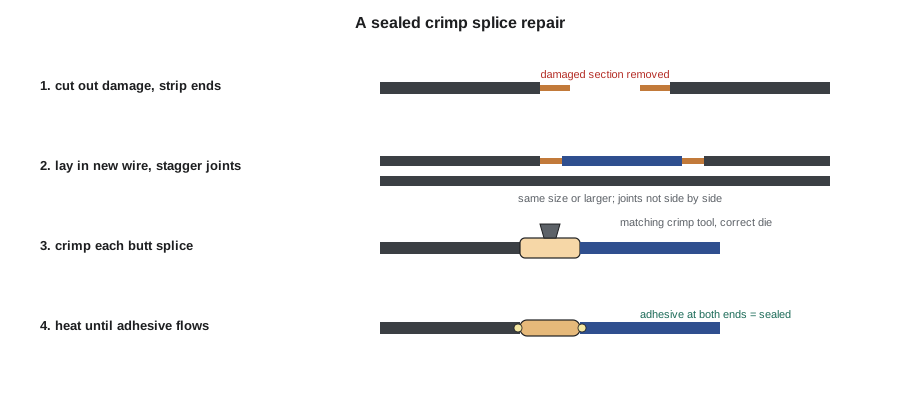
Manufacturers approve specific repair methods, and the service information should be checked before any repair. Most allow a sealed crimp splice: a butt splice sleeve with heat-shrink and adhesive, crimped with the matching tool and then heated until the adhesive flows out of both ends. Many also allow soldered splices covered with adhesive-lined heat-shrink tubing; solder must be rosin-core electrical solder, never acid-core, and the joint must be mechanically secure before soldering. Splices in the same harness are staggered so that they do not create a lump, and the repair section is taped or looped back into the harness conduit and clipped where the original was.
Some wires should not be spliced at all. Airbag and other restraint system wiring usually requires the manufacturer's repair kit or a new harness section. Network wires are twisted pairs, and a repair must keep the twist, typically about one turn per 25 millimeters, as close to the splice as possible and within the length the manufacturer allows. Shielded wires need the shield restored. High-voltage orange cables on hybrid and electric vehicles are never repaired by splicing; they are replaced. And no repair ever uses twisted wire and tape, wire nuts or insulation-piercing tap connectors, which let water into the wire and start corrosion that creeps along inside the insulation.
On van 2, Kiran removes the old add-on wiring entirely and installs a trailer wiring module that the van's manufacturer approves, plugged into the dedicated trailer connector already in the harness. The module powers the trailer lamps from its own fused feed, so the van's lamp circuits are not overloaded and the body control module does not see the trailer lamps as a fault. Where she has to extend the module's ground wire to a body ground point, she uses a sealed crimp splice and a new ring terminal on a cleaned, protected stud.
Corrosion and harness routing
Calcium and magnesium chloride used on winter roads, along with road salt, are the enemies of automotive wiring. Salt water wicks along the strands inside the insulation, a process called wicking, and can travel well away from where it entered. A wire that is green and stiff inside the insulation for 30 centimeters past a corroded connector must be cut back to clean copper, and sometimes the whole section must be replaced. Dielectric grease is used where the service information calls for it, typically on connector seals and some terminals, to keep water out; it is not a conductor and does not repair a bad connection. Harnesses are routed and clipped as the factory did, away from sharp edges, hot exhaust parts and moving components, with grommets where they pass through metal.
Worked problem
Is the extension wire big enough?
Kiran wants to extend a ground wire 6.5 ft to a body stud. The trailer lamps can draw up to 10 A in total through it. She has 16 AWG (1.31 mm²) wire on hand. How much voltage will the extension drop?
Show solution
- Resistance of copper ≈ 0.0175 Ω mm² per meter.
- R = 0.0175 × (6.5 × 0.3048) / 1.31 ≈ 0.027 Ω.
- Drop = 10 × 0.027 ≈ 0.27 V.
- That is acceptable for a ground side, but a size larger would leave more margin for corrosion over time.
Answer: About 0.27 V: acceptable, though a larger size gives more margin.
Checking the repair
A wiring repair is not finished until it has been tested the same way the fault was found. After the trailer module is installed, Kiran plugs a trailer lighting tester into the van's trailer socket and checks every function, then measures the voltage drop on the module's ground with all the trailer lamps on: 0.09 volts. She pulls gently on each splice to make sure the crimps hold, checks that the heat-shrink has sealed at both ends, and confirms that the harness is clipped where it cannot rub or reach the exhaust. Finally, she records the repair method, the wire size used and the test readings on the repair order. Hal Osei's fleet manager likes that level of detail, because his insurer asks about trailer wiring on commercial vehicles.
The same discipline applies to every repair in this course. A crimp that has not been pulled, a seal that has not been checked and a circuit that has not been retested under load are the usual reasons a vehicle comes back. Marty's line is that a comeback costs the shop twice: once to fix the fault again, and once in the customer's trust.
Common mistakes
MistakeJoining wires by twisting and taping them.
InsteadUse an approved sealed crimp or soldered splice with adhesive heat-shrink.
MistakeUsing a smaller wire for the repair.
InsteadUse the same size or larger.
MistakeChecking terminal tension with a meter probe.
InsteadUse the matching test pin from a terminal kit; probes spread terminals.
MistakeFitting a larger fuse because the original keeps blowing.
InsteadThe fuse protects the wire; find the cause of the overcurrent.
MistakeUsing insulation-piercing tap connectors.
InsteadThey let water into the wire; use approved methods only.
Summary and key terms
- Automotive wire is stranded copper, sized in AWG or square millimeters; repairs use the same size or larger.
- A wire must carry its current without overheating or losing too much voltage; long runs need larger wire.
- Fuses, fusible links and breakers protect the wire; the fuse fitted is the one specified.
- Sealed connectors use seals, locks and terminals whose tension is checked with the correct test pin.
- Approved repairs are sealed crimp or soldered splices with adhesive heat-shrink, staggered and routed as original.
- Restraint, network, shielded and high-voltage wiring have special rules or must be replaced.
- Salt corrosion wicks along wires; cut back to clean copper and protect the repair.
- AWG
- American Wire Gauge, a wire size system in which smaller numbers are thicker wires.
- Fusible link
- A short, smaller wire with special insulation that melts under a severe overload.
- Circuit breaker
- A protective device that opens on overcurrent and can be reset or resets itself.
- Terminal tension
- The grip of a female terminal on its mating pin.
- Connector position assurance
- A secondary lock that keeps two connector halves fully mated.
- Butt splice
- A sleeve that joins two wire ends end to end when crimped.
- Wicking
- Salt water traveling along the strands inside a wire's insulation.
Practice problems
Work each problem on paper first, then reveal the answer to check.
Why is automotive wire stranded instead of solid?
Show answer
Stranded wire survives vibration and flexing without cracking.
Which is thicker, 14 AWG or 18 AWG?
Show answer
14 AWG.
What does a fuse protect?
Show answer
The wire, from overheating.
How should the twist of a network pair be treated in a repair?
Show answer
Kept as close to the original twist as possible, right up to the splice.
Lesson quiz · 5 questions
Score 60% or more to complete this lesson.
Create a free account to save your progress, take quizzes and earn a certificate.