
AUTO-220 · Lesson 3 of 12 · 19 min
Circuits, voltage drop and circuit faults
Gord Haney's pickup is back at Ridgeline, and for once it is not the suspension. His complaint is that the headlamps have become dim over the past month, worst at idle, and that the low beams flicker over bumps. Simone Tremblay writes it up, and Marty assigns it to Kiran as her first real electrical diagnosis. "Dim lamps are a resistance problem until proved otherwise," he tells her. "Find where the volts are going."
This lesson covers how series and parallel circuits behave, how voltage divides around a circuit, the four kinds of circuit fault, and the voltage drop test, which is the most powerful single test a technician can do on a circuit that works but works badly.
Series circuits
In a series circuit, there is only one path for current, and every component carries the same current. The total resistance is the sum of the individual resistances, and the supply voltage divides among the components in proportion to their resistance. If one component opens, the whole circuit stops. A switch and a lamp in series are the simplest example: the switch, when closed, should have almost no resistance and drop almost no voltage, so nearly all of the voltage appears across the lamp.
Kirchhoff's voltage law, named after the German physicist Gustav Kirchhoff, says that the voltage drops around any closed loop add up to the supply voltage. In a lamp circuit, if the battery provides 12.6 volts and the lamp has 12.0 volts across it, the remaining 0.6 volts is being dropped somewhere else in the loop: the fuse, the switch, the wires, the connectors and the ground. That is the idea behind voltage drop testing: if the load is not getting its share, the missing volts are being lost in the parts of the circuit that should drop almost nothing.
Parallel circuits
In a parallel circuit, there are several branches, each connected directly across the same supply. Each branch has the full supply voltage across it, and the currents in the branches add up to the total current drawn from the supply. Adding a branch lowers the total resistance and raises the total current. If one branch opens, the others keep working; that is why vehicle lamps are wired in parallel, so that one burnt bulb does not put out the others.
Most real circuits are series-parallel: the branches are in parallel, but each branch shares a fuse, a switch, a feed wire and a ground with the others. A high-resistance fault in a shared part affects every branch. A high-resistance fault in one branch affects only that branch. That distinction is a powerful clue: if both headlamps are dim, the fault is probably in something they share; if only one is dim, it is probably in that lamp's own wiring, socket or ground.
# Series-parallel solver: two headlamps in parallel, fed through a shared switch, wire and ground
def parallel(*rs):
    return 1 / sum(1 / r for r in rs)
supply = 12.6
lamp_l, lamp_r = 2.6, 2.6           # ohm, each halogen low beam (hot)
shared = {"fuse and relay": 0.010, "feed wire": 0.015, "headlamp switch path": 0.020, "ground": 0.120}
r_lamps = parallel(lamp_l, lamp_r)
r_total = r_lamps + sum(shared.values())
amps = supply / r_total
print(f"total current {amps:5.2f} A")
for name, r in shared.items():
    print(f"  drop across {name:<22} {amps * r:5.2f} V")
v_lamp = amps * r_lamps
print(f"voltage at each lamp {v_lamp:5.2f} V, power each {v_lamp ** 2 / lamp_l:5.1f} W")total current 8.60 A drop across fuse and relay 0.09 V drop across feed wire 0.13 V drop across headlamp switch path 0.17 V drop across ground 1.03 V voltage at each lamp 11.18 V, power each 48.1 W
The four kinds of fault
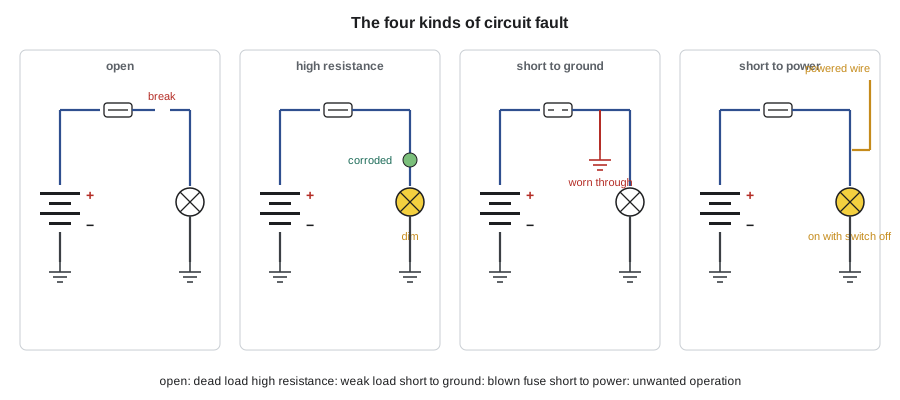
Almost every electrical fault is one of four kinds. An open circuit is a break in the path, such as a broken wire, a blown fuse, a corroded-through terminal or a switch that no longer closes; current stops, and the load does not work at all. High resistance is a partial open: a corroded terminal, a loose ground, a frayed wire or a burnt switch contact. Current still flows but less of it, and the load works poorly, as with Gord's dim lamps.
A short to ground happens when a wire on the power side of the load touches the body or another ground before the load, usually through chafed insulation. The circuit's resistance drops to almost nothing, current rises, and the fuse blows, often only when the wire moves against the sharp edge that wore it through. A short to power happens when a wire touches another powered wire: a load may come on when it should not, or two circuits may work together strangely, such as a dome lamp that glows when the brake pedal is pressed. A short between two circuits in the same harness is sometimes called a cross-short.
Each fault has a signature. An open shows full voltage on the supply side of the break and no voltage beyond it. High resistance shows normal voltage with the circuit off and a voltage loss across the bad spot with it on. A short to ground blows fuses. A short to power makes things work when they should not. Kiran writes the four kinds and their signatures on a card and keeps it in her shirt pocket until she no longer needs it.
The voltage drop test
A voltage drop test measures the voltage lost across part of a circuit while it carries its normal current. The meter's leads go across the section being tested, the circuit is turned on, and the meter reads how many volts that section is wasting. A good wire, connector or switch drops very little; a bad one drops more. Because the test is done under load, it finds high resistance that an ohmmeter misses.
Common guidelines, which vary by manufacturer and circuit, are that a single connection or terminal should drop no more than about 0.1 volts, a switch or relay contact no more than about 0.2 to 0.3 volts, and a whole side of a circuit, either the power side from battery positive to the load or the ground side from the load to battery negative, no more than about 0.5 volts at full load. Starter circuits, with hundreds of amps flowing, have their own limits, covered in Lesson 7. A drop of zero across a section means either a perfect connection or no current; the test is only valid when the circuit is actually working.
Kiran tests Gord's headlamp circuit section by section with the low beams on and the engine idling. First she measures the voltage at the lamp connectors: 11.4 volts at each, against 13.4 volts at the battery. Two volts are missing, and both lamps are equally dim, so the fault is probably in something they share. The power side, from the battery positive post to the lamp feed terminal, drops 0.31 volts, which is acceptable. The ground side, from the lamp ground terminal to the battery negative post, drops 1.62 volts. She moves along the ground path with the meter: 0.04 volts across each lamp's ground wire, then 1.51 volts across the ground eyelet bolted to the radiator support, where green and white corrosion has crept under the eyelet.
# Voltage drop test: compare each measured section with its guideline (illustrative limits)
readings = [
    ("power side, battery + to lamp feed", 0.31, 0.50),
    ("ground side, lamp ground to battery -", 1.62, 0.50),
    ("  lamp ground wire, left", 0.04, 0.10),
    ("  lamp ground wire, right", 0.04, 0.10),
    ("  radiator support ground eyelet", 1.51, 0.10),
    ("  body to battery - strap", 0.03, 0.10),
]
for name, measured, limit in readings:
    verdict = "ok" if measured <= limit else "TOO HIGH"
print(f"{name:<40} {measured:5.2f} V (limit {limit:4.2f}) {verdict}")power side, battery + to lamp feed 0.31 V (limit 0.50) ok ground side, lamp ground to battery - 1.62 V (limit 0.50) TOO HIGH lamp ground wire, left 0.04 V (limit 0.10) ok lamp ground wire, right 0.04 V (limit 0.10) ok radiator support ground eyelet 1.51 V (limit 0.10) TOO HIGH body to battery - strap 0.03 V (limit 0.10) ok
The repair is not to spray the eyelet with cleaner. Kiran removes the bolt, cleans the eyelet and the support down to bright metal, finds that the eyelet itself is cracked from corrosion and replaces it with a new sealed terminal crimped to the wire, refits it with a new bolt torqued to specification, and coats the joint with the corrosion-preventive compound the service information recommends. With the lamps on and the engine idling, the ground side now drops 0.12 volts and the lamps have 13.0 volts at their connectors. The flicker over bumps is gone too: the cracked eyelet had been making and breaking contact as the support flexed.
Finding opens and shorts
Opens are found by following voltage. With the circuit switched on, Kiran measures from each test point to a good ground, starting at the source and moving toward the load. Where the voltage disappears, the open is between that point and the last one that had voltage. On the ground side, she measures from the load's ground terminal to the battery negative; a reading of nearly full voltage there means the ground path is open.
Shorts to ground are harder, because the fuse blows as soon as the fault occurs. The shop uses a short finder or a fuse-saver: a circuit breaker or a load such as a sealed beam lamp in place of the fuse, so that the circuit can be powered without damage while the technician moves along the harness. With a lamp in place of the fuse, the lamp glows brightly while the short is present. Kiran disconnects connectors one at a time, starting at the load end; when the lamp goes out, the short is in the section she just isolated. Wiggling the harness while watching the lamp, or a compass-style short finder that follows the pulsed current through the wire, narrows it down further. The fault is then repaired at the damaged section, and the reason it chafed, such as a missing clip or a sharp bracket, is corrected so that it does not happen again.
Worked problem
Where is the missing voltage?
A blower motor runs slowly on high. With the blower running, Kiran measures 13.5 V at the battery, 12.9 V at the blower feed terminal, and 1.4 V from the blower ground terminal to the battery negative. What is the voltage across the motor, and which side of the circuit has the fault?
Show solution
- Voltage across the motor = feed voltage − ground-side voltage = 12.9 − 1.4 = 11.5 V.
- Power side drop = 13.5 − 12.9 = 0.6 V: slightly high but a high current circuit.
- Ground side drop = 1.4 V: far above about 0.5 V.
- The main fault is on the ground side: a corroded or loose ground between the motor and the battery negative.
Answer: 11.5 V across the motor; the ground side has the high resistance.
Recording what you find
Marty insists that every voltage drop test goes on the repair order as numbers, with the conditions: which section was measured, with what load switched on, and at what engine speed. "Ground side 1.62 volts, lamps on, idle" is a finding another technician can check; "bad ground" is an opinion. The numbers also protect the shop. If Gord's lamps dim again in a year, the next technician can compare the new readings with the old ones and see at once whether the same ground has corroded again or whether something new has failed. Kiran also photographs corroded terminals before cleaning them, because customers who see the green crust under an eyelet understand immediately why the repair was needed.
One more habit makes voltage drop testing faster. Instead of measuring every section one at a time from the start, Kiran first measures the whole power side and the whole ground side. Only the side that fails gets divided into smaller sections, and each failing section is divided again until the bad spot is found. On a circuit with a dozen connections, that halving approach usually finds the fault in three or four readings instead of twelve.
Common mistakes
MistakeMeasuring voltage drop with the circuit switched off.
InsteadNo current means no drop; the test is valid only with the load working.
MistakeCleaning a corroded ground with spray and calling it fixed.
InsteadRemove, clean to bright metal, replace damaged terminals, torque and protect the joint.
MistakeReplacing a load because it works poorly.
InsteadCheck the voltage at the load under load first; often the load is fine and the circuit is not.
MistakeReplacing a blown fuse with a larger one.
InsteadA blown fuse means too much current; find the short and fit the specified fuse.
MistakeRepairing a chafed wire without fixing what chafed it.
InsteadCorrect the routing, clip or bracket too.
Summary and key terms
- In a series circuit, current is the same everywhere and voltages divide in proportion to resistance.
- In a parallel circuit, each branch has full voltage and the branch currents add up.
- Faults are opens, high resistance, shorts to ground and shorts to power, each with its own symptom.
- Kirchhoff's voltage law: the drops around a loop add up to the supply voltage.
- A voltage drop test, done under load, finds the resistance that steals voltage from the load.
- Typical guidelines: about 0.1 V per connection and 0.5 V per side of a circuit.
- Opens are found by following voltage; shorts by isolating sections with a protected supply.
- Series circuit
- A circuit with one path, so every part carries the same current.
- Parallel circuit
- A circuit with several branches across the same supply.
- Open circuit
- A break in the path that stops current.
- High resistance
- Unwanted resistance that reduces current, making a load work poorly.
- Short to ground
- An unwanted path to ground before the load, which raises current and blows fuses.
- Short to power
- An unwanted connection to another powered circuit.
- Voltage drop test
- Measuring the voltage lost across part of a circuit while it carries normal current.
Practice problems
Work each problem on paper first, then reveal the answer to check.
Three resistors of 2, 3 and 5 Ω are in series on 12 V. What current flows?
Show answer
12 / 10 = 1.2 A.
Two 6 Ω loads are in parallel. What is their combined resistance?
Show answer
3 Ω.
Only the right headlamp is dim. Where should the search start?
Show answer
In that lamp's own socket, feed and ground, not in the shared parts.
A fuse blows only when the vehicle hits bumps. What kind of fault is likely?
Show answer
A short to ground where chafed insulation touches metal as the harness moves.
Lesson quiz · 5 questions
Score 60% or more to complete this lesson.
Create a free account to save your progress, take quizzes and earn a certificate.