
AUTO-220 · Lesson 1 of 12 · 19 min
Automotive electrical theory
Autumn arrives at Ridgeline Auto Service in Denver with the first hard frost, and with it the electrical season. Every technician in the shop knows the pattern: the first cold morning brings a row of vehicles that will not start, and the weeks after bring the strange ones, the dash lights that flicker, the battery that goes flat over a weekend, the module that will not talk to the scan tool. Marty Kowalchuk has told Kiran Dhaliwal that this is the term when she will either learn to love electrical work or learn to fear it, and that the difference is almost entirely in the fundamentals. A technician who really understands voltage, current and resistance can reason through a fault on a vehicle she has never seen before. A technician who does not ends up replacing parts until the problem goes away.
This lesson builds those fundamentals: what electricity is, the three quantities that describe a circuit, Ohm's law and the power law, the difference between direct and alternating current, and how the 12-volt system of a modern vehicle is laid out. It deliberately stays with the low-voltage system. The high-voltage batteries, inverters and motors of hybrid and electric vehicles are covered in AUTO-410, and nobody in the shop works on them without that training and the right equipment.
What electricity is
All matter is made of atoms, and every atom has a nucleus of protons and neutrons surrounded by electrons. In metals such as copper and aluminum, the outermost electrons are only loosely held, and they drift easily from one atom to the next. When something pushes those free electrons in one direction, the result is a flow of charge, an electric current. A conductor is a material with many free electrons, such as copper, aluminum, steel or gold; an insulator, such as rubber, plastic, glass or dry air, has almost none. Semiconductors such as silicon sit in between, and their behavior can be controlled, which is what makes diodes, transistors and every electronic module in a vehicle possible.
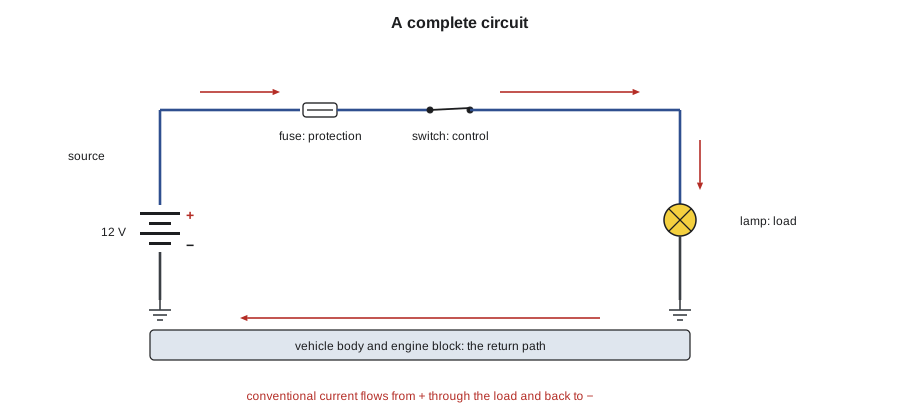
A circuit is a complete path that lets current flow from a source, through a load, and back to the source. In a vehicle, the source is the battery or the alternator; the load is anything that does work, such as a lamp, a motor or a heater; and the path is made of wires, terminals, switches and, for the return side, usually the vehicle's metal body and engine block. If the path is broken anywhere, current stops everywhere in that circuit. That one idea, that current needs a complete loop, explains most electrical faults Kiran will ever find.
Voltage, current and resistance
Voltage is electrical pressure: the push that makes current flow. It is measured in volts (V) and is always measured between two points, never at one point alone. A fully charged 12-volt battery has about 12.6 volts between its positive and negative posts when it is at rest; a running engine's charging system raises that to roughly 13.5 to 14.8 volts. The shop's analogy is a water system: voltage is like the pressure difference that pushes water through a pipe.
Current is the rate of flow of charge, measured in amperes or amps (A). One amp is a flow of about six million million million electrons per second past a point. A dome lamp might draw a fraction of an amp, a headlamp a few amps, a blower motor 15 to 25 amps and a starter motor 100 to 250 amps or more while cranking. In the water analogy, current is the amount of water flowing per second.
Resistance is opposition to current, measured in ohms (Ω). Every real conductor has some resistance; a long, thin wire has more than a short, thick one, and most metals increase their resistance as they get hotter. Loads have resistance by design: the filament of a bulb or the element of a seat heater turns electrical energy into heat and light. Unwanted resistance, at a corroded terminal, a loose ground or a frayed wire, is the most common cause of a circuit that works, but poorly.
Ohm's law
In 1827 the German physicist Georg Ohm showed that, for most conductors, the current is proportional to the voltage across them. The relationship is written as Ohm's law, and it is the single most useful equation in electrical diagnosis. If any two of the three quantities are known, the third can be calculated. Voltage equals current times resistance; current equals voltage divided by resistance; resistance equals voltage divided by current.
The law explains what happens when something changes. If resistance in a circuit goes up, because a terminal has corroded, the current goes down, and a lamp glows dimly or a motor runs slowly. If resistance goes down sharply, because a wire's insulation has worn through and the copper touches the body, the current shoots up until a fuse blows. If the voltage supplied drops, because the battery is weak, every load receives less current. Kiran will use Ohm's law to check whether a reading makes sense long before she uses it to calculate anything precisely.
# Ohm's law and the power law for some common 12-volt loads (illustrative resistances)
loads = [("dome lamp", 14.0), ("headlamp (halogen low beam)", 2.6),
         ("seat heater element", 2.2), ("blower motor on high", 0.6)]
volts = 13.8
print(f"supply {volts:.1f} V")
for name, ohms in loads:
    amps = volts / ohms
    watts = volts * amps
print(f"{name:<30} {ohms:5.1f} ohm -> {amps:5.1f} A, {watts:5.0f} W")supply 13.8 V dome lamp 14.0 ohm -> 1.0 A, 14 W headlamp (halogen low beam) 2.6 ohm -> 5.3 A, 73 W seat heater element 2.2 ohm -> 6.3 A, 87 W blower motor on high 0.6 ohm -> 23.0 A, 317 W
Power and energy
Electrical power is the rate at which a circuit does work, measured in watts (W). For direct current, power is simply voltage times current. A 55-watt halogen headlamp at about 13 volts draws a little over 4 amps; a 1,500-watt starter at 10 volts draws about 150 amps. Combining the power law with Ohm's law gives two more useful forms: power equals current squared times resistance, and power equals voltage squared divided by resistance.
The current-squared form explains why unwanted resistance gets hot. A terminal with only 0.05 ohms of extra resistance carrying 20 amps turns 20 × 20 × 0.05 = 20 watts into heat inside a connector designed to stay cool, which is enough to melt the plastic housing over time. Melted connectors at blower motor resistors, seat heaters and headlamp sockets are a classic sign of high resistance at a terminal, and replacing the component without repairing the terminal only brings the vehicle back.
Energy is power multiplied by time. Battery capacity is often given in ampere-hours (Ah): a 70 Ah battery could, in theory, supply 1 amp for 70 hours or 3.5 amps for 20 hours. In practice, the battery should never be run flat, and the usable capacity falls in the cold and as the battery ages. Energy in watt-hours is ampere-hours times voltage; the same 70 Ah battery at 12 volts holds roughly 840 watt-hours. Lesson 6 returns to capacity, and the capstone uses it to work out how long a small current drain takes to flatten a battery.
# How long can a small current drain run a battery before it will not start the engine?
capacity_ah = 70.0         # rated capacity
usable = 0.5               # only about half can be drawn and still crank reliably (illustrative)
for drain_ma in (25, 50, 150, 400):
    hours = capacity_ah * usable / (drain_ma / 1000)
print(f"{drain_ma:4d} mA drain: about {hours:6.0f} h ({hours / 24:5.1f} days)")25 mA drain: about 1400 h ( 58.3 days) 50 mA drain: about 700 h ( 29.2 days) 150 mA drain: about 233 h ( 9.7 days) 400 mA drain: about 88 h ( 3.6 days)
Conventional current and electron flow
Early experimenters decided, before anyone knew about electrons, that current flowed from positive to negative. Electrons actually move the other way, from negative to positive. Both descriptions predict exactly the same voltages and currents, and automotive wiring diagrams, service information and this course use conventional current, from positive through the load to negative. The only time electron flow matters to a technician is in understanding how some semiconductors work, which Lesson 10 touches on.
Direct and alternating current
Direct current (DC) flows in one direction only. A battery produces DC, and almost everything in a vehicle's low-voltage system runs on it. Alternating current (AC) reverses direction many times per second; the household supply in Canada and the US alternates 60 times per second. Inside the alternator, the generator actually makes three-phase AC, and a set of diodes, the rectifier, converts it to DC before it leaves the alternator, as Lesson 8 explains. Many sensors produce signals that are AC-like, such as a wheel speed sensor's rising and falling voltage, and some modules switch DC on and off so quickly that the result looks like a waveform on a scope. Lesson 10 and AUTO-330 cover those signals.
The 12-volt system
A typical vehicle's low-voltage system has a lead-acid battery under the hood, in the trunk or under a seat; a starter motor; an alternator, or in an electric vehicle a DC-to-DC converter that charges the 12-volt battery from the high-voltage pack; a power distribution center full of fuses and relays; dozens of electronic modules; and kilometers of wire. Most vehicles use a single-wire system with a chassis ground: the positive side of each circuit is a wire, and the return is the body or engine, connected back to the battery's negative post by heavy ground straps. This saves copper and weight, but it makes good ground connections critical; a corroded body ground can affect several unrelated circuits at once.
Some newer vehicles add a 48-volt system alongside the 12-volt one, usually for a mild-hybrid starter-generator and a few high-power loads. At 48 volts the same power needs a quarter of the current, so the wires can be smaller. A 48-volt system is still classed as low voltage, but it can arc more readily than 12 volts when a connection is broken under load, and it has its own battery and service procedures. Kiran treats any 48-volt component as something to look up before touching.
The rule Marty gives every apprentice on the first day of electrical work is to disconnect the battery negative cable first and reconnect it last whenever the service information calls for it. If a wrench touches the body while loosening the positive cable with the negative still connected, it completes a circuit through the wrench, with hundreds of amps available. Watches and rings come off for the same reason. Many modern vehicles also need the battery disconnected in a particular order, with the ignition off and the vehicle asleep, so that modules do not lose their learned values, and some need a memory saver connected to the diagnostic port.
Worked problem
Is that resistance reading reasonable?
A rear window defroster grid is rated about 150 W. Kiran measures its resistance at 2.9 Ω. At 13.8 V, what current and power should it draw, and does her reading make sense?
Show solution
- Current: I = V / R = 13.8 / 2.9 ≈ 4.8 A.
- Power: P = V × I = 13.8 × 4.8 ≈ 66 W.
- That is well under half the rated 150 W.
- A 150 W grid at 13.8 V should have R = V² / P = 190 / 150 ≈ 1.3 Ω, so the higher reading points to broken grid lines.
Answer: About 4.8 A and 66 W: too little, which suggests broken lines in the grid.
Common mistakes
MistakeThinking voltage can be measured at a single point.
InsteadVoltage is always measured between two points, such as a terminal and ground.
MistakeAssuming a circuit with some current is a healthy circuit.
InsteadUnwanted resistance lets current flow but reduces it; measure, do not assume.
MistakeReplacing a melted connector's component but not the terminal.
InsteadHigh resistance at the terminal caused the heat; repair it too.
MistakeLoosening the positive battery cable first.
InsteadDisconnect the negative first and reconnect it last to avoid shorting through the wrench.
MistakeTreating a 48-volt mild-hybrid component like a 12-volt part.
InsteadLook up the service procedure first; 48 V arcs more readily and has its own battery.
Summary and key terms
- A circuit needs a complete path from source through load and back to source; break it anywhere and current stops.
- Voltage is electrical pressure between two points, current is the flow of charge, and resistance opposes the flow.
- Ohm's law: V = I × R. Power: P = V × I = I²R = V²/R.
- Unwanted resistance reduces current and makes heat at connections.
- Battery capacity is in ampere-hours; energy in watt-hours is ampere-hours times volts.
- Vehicles use conventional current and DC, with the body as the return path for most circuits.
- Disconnect the negative battery cable first and reconnect it last.
- Voltage
- The electrical pressure difference between two points, in volts.
- Current
- The rate of flow of electric charge, in amperes.
- Resistance
- Opposition to current, in ohms.
- Ohm's law
- The relationship V = I × R between voltage, current and resistance.
- Power
- The rate of doing electrical work, in watts; for DC, volts times amps.
- Ampere-hour
- A unit of battery capacity: one amp for one hour.
- Chassis ground
- Use of the vehicle body and frame as the return path to the battery negative.
Practice problems
Work each problem on paper first, then reveal the answer to check.
A 12.6 V supply feeds a 3 Ω load. What current flows?
Show answer
I = 12.6 / 3 = 4.2 A.
A motor draws 18 A at 13.5 V. How much power does it use?
Show answer
P = 13.5 × 18 = 243 W.
A connection has 0.1 Ω of extra resistance and carries 15 A. How much heat does it make?
Show answer
P = I²R = 225 × 0.1 = 22.5 W.
Why can one corroded body ground affect several circuits?
Show answer
Many circuits share the same ground point back to the battery negative.
Lesson quiz · 5 questions
Score 60% or more to complete this lesson.
Create a free account to save your progress, take quizzes and earn a certificate.