
ARCH-420 · Lesson 11 of 12 · 21 min
Tender documents
Rosa Delgado has been chief estimator at a general contractor for fifteen years and has priced more than six hundred buildings, of which her company won about one in six. She comes to the studio in the eleventh week with the bid documents for a recreation building that her company priced last spring, and she shows the students what happens to a set in the three weeks between its release and the close. Her team split the drawings and specifications by trade and sent them to more than forty subcontractors and suppliers. Her estimators took off the work the company would do itself. They read every addendum, chased every question, and on the last afternoon assembled more than a hundred subcontract prices into one number in the space of two hours. 'Every unclear sentence in your documents', she says, 'is a decision someone in that room makes in thirty seconds, under pressure, with money on the line.' This lesson is about the documents that govern that process.
Procurement and contracting documents
The bid documents are the construction documents plus the procurement and contracting requirements that tell bidders how to submit a price and what contract they will sign. In MasterFormat these sit in Division 00. They usually include an invitation or advertisement, which announces the project and states where the documents can be obtained, the date and time of the close and any requirements for bidders; instructions to bidders, which set out the rules of the competition; the form on which the price is submitted; the requirements for bid security; the form of agreement, the general conditions and the supplementary conditions; and lists of the drawings and specifications that make up the set.
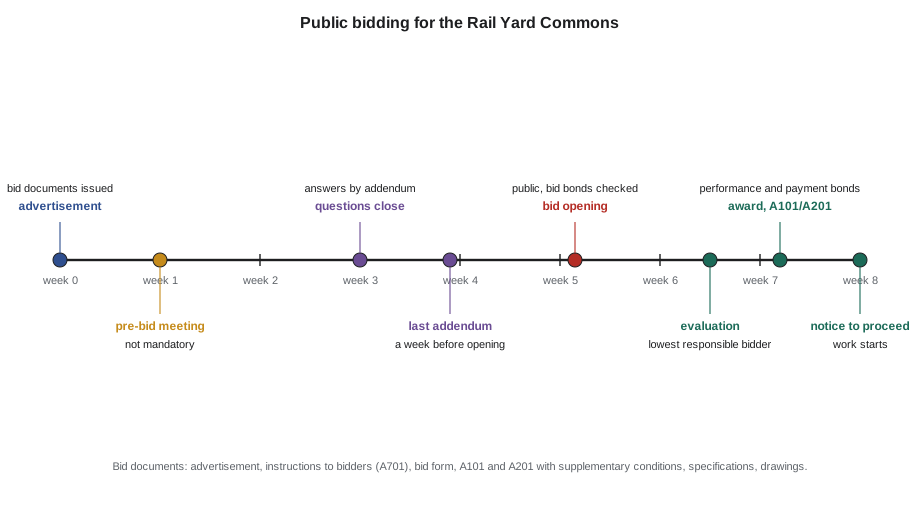
Public owners in the United States usually issue instructions to bidders adapted from AIA A701 or their own standard form, with a bid form and A101 and A201 with supplementary conditions, or their own contract forms. State and local law governs much of the process: public works over a set value must be advertised and awarded to the lowest responsible bidder whose bid responds to the documents, bids are opened in public, and bid security and performance and payment bonds are required. The instructions state how questions are asked, how addenda are issued, how bids must be submitted and when they are opened, and the conditions under which a bid may be rejected.
The rules of the competition
American public bidding law rests on statutes and the decisions interpreting them. A public owner must award to the lowest responsible bidder whose bid is responsive, meaning that it conforms in every material respect to the bid documents. A bid that changes the terms, omits a required form or fails to acknowledge an addendum may be rejected as nonresponsive; a bidder that lacks the capacity, experience or financial strength to perform may be rejected as not responsible, on grounds the owner must be able to justify. Bidders who make clerical mistakes can sometimes withdraw without forfeiting their bid security, under rules that vary from state to state. For the architect, the lesson is that every requirement in the instructions to bidders must be one the owner is prepared to enforce for everyone, because an inconsistently enforced rule invites a protest.
The bid form usually requires bid security, often a bid bond for five out of every hundred dollars of the bid, using a form such as AIA A310, and the successful bidder must then provide a performance bond and a payment bond, each commonly for the full contract amount, as public works laws generally require. The payment bond protects subcontractors and suppliers, who cannot file liens against public property. Some public owners also require bidders to list their major subcontractors with the bid, so that the general contractor cannot shop the subcontract prices after award.
Questions and addenda
During the bidding period bidders find gaps, conflicts and ambiguities, and they ask questions. The instructions name the person to whom questions must be sent, usually in writing to the architect or the owner's procurement officer, and the deadline for them. Answers are never given privately: if a question reveals something every bidder needs to know, the answer goes to every bidder in an addendum. A question answered by telephone to one bidder gives that bidder an advantage and gives the others grounds to complain.
Addenda are numbered in sequence, dated and issued to every registered bidder. Each states the documents it changes and how, with revised sheets clouded and tagged and revised specification paragraphs quoted in full or replaced. The bid form lists the addenda and each bidder must acknowledge all of them; a form that fails to acknowledge an addendum may be non-compliant. The last addendum must leave bidders enough time to price it. Delgado's rule of thumb is a week; anything issued in the last two or three days before the close is likely to be priced as risk rather than as work, and some owners' rules forbid addenda in the final days unless the close is extended.
Delgado adds what a good addendum looks like from the estimator's side. It is short, it says exactly what changed, it does not reissue unchanged sheets, and it does not hide a change in the price in the middle of an answer to a different question. The worst addendum she ever received was forty pages long, issued two days before the close, and changed the roofing system in a footnote.
Prices besides the base price
The bid form can ask for more than a single price. Alternates, which some owners call add or deduct alternates, ask bidders to price defined changes to the base work, such as adding the gathering-room terraces or substituting a different roofing, so that the owner can adjust the scope to the budget once the prices are known. Unit prices ask for rates for work whose quantity cannot be known in advance, such as the removal of unsuitable fill on the rail-yard site, per cubic yard. Allowances set a fixed amount in every bid for an item not yet defined, such as the signage or the hardware for the access control system, so that everyone prices the same amount and the actual cost is adjusted later.
Brandt warns the team that alternates must be described as carefully as the base work, with their own drawings or specification paragraphs, and that the way alternates will be used in evaluation must be stated in the instructions. If the owner can choose any combination of alternates after seeing the prices, it can in effect choose the winner. Many public owners list alternates in a fixed order and accept them in that order only, as far as the budget allows.
# Tabulate bids: check responsiveness, add alternates in their stated order
# within the budget, and find the lowest responsive bid.
budget = 16_000_000
alternates = ["terraces", "battery storage"]       # accepted in this order only
bids = {  # bidder: base, alternates, addenda acknowledged, bid bond provided
    "Bidder A": (15_480_000, {"terraces": 310_000, "battery storage": 260_000}, {1, 2, 3}, True),
    "Bidder B": (15_210_000, {"terraces": 390_000, "battery storage": 240_000}, {1, 2}, True),
    "Bidder C": (15_590_000, {"terraces": 220_000, "battery storage": 205_000}, {1, 2, 3}, True),
    "Bidder D": (15_350_000, {"terraces": 280_000, "battery storage": 275_000}, {1, 2, 3}, False),
}
addenda = {1, 2, 3}
responsive = {b: t for b, t in bids.items() if t[2] == addenda and t[3]}
for b in bids:
    if b not in responsive:
        print(f"{b}: nonresponsive (addenda or bid security)")
# Decide how many alternates the budget allows, using the lowest responsive prices.
chosen = []
for k in range(len(alternates) + 1):
    names = alternates[:k]
    low = min(t[0] + sum(t[1][a] for a in names) for t in responsive.values())
    if low <= budget:
        chosen = names
print("alternates accepted:", chosen or "none")
totals = {b: t[0] + sum(t[1][a] for a in chosen) for b, t in responsive.items()}
for b, v in sorted(totals.items(), key=lambda x: x[1]):
    print(f"  {b}: {v:,.0f}")
win = min(totals, key=totals.get)
print(f"lowest responsive: {win}, {totals[win]:,.0f} dollars")Bidder B: nonresponsive (addenda or bid security) Bidder D: nonresponsive (addenda or bid security) alternates accepted: ['terraces'] Bidder A: 15,790,000 Bidder C: 15,810,000 lowest responsive: Bidder A, 15,790,000 dollars
The tabulation shows why the rules matter. Bidder B has the lowest base price but failed to acknowledge addendum 3, and Bidder D did not include bid security; both are out. Of the two remaining, Bidder A is lower on the base price alone, but with both alternates accepted, Bidder C is lower overall. If the owner were free to pick alternates in any combination, it could make either one the winner. Because the order was published, the result follows from the rules and not from a choice made after the prices were seen.
What makes a set easy to price
Ben Okafor, the cost estimator who priced the comprehensive studio, joins Delgado for the last hour, and together they give the students the estimators' view. Documents are easy to price when the scope is complete and stated once; when each specification section matches the scope of a trade, so that it can be sent to the right subcontractors as a package; when quantities can be taken off the drawings without ambiguity, with dimensions that close and schedules that match the plans; when the documents say who does what at every boundary, so that two subcontractors do not both price the same flashing and nobody prices the backing; and when unusual requirements, such as the mock-up of the roof tooth or the extended warranty on the roofing, are stated where the trade will see them rather than buried in Division 01.
Delgado's last piece of advice is about what happens after the close. When the prices come in, the architect reviews the low bidder's price breakdown with the owner, checks for obvious errors or omissions, and confirms the bidder's qualifications. If the price is over budget, the owner can accept alternates in order, negotiate within the rules it published, or cancel and call again with a reduced scope. Throughout, the documents remain what they were at the close; no change is agreed with the low bidder that the others did not have a chance to price, except through the contract after award.
Worked problem
Writing an addendum item
Bidder questions reveal that the east wing roof plan shows six roof teeth but the north elevation still shows eight, and the roofing section's Part 3 refers to a mock-up 'as directed'. Write the addendum items.
Show solution
- Number and date the addendum and list it as addendum 2 to the bid documents for the Rail Yard Commons.
- Item 2.1, drawings: 'Sheet A-201, North Elevation: replace with the attached sheet A-201, revision 2, dated as shown. The building has six roof teeth as shown on A-102.'
- Item 2.2, specifications: 'Section 07 41 13, paragraph 3.2.A: delete and replace with: Construct a mock-up of one roof valley, 10 ft long, including the gutter, flashings and glazing sill, at the location shown on A-102, and obtain acceptance before proceeding with the roofing.'
- Remind bidders to acknowledge addendum 2 on the form.
Answer: Each item names the document, the exact change and the replacement text, and the mock-up is now defined well enough to price.
Exercise 11: assembling the tender package
- Draft the instructions to bidders for the east wing as a separate contract, with the rules for questions, addenda, alternates and evaluation.
- Prepare a bid form with a base price, two alternates in a fixed order, one unit price and one allowance.
- Answer three bidder questions supplied by the instructor and issue them as an addendum.
- Tabulate four mock bids and identify the winner under your published rules.
Self-check
- Does every bidder receive the same information, including every answer?
- Are the alternates described fully and evaluated in a published order?
- Does the last addendum leave time to price it?
- Could an estimator split my set by trade and send each package to subcontractors?
The site meeting
Most bid periods include a site meeting early in the period, at which the architect and the owner walk bidders around the site and answer general questions. On the rail-yard parcel the meeting matters, because bidders want to see the fill, the access from Pell Street and the edge of the stormwater park before pricing the excavation and the staging. The rules are the same as for written questions: anything said at the meeting that affects the price must be confirmed in an addendum, and minutes are issued to every bidder, whether or not they attended. Some owners make the meeting mandatory and reject bids from firms that did not attend; others leave it optional to widen competition. Either way, the instructions must say which, and the owner must apply the rule consistently.
Common mistakes
MistakeAnswering a bidder's question privately.
InsteadIssue every material answer to all bidders by addendum.
MistakeIssuing a large addendum in the last days before the close.
InsteadIssue the last addendum about a week before the close, or extend the close.
MistakeLeaving the use of alternates to the owner's discretion after the prices are known.
InsteadPublish the order in which alternates will be accepted.
MistakeWriting requirements in the instructions that the owner will not enforce.
InsteadInclude only rules that will be applied equally to every bidder.
MistakeBurying unusual requirements in Division 01.
InsteadState them in the trade section where the subcontractor will see them.
Summary and key terms
- The bid documents add the procurement and contracting requirements of Division 00 to the construction documents.
- American public bidding law requires award to the lowest responsible bidder whose bid is responsive.
- Questions are answered by numbered, dated addenda issued to every bidder and acknowledged on the form.
- Alternates, unit prices and allowances must be described fully and evaluated by published rules.
- Documents are easy to price when scope is complete, stated once and organized by trade.
- Instructions to bidders
- The document that sets the rules of the competition, from questions and addenda to submission and evaluation.
- Bid security
- A bond or deposit that guarantees a bidder will enter the contract if its price is accepted.
- Alternate
- A defined change to the base work that bidders price separately so the owner can adjust scope.
- Unit price
- A rate for work whose quantity cannot be known in advance.
- Allowance
- A fixed amount included in every bid for an item not yet defined, adjusted to the actual cost later.
Practice problems
Work each problem on paper first, then reveal the answer to check.
Why must answers to bidders' questions go to every bidder?
Show answer
So that every bidder prices the same information and no one gains an advantage.
What must a bidder do with each addendum?
Show answer
Acknowledge it on the form and include its effect in the price.
Why are alternates accepted in a published order?
Show answer
So the owner cannot choose the winner by selecting alternates after seeing the prices.
What is an allowance used for?
Show answer
To include the same amount in every bid for an item not yet defined.
What makes a bid nonresponsive?
Show answer
Failing to conform in a material respect to the bid documents, such as not acknowledging an addendum or omitting bid security.
Lesson quiz · 5 questions
Score 60% or more to complete this lesson.
Create a free account to save your progress, take quizzes and earn a certificate.