
ARCH-240 · Lesson 6 of 12 · 21 min
Glass
Luis Ortega is a façade engineer who spent his first five years as a glazier, and he brings a box of broken glass to class, each piece in a labeled bag. One is a plate of annealed glass broken into long, knife-like shards. One is tempered glass crumbled into a heap of small cubes. One is a laminated pane cracked into a spider web but still in one piece, held together by its plastic interlayer. The last is a tempered pane that broke, he says, by itself, eighteen months after installation, on a calm night with nobody near it. Joon-ho, who has been suspicious of the plastic spacer since the first week, asks whether glass is really the right material for anything. Ortega laughs. 'It's the only material that lets you see out and keeps the weather in,' he says. 'So we learn its habits.'
What glass is
Ordinary window glass is soda-lime-silica glass: about 70% silica from sand, with soda ash to lower the melting point and lime for durability, plus small amounts of other oxides. It is an amorphous solid, a liquid frozen without crystallizing, which is why it is transparent. Glass is hard, stiff, chemically very durable and impervious to water and air. Its great weakness is that it is brittle: it has no ductility, and tiny flaws on its surface concentrate stress, so its practical strength in tension is low and unpredictable.
Almost all flat glass is now made by the float process, introduced commercially by Pilkington in the late 1950s, in which molten glass is poured onto a bath of molten tin and spreads into a perfectly flat ribbon before being cooled slowly in a long oven called a lehr. Standard thicknesses range from about ⅛ to ¾ in. Ordinary float glass has a slight green tint from iron, visible on its edges; low-iron glass, with very little iron, is clearer and transmits more light and solar energy, at a higher price.
Strength and safety
Float glass straight from the lehr is annealed: cooled slowly so that it has little internal stress. It can be cut, drilled and edged after manufacture. When it breaks, it forms large, sharp shards.
Heat-treated glass is reheated and then cooled rapidly with air jets, which leaves the surfaces in compression and the core in tension. Because a crack must first overcome the surface compression, the glass is stronger. Heat-strengthened glass is about twice as strong as annealed glass and breaks into larger pieces that tend to stay in the frame. Fully tempered glass is about four times as strong and breaks into small, relatively harmless cubes, so it is a safety glass. Tempered glass cannot be cut or drilled after tempering; all holes and edges must be finished first. Very occasionally a tiny nickel sulfide inclusion slowly expands and breaks a tempered pane spontaneously, as happened to Ortega's last sample. Heat-soak testing, which holds the tempered glass at high temperature to break susceptible panes in the factory, reduces the risk.
Laminated glass bonds two or more panes with a plastic interlayer, usually polyvinyl butyral (PVB) or a stiffer ionoplast. When it breaks, the fragments stick to the interlayer, and the pane stays in the opening. Laminated glass is used for overhead glazing, balustrades, glass floors, security and hurricane glazing and wherever falling glass would be dangerous. It also reduces sound transmission and blocks most ultraviolet light.
Codes require safety glazing in hazardous locations, where people may fall or push against glass: doors, panels beside doors, low windows near walking surfaces, shower enclosures, guards and railings. In the United States, safety glazing is tested to the federal standard 16 CFR 1201 or to ANSI Z97.1, and the building code sets where it is required. Traditional wired glass, once common in fire doors, no longer qualifies as safety glazing in most locations, and ceramic or specially laminated fire-rated glass has replaced it.
| Type | Relative strength | Breakage | Can be cut after treatment? |
|---|---|---|---|
| Annealed | 1 | Large sharp shards | Yes |
| Heat-strengthened | About 2 | Larger pieces, tend to stay in frame | No |
| Fully tempered | About 4 | Small cubes (safety glass) | No |
| Laminated | Depends on the plies | Cracks but stays bonded to interlayer | Before lamination only |
Glass and heat
A single pane of glass is a poor insulator. Most of its resistance to heat flow comes from the thin films of still air on each face. Modern windows therefore use insulating glass units: two or three panes separated by sealed cavities filled with dry air or, better, argon or krypton gas. Spacers around the edge hold the panes apart and contain a desiccant to absorb moisture. Edge seals keep the gas in and water vapor out.
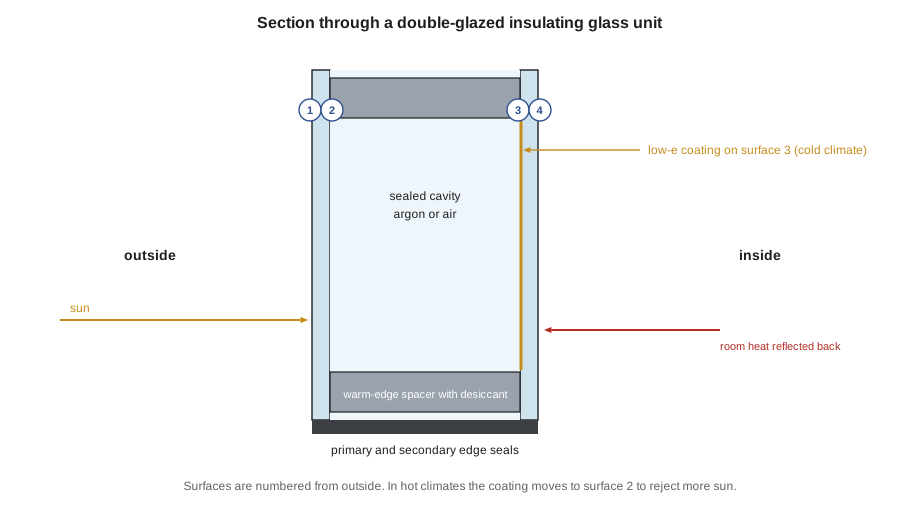
Low-emissivity, or low-e, coatings are microscopically thin layers of metal or metal oxide that let visible light through but reflect long-wave infrared radiation, the heat given off by warm room surfaces. They roughly halve the heat loss of a double-glazed unit. Hard-coat or pyrolytic low-e is applied during float manufacture and is durable; soft-coat or sputtered low-e is applied later in a vacuum chamber, performs better but must be protected inside the sealed unit. Spectrally selective coatings also reflect much of the sun's near-infrared, cutting solar heat gain while admitting daylight.
The edge of an insulating unit is its weak point. Old spacers of aluminum conducted heat around the cavity, making the glass edge cold and wet with condensation in winter. Warm-edge spacers of stainless steel, structural foam or plastic composites, the kind Joon-ho found in the library, are far better insulators. 'The plastic spacer is not a cheap trick,' Ortega tells him. 'It's why your grandparents' windows had frost on the bottom and yours don't.' The polymers in the edge seals do age, however; a unit whose seal fails fogs between the panes and must be replaced.
Window performance is rated by a few numbers that every architect should be able to read.
- The U-factor measures heat loss through the whole window, including frame and edges: lower is better. It is given in Btu/(h·ft²·°F).
- The solar heat gain coefficient (SHGC) is the share of incident solar radiation that ends up as heat inside, from 0 to 1. A high SHGC helps passive heating on south walls in winter; a low one limits overheating on west walls.
- Visible transmittance (VT) is the share of visible light transmitted. A high ratio of VT to SHGC means good daylight with little heat.
- Condensation resistance indicates how well the interior surface resists condensation in cold weather.
In the United States, the National Fenestration Rating Council (NFRC) rates whole windows, and the label on each unit gives its U-factor, SHGC and VT. On the northern prairies, triple glazing has become common in high-performance buildings.
This simple equation, heat flow equals U-factor times area times temperature difference, lets the students compare options for the community hub's tall south windows in the commons.
# Commons south glazing: winter heat loss and midday solar gain for two glazing options
area = 520                     # glazed area, ft2
t_in, t_out = 70, -27       # design indoor and outdoor temperatures
sun = 238                       # clear-sky solar radiation on the south wall at winter noon, Btu/h ft2
options = {"double, low-e, argon": (0.28, 0.40, 0.62), "triple, low-e, argon": (0.18, 0.33, 0.55)}
for name, (u, shgc, vt) in options.items():
    loss = u * area * (t_in - t_out)
    gain = shgc * area * sun
    print(f"{name:<22} U {u}  loss {loss:8,.0f} Btu/h   noon solar gain {gain:8,.0f} Btu/h   VT {vt}")
d, t = options["double, low-e, argon"][0], options["triple, low-e, argon"][0]
print(f"Triple glazing cuts the design heat loss by {100 * (1 - t / d):.0f}%")
# Inner glass surface temperature (simple film model): warmer glass means less draft and condensation
h_in = 1.41
for name, (u, _, _) in options.items():
    surface = t_in - u * (t_in - t_out) / h_in
print(f"{name:<22} inner surface about {surface:.0f} degrees")double, low-e, argon U 0.28 loss 14,123 Btu/h noon solar gain 49,504 Btu/h VT 0.62 triple, low-e, argon U 0.18 loss 9,079 Btu/h noon solar gain 40,841 Btu/h VT 0.55 Triple glazing cuts the design heat loss by 36% double, low-e, argon inner surface about 51 degrees triple, low-e, argon inner surface about 58 degrees
Triple glazing cuts the design heat loss through the windows by more than a third, and its warmer inner surface makes the commons more comfortable: people sitting near cold glass feel a chilly downdraft and lose heat by radiation even when the air is warm. The price is weight, about half again as much glass, and a little less solar gain and light. The numbers also show why south glazing is valuable on the prairies: at noon on a clear January day the sun pours far more heat through these windows than they lose, even with triple glazing. The difficulty is that the sun shines for only a few hours, while the night lasts fifteen. Mass in the floor, such as Ingrid's polished slab, can store some of the midday gain and release it in the evening.
Glass and light
Glass transmits light, but how it does so shapes a room. Clear glass gives views and sharp shadows. Patterned, acid-etched and sandblasted glass diffuse light and give privacy. Fritted glass has a pattern of ceramic dots or lines fired onto the surface, used to cut solar gain, reduce glare and make glass visible to birds. Tinted glass absorbs part of the light and heat and changes the view's hue; reflective coatings give a mirror-like exterior by day that becomes a dark mirror on the inside at night.
Birds do not see glass. In North America, collisions with buildings kill hundreds of millions of birds each year. Bird-friendly design uses visible patterns on the outer surface, with markers spaced close enough that birds treat the glass as a barrier, along with avoiding reflective glass near trees and transparent corners. Several cities and states have bird-safe rules, and Minnesota's sustainable building guidelines for state-funded projects address bird-safe glazing. For the hub, whose commons has a glass corner facing the trees of the greenway, the students decide to use a fritted pattern on the outer pane.
Glass under load
Glass must resist wind pressure, snow on sloped glazing, people leaning on guards and its own weight. Glass thickness is selected from charts or calculated to standards such as ASTM E1300, which account for the size of the pane, its support conditions and the duration of the load, because glass is weaker under long-term loads. Larger panes need thicker glass. Glass is also vulnerable to thermal stress: if part of a pane heats up in the sun while the edge stays cold in the frame or shade, the tension can crack annealed glass. Heat-strengthening reduces the risk where shading, dark coatings or deep frames create large temperature differences.
Structural glass, carrying more than its own panel's loads, has become popular in entrances and atriums: glass fins stiffen tall glazed walls, laminated glass beams carry small roofs, and glass balustrades act as guards. These assemblies always use laminated, usually heat-treated glass so that a broken element still holds together, and they need specialist engineering.
Worked problem
Choosing glass for the commons' glass corner
The commons has a two-story glass corner facing north-east toward a bus stop and the street, with doors and a bench along the inside. What glass make-up would you propose?
Show solution
- Use triple-glazed units for comfort near the bench and to reduce condensation in a cold climate.
- Make the inner pane laminated and the outer pane heat-strengthened or tempered, because the glass is near a walking surface and doors, and large panes face wind.
- Use tempered or laminated safety glass in the doors and in the panels beside them.
- Apply a bird-friendly fritted pattern to surface 1 near the trees and at the corner, where birds see through to the sky.
- Use warm-edge spacers and frames with good thermal breaks; consider low-iron glass if a very clear view is important.
Answer: Triple-glazed units with safety glass where required, a bird-friendly frit on the outer face, warm-edge spacers and well-insulated frames.
Exercise 6: glass
- Read the label or data sheet of a window in your home or studio and record its U-factor, SHGC and VT.
- Calculate the heat loss through the glazing of one room of your community hub on a design winter day for two glazing options.
- Mark on your hub plans every location where safety glazing would be required.
- Propose a bird-friendly glazing strategy for the hub and sketch the pattern.
- Sketch a section through an insulating glass unit in its frame and label each surface and component.
Common mistakes
MistakeCutting or drilling tempered glass on site.
InsteadFinish all holes and edges before tempering, or use laminated annealed glass.
MistakeSpecifying annealed glass in doors or low panels.
InsteadUse tempered or laminated safety glazing in hazardous locations.
MistakeChoosing glass by appearance alone.
InsteadCheck the U-value, SHGC, VT and condensation resistance against climate and orientation.
MistakeIgnoring thermal stress in shaded or dark glass.
InsteadAsk the supplier for a thermal stress check and heat-strengthen where needed.
MistakeForgetting birds.
InsteadUse visible markers on surface 1 where glass reflects trees or sky.
Summary and key terms
- Window glass is soda-lime-silica float glass: hard, stiff, durable and brittle.
- Heat-strengthened glass is about twice as strong as annealed, tempered about four times; tempered glass breaks into small cubes.
- Laminated glass stays in place when broken and is used overhead, in guards and for security.
- Insulating glass units with low-e coatings, gas fills and warm-edge spacers greatly reduce heat loss.
- The U-factor, SHGC and VT describe a window's energy and light performance.
- Safety glazing, bird-friendly design and thermal stress must all be considered in selecting glass.
- Float glass
- Flat glass made by floating molten glass on a bath of molten tin.
- Tempered glass
- Glass heat-treated to about four times the strength of annealed glass, breaking into small cubes.
- Laminated glass
- Panes bonded with a plastic interlayer that holds fragments when broken.
- Low-e coating
- A thin coating that reflects long-wave infrared heat while transmitting light.
- Solar heat gain coefficient
- The share of incident solar radiation that becomes heat inside.
- Insulating glass unit
- Two or more panes sealed around a spacer with a dry gas-filled cavity.
Practice problems
Work each problem on paper first, then reveal the answer to check.
Why does tempered glass make a good safety glazing?
Show answer
It is about four times as strong as annealed glass and breaks into small, relatively harmless cubes.
A window has a U-factor of 0.28 and an area of 32 ft². What is the heat loss when it is 40 °F warmer inside than out?
Show answer
0.28 × 32 × 40 ≈ 358 Btu/h.
Why would you choose a low SHGC for a west-facing window?
Show answer
Low afternoon sun from the west causes overheating that overhangs cannot block.
What causes fogging between the panes of an old insulating glass unit?
Show answer
The edge seal has failed and moist air has entered the cavity.
Where is a low-e coating usually placed in a double-glazed unit in a cold climate?
Show answer
On surface 3, the cavity side of the inner pane.
Lesson quiz · 5 questions
Score 60% or more to complete this lesson.
Create a free account to save your progress, take quizzes and earn a certificate.