
ARCH-220 · Lesson 11 of 12 · 22 min
Global practice
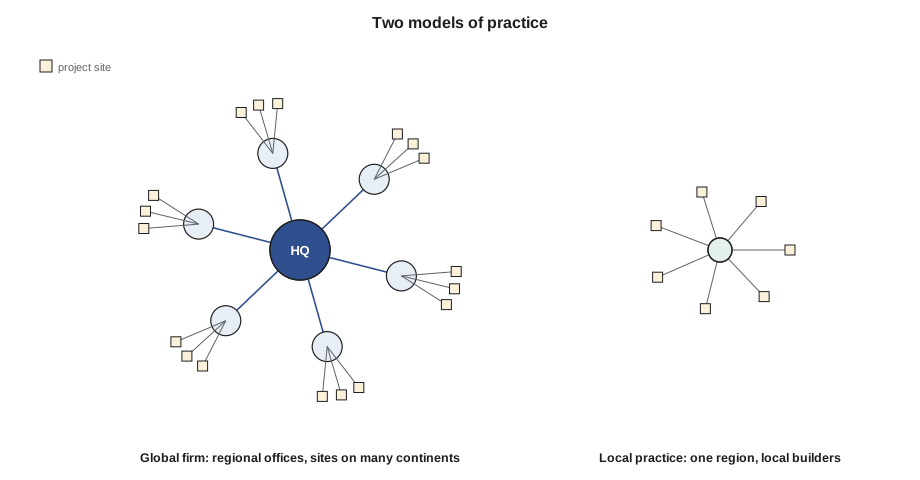
Dr. Arslan opens the lesson with a map of the world covered in small dots. Each dot is a project by one architecture firm, a large international practice with offices on four continents: towers in Shanghai and Dubai, airports in Asia, a university campus in the Gulf, stadiums in South America, and a few buildings in its home country. 'This firm employs more architects than live in some small cities,' she says. 'It works across dozens of time zones; its drawings may be produced in one country, checked in another and built in a third. Its designers may never visit some of the sites. Now look at this one.' She shows a second map with a single cluster of dots, all in one valley in Chile. 'This architect won the Pritzker Prize in 2026. Which of these is the future of architecture?' Callum says the first. Wren says the second. 'They may both be right,' Dr. Arslan says. 'That is what makes global practice interesting.'
Since the 1980s, architecture has become a global profession. Large firms work in many countries; famous architects design landmarks far from home; competitions, biennales and prizes are international; software, standards and materials are shared across borders; and architectural images travel instantly through magazines, websites and social media. This lesson examines what globalization has done to architecture and the theories that try to make sense of it, from the star system and the Bilbao effect to questions of labor, ethics and identity.
The star system and the Bilbao effect
In the late twentieth century, a small number of architects became international celebrities, often called starchitects. They included Frank Gehry, Zaha Hadid, Rem Koolhaas, Norman Foster, Jean Nouvel, Santiago Calatrava and Daniel Libeskind, among others. Cities, universities, museums and developers competed to commission their buildings, which were expected to be instantly recognizable and to attract attention, visitors and investment. The phenomenon was not entirely new: Michelangelo, Wren and Wright were famous in their day. But the speed and scale of global media made it different in kind.
The Guggenheim Museum in Bilbao, which you studied in Lessons 4 and 8, gave its name to the phenomenon. When it opened in 1997, Bilbao was a declining port and industrial city in the Basque Country of Spain. The museum, part of a larger regeneration plan that included a new metro by Norman Foster, a new airport terminal by Calatrava and the cleanup of the river, attracted around a million visitors a year in its early years and became a symbol of the city's transformation. Other cities hoped that a spectacular building by a famous architect would do the same for them. This hope became known as the Bilbao effect.
Most attempts to repeat it failed. Studies of Bilbao itself showed that the museum succeeded as part of a long-term public investment in infrastructure, education and the environment, not as a single object. Many later iconic buildings, in cities large and small, had huge cost overruns, attracted fewer visitors than expected and imposed long-term operating costs. Critics such as the historian Charles Jencks, in The Iconic Building (2005), analyzed the phenomenon; others argued that it encouraged architecture as branding and spectacle at the expense of everyday buildings. The economic crisis of 2008 ended the first wave of iconic projects in Europe and North America, though the trend continued in Asia and the Gulf.
Koolhaas and the theory of bigness
Rem Koolhaas, the Dutch architect who founded the Office for Metropolitan Architecture (OMA) in 1975, became the most influential theorist of global architecture. His first book, Delirious New York (1978), described Manhattan as a culture of congestion, in which skyscrapers stacked unrelated activities on top of one another, a retroactive manifesto for a city no one had planned. In S,M,L,XL (1995), a massive book written with the designer Bruce Mau, his essays on Bigness argued that beyond a certain size, a building can no longer be controlled by a single architectural gesture, and its interior and exterior become independent. Another essay, The Generic City, described the anonymous, fast-growing cities of Asia and elsewhere, without history or center, as the real condition of contemporary urbanism.
Koolhaas's later essay Junkspace (2001) described the endless, air-conditioned interiors of airports, malls and casinos as the true product of modernization, a space without architecture. His studies of Chinese and African cities with students at Harvard, and his buildings, such as the Seattle Central Library (2004) and the CCTV headquarters in Beijing (completed 2012), a loop of two leaning towers joined at the base and top, put his theories into practice. Koolhaas received the Pritzker Prize in 2000. His work is often read as accepting, even celebrating, global capitalism, though he presents himself as an observer.
Large firms and the global workplace
Starchitects receive most of the attention, but most of the world's large buildings are designed by large firms that are less famous. Some international firms employ thousands of people in dozens of offices. Large engineering and design conglomerates combine architecture with engineering, planning and project management. Firms from North America, Europe, Japan and Australia designed many of the towers, airports and new districts built in China, the Gulf states and Southeast Asia from the 1990s to the 2010s. The world's tallest building since 2010, the Burj Khalifa in Dubai, at about 2,717 ft, was designed by Skidmore, Owings and Merrill of Chicago, with Adrian Smith as design partner.
Globalization has changed how architects work. Digital models and building information modeling, which you studied in ARCH-210, allow teams in different countries to work on the same project, sometimes around the clock across time zones. Some firms send documentation work to offices in countries with lower costs. Architects must understand the codes, construction practices and cultures of many places, and local architects of record are usually needed to take legal responsibility. In North America, architects must be licensed in each province or state where they practice, though agreements between licensing bodies, including one between Canada and the United States in effect since 2014, have made it easier to work across the border.
American firms have built extensively abroad, from Skidmore, Owings and Merrill's towers in the Gulf and China to Kohn Pedersen Fox's skyscrapers in Asia. At the same time, many major American buildings were designed by foreign architects with American partners, such as Jean Nouvel's Guthrie Theater (2006) in Minneapolis, with its blue metal skin and a cantilevered lobby, the Endless Bridge, reaching about 178 feet toward the Mississippi. Canadian firms work in the United States too: Diamond Schmitt, for example, has designed concert halls and theaters in several American cities.
The Pritzker map
The Pritzker Architecture Prize, founded in 1979 by the Pritzker family of Chicago, is the most prestigious international award in architecture. Its list of laureates is a rough map of whose architecture the profession has considered most important, and it has shifted over time. In its first decade it went mainly to architects from the United States and Western Europe. In recent years it has gone to architects from Chile, India, Burkina Faso, China and Japan, and to more women and partnerships. In 2025 it went to Liu Jiakun of China, whose buildings in Chengdu use local materials and respond to the daily life of the city. In 2026 it went to Smiljan Radić Clarke of Chile, known for small, poetic buildings that combine rough materials, stone, wood and fabric, with experimental structures.
# Pritzker laureates by region of main practice, 1979 to 2026.
# One entry per year; shared prizes count once.
laureates = {
    "North America": [1979, 1982, 1983, 1984, 1988, 1989, 1991, 2005],
    "Europe": [1981, 1985, 1986, 1990, 1992, 1994, 1996, 1997, 1998, 1999, 2000, 2001,
               2003, 2004, 2007, 2008, 2009, 2011, 2015, 2017, 2020, 2021, 2023],
    "Asia": [1987, 1993, 1995, 2010, 2012, 2013, 2014, 2018, 2019, 2024, 2025],
    "Latin America": [1980, 2006, 2016, 2026],
    "Oceania": [2002],
    "Africa": [2022],
}
total = sum(len(v) for v in laureates.values())
print("Years counted:", total)
for region, years in laureates.items():
    early = sum(1 for y in years if y < 2000)
    late = len(years) - early
print(f"{region:14s} {len(years):2d} in all, {early:2d} before 2000, {late:2d} from 2000")Years counted: 48 North America 8 in all, 7 before 2000, 1 from 2000 Europe 23 in all, 10 before 2000, 13 from 2000 Asia 11 in all, 3 before 2000, 8 from 2000 Latin America 4 in all, 1 before 2000, 3 from 2000 Oceania 1 in all, 0 before 2000, 1 from 2000 Africa 1 in all, 0 before 2000, 1 from 2000
The counts in the script are approximate, because regions of practice are not always clear: Zaha Hadid was born in Baghdad and practiced in London; Francis Kéré practices in Berlin and Burkina Faso; Frank Gehry was born in Toronto and practices in Los Angeles. Even so, the trend is visible. Before 2000, Asia, Latin America, Oceania and Africa together received only a handful of prizes; since 2000 they have received many more. Whether this reflects a real change in where important architecture is made, or a change in what the jury values, is a question worth arguing about.
| Year | Laureate | Country of main practice | Known for |
|---|---|---|---|
| 2016 | Alejandro Aravena | Chile | Incremental social housing |
| 2018 | Balkrishna Doshi | India | Modern architecture for Indian climate and society |
| 2021 | Anne Lacaton and Jean-Philippe Vassal | France | Transforming rather than demolishing |
| 2022 | Diébédo Francis Kéré | Burkina Faso and Germany | Community-built schools in local materials |
| 2023 | David Chipperfield | United Kingdom | Restraint and the restoration of the Neues Museum |
| 2024 | Riken Yamamoto | Japan | Housing that connects private and community life |
| 2025 | Liu Jiakun | China | Buildings of local materials responding to everyday life |
| 2026 | Smiljan Radić Clarke | Chile | Small, poetic buildings of rough materials |
Ethics of building abroad
Building abroad raises ethical questions that local practice may not. Architects may work for governments that suppress free speech, or design buildings that serve as propaganda. They may design projects built by migrant workers living and working in harsh conditions. In 2014, Zaha Hadid was widely criticized for remarks suggesting that the welfare of workers building a stadium she had designed in Qatar was not an architect's responsibility; the debate that followed, during preparations for the 2022 World Cup, made labor conditions a recognized professional concern. Architects have also been asked whether designing luxury towers in cities with severe housing shortages, or prisons and detention centers, is compatible with professional ethics.
There are no simple rules. Some architects refuse certain commissions; others argue that engagement can improve conditions and that refusing leaves the work to less scrupulous firms. Professional codes, such as those of the Royal Architectural Institute of Canada and the American Institute of Architects, require architects to respect human rights and the environment, but they leave much to individual judgment. A useful test is to ask who benefits from the building, who builds it and under what conditions, and who will use it.
Global and local
Globalization has not produced a single world architecture. Instead it has produced tension between the global and the local, the theme of critical regionalism in Lesson 5. On one side are the generic towers and malls that look the same everywhere; on the other are architects such as Wang Shu, Liu Jiakun, Kéré and Radić, who have achieved international recognition by working deeply in their own places. The two are connected: the local architects learn from global exchange, and global firms increasingly seek local knowledge and partners. The Venice Architecture Biennale, held every two years since 1980, and the many other biennales and triennales around the world, are places where these exchanges happen. The 2025 Venice Biennale, curated by Carlo Ratti, took intelligence, natural, artificial and collective, as its theme.
Worked problem
Should the firm take the commission?
Joon-ho is working for the summer in a large firm that has been invited to design a luxury hotel tower in a fast-growing city abroad. The project would bring work and prestige. Dr. Arslan asks him to set out the questions the partners should ask before deciding.
Show solution
- Who is the client, and what is the building for? A hotel tower may be harmless or may displace existing residents.
- Who will build it, and under what conditions? Ask about labor practices, recruitment fees, housing, wages and safety, and whether the firm can influence them through the contract.
- What is the site's history and context? Is local knowledge available through a local partner?
- What are the environmental impacts? A glass tower in a hot climate may need enormous cooling energy.
- What can the firm contribute? If the firm can improve the design's climate response, public spaces and labor standards, engagement may be justified; if not, refusing may be the better choice.
Answer: A global commission should be judged by its purpose, its builders' conditions, its context and its environmental effects. Asking these questions before signing is part of professional responsibility.
Exercise 11: a global building at home
This exercise takes about four hours.
- Find a building in your region designed by an architect or firm from another country, and one designed by a local architect for a similar use.
- Research who designed each, who was the local partner and how the design responded to its site and climate.
- Draw a site plan and a section of each.
- Deliverable: two pages, one per building, and a paragraph comparing how each relates to its place and to global architectural culture.
Self-critique checklist
- Have I identified all the firms involved, including local architects of record and engineers?
- Have I avoided assuming that foreign means placeless or local means good?
- Have I considered the building's effect on its city as well as its form?
- Have I distinguished the architect's image from the building's daily use?
Common mistakes
MistakeBelieving a famous building alone can transform a city.
InsteadBilbao's museum succeeded as part of a long-term public investment in infrastructure and the environment.
MistakeThinking global practice means only starchitects.
InsteadMost large buildings worldwide are designed by large, less famous firms.
MistakeAssuming the Pritzker list is a neutral measure of quality.
InsteadIt reflects the jury's values and has shifted over time.
MistakeIgnoring the conditions of construction workers.
InsteadLabor conditions are now a recognized professional concern, especially on projects abroad.
Summary and key terms
- Since the 1980s architecture has become a global profession of international firms, famous architects, competitions and media.
- The Bilbao effect names the hope that a spectacular building can transform a city; most attempts to repeat it failed.
- Koolhaas theorized bigness, the generic city and junkspace as conditions of global modernization.
- Large firms and digital tools allow work across countries and time zones, but local partners and licensing remain essential.
- The Pritzker Prize has shifted toward architects from more regions; recent laureates include Liu Jiakun (2025) and Smiljan Radić Clarke (2026).
- Starchitect
- An architect with international celebrity whose buildings are sought as landmarks.
- Bilbao effect
- The hope that a spectacular building by a famous architect can transform a city's economy and image.
- Bigness
- Koolhaas's term for buildings so large that they escape the control of a single architectural gesture.
- Generic City
- Koolhaas's description of fast-growing cities without history or center.
- Architect of record
- The locally licensed architect who takes legal responsibility for a project's documents.
Practice problems
Work each problem on paper first, then reveal the answer to check.
What is the Bilbao effect?
Show answer
The hope that a spectacular building by a famous architect can transform a city, named after the Guggenheim Bilbao (1997).
Name two of Koolhaas's theoretical texts.
Show answer
For example, Delirious New York (1978) and S,M,L,XL (1995), which includes Bigness and The Generic City.
Which firm designed the Burj Khalifa?
Show answer
Skidmore, Owings and Merrill, with Adrian Smith as design partner.
Who received the Pritzker Prize in 2025 and in 2026?
Show answer
Liu Jiakun of China in 2025 and Smiljan Radić Clarke of Chile in 2026.
Why is an architect of record needed on many international projects?
Show answer
Local licensing laws require a locally licensed architect to take legal responsibility.
Lesson quiz · 5 questions
Score 60% or more to complete this lesson.
Create a free account to save your progress, take quizzes and earn a certificate.