
APT-330 · Lesson 6 of 12 · 23 min
Supplier relationships and programs
▶ Video coming soon A video version of this lesson is on the way.
Rolf keeps a gray binder on the shelf behind his desk with the department's most important documents in it: the parts sections of the Tessaro dealer agreement, the current program bulletins, the Corvane and Torvale supply agreements, and a page for every supplier with names, terms and notes. At the sixth session he handed it to Imani. "Everything we sell comes from somebody," he said. "How well we buy decides how well we can sell. And most of what makes buying work is a relationship, not a price."
The department's suppliers
Rolf sorted the department's suppliers into four groups:
- The maker. Tessaro supplies genuine parts from its parts distribution center under the dealer agreement. It is by far the largest supplier, with stock orders, daily orders and emergency orders, and it sets the rules for returns, warranty and programs.
- Aftermarket lines. Corvane and Torvale supply filters, wipers, brake parts, batteries and other lines for older Tessaro models and for the wholesale trade, where garages compare prices.
- Local and specialty sources. Other Tessaro dealers through the maker's dealer locator, the group's sister stores, and local suppliers of shop supplies, paint materials and fasteners.
- Service providers. Freight carriers and couriers such as Quillfern Freight and Brackenly Express, the training provider Cairnmore Safety Training, the forklift trainer and the waste and core recyclers.
Each group needs a different kind of attention. With the maker, the manager's job is to use the programs well and meet the obligations. With aftermarket suppliers, it is to negotiate terms and hold them to their promises. With service providers, it is to set clear expectations and check performance.
What the dealer agreement asks of the parts department
A dealer agreement gives the dealership the right to sell and service the maker's vehicles and sets out what the dealer must do in return. The parts sections vary by maker, but they usually cover:
- Stocking. Keep a reasonable stock of genuine parts for the vehicles sold and serviced, often guided by the maker's recommended stocking levels.
- Facilities and systems. Meet the maker's standards for the parts area, the counter and the computer systems that connect to the maker's ordering and warranty systems.
- Ordering. Place stock orders on the maker's schedule, and pay on the maker's terms.
- Warranty. Follow the warranty policy for parts used on warranty repairs, including keeping and returning failed parts when asked (lesson 7).
- Returns. Use the maker's return programs within their rules.
- Reporting and audits. Send the monthly financial statement in the maker's format and allow audits of warranty and program claims (lessons 9 and 10).
Rolf's advice was to read the parts sections once a year, slowly. "Most of the expensive surprises in this job come from a rule nobody had read."
Stock orders, daily orders and emergency orders
Makers usually price their orders by urgency. A stock order, placed on the maker's schedule and filled from the distribution center on the normal delivery, earns the best discount or the lowest freight charge. A daily order for parts needed sooner costs a little more. An emergency or vehicle off road order, shipped by the fastest route for a customer whose vehicle is waiting, costs the most. The details are in Tessaro's program bulletins and change from time to time; the examples here use sample values for teaching.
Under Tessaro's sample program, stock order parts earn an extra 4 percent discount compared with daily orders. Rolf checked how much the department was losing by ordering stockable parts on daily orders. In October, about 60,000 dollars of daily-order purchases were parts the department normally stocks and could have ordered on the stock order a few days earlier. At 4 percent, 60,000 × 0.04 = 2,400 dollars of discount was missed in one month.
The fix was in the stocking settings and in discipline: order points that trigger replenishment early enough to catch the stock order, and a rule that daily orders for stocked parts need a reason. Daily and emergency orders are the right tool for parts that a customer needs now; they are an expensive habit for parts the department should have had on the shelf.
Return programs
Parts that don't sell are money sitting on a shelf. Makers allow dealers to return some of that stock under a return program, within limits. APT-210 showed how the Tessaro sample program works: twice a year, the dealer may return parts up to 4 percent of the previous year's stock order purchases, and a handling charge of 10 percent is deducted from the credit.
Worked problem
The return allowance
Linmore's stock order purchases last year were 2,950,000 dollars. How much can it return this year, and what credit does a return of 31,200 dollars earn?
Show solution
- Annual allowance = 2,950,000 × 0.04 = 118,000 dollars, or about 59,000 dollars in each of the two windows.
- Credit on a 31,200 dollar return = 31,200 × (1 − 0.10) = 28,080 dollars.
- The 3,120 dollar handling charge is the cost of the mistake that put the parts on the shelf.
Answer: 118,000 dollars a year; the 31,200 dollar return earns a 28,080 dollar credit.
Rolf told Imani that a return program is a safety valve, not a strategy. The allowance is tied to stock order purchases, so a department that orders well earns a larger allowance and needs less of it. He uses the full allowance every window, choosing the oldest eligible stock first, and he never lets a window close unused. In the two years before Fergus arrived, the sister store had used neither window, which is part of why it had 82,000 dollars of non-moving stock.
Aftermarket supply agreements
With aftermarket suppliers, more is negotiable. Rolf's agreements with Corvane and Torvale cover:
- Pricing and discounts, including any volume rebates.
- Delivery: how often the supplier's truck comes, cut-off times and freight terms.
- Returns and warranty: how unsold and defective parts go back, and for what credit.
- Stock adjustment: an annual right to exchange slow-moving lines for faster ones.
- Marketing support: co-operative advertising funds, displays and catalogs.
- Training and technical help: product training for counter staff and a technical line for difficult cases.
Two of those deserve a closer look, because they are often misunderstood.
A volume rebate pays back a percentage of purchases if the department reaches a level during the year. Torvale's sample rebate pays 1 percent on purchases from 150,000 dollars, 2 percent from 250,000 dollars and 3 percent from 350,000 dollars, applied to all of the year's purchases.
Worked problem
Is the next rebate tier worth chasing?
With six weeks left in the year, Linmore's Torvale purchases are 238,000 dollars, earning the 1 percent tier. What is the rebate now, and what would it be at 250,000 dollars?
Show solution
- At 238,000 dollars and 1 percent: 238,000 × 0.01 = 2,380 dollars.
- At 250,000 dollars and 2 percent: 250,000 × 0.02 = 5,000 dollars.
- The extra 12,000 dollars of purchases would raise the rebate by 5,000 − 2,380 = 2,620 dollars.
Answer: Worth it only if the extra 12,000 dollars of parts are ones the department will sell soon. Buying parts that sit on the shelf for a year to earn a rebate costs the carrying cost, about 25 percent a year, which on 12,000 dollars is 3,000 dollars, more than the rebate gained.
A co-operative (co-op) advertising fund is money a supplier sets aside, usually as a percentage of purchases, to share the cost of advertising its products. Corvane's sample program accrues 2 percent of purchases. With 210,000 dollars of Corvane purchases a year, the fund is 210,000 × 0.02 = 4,200 dollars. The money is claimed, not received automatically: the dealer must run approved advertising, such as a fall wiper promotion, and send proof and invoices before the deadline. Many departments leave co-op money unclaimed every year because nobody owns the paperwork. At Linmore, it is on Imani's list for the new year.
Measuring supplier performance
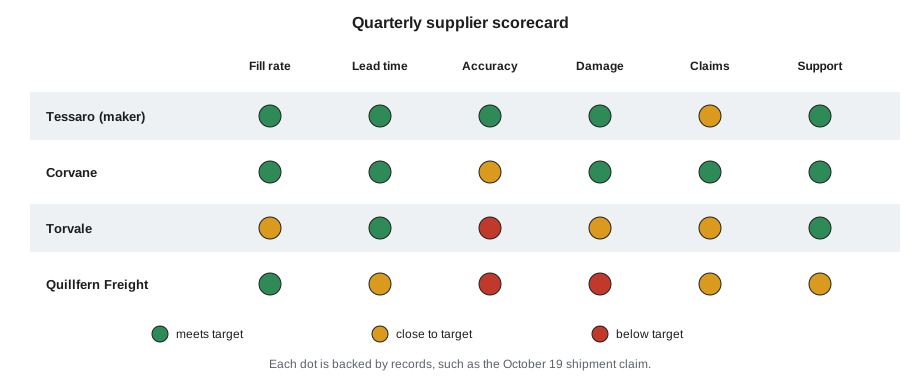
Rolf keeps a supplier scorecard for each main supplier, reviewed every quarter:
| Measure | What it shows | Example |
|---|---|---|
| Fill rate | Share of ordered lines shipped complete on time | Tessaro stock order: 97 percent of lines |
| Lead time | Days from order to receipt | Torvale: two days, as agreed |
| Shipment accuracy | Lines received as ordered, with no wrong or short parts | Quillfern Freight delivery of October 19: 4 rotors short, 2 boxes of wrong pads |
| Damage | Lines damaged in transit | October 19: one cracked rotor plus one found next day |
| Claim handling | Days to resolve a claim | October 19 claim: all recovered in ten days |
| Support | Training, technical help, invoices correct | Corvane technical line answered every call in October |
The scorecard turns complaints into facts. When Rolf sat down with Torvale's representative in November, he didn't say deliveries had been bad; he showed the October 19 shipment, the claim and the ten days it took, and asked what the supplier would change. Torvale agreed to pack rotors on their own pallet and to send a corrected order the same day when a shortage is reported.
Building the relationship
Rolf's last point was the one he cared about most. Suppliers are people: the Tessaro district parts manager, Clementine Kesterton, the aftermarket representatives, the carriers' claims staff, the distribution center's dealer support desk. A department that pays on time, orders cleanly, files claims with good records and treats suppliers' people with respect gets help when it needs it: a part found in another warehouse, a return approved after the window, a training seat in a full course.
He gave Imani a few habits:
- Pay on time, or call before the due date if there is a problem.
- Give clean information: correct part numbers, complete claim records, photographs of damage.
- Meet regularly, not only when something goes wrong.
- Keep promises: if the department commits to a stock order or a promotion, it does it.
- Escalate calmly, with facts, and to the right person.
- Write it down. Every agreement, discount or exception goes in the binder, with the date and the name of the person who agreed it.
Imani's homework was to read the program bulletins for the current quarter and list every program the department wasn't using. She found three: an unused co-op balance, a training credit for the Marlo course, and a wholesale growth program the department qualified for but had never registered. The last one alone, Rolf calculated, was worth a few thousand dollars a year. He registered the department the next morning.
Payment terms and supplier accounts
How the department pays its suppliers matters as much as how it buys. Tessaro's parts statement is due on the maker's terms, and late payment can lead to lost discounts, interest or, in a bad case, orders held. Aftermarket suppliers offer terms such as net 30, sometimes with a small discount for paying within ten days. Lucinda's accounting office pays the invoices, but the parts department must approve them first, checking each one against what was received. An invoice for parts that never arrived, or for a price higher than agreed, is caught at that step or not at all.
Rolf showed Imani the most common invoice problems: quantities billed but not received, prices different from the agreement, freight charged on orders that should have shipped free, and credits for returns that never arrived. Each one is small, but together they can add up to thousands of dollars a year. The control is simple: match every invoice to the receiving record and the agreed price, and follow up every credit until it appears on a statement.
Ending or changing a supplier relationship
Sometimes a supplier stops working for the department: fill rates fall, prices rise without reason, or claims drag on for months. Before changing, Rolf follows three steps. He raises the problem with the supplier's representative, with the scorecard, and gives a fair time to fix it. He checks what changing would really cost: new catalog setup, staff training, returning the old line's stock and the risk of a new supplier's own problems. And he reads the agreement for notice periods and return rights. A supplier change made in anger, he said, usually costs more than the problem it was meant to fix.
Imani added one more habit to Rolf's list after reading the binder: keep the supplier pages current, because the representative who agreed a discount last year may have moved on, and the next one will ask for proof.
Common mistakes
MistakeOrdering stockable parts on daily or emergency orders by habit.
InsteadSet order points to catch the stock order, and require a reason for daily orders on stocked parts.
MistakeLetting a return window close unused.
InsteadPlan returns before every window and send the oldest eligible stock first.
MistakeBuying extra stock just to reach a rebate tier.
InsteadCompare the extra rebate with the carrying cost of the stock.
MistakeLeaving co-op funds unclaimed.
InsteadAssign someone to plan approved advertising and file the claims before the deadline.
MistakeComplaining to suppliers without records.
InsteadUse a scorecard and specific examples, and agree changes in writing.
Summary and key terms
- A parts department's suppliers include the maker, aftermarket lines, local sources and service providers, each needing different management.
- The dealer agreement sets parts obligations for stocking, facilities, ordering, warranty, returns, reporting and audits.
- Stock orders usually cost least; daily and emergency orders cost more and should be kept for real urgency.
- Return programs, volume rebates and co-op funds are valuable only when used carefully and claimed on time.
- Supplier scorecards and good habits, paying on time, clean information and written agreements, build relationships that help when problems arise.
- Dealer agreement
- The contract between a maker and a dealer, including the parts department's obligations.
- Stock order
- A replenishment order placed on the maker's schedule, usually at the best discount.
- Return program
- A maker or supplier program that lets the dealer return some unsold stock for credit.
- Volume rebate
- A payment back of a percentage of purchases when a purchase level is reached.
- Co-operative advertising fund
- Money a supplier sets aside, often as a percentage of purchases, to share the cost of approved advertising.
- Supplier scorecard
- A regular record of a supplier's fill rate, lead time, accuracy, damage and support.
Practice problems
Work each problem on paper first, then reveal the answer to check.
Stock order purchases were 1,800,000 dollars. With a 4 percent allowance, what can be returned this year?
Show answer
1,800,000 × 0.04 = 72,000 dollars.
A return of 20,000 dollars has a 10 percent handling charge. What is the credit?
Show answer
20,000 × 0.90 = 18,000 dollars.
A co-op program accrues 3 percent on 150,000 dollars of purchases. What is the fund?
Show answer
150,000 × 0.03 = 4,500 dollars.
Daily orders for stocked parts total 40,000 dollars in a month. With a 4 percent stock order discount, what was missed?
Show answer
40,000 × 0.04 = 1,600 dollars.
Why is a supplier scorecard better than a general complaint?
Show answer
It gives specific facts the supplier can act on and lets both sides track improvement.
Lesson quiz · 5 questions
Score 60% or more to complete this lesson.
Create a free account to save your progress, take quizzes and earn a certificate.