
APT-330 · Lesson 5 of 12 · 19 min
Training and apprentices
▶ Video coming soon A video version of this lesson is on the way.
Talia Brankovic's training file sat on Rolf's desk at the start of the fifth session, next to an empty folder labeled with Anouk's name. Talia had started on September 14; by mid-November she worked the front counter alone in quiet hours, had done her first shifts on the back counter, picked stock order waves, ridden the delivery run, and closed the cash drawer. She was working through a written training plan toward the ASE P2 test. "None of that happened by accident," Rolf said. "Somebody planned every step, and somebody signed off every step. From January, that somebody is you."
Why a department trains
Training costs money: the trainer's time, the trainee's slower work, course fees and mistakes along the way. Rolf gave Imani four reasons the department spends it anyway.
- There is no other way to get good people. Experienced parts people are scarce, and the ones who are available often bring habits from other stores. Growing them is more reliable.
- Products change constantly. Hybrid and electric vehicles, programmable modules, new catalog systems and new return rules mean that even a twenty-year veteran needs regular training.
- Accuracy is cheaper than errors. A wrong part costs a return, a second trip, a waiting technician and sometimes a customer.
- People stay where they grow. A clear path from apprentice to certified specialist to senior specialist and assistant manager keeps ambitious people in the department.
The apprenticeship route
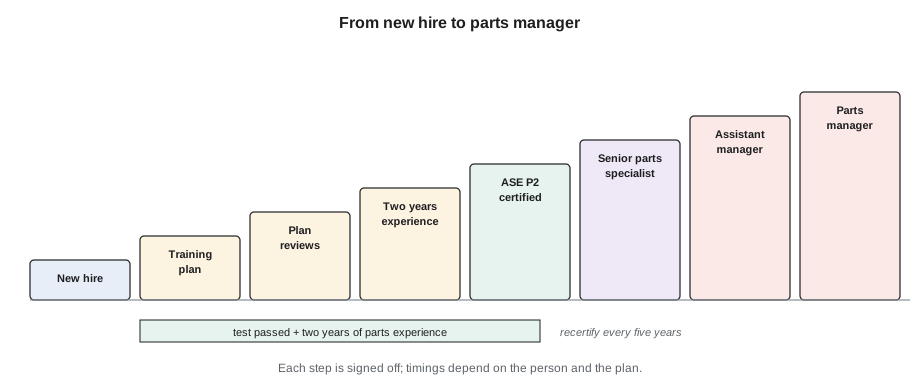
In the United States, there is no national license for parts work. The main credential is the ASE P2 Automobile Parts Specialist certification: the test has 75 scored questions (plus 10 unscored research questions) in 90 minutes, and full certification needs a passing score plus two years of parts experience, with recertification every five years. Employers can also register a formal apprenticeship. In Ohio, registered apprenticeship programs are approved through ApprenticeOhio, run by the Ohio Department of Job and Family Services with the Ohio State Apprenticeship Council. A registered program sets out the on-the-job learning, the related classroom instruction (federal guidance suggests at least 144 hours a year) and a wage schedule that rises as the apprentice progresses. Linmore uses a written training plan modeled on those standards rather than a registered program.
Rolf showed Imani how Talia's path was laid out:
| Stage | Typical timing | Main skills | Signed off by |
|---|---|---|---|
| Orientation and safety | First two weeks | Warehouse safety, hazard communication, forklift awareness, the counter system | Imani, Sasha |
| Front counter basics | Months 1 to 3 | Retail lookups, the price matrix, returns, cash and card | Imani |
| Warehouse rotation | Months 2 to 4 | Receiving, put-away, picking, cycle counts, shipping | Sasha |
| Back counter and service | Months 3 to 9 | Repair order requests, warranty parts, special orders | Imani, Priyanka |
| Wholesale and delivery | Months 6 to 12 | Wholesale accounts, phone orders, delivery runs | Rolf, Gideon |
| Training plan reviews | Every three months | Progress against the plan | Rolf |
| ASE P2 test | From September 2028 | All areas of the trade | ASE |
Support for apprentices and employers
Governments support apprenticeship with money as well as rules, and a manager should know what is available, because it changes the cost of training.
In the United States, federal and state grants for registered apprenticeship are delivered through state workforce agencies and change from year to year, and ASE certification costs are often paid by employers. Linmore pays Talia's ASE test fees and her study materials, and its office checks each year whether any current program applies to its training plan.
Rolf's rule was that incentives are a bonus, not a reason. "We hire an apprentice because we need a parts person in four years. If the government helps pay for it, good."
Training on the job
Most learning happens at the counter and in the warehouse, and a manager's job is to make it structured rather than accidental. Rolf's method has four steps, the same for every skill:
- Explain the task and why it matters, using a real example.
- Show it done properly, while the trainee watches.
- Let the trainee do it with the trainer watching and correcting.
- Check it later without the trainer present, and sign it off only when it is done correctly several times.
For counter skills, the department keeps short written procedures for the tasks people forget or do inconsistently: closing the cash drawer, receiving a core return, processing a warranty part, entering a lost sale. New staff use them as a checklist; experienced staff use them to settle arguments.
Imani asked how long a skill should take. Rolf said it depended on the person and the skill, and that the danger was rushing. He showed her a note from Talia's file: on November 10 her first drawer close was 10 dollars short because of an unrecorded refund on a clip. Rolf had treated it as a training point, not a failure. The procedure was updated to include a check of the refund log before counting, and Talia's next three closes balanced.
Training the whole team
Apprentices aren't the only people who need training. Rolf keeps a simple training matrix: a grid of every person against every skill and required course, with the date each was completed and when it must be renewed.
| Course or skill | Who needs it | Renewal |
|---|---|---|
| Forklift operator training and evaluation | Warehouse staff and anyone who drives the lift | At least every three years, by OSHA rule |
| Hazardous materials training | Receiving, shipping and the driver | At least every three years |
| Hazard communication | Everyone | Yearly review |
| Tessaro online parts courses | Counter staff | As new models launch |
| Electrified vehicle parts awareness | Everyone who handles high-voltage parts | As set by the maker |
| Customer service refresher | Counter staff | Yearly |
Training costs time as well as money. When Tessaro released its parts course for the Marlo EV, Rolf scheduled it for four counter staff in two groups, 8 hours each. At an average of 26.00 dollars an hour, the staff time alone cost 8 × 4 × 26.00 = 832.00 dollars, plus the cover for the counter. He scheduled it in the first half of November, before the first deliveries planned for December, rather than in the busy weeks of the tire change season.
The matrix also shows gaps. In October it showed that only two people could run the month-end core statement and only one could set up a new wholesale account in the system. Both became training goals for the winter.
Mentors and trainers
A trainer needs more than skill. Rolf chooses mentors who are patient, explain their reasons and admit their own mistakes. Imani had been Talia's mentor since September, and Rolf now wanted her to train the trainers: to help Teodor and Maribel teach Anouk, so that the department wasn't dependent on one person.
He gave Imani three rules for mentors. Ask the trainee to explain back what they learned, because explaining shows understanding. Correct mistakes privately and immediately, with the reason. And let the trainee meet real customers early, with support, because confidence comes from doing the job, not from watching it.
Preparing for Anouk
The last task of the session was Anouk's first two weeks. Imani drafted the plan with Rolf:
- Before day one: the offer letter, Form I-9 and tax forms; uniform and safety boots; system login.
- Day one, Monday, November 16: welcome from Walter, a tour with Talia (who had walked Anouk through the department on her pre-start visit on November 13), safety orientation with Imani, and an afternoon watching the front counter.
- First week: hazard communication and forklift awareness, the counter system on the training screen, and shadowing Teodor at the front counter.
- Second week: a day with Sasha in receiving, a morning on the back counter watching repair order requests, and her first retail sales with Imani beside her.
- End of week two: a short review with Rolf and Imani: what she has learned, what is confusing, and her goals for the first three months.
Anouk's training plan would follow the same stages as Talia's, with her first review at three months. "Two apprentices at once is a lot," Rolf said. "But in four years we'll have two parts people who learned it our way. That's the cheapest staffing plan there is."
Training for experienced staff
Rolf was careful to point out that training isn't only for new people. Teodor had fifteen years at the counter and knew more about older Tessaro models than anyone in the district, but he had never sold a part for a hybrid until the Vela Hybrid arrived. Maribel was the department's best phone salesperson and wanted to learn wholesale account management. Sasha had asked for training in the DMS reporting tools so that she could build her own receiving reports. Each of them had a training goal for the year, written in their review and funded from the department's training budget.
Experienced staff often learn best by teaching. When the department introduced the morning pre-pick, Rolf asked Teodor to write the procedure and train the others, because the technicians trusted him. Teaching made Teodor think about every step, and the procedure was better for it.
Measuring whether training works
A training plan is only useful if it changes how people work. Rolf measures it in three ways. First, by the sign-offs: each skill in the path is checked and dated. Second, by the work itself: accuracy, add-on rates and customer comments for the people trained. Third, by asking the trainees what helped and what didn't. After Talia's first two months, for example, her accuracy on electrical parts was 45 of 48 lines, about 94 percent, above the department's 92 percent target, and her add-on rate had risen steadily. Those numbers told Rolf the training path was working, and also that it was time to give her harder work.
The training budget
Training needs a budget, like any other expense. Rolf's budget for the coming year covers course fees, the in-school weeks for the apprentices, travel to the maker's training center, the vendor's DMS training day and the time of the trainers and trainees. He builds it from the training matrix: every course that will come due for renewal, every new skill on someone's goals, and every new product the department expects to sell. The total goes into the department's semi-fixed expenses (lesson 9), and Rolf defends it the same way he defends any other cost, by showing what it buys: fewer errors, faster service and people who stay.
Imani asked what happens when the budget is cut. Rolf said that the legally required courses, such as forklift and hazardous materials training, are never cut, because they are not optional. After that, he protects the apprentices' in-school training and the new-product courses first, because those keep the department able to sell what customers are buying. Conferences and optional courses wait for a better year.
Learning from mistakes without blame
Every trainee makes mistakes, and so does every experienced person. How the department responds decides whether people report mistakes or hide them. Rolf's rule is that an honest mistake, reported quickly, is a training opportunity, and the response is to fix the customer's problem first, then look at the process. Did the person know the procedure? Was the procedure clear? Did the system make the mistake easy? Most of the time the answer points to something the department can change, such as a confusing catalog note, a missing check step or a bin label in the wrong place.
Mistakes that are hidden are different. A wrong part put back on the shelf without a record, or a drawer difference covered up, does real damage, because the department can't fix what it doesn't know about. Rolf explains this to every trainee in their first week: tell us about mistakes, and you will never be in trouble for an honest one. Hide them, and you will be.
Talia's November 10 drawer difference was a good example. She reported it at once, helped find the cause, and suggested the change to the procedure herself. Rolf mentioned it at the Friday huddle as an example of the right way to handle a mistake, without naming the amount.
A training plan for the new assistant manager
Imani's own development needed a plan too. Rolf wrote one with her at the end of the session, using the same stages he used for apprentices: the knowledge she needed (the financial statement, the dealer agreement, employment rules), the skills to practice (scheduling, interviewing, reviewing performance, leading the Monday meeting), and the sign-offs, each by Rolf after watching her do it. She would also take the dealership group's short supervisor course in the winter and sit with Lucinda for a morning during the next month-end close. "Same method," Rolf said. "Explain, show, do, check. It works for managers too."
Common mistakes
MistakeLeaving apprentice training to whoever is free.
InsteadWrite a training path with stages, sign-offs and a named mentor.
MistakeSigning off a skill after seeing it done once.
InsteadCheck it later without the trainer and sign off only after several correct repetitions.
MistakeTreating an apprentice's mistake as a failure.
InsteadUse it to fix the procedure and coach the skill.
MistakeTracking training in people's memories.
InsteadKeep a training matrix with completion and renewal dates.
MistakeScheduling training in the busiest weeks.
InsteadPlan courses for quieter periods and before the knowledge is needed.
Summary and key terms
- In the United States, the ASE P2 certification needs a passing test and two years of experience; employers may also register apprenticeship programs, in Ohio through ApprenticeOhio.
- Government support for apprentices and employers changes often; check the current programs before each hire.
- On-the-job training works best as explain, show, let the trainee do it, then check later.
- A training matrix tracks every person's required courses and skills with renewal dates.
- Good mentors explain their reasons, correct privately and let trainees meet real customers early.
- Apprenticeship agreement
- A registered agreement between an apprentice and employer for training in a trade.
- Training matrix
- A grid of people against required skills and courses, with completion and renewal dates.
- Logbook
- The record of skills an apprentice has learned, signed off by the employer.
- Mentor
- An experienced employee responsible for guiding and checking a trainee.
- Sign-off
- Written confirmation that a trainee can perform a skill correctly on their own.
Practice problems
Work each problem on paper first, then reveal the answer to check.
A course takes 6 hours for 5 staff at 25.00 dollars an hour. What is the staff time cost?
Show answer
6 × 5 × 25.00 = 750.00 dollars.
List the four steps of Rolf's training method.
Show answer
Explain, show, let the trainee do it with correction, check later without the trainer.
Why should a manager train more than one person to do each critical task?
Show answer
So the department can cover absences and doesn't depend on one person.
What should a training matrix record?
Show answer
Each person, each required skill or course, the completion date and the renewal date.
Why does Rolf ask trainees to explain back what they learned?
Show answer
Explaining shows real understanding and reveals gaps.
Lesson quiz · 5 questions
Score 60% or more to complete this lesson.
Create a free account to save your progress, take quizzes and earn a certificate.