
APT-330 · Lesson 1 of 12 · 22 min
The parts department in the dealership or store
▶ Video coming soon A video version of this lesson is on the way.
In late September, Walter Bisset called Rolf Ingvaldsen into the general manager's office and closed the door. The Linmore group was growing. Tessaro had asked every dealer in the district to prepare for the electric Marlo, the sister store in Lancaster needed help, and Rolf had run the Morse Road parts department for many years without a deputy. "If you were off for a month," Walter asked, "who runs it?" They both knew the answer: Imani Grantham, the department's senior parts specialist, who already trained the apprentices and knew every account. Walter wanted her ready to step in as assistant parts manager in the new year.
Rolf agreed on one condition. Imani was the best counter person he had ever worked with, but running a department is a different job. So from early October, Rolf blocked two hours every Wednesday afternoon, 2 to 4 p.m., in the parts office. Imani covered the counter in the morning and spent those afternoons with Rolf, his files and his reports: the price matrix, the monthly financial statement, the staff schedule, the supplier agreements, the customer surveys. This course follows those sessions. Each lesson takes one part of the parts manager's job, shows how Rolf does it at Linmore Tessaro and why, and ends with what Imani took away.
The first session began with a question Rolf asked every new manager he had ever met: "Where does the parts department fit in this business, and how does it make money?"
Where parts sits in a dealership
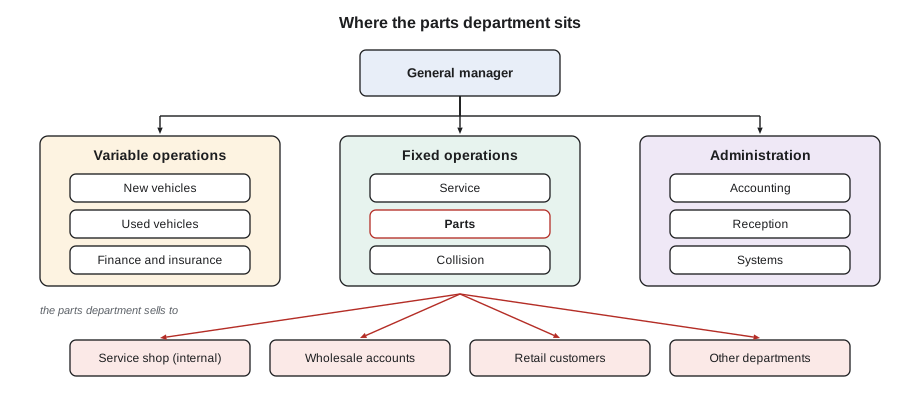
A franchised dealership is several businesses under one roof. Rolf drew the organization on the whiteboard, the way most dealers' financial statements divide it:
- Variable operations: new vehicle sales, used vehicle sales, and finance and insurance (F&I). Their sales rise and fall with the vehicle market, interest rates and the maker's supply.
- Fixed operations: service, parts and, at many dealers, a collision repair shop. Their work comes from the vehicles already on the road, so their income is steadier from month to month. The name is old dealer language; the income is not truly fixed, but it is much less sensitive to the sales cycle.
- Administration: the general manager, the accounting office, reception and the systems that serve every department.
Each department has a manager and its own line on the monthly financial statement. The parts manager usually reports to the general manager, or in larger groups to a fixed operations director who oversees both service and parts. At Linmore Tessaro, Rolf reports to Walter, and works side by side with Priyanka Rautela, the service manager, whose shop is the department's biggest customer.
Fixed operations matter far beyond their share of sales. A dealership earns most of its revenue from vehicle sales but a large share of its gross profit from service and parts, and that profit arrives every month whether or not vehicles are selling. Dealers track this with the fixed absorption rate: the gross profit of service and parts (and collision, where there is one) divided by the dealership's total overhead expenses, not counting the selling costs of the vehicle departments. At 100 percent, fixed operations cover all the overhead, and every vehicle sold adds profit. NADA's Dealer Academy reported a national average of about 64 percent in August 2025, and many dealers set 100 percent or more as a target.
Worked problem
Linmore Tessaro's absorption rate
Over the last 12 months, the Morse Road parts department earned 1,104,000 dollars of gross profit and the service department 1,690,000 dollars. The dealership's overhead expenses, excluding the variable selling costs of the vehicle departments, were 3,900,000 dollars. What is the fixed absorption rate?
Show solution
- Add the fixed operations gross profit: 1,104,000 + 1,690,000 = 2,794,000 dollars.
- Divide by overhead: 2,794,000 ÷ 3,900,000 = 0.716.
- Express as a percentage: about 71.6 percent.
Answer: About 72 percent. Service and parts cover almost three quarters of the overhead; the vehicle departments must cover the rest before the dealership makes a profit.
"That number is why Walter cares about this department," Rolf said. "When new vehicle sales dropped two winters ago, parts and service kept the lights on."
The department's three markets
Rolf turned to his own department's sales. Over the last 12 months it sold 4,944,000 dollars of parts, about 412,000 dollars in an average month, to three groups of customers:
| Market | Monthly sales (dollars) | Share of sales | Who buys |
|---|---|---|---|
| Internal (service and other departments) | 188,000 | 45.6 percent | Customer-pay repairs, warranty repairs, used vehicle reconditioning, shop supplies |
| Wholesale | 147,000 | 35.7 percent | Independent garages, body shops and fleets on account, such as Bramhall Auto Service and Orland Courier |
| Retail | 77,000 | 18.7 percent | Walk-in, phone and online customers who pay at the counter |
Each market has its own prices, costs and risks, and a manager watches each one separately:
- Internal sales go onto repair orders. Customer-pay repairs are priced by the dealership; warranty and recall parts are paid by the maker under its warranty rules (lesson 7); reconditioning parts for used vehicles are charged to the used vehicle department, usually at a small markup. The parts department's speed decides how many hours the technicians can bill.
- Wholesale sales go to other repair businesses at a discount from list price, often with delivery and monthly statements. Wholesale volume is large but margins are thin, and it carries credit risk.
- Retail sales carry the highest margins but the smallest volume, and need the most counter time per dollar sold.
Imani knew all three markets from the counter. What she had not seen was how differently they earned money. "I sell Corinne a set of pads and I sell Gordon the same set," she said. "Corinne's ticket is bigger every week. Gordon's makes us more money." Rolf smiled. "That's lesson 2."
Dealership parts and aftermarket stores
The Linmore group runs both kinds of parts business, and Rolf wanted Imani to understand how they differ, because she would meet managers from both.
- A dealership parts department sells the maker's genuine parts, plus some aftermarket lines. It buys most of its stock from the maker's parts distribution center (PDC) under the dealer agreement, which sets stocking, ordering, return and warranty rules. Its biggest customer is its own service shop, and its catalog is the maker's electronic parts catalog.
- An aftermarket parts store, like Linmore Parts Supply, sells parts from many brands for many makes. It buys from a warehouse distributor or a buying group, which buys from the manufacturers. This chain is often described as manufacturer, warehouse distributor, jobber store, installer. The store's main customers are independent garages and do-it-yourself drivers, and it competes on availability, delivery speed and price.
Many large aftermarket chains now own their own distribution centers and stores, and some sell online directly to drivers. Dealers, in turn, have grown their wholesale business to compete with them, using the maker's programs and their own delivery vans. The two kinds of business compete for the same independent garage, which is why Corinne Ferraby at Bramhall Auto Service buys from both.
| Dealership parts department | Aftermarket store | |
|---|---|---|
| Main supplier | The maker's parts distribution center | A warehouse distributor or the chain's own center |
| Main product | Genuine parts for one or a few makes | Many brands for many makes |
| Biggest customer | Its own service shop | Independent garages |
| Rules set by | The dealer agreement and maker programs | The store owner, chain or buying group |
| Typical strength | Exact fit, warranty work, new models | Choice, price range, coverage of older vehicles |
What the parts manager is responsible for
Rolf's job description ran to two pages. He summed it up for Imani in six areas, which became the plan for their sessions:
- Sales and gross profit. Setting prices, discounts and targets, and watching the reports that show whether they are met (lessons 2 and 3).
- People. Hiring, scheduling, paying, training and leading the staff, including apprentices (lessons 4 and 5).
- Inventory. Keeping the right parts in stock at the lowest investment, covered in APT-210, plus the supplier programs that support it (lesson 6).
- Internal customers. Supporting the service shop and other departments (lesson 7).
- External customers. Keeping retail and wholesale customers satisfied and loyal (lesson 8).
- Money and controls. Reading the department's financial statement, protecting its assets, meeting the maker's audits and keeping its policies (lessons 9 and 10), and choosing the technology that does all of it faster (lesson 11).
Lesson 12 brings all six together in the hardest test of a manager: turning around a department that has fallen behind.
A day in the manager's chair
On the first Wednesday, Rolf printed his own calendar for the previous week so that Imani could see where a parts manager's time goes. It looked nothing like a counter person's day:
- Every morning, 7:30: the daily report. Yesterday's sales and gross profit by market, special orders due, emergency orders placed, any lost sales recorded, and the cash and credit card reconciliation from the evening close.
- Monday, 8:15: the parts and service meeting with Priyanka. Parts holding up repair orders, warranty parts waiting to be returned, and the week's big jobs.
- Tuesday: the stock order review on the order day, and two supplier calls.
- Wednesday: a wholesale account visit with Gideon on the delivery run, and the afternoon session with Imani.
- Thursday: the staff schedule for the next two weeks, a performance conversation, and approving credit memos and price overrides.
- Friday: Walter's managers' meeting, the weekly sales pace against target, and a walk through the warehouse with Sasha.
"Notice what's missing," Rolf said. "I'm behind the counter maybe five hours a week, when we're short or when a customer asks for me. If the manager is always at the counter, nobody is doing the manager's job." Imani admitted that was the part she found hardest to picture. She liked the counter, and she was good at it.
Rolf told her that most new managers struggle with the same thing. The skills that make someone a great parts person, speed, product knowledge, a good memory for customers, are the starting point, but the job now depends on getting work done through other people and on decisions made with numbers. Her task in the coming months was not to stop being good at the counter; it was to make the whole team as good as she was.
Measuring the department
Before they finished, Rolf listed the measures he reported every month, most of which Imani had met in APT-210. The full set is the subject of lesson 3, but the core is short:
- Sales and gross profit by market, against target and against the same month last year.
- Gross profit margin: gross profit divided by sales. Over the last 12 months, 1,104,000 ÷ 4,944,000 = 22.3 percent.
- Inventory turns and gross margin return on inventory (GMROI): 6.0 turns and 1.725 dollars of gross profit for each dollar of average inventory.
- Fill rate: 371 of 412 requests filled from stock in the last sample, 90 percent against a target of 92.
- Expenses and net departmental profit, from the financial statement (lesson 9).
- Customer satisfaction from the maker's surveys and the department's own complaint log (lesson 8).
"Our margin looks low next to some departments," Rolf added, "because more than a third of our sales are wholesale. A department that sells mostly to its own shop and to retail customers will show a higher margin. Always ask what's behind the number before you compare it."
Rolf also pointed out how many dollars each person in the department handles. With eight people after Anouk Mendelsohn starts as the second apprentice, 4,944,000 dollars of annual sales works out to 618,000 dollars per person. Makers and dealer groups often compare sales per employee between stores, and a low figure can point to too many staff, a weak market or slow processes. A high figure can mean the team is efficient, or that it is stretched too thin and customers are waiting. The number starts a conversation; it doesn't end one.
The aftermarket store's manager
To show the contrast, Rolf asked Imani to spend an hour at Linmore Parts Supply before the next session and talk with its store manager about his week. She came back with a list. The store manager spent much more time on outside sales calls to independent garages, watched his delivery times by the minute, and compared his prices every week with two competing chains. He had no service shop of his own to support, so every sale had to be won from a customer who could just as easily call someone else. His suppliers ran buying programs with volume rebates, and his stock was set partly by his warehouse distributor's recommendations for a store of his size.
"Same trade, different business," Imani said. "He worries about the garage down the street switching to a chain. You worry about Priyanka's technicians standing at the counter." Rolf agreed. "And both of us worry about the money tied up on the shelves."
The two managers also shared more than she expected. Both were judged on gross profit, not just sales. Both had to keep staff trained on new vehicles and new systems. Both lived with the same customer expectation, that the right part would be there today. And both had owners who read the monthly statement line by line.
What Imani took away
At the end of the first session, Rolf asked Imani to write down three things she would do differently as a manager. She wrote: read the daily report before talking to anyone; know which market every sale comes from; and stop answering every question at the counter herself, so that the counter staff learn to answer them. Rolf kept the note in her training file. It was the first page of what would become, by mid-November, a thick binder of her own.
Common mistakes
MistakeTreating the parts department as a stockroom that only serves the service shop.
InsteadManage it as a business with three markets, each with its own prices, costs and risks.
MistakeComparing gross margin with another department without asking about its sales mix.
InsteadCheck the share of wholesale, internal and retail sales before drawing conclusions.
MistakeSpending the manager's whole day at the counter.
InsteadPlan time for reports, people, suppliers and customers, and build a team that can run the counter.
MistakeAssuming an aftermarket store and a dealership department are run the same way.
InsteadLearn each one's suppliers, rules and customers before giving advice.
MistakeIgnoring the fixed absorption rate.
InsteadKnow how much of the dealership's overhead service and parts cover, because the general manager does.
Summary and key terms
- A franchised dealership has variable operations (vehicle sales, F&I), fixed operations (service, parts, collision) and administration.
- The fixed absorption rate compares fixed operations gross profit with the dealership's overhead; 100 percent means they cover it all.
- A parts department sells to three markets, internal, wholesale and retail, with different margins and risks.
- Dealership departments buy genuine parts from the maker's PDC under the dealer agreement; aftermarket stores buy many brands through warehouse distributors.
- A parts manager is responsible for sales and gross profit, people, inventory, internal customers, external customers, and money and controls.
- Fixed operations
- The service, parts and collision departments of a dealership, whose income comes from vehicles already on the road.
- Variable operations
- The new vehicle, used vehicle and finance and insurance departments.
- Fixed absorption rate
- Service and parts (and collision) gross profit divided by dealership overhead, as a percentage.
- Parts distribution center (PDC)
- A maker's warehouse that supplies parts to its dealers.
- Warehouse distributor
- An aftermarket business that buys from parts manufacturers and supplies jobber stores.
- Sales mix
- The share of a department's sales that comes from each market.
Practice problems
Work each problem on paper first, then reveal the answer to check.
Service and parts earned 2,400,000 dollars of gross profit and dealership overhead was 3,000,000 dollars. What is the absorption rate?
Show answer
2,400,000 ÷ 3,000,000 = 0.80, or 80 percent.
Name the three markets of a dealership parts department.
Show answer
Internal (service and other departments), wholesale and retail.
Why are fixed operations valuable to a dealer when vehicle sales fall?
Show answer
Their work comes from vehicles already on the road, so their gross profit is steadier and helps cover overhead.
A department sells 3,600,000 dollars a year with six staff. What are sales per employee?
Show answer
3,600,000 ÷ 6 = 600,000 dollars.
Who usually supplies an aftermarket jobber store?
Show answer
A warehouse distributor or the chain's own distribution center, which buys from the manufacturers.
Lesson quiz · 5 questions
Score 60% or more to complete this lesson.
Create a free account to save your progress, take quizzes and earn a certificate.