
APT-330 · Lesson 4 of 12 · 21 min
Managing parts staff
▶ Video coming soon A video version of this lesson is on the way.
The fourth session began with a hiring file. In October, Linmore Tessaro had advertised for a second parts associate on a training plan, interviewed four people, and hired Anouk Mendelsohn, who would start on the counter on Monday, November 16. Imani had sat in on two of the interviews. Now Rolf opened the folder and walked her through everything in it, from the job posting to the first day's paperwork. "Most of a manager's problems," he said, "are people problems. And most people problems start with who we hired, how we trained them, or what we never told them."
The parts department's team
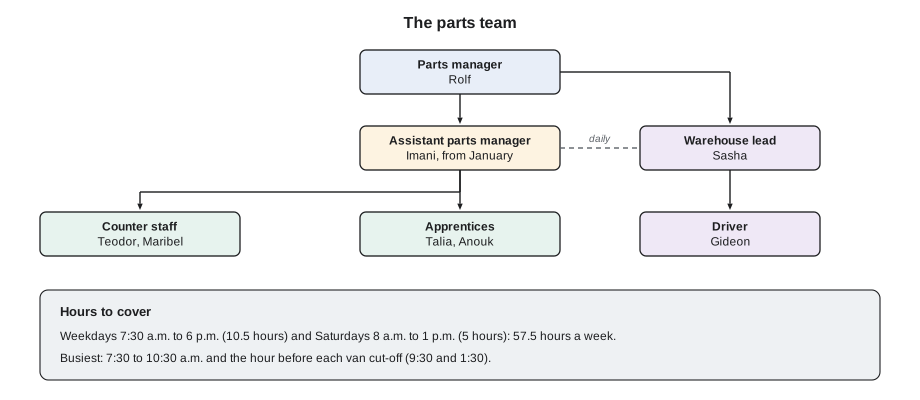
With Anouk, the Morse Road department has eight people. Rolf drew the structure for Imani, with her future role in it:
- Parts manager (Rolf): responsible for the whole department.
- Assistant parts manager (Imani, from the new year): runs the counter team day to day, leads training, approves routine credits and overrides, and stands in for the manager.
- Counter staff (Teodor Vasko and Maribel Quist on the front and back counters, with Imani): retail, wholesale and service requests.
- Warehouse lead (Sasha Esparza): receiving, shipping, put-away, cycle counts and returns.
- Driver (Gideon Achebe): wholesale deliveries and pickups.
- Apprentices (Talia Brankovic and, from November 16, Anouk): learning the trade on a structured plan (lesson 5).
Every role has a written job description: the purpose of the job, its main duties, who it reports to, the skills and credentials needed, and the measures used to judge it. Rolf rewrites each one when the job changes. Talia's description, for example, was updated in October to include back counter work after her first day there.
Hiring
Rolf hires for attitude and trains for knowledge. A parts person needs to be accurate, curious, calm with impatient customers and willing to learn systems; most of the part knowledge can be taught. His hiring process has five steps.
- Define the job. Update the job description and decide the pay range before advertising.
- Advertise. Post the job on the dealership's site and job boards, and ask the trade school and staff for referrals.
- Screen and interview. A short phone screen, then an interview with Rolf and one team member, using the same questions for every candidate and a simple scoring sheet.
- Test the basics. A short practical exercise: find three parts in a printed catalog page, add up an invoice, and explain a return policy to a pretend customer.
- Check and offer. Reference checks with the candidate's permission, then a written offer.
Employment law sets rules for every step, and the dealership's human resources adviser checks each posting before it goes out.
In the United States, federal laws such as Title VII of the Civil Rights Act, the Age Discrimination in Employment Act and the Americans with Disabilities Act prohibit discrimination in hiring, and the Equal Employment Opportunity Commission enforces them. Ohio has its own civil rights law with similar protections. Ohio has no statewide rule requiring pay ranges in job postings, but the City of Columbus, where Linmore Tessaro sits, has banned questions about an applicant's salary history since March 1, 2024, for employers with 15 or more employees in the city. Employers may still ask about the pay an applicant expects. Every new employee must complete the federal Form I-9 to confirm they are allowed to work in the United States.
Anouk's posting showed the pay range, described the training plan, and listed the hours, including one Saturday in three. Rolf kept the scoring sheets for all four candidates in the file. "If anyone ever asks why we chose her," he said, "the answer is written down, and it's about the job."
Hours, overtime and pay
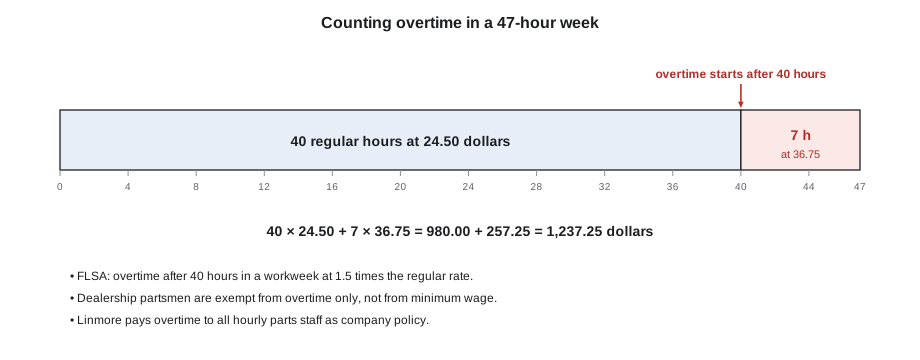
A parts department is open longer than any one person works. Linmore's parts counter opens at 7:30 a.m. and closes at 6 p.m. on weekdays, and opens 8 a.m. to 1 p.m. on Saturdays, a total of 10.5 × 5 + 5 = 57.5 hours a week. Each of those hours needs at least two people at the front counter and one at the back during the busy morning, which means overlapping shifts and a rotation for Saturdays and holidays.
Pay and hours follow employment standards law, and the manager is the person who has to know the rules.
Under the federal Fair Labor Standards Act (FLSA), employees must be paid at least the minimum wage and, unless exempt, overtime at one and a half times the regular rate for hours over 40 in a workweek. Ohio's minimum wage for non-tipped employees is 11.00 dollars an hour in 2026, above the federal 7.25. Ohio's overtime law follows the FLSA's rules and exemptions. The FLSA has a specific exemption from overtime, not from minimum wage, for salespeople, partsmen and mechanics primarily engaged in selling or servicing vehicles at a dealership that sells vehicles to ultimate purchasers. Department of Labor guidance and recent court decisions apply it to dealership employees whose main job is selling, stocking or issuing parts. The exemption doesn't apply to an aftermarket store like Linmore Parts Supply, which doesn't sell vehicles. The Linmore group chooses to pay overtime to all of its hourly parts staff as a matter of company policy, which is allowed, since the law sets a minimum.
Worked problem
A week with overtime
In one busy week in October, Gideon worked 47 hours at his regular rate of 24.50 dollars an hour. What was his pay for the week under the overtime rule that applies at Morse Road?
Show solution
- Overtime rate = 24.50 × 1.5 = 36.75 dollars an hour.
- Under Linmore's policy, overtime starts after 40 hours: 47 − 40 = 7 overtime hours.
- Regular pay = 40 × 24.50 = 980.00 dollars. Overtime pay = 7 × 36.75 = 257.25 dollars.
- Total = 980.00 + 257.25 = 1,237.25 dollars.
Answer: 1,237.25 dollars. A schedule that keeps regular weeks at or under 40 hours avoids overtime except in true peaks.
Rolf's pay plan for counter staff is an hourly wage plus a monthly bonus tied to the department's gross profit, not to individual sales, so that the counter shares customers and helps each other rather than competing for tickets. The warehouse lead's bonus includes inventory accuracy and order accuracy. Bonuses are explained in writing, so that everyone knows how they are calculated.
Scheduling the counter
Rolf builds the schedule two weeks ahead, and posts it so staff can plan their lives. He follows four rules:
- Cover the peaks. The busiest hours are 7:30 to 10:30 a.m., when technicians start their jobs and garages place their first orders, and the hour before each van cut-off. Breaks are scheduled outside those hours.
- Rotate the hard shifts fairly. Saturdays, early opens and late closes rotate on a written pattern; swaps are allowed with the manager's approval.
- Keep a trained person on every position. Each shift needs someone who can do the back counter, someone who can close the cash drawer and someone with hazardous materials and forklift training on site.
- Plan for absence. Vacations are booked early, and each person is cross-trained on at least one other position, so that one sick day doesn't stop the department.
Imani's first real scheduling job was the December holiday period, when half the staff wanted the same week off. Rolf's rule was first come, first served, with the requests in writing, and a promise that whoever missed out this year would have first choice next year.
Leading the team
Rolf described his approach to leading people in a few habits:
- Set clear expectations. Every person knows their duties, their measures and the department's standards, such as greeting a waiting customer within 30 seconds and scanning every part.
- Give feedback often. Short, specific comments when they happen, good and bad, rather than saving everything for the annual review.
- Hold regular one-to-one meetings. Fifteen minutes with each person every month, about their work, their goals and anything getting in the way.
- Review performance formally once a year, using the job description's measures and the person's own goals for the next year.
- Deal with problems early and in private. A first conversation, then a written warning if needed, with dates and facts, following the dealership's policy. Discipline is about the behavior, not the person.
- Recognize good work in public. Rolf mentions specific results at the Friday team huddle, such as Sasha's crew putting away 131 of 140 stock order lines by 2:30 on the fire drill day.
He also told Imani the hardest part of becoming a manager in her own department: the people she would lead had been her peers the week before. Rolf's advice was to say so openly, to keep the friendships but not the favors, and to make every decision the same way she would for someone she didn't know.
Safety, respect and the manager's duties
A supervisor has legal duties for the safety of the people they direct.
Under the federal Occupational Safety and Health Act, the employer must provide a workplace free from recognized hazards and follow OSHA's standards, such as those for forklifts, hazard communication and walking and working surfaces. Supervisors carry out those duties day to day: training workers, enforcing the rules and correcting hazards. Federal and Ohio civil rights laws require employers to prevent and respond to harassment, and the dealership's policy sets out how to report and investigate it. The dealership's safety committee, which Imani already sits on, inspects the workplace and makes recommendations.
Rolf's view was that safety and respect are managed the same way as sales: with clear rules, training, regular checks and quick action when something goes wrong. A manager who walks past a forklift being driven too fast, or a joke that makes someone uncomfortable, has just set the department's real standard.
Keeping good people
Replacing a trained parts person is expensive. Rolf estimated the cost of losing an experienced counter person at about a quarter of a year's pay, counting the time to hire, the trainer's time, the new person's slower first months and the mistakes along the way. On a salary of 46,000 dollars, that is 46,000 × 0.25 = 11,500 dollars, before counting the customers who follow a familiar voice to another store. Rolf keeps people by paying fairly for the market, giving them a path to grow (lesson 5), scheduling fairly, and listening at the one-to-one meetings. When someone does leave, he asks for an honest exit interview and writes down what he learns.
Onboarding and the first ninety days
Hiring well is wasted if the first weeks go badly. Many new employees decide within their first few months whether they will stay. Rolf's onboarding plan for every new hire has three check-ins: at the end of the first week, the first month and the third month. At each one he asks the same questions. What has been easier than you expected? What has been harder? What do you need that you haven't got? And is the job what we said it would be? The answers have led to real changes, such as a quieter training desk and a printed list of the department's most-used part numbers for new staff.
The first ninety days are also when the new employee learns the department's real standards, by watching what everyone else does. That is why Rolf pairs new staff with the people who do the job best, not with whoever happens to be free.
Absence, lateness and leaves
Every department has people who are sometimes sick, late or away for family reasons. The manager's job is to apply the dealership's attendance policy fairly, to keep records, and to know which absences are protected by law. The federal Family and Medical Leave Act gives eligible employees at larger employers up to 12 weeks of unpaid, job-protected leave a year for certain family and medical reasons, and the Americans with Disabilities Act may require reasonable accommodation for a disability. Rolf's advice was simple: never discipline someone for an absence before checking whether it is protected, and ask the dealership's human resources adviser whenever a situation is unclear.
Lateness at a parts counter matters more than in many jobs, because the 7:30 a.m. opening is when technicians and garages need parts most. Rolf deals with it early, privately and with facts: the dates, the times and the effect on the team. Most lateness, he has found, has a cause that can be solved, such as a bus schedule or a child care change, and a small change to a start time can solve it.
Common mistakes
MistakeHiring the candidate with the most part knowledge without checking attitude and accuracy.
InsteadHire for reliability, accuracy and customer skills; part knowledge can be trained.
MistakeAsking interview questions about personal matters unrelated to the job.
InsteadUse the same job-related questions for every candidate and record the scores.
MistakeAssuming overtime rules are the same everywhere.
InsteadKnow the threshold, the exemptions and the company's own policy where you work.
MistakeScheduling breaks during the morning peak.
InsteadBuild the schedule around the busiest hours and the van cut-offs.
MistakeSaving all feedback for the annual review.
InsteadGive short, specific feedback often, and deal with problems early and in private.
Summary and key terms
- Each role needs a current job description with duties, reporting line, skills and measures.
- Hiring follows a consistent process and must meet employment and human rights law, including posting rules where they apply.
- Under the FLSA, overtime starts after 40 hours a week at one and a half times the regular rate, with a partsman exemption at dealerships; Ohio minimum wage is 11.00 dollars in 2026.
- Schedules cover the peak hours, rotate hard shifts fairly, keep a trained person on every position and plan for absence.
- Managers lead through clear expectations, frequent feedback, regular one-to-ones, fair discipline and attention to safety and respect.
- Job description
- A written statement of a role's purpose, duties, reporting line, required skills and measures.
- Overtime
- Hours worked beyond the legal or policy threshold in a work week, paid at a higher rate.
- One-to-one meeting
- A regular private meeting between a manager and one employee.
- Exit interview
- A conversation with a departing employee about why they are leaving and what could be better.
- Cross-training
- Training an employee to do a second position so the department can cover absences.
Practice problems
Work each problem on paper first, then reveal the answer to check.
An employee works 50 hours at 22.00 dollars an hour. What is the week's pay with overtime after 40 hours?
Show answer
40 × 22.00 = 880.00; 10 × 33.00 = 330.00; total 1,210.00 dollars.
A department is open 7:30 a.m. to 5:30 p.m. weekdays and 8 a.m. to noon on Saturdays. How many hours a week is it open?
Show answer
10 × 5 + 4 = 54 hours.
What does the Columbus salary history ordinance prohibit?
Show answer
Asking applicants about their past pay, screening them on it, or relying solely on it to set pay, for employers with 15 or more employees in the city.
Losing an employee is estimated to cost a quarter of a 44,000 dollar salary. What is the cost?
Show answer
44,000 × 0.25 = 11,000 dollars.
Why does Rolf base counter bonuses on department gross profit?
Show answer
So the team shares customers and helps each other rather than competing for individual sales.
Lesson quiz · 5 questions
Score 60% or more to complete this lesson.
Create a free account to save your progress, take quizzes and earn a certificate.