
APT-120 · Lesson 8 of 12 · 24 min
Fasteners, bearings and seals
▶ Video coming soon A video version of this lesson is on the way.
On Wednesday, October 14, Gideon Achebe came back from a delivery run with a request from an independent garage and a sandwich bag. Inside were a bolt with a rounded head, a sealed bearing with a cracked shield, and a torn oil seal. "They need one of each," he said, "and they don't know what car the bearing came off. It's from a customer's trailer." Imani tipped the bag onto the counter. "These three you don't look up by vehicle," she said. "You look them up by what they are. Every one of them has its size written on it, or you can measure it."
Fasteners, bearings and seals are among the most common parts sold at any counter, and among the most often sold by specification rather than by vehicle. A bolt is identified by its thread, length and strength; a bearing by its standard number; a seal by its three dimensions and type. This lesson explains how to read and identify each, and when a vehicle-specific part is still needed. Lesson 10 covers the measuring tools.
Bolts, screws and nuts
A bolt is a threaded fastener meant to be used with a nut, and a screw threads into a part, but at the parts counter the words are often used loosely. Either way, a threaded fastener is described by:
- the thread system and diameter, such as metric M10 or inch 3/8 in;
- the pitch, which is the distance between threads in millimeters for metric threads, or the number of threads per inch for inch threads;
- the length, measured from under the head to the tip for most heads, and overall for countersunk heads;
- the strength grade or property class;
- the head style and drive, such as hex, flange, socket head, six-lobe or Phillips; and
- the finish, such as plain, zinc-plated or coated.
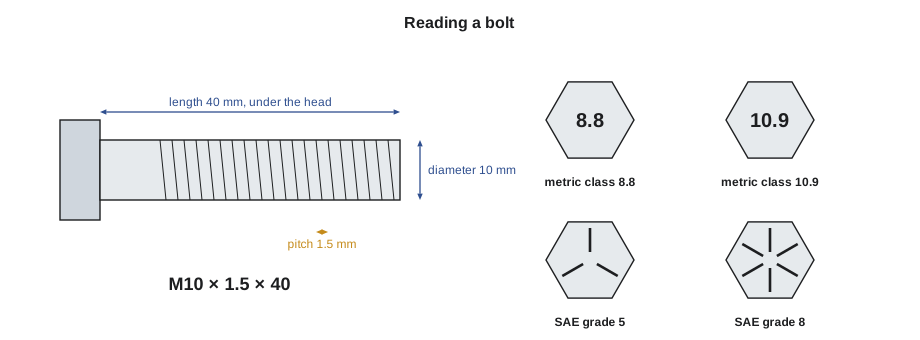
Metric fasteners are written as diameter × pitch × length in millimeters. M10 × 1.5 × 40 is a bolt 10 mm in diameter with threads 1.5 mm apart and 40 mm long. Inch fasteners are written as diameter, threads per inch and length: 3/8-16 × 1-1/2 is 3/8 inch in diameter, 16 threads per inch and 1-1/2 inches long. Almost every modern car and light truck uses metric fasteners; inch fasteners are still common on older North American vehicles, trailers, heavy trucks, farm equipment and industrial machinery.
Coarse and fine threads
Most diameters come in a coarse and one or more fine pitches. For metric threads, the coarse pitch is the standard one and is often left out of the description: M10 means M10 × 1.5 unless a finer pitch is stated. M10 × 1.25 is a fine thread. Inch threads use the Unified system: UNC for coarse and UNF for fine. A 3/8 inch bolt is 3/8-16 UNC or 3/8-24 UNF.
| Size | Coarse pitch | Common fine pitch |
|---|---|---|
| M8 | 1.25 mm | 1.0 mm |
| M10 | 1.5 mm | 1.25 mm |
| M12 | 1.75 mm | 1.25 or 1.5 mm |
| 5/16 in | 18 threads per inch (UNC) | 24 threads per inch (UNF) |
| 3/8 in | 16 (UNC) | 24 (UNF) |
| 1/2 in | 13 (UNC) | 20 (UNF) |
Coarse and fine threads of the same diameter do not interchange. A fine-thread bolt forced into a coarse-thread hole destroys both threads. And an inch bolt and a metric bolt of similar size, such as 3/8 in and M10, are close enough to start by hand and different enough to strip. A thread pitch gauge settles the question in seconds (lesson 10).
Strength: property classes and grades
Fasteners are made in several strengths, and using a weaker fastener than the original can be dangerous, especially in suspension, steering, brakes and engines. Strength is marked on the head:
- Metric bolts carry a property class number, such as 8.8, 10.9 or 12.9, under the international standard ISO 898-1. The first number is one hundredth of the minimum tensile strength in megapascals, so 8.8 means at least 800 MPa and 10.9 at least 1,000 MPa. The second number, after the point, is the ratio of yield strength to tensile strength, so an 8.8 bolt yields at about 0.8 × 800 = 640 MPa.
- Inch bolts in North America carry SAE J429 grade marks as radial lines on the head: no lines for grade 2, three lines for grade 5, and six lines for grade 8. Grade 8 is the strongest of the three.
- Nuts have their own classes and marks, and a high-strength bolt needs a nut of matching class: a class 10 nut with a 10.9 bolt, for example.
Worked problem
Identifying the bolt in the bag
The bolt in Gideon's bag measures 10 mm across the threads, the pitch gauge fits the 1.25 mm leaf, it is 35 mm long under the head, and the head is stamped 10.9 with a flange. How should Talia describe it, and what nut does it need?
Show solution
- Diameter and pitch: M10 with a fine 1.25 mm pitch.
- Length: 35 mm under the head.
- Strength: property class 10.9, minimum tensile strength 1,000 MPa.
Answer: It is an M10 × 1.25 × 35 flange bolt, class 10.9, and it needs a class 10 nut of the same thread. Selling a class 8.8 bolt, or a coarse-thread M10, would be wrong even though both would look similar.
One-time and special fasteners
Some fasteners must not be reused. Torque-to-yield bolts, common for cylinder heads, connecting rods, crankshaft pulleys and some suspension joints, are tightened past their yield point so that they stretch slightly and clamp evenly; once stretched, they are replaced. Prevailing-torque nuts with nylon inserts or deformed threads, self-locking bolts with pre-applied thread locker, and some stretch bolts are also single-use. Catalogs mark them with notes such as "single use" or "replace when removed" (lesson 4), and the service information lists them in the repair procedure.
When a technician orders a part held on by one-time fasteners, the parts technician offers the fasteners too. A head gasket without new head bolts, or a hub without its axle nut, means a second trip and an unhappy technician. Wheel studs, lug nuts, special clips and push pins are usually vehicle-specific and are looked up in the catalog rather than by size.
Bearings
A bearing supports a rotating shaft or wheel and reduces friction. The main types sold at a parts counter are:
- Ball bearings, with balls between an inner and an outer ring. The deep-groove ball bearing is the most common bearing in the world, found in alternators, idler pulleys, electric motors and many industrial machines.
- Roller bearings, with cylindrical rollers, which carry heavier radial loads.
- Tapered roller bearings, with tapered rollers that carry both radial loads and thrust. They are used in wheel hubs, differentials and trailer axles, and are sold as a cone (the inner ring with the rollers) and a cup (the outer ring), separately or as a matched set.
- Needle bearings, with thin rollers, used where space is tight.
- Hub assemblies, common on modern cars, which combine the bearings, the hub flange and often the wheel speed sensor in one sealed unit. These are vehicle-specific and are looked up by VIN.
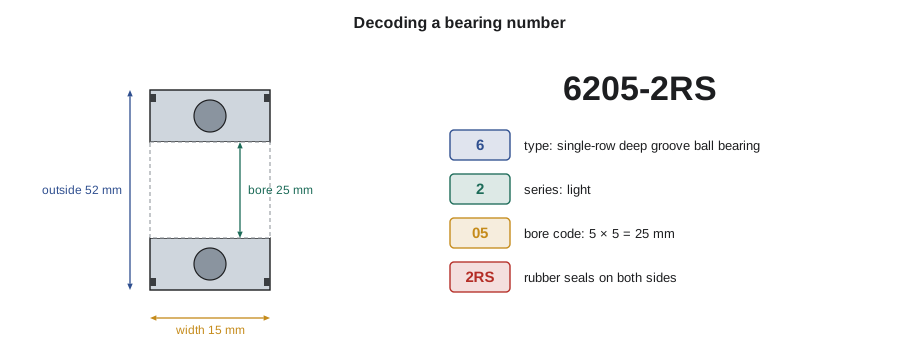
Standard ball and roller bearings follow an international numbering system based on ISO dimension series, and most bearing makers use the same basic numbers. For a deep-groove ball bearing such as 6205:
- the first digit, 6, is the bearing type: a single-row deep-groove ball bearing;
- the second digit, 2, is the dimension series, which sets the outside diameter and width for a given bore; the 2 series is lighter than the 3 series;
- the last two digits, 05, are the bore code. For codes 04 and up, the bore in millimeters is the code times 5, so 05 means 25 mm. Codes 00, 01, 02 and 03 mean 10, 12, 15 and 17 mm.
Suffixes after the number describe seals, shields, clearance and other features: 2RS or a similar code means rubber seals on both sides, ZZ or 2Z means metal shields on both sides, and codes such as C3 mean greater internal clearance than normal, often used where the bearing runs hot. Suffix codes differ between bearing makers, so the parts technician checks the brand's code list.
Worked problem
The trailer bearing
The bearing in Gideon's bag is marked 6205-2RS on its outer ring, though one seal is cracked. Talia measures it to check: bore 25.00 mm, outside diameter 52.00 mm, width 15.00 mm. Does the measurement agree with the number, and what should she sell?
Show solution
- Bore code 05:
- \[5 \times 5 = 25\ \text{mm}\]
- A 6205 is 25 mm bore, 52 mm outside diameter and 15 mm wide, which matches the measurement.
Answer: The measurement confirms the number. Talia sells a 6205-2RS, sealed both sides, which suits a trailer wheel exposed to water and dirt. A 6205-ZZ with shields would fit the same space but seal less well, so she would sell it only if the customer specifically wanted it.
Seals
Seals keep lubricants in and dirt and water out. The ones most often sold at a counter are:
- Radial lip seals, also called oil seals or shaft seals, which seal around a rotating shaft, such as crankshaft, axle, wheel and transmission seals. They are described by three dimensions, shaft diameter × bore diameter × width, such as 35 × 52 × 7 mm, and by their type: single or double lip, with or without a spring, and the lip material.
- O-rings, described by their inside diameter and cross-section, such as 20 × 2.5 mm, and their material. Inch O-rings often use standard dash numbers.
- Gaskets, which seal between two flat surfaces, such as a valve cover or water pump gasket. These are almost always vehicle-specific and looked up in the catalog.
Seal materials matter as much as size. Nitrile rubber is the common general-purpose material for oil. Fluoroelastomer (FKM) handles higher temperatures and some fuels, silicone handles high and low temperatures but not much wear, and PTFE is used for some high-speed crankshaft seals. A seal of the right size in the wrong material may fail quickly. When the old seal's material is unknown, the vehicle-specific seal from the catalog is the safer choice.
Worked problem
Identifying a seal by size
The torn oil seal from the garage measures 35.0 mm inside, 52.0 mm outside and 7.0 mm wide. It has a single lip with a garter spring and a small dust lip, and the old seal is nitrile. How should Talia describe the replacement?
Show solution
- Shaft × bore × width:
- \[35 \times 52 \times 7\ \text{mm}\]
- Type: double lip (main lip with spring plus dust lip); material: nitrile.
Answer: A 35 × 52 × 7 mm double-lip spring-loaded seal in nitrile. Seal makers' catalogs list seals by these three dimensions, so the size, type and material are enough to find an equivalent from stock.
When to look up by vehicle and when by specification
Fasteners, bearings and seals can be sold either way, and the parts technician chooses the safer route for each case:
| Situation | Look up by | Why |
|---|---|---|
| Vehicle known, catalog lists the part | Vehicle (VIN) | Gets special sizes, coatings and one-time fasteners right |
| Vehicle unknown, part has a clear standard number | Specification | Standard bearings and seals interchange by number |
| Industrial or trailer equipment | Specification | Parts are usually standard sizes |
| Safety-critical fastener, grade unknown | Vehicle or ask the technician | Grade and coating must match the original |
| Hub assembly, wheel stud, gasket | Vehicle (VIN) | These are vehicle-specific |
Gideon delivered the bolt, the bearing and the seal to the garage that afternoon. Imani's note on the invoice read: "M10 × 1.25 × 35 flange 10.9; 6205-2RS; seal 35 × 52 × 7 nitrile, double lip." The next time the garage needed the same parts, it could order them by the invoice.
Washers, nuts and locking devices
Fasteners rarely work alone. Flat washers spread the load under a bolt head or nut; spring and toothed lock washers resist loosening; prevailing-torque nuts, with a nylon insert or a deformed thread, grip the bolt; and thread-locking compounds lock threads chemically. Many of these are single use, because a nylon insert or a deformed thread loses its grip after it has been removed. When a catalog lists a bolt with a particular washer or nut, the parts technician sells the matching parts together, and checks whether the bolt comes with a pre-applied thread locker, which is usually shown as a colored patch on the threads.
Common mistakes
MistakeSelling a coarse-thread bolt for a fine-thread hole because the diameter matches.
InsteadCheck the pitch with a gauge; coarse and fine threads do not interchange.
MistakeReplacing a grade 8 or class 10.9 bolt with a weaker one.
InsteadMatch or exceed the original grade, and use a nut of matching class.
MistakeReusing torque-to-yield or other single-use fasteners.
InsteadOffer new fasteners whenever the catalog marks them single use.
MistakeReading a bearing bore code of 05 as 5 mm.
InsteadFor codes 04 and up, multiply by 5: 05 means 25 mm.
MistakeChoosing a seal by size alone.
InsteadMatch the type and material too, or use the vehicle-specific seal.
Summary and key terms
- Threaded fasteners are described by thread system, diameter, pitch, length, strength, head style and finish.
- Metric threads are written M10 × 1.5; inch threads 3/8-16 UNC or 3/8-24 UNF. Coarse and fine do not interchange.
- Metric property classes such as 8.8 and 10.9 are stamped on the head; SAE grades 5 and 8 are shown by three and six radial lines.
- Torque-to-yield and other single-use fasteners must be replaced when removed.
- Bearing numbers such as 6205 give the type, series and bore code; suffixes show seals, shields and clearance.
- Lip seals are described by shaft, bore and width; O-rings by inside diameter and cross-section; material matters as much as size.
- Look up by vehicle when the catalog covers the part; use specifications for standard parts and unknown applications.
- Pitch
- The distance between threads (metric) or the number of threads per inch (inch).
- Property class
- The strength marking on a metric bolt, such as 8.8 or 10.9.
- Grade
- The strength rating of an inch bolt, shown by radial lines on the head.
- Torque-to-yield bolt
- A bolt tightened past its yield point that must be replaced after removal.
- Deep-groove ball bearing
- The most common ball bearing type, numbered in the 6000 series.
- Bore code
- The last two digits of a standard bearing number, giving the bore size.
- Lip seal
- A seal with a flexible lip that seals around a rotating shaft.
Practice problems
Work each problem on paper first, then reveal the answer to check.
What does M12 × 1.75 × 50 describe?
Show answer
A metric bolt 12 mm in diameter, 1.75 mm pitch and 50 mm long.
How many radial lines are on an SAE grade 8 bolt head?
Show answer
Six.
What is the bore of a 6207 bearing?
Show answer
35 mm (07 × 5).
What does the suffix 2RS mean on a bearing?
Show answer
Rubber seals on both sides.
A seal is 40 × 62 × 8 mm. What do the three numbers mean?
Show answer
Shaft diameter, bore diameter and width.
Lesson quiz · 5 questions
Score 60% or more to complete this lesson.
Create a free account to save your progress, take quizzes and earn a certificate.