
APT-120 · Lesson 1 of 12 · 23 min
Why the right part matters
▶ Video coming soon A video version of this lesson is on the way.
On Friday, September 18, 2026, Talia Brankovic's fifth day at Linmore Tessaro, a technician named Dario Pellicano came up to the back counter holding a brake caliper in each hand. One was the seized caliper he had just taken off a customer's Tessaro Vela. The other was the new one the counter had pulled for him that morning. They looked almost the same, but the bleeder screw and the brake hose fitting were on the wrong side. The counter had sold a left-hand caliper for a right-hand job. The car was on a hoist, half apart, and the right caliper was not in stock.
Imani Grantham, Talia's mentor, took both calipers, apologized, phoned the regional parts distribution center, and found the correct part for the next morning's truck. Then she turned to Talia. "That one wasn't you," she said, "but it's a good place to start. Everything we do at this counter depends on one thing: handing over the right part the first time. This term we're going to learn how to make sure that happens."
This course, APT-120, is about parts identification: working out exactly which part a customer or technician needs, finding it in the catalog, and confirming that it fits. APT-110 introduced the parts department, its systems and its hazards. This course goes inside the lookup itself: the vehicle identification number, build data, electronic catalogs, exploded views, part numbers and supersessions, the different kinds of replacement parts, the common parts every counter sells by specification, and the precision tools that settle arguments about size. It ends with a practice day of ten real-world requests.
What a wrong part costs
A wrong part is never just a returned box. It costs the customer, the shop and the parts department in ways that are easy to underestimate. When the part is for a vehicle in the dealership's own shop, the technician stops work, a hoist is tied up, the customer may need a rental car, and the promised time is missed. When it goes to a wholesale customer across town, the van has to make a second trip and the customer's own technician waits. When a retail customer installs a wrong part at home, the part may be damaged, unreturnable or, worse, fitted and driven on.
Some costs are easy to measure: freight, restocking fees, the delivery driver's time, the technician's lost time and the extra rental days. Others are harder to put a number on but matter more: the customer's trust, the service advisor's credibility, and the parts department's reputation with the shop. A department that gets a reputation for sending the wrong part loses wholesale accounts to competitors, and its own technicians start to double-check everything, slowing the whole shop down.
Worked problem
The cost of one wrong caliper
The wrong caliper on the Vela left a technician waiting. Use these sample figures to estimate what the mistake cost the dealership: the technician lost 0.8 hours of productive time, which the shop sells at 165 dollars an hour; the customer needed a rental car for one extra day at 62 dollars; and the emergency order added a 28 dollar freight charge. The wrong caliper was returned to stock at no loss.
Show solution
- Lost technician time:
- \[0.8 \times 165 = 132\ \text{dollars}\]
- Add the rental and the freight:
- \[132 + 62 + 28 = 222\ \text{dollars}\]
Answer: About 222 dollars, not counting the customer's lost day, the service advisor's time on the phone, or the damage to the dealership's reputation. The gross profit on a typical caliper sale is far smaller than that, so one wrong part can wipe out the profit on many right ones. The figures are sample values for this course.
Why identification is harder than it looks
It might seem that finding a part is simple: the customer names the vehicle, the parts technician types it in, and the catalog shows the part. In practice several things make it harder.
- Vehicles vary within a model. One model year of the Tessaro Vela may be built with two engines, two transmissions, front-wheel or all-wheel drive, three trim levels and several option packages. Each choice can change dozens of parts.
- Parts change during production. Manufacturers revise parts part-way through a model year to fix problems, reduce cost or change suppliers. A vehicle built in March may use a different water pump from one built in October of the same model year.
- Many parts come in versions that look alike. Left and right, front and rear, upper and lower, with or without a sensor, standard or heavy-duty. The wrong caliper looked almost identical to the right one.
- Customers describe parts in their own words. A customer may ask for "the belt that squeals" or "the thing under the car that rattles". A technician may use a slang name. The parts technician has to translate the description into a catalog term.
- Catalogs are only as good as their data. Catalog data is huge and updated constantly, and it sometimes contains errors or gaps, especially for older vehicles and aftermarket applications.
Good parts technicians handle all of this with a consistent method rather than memory or guesswork. Memory fails as soon as a part is revised, and guesswork fails as soon as two versions look alike.
A lookup method
Imani taught Talia a method she had learned from the parts manager who trained her, Rolf Ingvaldsen's predecessor. She wrote it on a card that Talia kept taped to her monitor for the first month. Every part request goes through the same steps:
- 1. Identify the vehicle or machine exactly. Get the vehicle identification number whenever possible, not just the year, make and model. For equipment, get the model and serial number.
- 2. Identify the part exactly. Find out what the part does, where it is on the vehicle, which side or position, and why it is being replaced. Ask to see the old part if it is available.
- 3. Find the part in the catalog. Use the VIN-filtered catalog, find the right group and illustration, and read every note and qualifier on the line.
- 4. Verify. Compare against the old part, the measurements or the vehicle's labels. Check for supersessions, kits and related parts such as gaskets or one-time bolts.
- 5. Confirm with the customer. Read back the description, side, quantity, price and availability before the part is pulled or ordered.
- 6. Record it. Put the VIN, the repair order number or the customer's account on the invoice so the next person can see exactly what was sold and why.
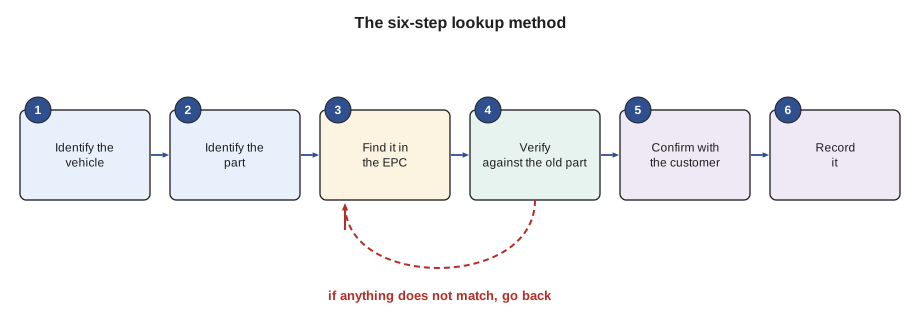
The loop in the figure matters most. If anything does not match at the verification step, the parts technician goes back to the catalog, or back to the customer, rather than hoping the part will do. "Close enough" is how wrong parts get sold.
Asking the right questions
Most identification problems are solved by asking better questions. Imani's usual questions at the front counter were:
- "Do you have the VIN, or can I see the vehicle's registration or insurance card?" The VIN is printed on both.
- "What happened, and what has been replaced already?" A customer replacing a thermostat because the engine runs cold needs a different conversation from one replacing it because of a leak.
- "Which side?" followed by "sitting in the driver's seat, is that your left or your right?" Lesson 5 explains why the viewpoint matters.
- "Do you have the old part with you?" An old part, even a broken one, answers more questions than any description.
- "Is this for a repair shop or for you to install?" A shop may need related parts or a specific brand; a do-it-yourself customer may need a gasket, sealant or a tool rental as well.
Questions should be friendly and quick, not an interrogation. A good parts technician explains why the question matters: "There are two different calipers for this car, and the VIN tells me which one you have." Customers who understand why are much more willing to go back to the parking lot to read the VIN.
Worked problem
How often does the extra question pay off?
Over two weeks, Imani kept a tally of front-counter requests where the customer first gave only the year, make and model. Of 140 such requests, 31 turned out to need a VIN or the old part to choose between two or more possible parts. If the counter had guessed the more common part in those 31 cases and been right half the time, how many wrong parts would it have sold?
Show solution
- Requests that needed more information:
- \[31\]
- Wrong if guessing is right half the time:
- \[31 \div 2 = 15.5 \approx 15\ \text{or}\ 16\]
Answer: About 15 or 16 wrong parts in two weeks, from the front counter alone, or roughly 1 in 9 of those requests. Asking for the VIN or the old part costs a minute; each wrong part costs far more. The tally is a sample for this course.
Verification: proving the part fits
Catalog lookup gives a part number. Verification proves it is the right one. The main verification methods are:
- Compare with the old part. Hold the new part beside the old one: shape, mounting points, connector, number and position of holes, length, and any numbers stamped or printed on it. Lesson 6 explains how to read the numbers on parts.
- Check the vehicle's labels. Paint codes, option codes, tire sizes and engine codes on the vehicle's labels confirm what the VIN suggests. Lesson 3 covers build data.
- Measure. For parts sold by size, such as bearings, seals, belts, hoses, fasteners and filters, measurement settles the question. Lessons 8 to 10 cover these parts and the tools.
- Read the notes and the illustration. Catalog lines carry notes such as "from production date", "with towing package" or "left side". Lesson 4 shows how to read them.
- Ask the technician. A technician with the vehicle apart can count bolts, read a casting number or measure a shaft in a minute. Shop technicians would rather answer one question than wait a day for the right part.
For the Vela caliper, two checks would have caught the error: the catalog line said "right", and a quick look at the old part would have shown the bleeder screw on the other side. Imani made Talia say both checks out loud for every caliper for the rest of the month.
| Verification | Best for | What it catches |
|---|---|---|
| Compare with the old part | Any part the customer can bring in | Wrong side, wrong version, wrong connector |
| Vehicle labels | Option-dependent parts, paint, tires | Wrong option package or build |
| Measurement | Bearings, seals, belts, hoses, fasteners, filters | Wrong size or thread |
| Catalog notes | Parts with production splits or qualifiers | Wrong date range or option |
| Ask the technician | Shop jobs with the vehicle apart | Anything the catalog cannot see |
The parts technician's responsibility
Identification is the core skill of the trade, and it is why the parts technician exists. A customer or technician who could find every part alone would not need the counter. The ASE P2 Automobile Parts Specialist test gives identification and catalog use a large share of their content, and later courses in this program build on it: APT-130 covers the counter conversation, APT-230 the mechanical systems that parts come from, and APT-310 electrical and electric vehicle parts.
Responsibility also means owning mistakes. When a wrong part goes out, the parts technician finds out why, fixes the immediate problem quickly, and changes something so it does not happen again. After the caliper, Rolf added a line to the back counter's checklist: every caliper, control arm, axle and mirror is checked for side against the catalog line and the old part before it leaves the counter. The checklist took ten seconds per part. In the following month, the back counter sold 46 side-specific parts without a single wrong side.
Imani's last word on the subject that first week was about attitude. "Never be embarrassed to ask one more question," she said. "The customer will forget the extra minute. They won't forget the second trip." Talia found that experienced technicians treated her questions with more respect, not less, once they saw that the parts she handed over were right.
Common mistakes
MistakeLooking up a part from the year, make and model alone when the VIN is available.
InsteadGet the VIN, because vehicles of one model vary by engine, options and production date.
MistakeChoosing the more common version when two parts look alike.
InsteadAsk for the old part, a label or a measurement until only one part fits.
MistakeSkipping the side check on calipers, control arms, axles and mirrors.
InsteadCheck the side against the catalog line and the old part, and say it out loud.
MistakeIgnoring the notes on a catalog line.
InsteadRead every note and qualifier, such as production dates and option codes.
MistakeTreating a wrong part as only a returned box.
InsteadCount the technician's lost time, rentals, freight and the damage to the counter's reputation.
Summary and key terms
- Parts identification means finding exactly the part that fits, not one that looks close.
- A wrong part costs technician time, rentals, freight and trust, often far more than the profit on the sale.
- Identification is hard because builds vary within a model, parts change during production and many parts come in look-alike versions.
- A consistent method works better than memory: identify the vehicle, identify the part, find it, verify, confirm and record.
- Good questions, especially asking for the VIN and the old part, solve most identification problems.
- Verification uses the old part, vehicle labels, measurement, catalog notes and the technician's eyes.
- When a mistake happens, fix it quickly and change something so it does not happen again.
- Parts identification
- Working out exactly which part a customer needs and confirming that it fits.
- Verification
- Checking a looked-up part against the old part, labels, measurements or notes before selling it.
- Side-specific part
- A part made in left and right versions, such as a caliper, control arm or mirror.
- Production change
- A revision to a part part-way through a model year.
- Back counter
- The counter that serves the dealership's own service technicians.
- Comeback
- A repair that returns because it was not fixed right the first time, sometimes caused by a wrong part.
Practice problems
Work each problem on paper first, then reveal the answer to check.
List the six steps of the lookup method.
Show answer
Identify the vehicle, identify the part, find it in the catalog, verify, confirm with the customer, and record it.
A technician loses 1.5 hours at 165 dollars an hour because of a wrong part. What is the lost time worth?
Show answer
247.50 dollars.
Name two ways to verify a part before it leaves the counter.
Show answer
Compare it with the old part, check the vehicle labels, measure it, read the catalog notes, or ask the technician.
Why do manufacturers change parts during a model year?
Show answer
To fix problems, reduce cost or change suppliers.
Where can a customer find the VIN without going back to the vehicle?
Show answer
On the vehicle registration or the insurance card.
Lesson quiz · 5 questions
Score 60% or more to complete this lesson.
Create a free account to save your progress, take quizzes and earn a certificate.