
APT-120 · Lesson 11 of 12 · 23 min
Researching hard-to-find parts
▶ Video coming soon A video version of this lesson is on the way.
On Wednesday, October 28, Priyanka Rautela, the service manager, walked a repair order over to the back counter herself, which Talia had learned usually meant trouble. The car was a 2009 Tessaro Marlo, a small hatchback the brand had stopped building years before. The driver's window regulator had broken, and the electronic parts catalog showed the part number with the status every parts technician dreads: no longer available. "The customer has owned this car since it was new," Priyanka said. "She'd rather fix it than replace it. See what you can find."
Most lookups end with a part on the shelf or a part on order. A few end with a part that cannot be ordered at all. Finding those parts is a research skill, and the parts technician who can do it keeps older vehicles on the road, saves customers money and earns the trust of the service department. This lesson sets out a systematic search, the sources worth knowing, and how to present the options to the customer.
Why parts become hard to find
A part becomes hard to find for several reasons, and knowing which one applies points to where to look:
- No longer available (NLA). The manufacturer has stopped making and stocking the part. This is common for parts of vehicles more than ten to fifteen years old, and for low-volume trim, interior and body parts.
- Back-ordered. The part is still listed but is out of stock across the supply chain, sometimes for weeks or months. The cause may be a supplier shortage, a recall that has used up stock, or a sudden demand.
- Low-volume or special vehicles. Limited editions, commercial conversions, imported models and older heavy equipment have small production runs and few stocking points.
- Unidentified parts. The vehicle has been modified, the records are wrong, or the part has no visible number, so the first problem is knowing what to search for.
- Discontinued with no replacement. Supersession has ended in a dead end (lesson 6): the last number in the chain is itself NLA.
Manufacturers are expected to support their vehicles with parts for a reasonable period, and many keep common service parts available for ten years or more after a model ends. Parts that wear or fail often, such as filters, brakes and common sensors, stay in production longest. Trim, interior and body parts usually go first.
Start with the facts
Every search starts by collecting the facts, because the facts decide which sources apply. Before calling anyone, the parts technician gathers:
- The full VIN and the decoded model, year, engine, transmission and build date (lessons 2 and 3).
- The part number from the catalog and its supersession history, including any older numbers (lesson 6).
- The old part itself if possible, with any numbers cast, stamped or printed on it, and photographs of it from several sides.
- Measurements of key dimensions (lesson 10), such as a bearing's size, a hose's diameter or a bracket's hole spacing.
- What the customer needs: how soon, how much they can spend, and whether a used, rebuilt or alternative part is acceptable.
Talia started a search record on the repair order: VIN, catalog number, the NLA status, the two earlier numbers the regulator had superseded from, and photos of the broken regulator from the technician. Every call and result would go on that record.
A systematic search
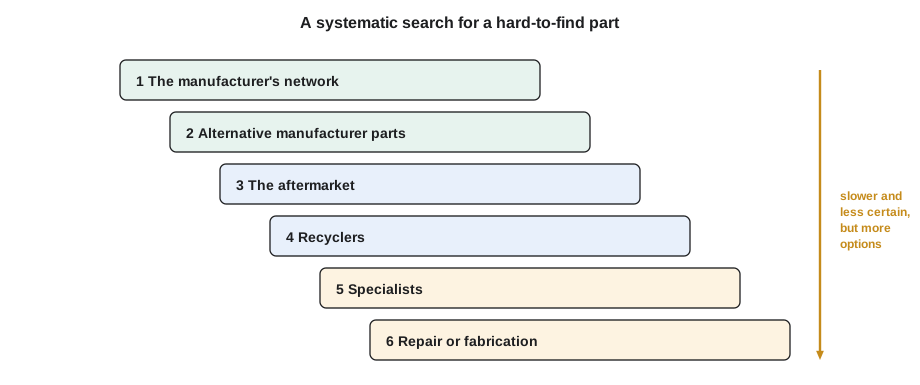
An experienced parts technician searches in an order that starts with the fastest, most reliable sources and moves outward. A typical order:
- 1. Check the manufacturer's network. An NLA status at one dealer does not always mean no part exists. Other dealers may still have the part on their shelves from earlier orders. Most manufacturers give dealers a locator that shows stock at other dealers, and the parts technician can buy the part dealer to dealer.
- 2. Check for an alternative manufacturer part. Another model may have used the same part under a different number, or a later number may fit with a small change. The catalog's where-used or application lists and the manufacturer's parts support line can help.
- 3. Check the aftermarket. Aftermarket suppliers often keep making popular parts long after the manufacturer stops. Electronic catalogs from aftermarket suppliers can be searched by vehicle and by the manufacturer's number.
- 4. Check recyclers. Automotive recyclers dismantle vehicles and sell used parts, many with warranties. Recycler networks list inventory across many yards and use interchange data to show which other vehicles had a matching part.
- 5. Check specialists. Restoration suppliers, rebuilders and machine shops can supply, repair or reproduce parts that no one stocks.
- 6. Consider repair or fabrication. Some parts can be repaired, rebuilt or made, including by a machine shop or, for some non-structural plastic parts, by 3D printing.
The manufacturer's network
Talia began with the dealer locator. The regulator was NLA, but the locator showed one in stock at a Tessaro dealer about 190 mi away, ordered years earlier for a car that never came back. Dealer-to-dealer purchases are common: the selling dealer ships the part, usually at a price between its cost and its list price, and the buying dealer resells it. Before ordering, Talia called the other dealer's parts department and asked them to check the shelf, because locator data can be out of date. They found the box, but it held the passenger side regulator. The locator had the wrong part on file.
The manufacturer's parts support line was the next call. Parts support can sometimes say whether an NLA part will be made again, whether a kit or later part replaces it, or whether any are left in a regional warehouse. In this case, they confirmed the regulator was permanently NLA and that no replacement number existed.
Alternative manufacturer parts
Manufacturers often use one part on several models. The same window regulator might be fitted to a hatchback and a wagon built on the same platform, or a cooling fan used on several engines. Where the catalog offers an application or where-used search, it shows every model that used a part number. When the original number is NLA, the parts technician looks for a sibling model's part with the same shape and connections, then checks the differences carefully: mounting points, connector, motor and length.
Talia checked the Marlo's sister model, a small wagon built on the same platform. Its front door regulator had a different number, and the illustrations showed a different rail length. Close is not the same as interchangeable, so she moved on.
The aftermarket
Aftermarket suppliers make window regulators, mirrors, lamps, sensors, cooling parts and many other parts for vehicles the manufacturer has stopped supporting, because a large population of older vehicles is a steady market. Aftermarket catalogs are searched by vehicle application, by the manufacturer's original number, or by the aftermarket part number, and they often show product photographs and dimensions that help confirm fit.
Two aftermarket regulators were listed for the 2009 Marlo: one from an economy line at 62 dollars and one from a premium line at 118 dollars, both with the motor included. The aftermarket supplier showed the premium regulator in stock at its regional warehouse, with next-day delivery. Aftermarket parts for low-volume models sometimes fit less exactly than the original, so the parts technician compares the photographs and dimensions with the old part and reads any notes, such as "requires transferring motor from original" or "fits models with power windows only".
Recyclers and used parts
Automotive recyclers, sometimes called auto dismantlers or salvage yards, recover parts from vehicles that have been written off or retired. Modern recyclers inventory parts by vehicle, test many of them, and sell them with warranties, often 30 to 90 days or longer. Used OEM parts are often the best or only choice for body panels, interior trim, mirrors, modules and other parts that the aftermarket does not make.
Recyclers rely on salvage interchange data, a reference that groups parts known to fit across different models and years. A recycler can say that the regulator from a 2010 or 2011 Marlo, or from a particular trim of the wagon, is a direct fit. Interchange data is good but not perfect, so the parts technician gives the recycler the full VIN, the side, the trim level, the options, the original part number and photographs, and asks them to confirm against the actual vehicle before shipping.
Talia found three used regulators through a recycler network: a 2010 Marlo regulator at 75 dollars with a 90-day warranty, a 2008 at 60 dollars with a 30-day warranty but a motor of unknown condition, and a 2011 from a car with only partial records. She asked the first yard to test the motor and send photographs.
| Question to ask a recycler | Why it matters |
|---|---|
| What is the donor vehicle's VIN and mileage? | Confirms model, year and wear |
| Has the part been tested? | Moving and electrical parts may fail |
| Can you send photographs, including numbers? | Confirms the part matches the old one |
| What is the warranty and return policy? | Protects the customer and the shop |
| What are the shipping cost and time? | Large parts can cost more to ship than to buy |
Specialists, rebuilders and fabrication
When no new or used part can be found, specialists can often help:
- Restoration suppliers reproduce trim, seals, emblems and body parts for older and collectible vehicles. Their catalogs often go back decades.
- Rebuilders repair specific kinds of parts, such as steering racks, starters, alternators, instrument clusters, electronic modules and air conditioning compressors. The customer's own part is sent away and returned rebuilt.
- Machine shops can make bushings, spacers, brackets, shafts and other simple metal parts from a sample or drawing, and can resurface, sleeve or rebuild worn parts.
- Upholstery and trim shops repair or recover seats, door panels and headliners.
- 3D printing can make some small, non-structural plastic parts, such as clips, knobs, covers and trim pieces. It is not suitable for safety-related, load-bearing or heat-exposed parts unless the design and material are proven, and the parts technician leaves that judgment to the shop and the customer with full information.
Rebuilding the customer's own part is often a good choice for electronic modules and other parts programmed to the vehicle, because the rebuilt part keeps its programming and avoids an expensive dealer setup. Shipping time both ways must be included in the estimate.
Service information and the right to repair
Hard-to-find parts searches often need service information: wiring diagrams, procedures and part details. In the United States, automakers have committed through agreements and state laws, often called right to repair rules, to make service information, training and tools available to independent repairers on terms similar to their dealers. A dealer parts department has direct access to the manufacturer's information, but knowing that independent shops have this access too helps when a wholesale customer asks where to find something.
Presenting the options
A parts search ends not with a single answer but with a set of options for the customer, laid out so they can choose. Each option should show the part, its condition, its price, its warranty, how soon it can be installed and any risks. Price alone is rarely the deciding point; the time the vehicle is off the road and the chance of a second repair often matter more.
Worked problem
Comparing the regulator options
Talia has three good options for the Marlo window regulator. The shop's labor to install a regulator is 1.4 hours at 140 dollars an hour, whichever part is used. The used part has a 90-day warranty and a test report; there is a 1 in 10 chance, the service department estimates, that a used motor fails within a year, which would mean a second installation at the customer's cost after the warranty. Compare the total cost to the customer of the premium aftermarket part at 118 dollars and the used part at 75 dollars plus 28 dollars shipping.
Show solution
- Labor for one installation:
- \[1.4 \times 140 = 196\ \text{dollars}\]
- Premium aftermarket total:
- \[118 + 196 = 314\ \text{dollars}\]
- Used part total:
- \[75 + 28 + 196 = 299\ \text{dollars}\]
- Difference:
- \[314 - 299 = 15\ \text{dollars}\]
- Expected cost of a second repair, 1 in 10 chance of about 299 dollars:
- \[0.1 \times 299 \approx 30\ \text{dollars}\]
Answer: The used part saves 15 dollars at the start, but with about a 1 in 10 chance of paying roughly 299 dollars again, the expected cost of a repeat repair is about 30 dollars, more than the saving. The premium aftermarket part with its longer warranty is the better value for most customers, and it arrives tomorrow. The prices and failure chance are sample values for this course.
Talia wrote the options on the repair order: premium aftermarket regulator, 118 dollars, in stock next day, one-year parts warranty; used OEM regulator, 103 dollars delivered, tested, 90-day warranty, three days; economy aftermarket, 62 dollars, next day, with reviews from other shops noting a shorter life. Priyanka's service advisor called the customer, who chose the premium aftermarket part. The car was finished the next afternoon.
Documenting the search
Every search should leave a record: what was needed, who was called, what they had, prices, and what was chosen. The record helps if the part fails, if the same vehicle needs another part, or if another customer with the same model appears. Many parts departments keep a hard-to-find list of sources that have worked: the recycler that always sends good photographs, the rebuilder that turns modules around in three days, the restoration supplier for one model's trim. Talia added the regulator search to the department's list with the aftermarket part number and the note "fits 2009 to 2011 Marlo, both sides available, checked October 28, 2026".
Searches also take time, and the parts technician should keep the customer and service department informed. A short update such as "one source checked, two more calls this afternoon, I'll have options by four" prevents repeated calls and sets expectations.
When the search fails
Sometimes nothing can be found in time or at a sensible price. The parts technician says so clearly and offers what is possible: a used part with a longer wait, a repair to the old part, a modified part fitted by the shop with the customer's agreement, or a decision by the customer not to repair. For a safety-related part, such as a brake, steering or restraint component, only parts that meet the original specification are acceptable, and the parts technician never suggests an improvised substitute. Those decisions belong to the technician and the customer with full information.
Common mistakes
MistakeTrusting a dealer locator's stock without a phone check.
InsteadCall and ask them to check the shelf and the part number.
MistakeAssuming a sibling model's part fits because it looks similar.
InsteadCompare mounting points, connectors, lengths and notes before buying.
MistakeBuying a used part on the description alone.
InsteadGive the recycler the VIN, side and part number, and ask for photographs and a test.
MistakePresenting only the cheapest option.
InsteadShow price, warranty, timing and risks for each option so the customer can choose.
MistakeLeaving no record of the search.
InsteadWrite the sources, prices and choice on the repair order and the hard-to-find list.
Summary and key terms
- Parts become hard to find when they are NLA, back-ordered, low-volume, unidentified or a supersession dead end.
- Start every search with the full VIN, part number history, the old part, measurements and the customer's needs.
- Search in order: manufacturer network, alternative manufacturer parts, aftermarket, recyclers, specialists, then repair or fabrication.
- Recyclers use salvage interchange data; give them the full VIN and ask for photographs and testing.
- Rebuilders, machine shops, restoration suppliers and trim shops can supply or repair parts no one stocks.
- Present options with price, warranty, timing and risk, not price alone.
- Record every search and keep a hard-to-find source list.
- NLA
- No longer available; a part the manufacturer no longer makes or stocks.
- Dealer locator
- A manufacturer system that shows parts stock at other dealers.
- Automotive recycler
- A business that dismantles vehicles and sells their used parts.
- Salvage interchange
- A reference that groups used parts known to fit across models and years.
- Rebuilder
- A specialist that repairs a customer's own part and returns it.
- Hard-to-find list
- A parts department's record of sources that have worked for difficult parts.
Practice problems
Work each problem on paper first, then reveal the answer to check.
What is the first source to check for an NLA part?
Show answer
The manufacturer's network: other dealers' stock through the dealer locator and the parts support line.
Why give a recycler the full VIN?
Show answer
So they can confirm the part against the actual donor vehicle using interchange data.
A part costs 90 dollars and labor is 1.5 hours at 140 dollars. What is the total?
Show answer
90 + 210 = 300 dollars.
Name a part that is often best rebuilt rather than replaced.
Show answer
An electronic module, because the rebuilt part keeps its programming.
When is an improvised substitute never acceptable?
Show answer
For safety-related parts such as brakes, steering and restraints.
Lesson quiz · 5 questions
Score 60% or more to complete this lesson.
Create a free account to save your progress, take quizzes and earn a certificate.