
APT-120 · Lesson 2 of 12 · 25 min
The vehicle identification number
▶ Video coming soon A video version of this lesson is on the way.
On Wednesday, September 23, Imani handed Talia a sticky note with seventeen characters on it: 1TSVL4B29TK104829. "That's a Vela in the shop for brakes," she said. "Before you touch the catalog, tell me everything this number says about the car, and tell me whether I copied it correctly." Talia had typed VINs into the catalog all week, but she had never looked at one as anything more than a password. By the end of the morning she could read most of it, and she had learned that the ninth character could catch a copying mistake.
The vehicle identification number (VIN) is the single most important piece of information at a parts counter. It identifies one vehicle among all the vehicles ever built, and the manufacturer's catalog uses it to filter parts to the exact build. This lesson explains how a VIN is structured, where to find it, how the check digit works, what the VIN can and cannot tell a parts technician, and how to avoid the most common mistakes in copying and using it.
A standard 17-character number
Since the 1981 model year, every car, light truck, motorcycle, bus, trailer and heavy truck sold in Canada and the United States has carried a 17-character VIN in a standard format. The format is set out in the United States by the National Highway Traffic Safety Administration's VIN regulation, 49 CFR Part 565, and it follows the international VIN standards ISO 3779 and ISO 3780. Canada uses the same 17-character structure, so a vehicle built for either market can be read the same way.
Seventeen characters is long enough to give every vehicle a unique number for decades. To avoid confusion with numbers, the letters I, O and Q are never used anywhere in a VIN: I and O look too much like 1 and 0, and Q looks like O. If a customer reads out an O, the character is a zero; if they read an I, it is a one.
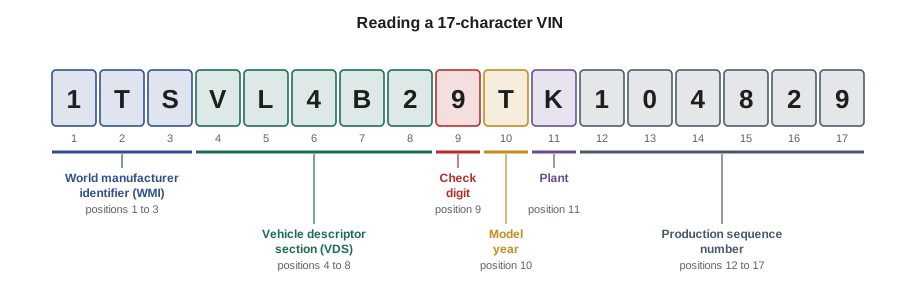
Positions 1 to 3: the world manufacturer identifier
The first three characters are the world manufacturer identifier (WMI). They identify the manufacturer and, often, the type of vehicle and the country or region where it was built. The first character usually indicates the region: for vehicles built in North America, 1, 4 and 5 indicate the United States, 2 Canada, and 3 Mexico. WMIs are assigned to manufacturers through a registration system: in the United States, SAE International maintains the codes on behalf of NHTSA, and in Canada the Canadian Vehicle Manufacturers' Association coordinates codes for manufacturers based in Canada.
In this course, the fictional make Tessaro uses the invented WMIs 1TS for cars and SUVs built at its US plants and 2TS for those built in Canada. Real WMIs belong to real manufacturers, so this course never uses them in examples. A small manufacturer that builds fewer than 1,000 vehicles a year has a WMI ending in 9 and shares it with other small makers; positions 12 to 14 then complete its identification.
For a parts technician, the WMI confirms the make and, sometimes, the country of assembly. A vehicle sold in Canada may have been built in the United States, Mexico, Japan or elsewhere, and a few parts, such as lighting, emissions equipment or daytime running light modules, can differ between vehicles built for the two markets.
Positions 4 to 8: the vehicle descriptor section
Positions 4 to 8 form the vehicle descriptor section (VDS). The manufacturer decides what these characters mean, within the regulation's requirements: they must describe attributes such as the model line, series, body type, engine type and, for some vehicles, the restraint system or gross vehicle weight rating. For passenger cars and light trucks built for 2010 and later model years, position 7 is always a letter, which is how the regulation tells the 2010 to 2039 model-year cycle apart from the 1980 to 2009 cycle (lesson 3 explains the cycle).
Because each manufacturer defines its own VDS codes, a parts technician cannot read them without the manufacturer's decoding tables, which the electronic catalog and the dealer management system apply automatically. In Tessaro's invented scheme, the VDS VL4B2 on Imani's note means: VL for the Vela model line, 4 for the four-door body with all-wheel drive, B for the series and restraint system, and 2 for the 2.0 L turbocharged engine.
| Position | Characters on the note | Meaning (invented Tessaro scheme) |
|---|---|---|
| 4 and 5 | VL | Vela compact SUV |
| 6 | 4 | Four-door, all-wheel drive |
| 7 | B | Series and restraint system (always a letter for 2010 and later) |
| 8 | 2 | Engine: 2.0 L turbocharged (Tessaro code TX20) |
Position 9: the check digit
The ninth character is the check digit. It is calculated from the other sixteen characters by a fixed formula set out in the VIN regulation, and its only job is to catch copying errors. If one character of a VIN is copied wrong, or two neighboring characters are swapped, the check digit almost always stops matching. Catalog and DMS software check it automatically and warn when a VIN is invalid. Parts technicians rarely calculate it by hand, but knowing how it works explains why a single wrong character gets rejected, and why the fix is to re-read the VIN rather than to override the warning.
The calculation has four steps:
- Convert each character to a number. Digits keep their value. Letters are converted with a fixed table: A and J are 1; B, K and S are 2; C, L and T are 3; D, M and U are 4; E, N and V are 5; F and W are 6; G, P and X are 7; H and Y are 8; R and Z are 9.
- Multiply each value by its position's weight. The weights for positions 1 to 8 are 8, 7, 6, 5, 4, 3, 2 and 10; position 9, the check digit itself, has a weight of 0; positions 10 to 17 are weighted 9, 8, 7, 6, 5, 4, 3 and 2.
- Add the products and divide the total by 11.
- The remainder is the check digit. A remainder from 0 to 9 gives that digit; a remainder of 10 gives the letter X.
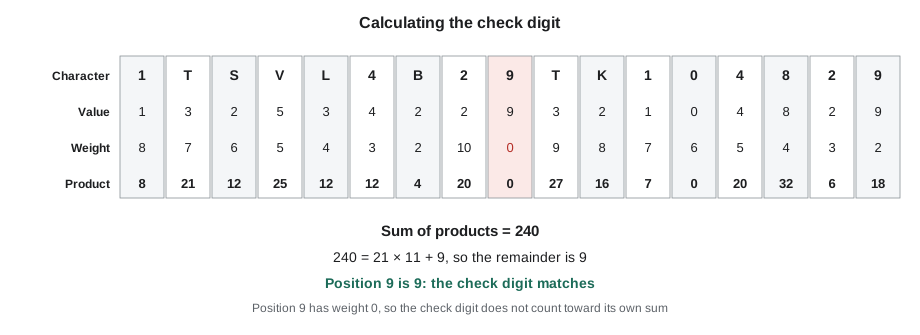
Worked problem
Checking the VIN on the sticky note
Verify the check digit of the invented VIN 1TSVL4B29TK104829.
Show solution
- Converted values, positions 1 to 17: 1, 3, 2, 5, 3, 4, 2, 2, (9), 3, 2, 1, 0, 4, 8, 2, 9.
- Products with the weights 8, 7, 6, 5, 4, 3, 2, 10, 0, 9, 8, 7, 6, 5, 4, 3, 2:
- \[8 + 21 + 12 + 25 + 12 + 12 + 4 + 20 + 0 + 27 + 16 + 7 + 0 + 20 + 32 + 6 + 18 = 240\]
- Divide by 11:
- \[240 = 11 \times 21 + 9\]
- The remainder is 9, and the ninth character is 9.
Answer: The check digit matches, so the VIN was very probably copied correctly. Talia confirmed the result by typing the VIN into the catalog, which accepted it and showed a 2026 Vela with the 2.0 L turbocharged engine and all-wheel drive.
Worked problem
Catching a swapped pair
A wholesale customer phones in the same Vela's VIN as 1TSVL4B29TK140829, with the 0 and the 4 in positions 13 and 14 swapped. Does the check digit catch the mistake?
Show solution
- Only positions 13 and 14 change. Before: 0 × 6 + 4 × 5 = 20. After: 4 × 6 + 0 × 5 = 24.
- New total:
- \[240 - 20 + 24 = 244\]
- Divide by 11:
- \[244 = 11 \times 22 + 2\]
- The calculated check digit would be 2, but the ninth character is 9.
Answer: The check digit does not match, so the catalog rejects the VIN. The right response is to ask the customer to read the VIN again, character by character, not to try changing characters until one is accepted. A guessed VIN that happens to pass the check could belong to a completely different vehicle.
The check digit is mandatory on vehicles built for the North American market. Vehicles imported from markets that do not use it, such as some gray-market imports, may have a VIN whose ninth character does not follow the formula; the catalog may then refuse the VIN even though it was copied correctly. In that case the parts technician identifies the vehicle from its other data and notes the problem on the invoice.
Position 10: the model year
The tenth character gives the model year, which is the year the manufacturer assigns to the vehicle's design, not necessarily the calendar year it was built. A 2027 model may be built from the summer of 2026. The codes follow a 30-year cycle using letters and digits, skipping I, O, Q, U and Z and the digit 0. The current cycle began with A for 2010; the codes for recent years are:
| Code | Model year | Code | Model year |
|---|---|---|---|
| L | 2020 | T | 2026 |
| M | 2021 | V | 2027 |
| N | 2022 | W | 2028 |
| P | 2023 | X | 2029 |
| R | 2024 | Y | 2030 |
| S | 2025 | 1 | 2031 |
Because the cycle repeats every 30 years, a T in position 10 could mean 1996 or 2026. For cars and light trucks, position 7 resolves the question: a digit in position 7 means the 1980 to 2009 cycle, and a letter means the 2010 to 2039 cycle. On Imani's note, position 7 is B, so the T means 2026.
Position 11 and positions 12 to 17
The eleventh character identifies the assembly plant. Its meaning is set by the manufacturer. For parts work it matters occasionally, when two plants build the same model with slightly different parts or start a production change on different dates. In the invented Tessaro scheme, K is the company's main SUV plant.
Positions 12 to 17 are the production sequence number, sometimes called the serial number of the vehicle. For high-volume manufacturers it runs in sequence through the model year at each plant. Catalogs often use it to mark production changes: a note may say "from VIN 104500" or "up to VIN 104499". For cars and light trucks the last five characters are always digits.
Worked problem
Is this vehicle before or after the change?
A catalog note says the Vela's rear brake rotor was changed "from VIN 106201" at plant K for the 2026 model year. Imani's VIN ends TK104829. Which rotor does the car use?
Show solution
- Model year T (2026) and plant K match the note.
- Sequence number: 104829. Compare with the change point:
- \[104829 < 106201\]
- The car was built before the change.
Answer: The car uses the earlier rotor. If the model year or the plant had been different, the note would not apply at all, and the parts technician would read the lines for that model year or plant instead.
Where to find the VIN
The VIN is marked in several places on a vehicle, so it can be read even if one location is damaged or covered:
- On the dashboard, visible through the windshield on the driver's side. This location is required on passenger cars and light trucks.
- On the certification label, usually on the driver's door edge or door pillar, along with the date of manufacture and weight ratings (lesson 3).
- On the registration and the insurance card. For customers who phone, this is usually the easiest source.
- On major parts. Many manufacturers mark the VIN, or part of it, on the engine, the transmission and some body panels, which helps trace stolen parts.
- In the vehicle's computers. A scan tool reads the VIN from the engine control module, which is useful when labels are missing or a body panel has been replaced.
What the VIN does not tell you
The VIN identifies the vehicle, and through the manufacturer's records it unlocks the build, but it does not answer every question. It usually does not say whether a previous owner has replaced parts with different ones: an aftermarket stereo, larger wheels, a different engine, or a used door in a different color. It may not include dealer-installed accessories. And for aftermarket catalogs that work by year, make, model and engine rather than by VIN, the parts technician may still need to choose between options the VIN does not encode, such as brake size or suspension package.
This is why the lookup method in lesson 1 always ends with verification. The VIN narrows the choice; the old part, the labels and the technician confirm it.
Talia gave Imani her answer just before lunch: a 2026 Tessaro Vela, built at plant K in the United States, four-door with all-wheel drive, 2.0 L turbocharged engine, production number 104829, built before the rear rotor change, with a valid check digit. Imani nodded. "Now you can open the catalog," she said.
Common mistakes
MistakeReading the letter O or I in a VIN.
InsteadTreat them as the digits 0 and 1; the letters I, O and Q are never used.
MistakeOverriding an invalid-VIN warning by changing characters until one passes.
InsteadAsk the customer to read the VIN again, character by character, from the dashboard or registration.
MistakeTaking the model year from the calendar year of sale.
InsteadRead position 10, and use position 7 to tell which 30-year cycle applies.
MistakeIgnoring the production sequence number.
InsteadCompare it with catalog notes such as "from VIN 106201" for the same model year and plant.
MistakeAssuming the VIN shows every part on the vehicle today.
InsteadVerify against the old part, because owners and shops may have changed parts.
Summary and key terms
- The 17-character VIN identifies one vehicle and is the key to the manufacturer's catalog.
- Positions 1 to 3 are the world manufacturer identifier; 4 to 8 describe the vehicle; 9 is the check digit; 10 is the model year; 11 is the plant; 12 to 17 are the production sequence.
- The letters I, O and Q are never used.
- The check digit is calculated with a fixed conversion table and position weights; it catches most copying errors.
- Model-year codes repeat every 30 years; for cars and light trucks a letter in position 7 marks the 2010 to 2039 cycle.
- Catalog notes often use the plant and sequence number to mark production changes.
- The VIN does not show later changes by owners, so verification is still needed.
- VIN
- Vehicle identification number: the 17-character code that identifies one vehicle.
- World manufacturer identifier
- Positions 1 to 3 of a VIN, identifying the manufacturer and often the region and vehicle type.
- Vehicle descriptor section
- Positions 4 to 8 of a VIN, describing the model, body, engine and similar attributes.
- Check digit
- Position 9 of a VIN, calculated from the other characters to catch copying errors.
- Model year
- The year assigned to a vehicle's design, coded in position 10 of the VIN.
- Production sequence number
- Positions 12 to 17 of a VIN, counting vehicles built at a plant.
- Plant code
- Position 11 of a VIN, identifying the assembly plant.
Practice problems
Work each problem on paper first, then reveal the answer to check.
Which three letters are never used in a VIN, and why?
Show answer
I, O and Q, because they look like the digits 1 and 0.
What does a 2 in position 1 usually indicate for a North American vehicle?
Show answer
That it was built in Canada.
Which model year does the code V stand for in the current cycle?
Show answer
2027.
A total of 244 divided by 11 leaves what remainder, and what check digit does that give?
Show answer
Remainder 2, so the check digit would be 2.
A note says "from VIN 106201". The vehicle's sequence number is 107350, same model year and plant. Does the note apply?
Show answer
Yes; the vehicle was built after the change.
Lesson quiz · 5 questions
Score 60% or more to complete this lesson.
Create a free account to save your progress, take quizzes and earn a certificate.