
APP-310 · Lesson 9 of 12 · 25 min
Gas water heaters and venting
▶ Video coming soon A video version of this lesson is on the way.
Hiro Nakashima's file from Friday, October 2, described a call Dee wanted Kiran to know before he ever stood in front of a gas water heater. Tobiah Renfrew in Berwick owned a nine-year-old natural-draft gas water heater in his basement laundry room, and its pilot kept going out. Hiro, who does all of Penfold's gas work, found the reason in the burner compartment: the flame arrestor screen on the bottom of the heater was matted with dryer lint, starving the burner of air. The heater's thermal cutoff had tripped. Hiro shut off the gas, replaced the cutoff with the maker's kit, cleaned the arrestor as the instructions describe, relit the pilot, and ran a draft and carbon monoxide check before leaving. He also found the dryer's vent connection loose behind the machine, blowing lint into the room. At the November 6 water night, he showed Kiran the parts. "An appliance technician needs to understand this heater," he said, "but at Penfold the gas work is mine."
This lesson explains how gas storage water heaters work, their controls and safety devices, the three common venting arrangements and how each fails, and the draft and carbon monoxide checks that every gas water heater service includes. It builds on GAS-210, which covers water heaters from the gas fitter's side. Under the fuel gas code, the maker's instructions and Penfold's own rule, work on a gas water heater's gas system, controls, burner and venting is done only by a trained gas technician, at Penfold Hiro; Kiran's role is to recognize problems, keep himself and the customer safe, and call Hiro.
How a gas water heater works
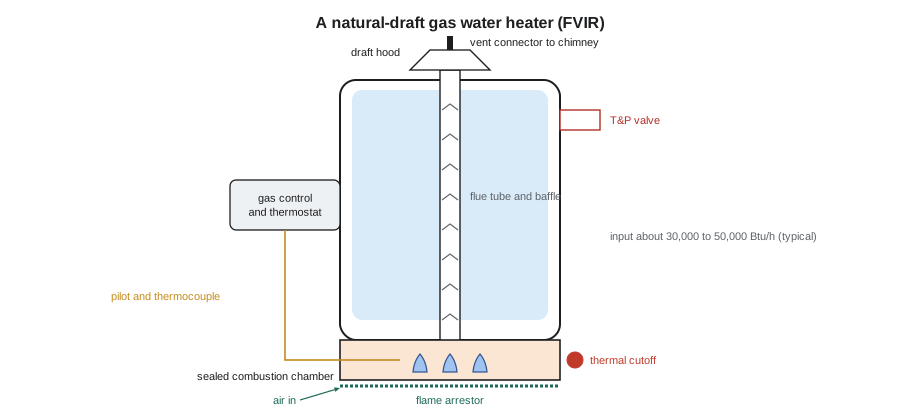
A gas storage water heater is an insulated tank, like the electric heater of lesson 8, with a burner underneath it. Hot combustion products rise through a flue tube up the center of the tank, which carries a twisted metal baffle that slows the gases so they give up more heat to the water, and then leave through the top into the venting. The tank has the same dip tube, anode, drain valve and T&P valve as an electric tank, and wears out the same way.
A typical residential gas heater has an input of about 30,000 to 50,000 Btu/h (typical; the rating plate governs). Because it burns gas at a much higher rate than an electric element heats, it recovers much faster.
Worked problem
Recovery of a gas water heater
A 50 gal natural-draft gas water heater has an input of 40,000 Btu/h and a recovery efficiency of 0.78. How many gallons per hour can it heat from 50 °F to 140 °F? Use 8.33 Btu per gallon per °F.
Show solution
- Heat into the water per hour:
- \[40\,000 \times 0.78 = 31\,200 \text{ Btu}\]
- Temperature rise: 90 °F.
- \[\text{Recovery} = \frac{31200}{8.33 \times 90} \approx 41.6 \text{ gal per hour}\]
Answer: About 41.6 gal per hour, roughly twice the 20.5 gal per hour of the 4,500 W electric tank in lesson 8, even though the gas heater loses some heat up the vent.
Controls and safety devices
The gas control valve, usually combined with the thermostat in one unit on the front of the tank, has a temperature probe in the water. On standing-pilot models it includes a pilot safety: a thermocouple heated by the pilot flame produces a small voltage that holds the gas valve's safety magnet open. If the pilot goes out, the thermocouple cools, the voltage falls and the valve shuts off all gas within a short time. Many newer heaters use a thermopile or electronic ignition instead, and some include a self-diagnostic light that blinks codes listed on the label.
The gas control also contains a high-limit energy cutoff like the electric heater's, which shuts off the gas if the water overheats. Since the early 2000s, most residential gas storage water heaters have been built to be flammable vapor ignition resistant (FVIR): the combustion chamber is sealed, air enters only through a flame arrestor screen that stops a flame from passing out to ignite flammable vapors on the floor, such as gasoline vapor in a garage, and a thermal cutoff shuts the heater down if burning occurs inside the chamber or the chamber overheats. Lint, dust and pet hair blocking the arrestor starve the burner of air, make it burn badly and can trip the cutoff, as on Mr. Renfrew's heater. The maker's instructions say how to clean the arrestor and whether a tripped cutoff is replaceable or the whole control must be replaced.
Worked problem
Reading a thermocouple
The tech sheet for a standing-pilot heater gives its thermocouple an output of about 25 to 30 mV open circuit and says the gas control needs at least 15 mV under load to stay open (sample values). On a later call, Hiro measures 9 mV under load with a thermocouple adapter. What does that mean?
Show solution
- Measured under load: 9 mV.
- Required: at least 15 mV.
- The thermocouple is not producing enough voltage to hold the valve open reliably, so the pilot drops out.
Answer: The thermocouple is weak or the pilot flame is not heating it properly. Hiro checks the pilot flame first, because a dirty pilot orifice gives a small flame that heats the thermocouple poorly, then replaces the thermocouple if the flame is right. This is gas work, done by Hiro.
Venting
Every gas water heater must get rid of its combustion products, which contain water vapor, carbon dioxide and, if the burner is not burning well, carbon monoxide. Residential heaters use one of three venting arrangements, and the venting is designed and installed under the gas code and the maker's instructions. GAS-230 covers venting design in depth.
- Natural draft (atmospheric): the hot flue gases rise by buoyancy through a draft hood on top of the heater, a vent connector and a chimney or vent. The draft hood has an open relief opening that lets room air mix with the flue gases and keeps wind or downdraft from reaching the burner. Natural-draft heaters depend on the chimney working and the room having enough air.
- Power vent: a blower on top of the heater pushes the flue gases out through plastic or metal vent pipe, often through a side wall. A pressure switch proves the blower is working before the burner lights. Power-vent heaters need a 120 V supply and fail with a blower or pressure switch fault code.
- Direct vent: the heater takes its combustion air from outdoors and sends the flue gases outdoors through a sealed concentric or two-pipe vent, so it does not use room air.
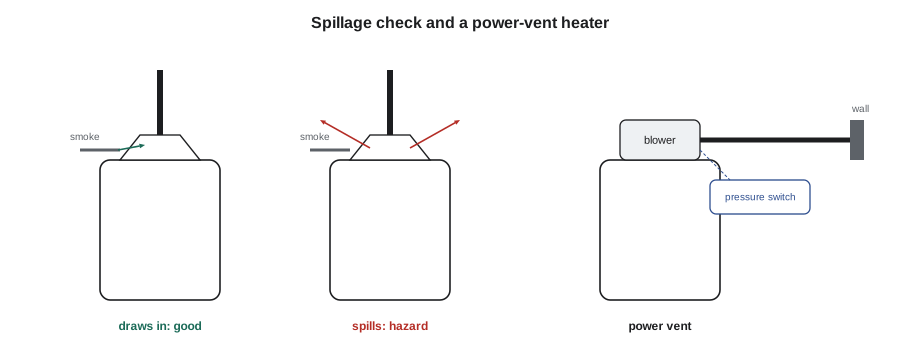
Natural-draft heaters can spill combustion products into the house if the chimney is blocked, the vent is disconnected, or the house is depressurized by exhaust fans, a dryer, a large range hood or a fireplace, as APP-230 showed with a big island hood that made a water heater spill. Spilling flue gases are a carbon monoxide hazard. Signs include scorch marks or melted plastic on the draft hood or the T&P valve, rust or water stains on top of the heater, condensation on nearby windows, and a carbon monoxide alarm sounding.
Draft and carbon monoxide checks
Every gas water heater service ends with a check that the heater burns and vents properly. After the burner has run for a few minutes, the gas technician checks for spillage at the draft hood of a natural-draft heater with a smoke source or a mirror, ideally with the house's exhaust fans running to create the worst case; checks the flame for a clean, blue appearance; and measures carbon monoxide in the flue gases with a combustion analyzer, converting the reading to air-free CO as GAS-230 explains, so the reading does not depend on how much air was mixed in.
Worked problem
Converting a CO reading to air-free
Hiro measures 45 ppm carbon monoxide in the flue gases of Mr. Renfrew's heater, with 9.0 in 100 oxygen in the sample. What is the air-free CO?
Show solution
- Air-free CO:
- \[\text{CO}_{AF} = \text{CO} \times \frac{20.9}{20.9 - \text{O}_2} = 45 \times \frac{20.9}{11.9} \approx 79 \text{ ppm}\]
Answer: About 79 ppm air-free. That is under Penfold's company action level of 100 ppm air-free for investigation (company guidance, as in APP-230), so with no spillage and a good flame the heater can return to service. A high reading would mean a combustion or venting problem to correct before use.
If a gas technician finds a hazardous condition, such as a blocked chimney, a disconnected vent, spillage or high CO, the heater is shut off and tagged following the utility's and the authority's procedures, as GAS-340 describes, and the customer is told in writing. An appliance technician who sees signs of spillage, smells gas or hears a CO alarm on any call does not try to fix the heater: he gets everyone out if there is a gas smell or an alarm, calls the gas utility or 911 from outside as appropriate, and calls Hiro.
Common gas water heater complaints
| Complaint | Often caused by | Who acts |
|---|---|---|
| Pilot will not stay lit | Weak thermocouple, dirty pilot, blocked arrestor, tripped thermal cutoff | Gas technician |
| Not enough hot water | Thermostat set low, sediment, broken dip tube, undersized for demand | Gas technician; plumber for dip tube or tank |
| Rumbling or popping | Sediment boiling at the tank bottom | Flush as the guide says |
| Rotten-egg smell in hot water | Anode reacting with bacteria in water | Anode change (tank work) |
| Smell of gas | Leak at control, connector or piping | Leave, call utility from outside, gas technician |
| Scorching at draft hood, CO alarm | Spillage, blocked vent, depressurized house | Gas technician; correct before use |
| Water at base | T&P discharge, leaking fitting, leaking tank | Plumber; leaking tank is replaced |
As with electric heaters, Penfold services only customer-owned heaters and leaves tank replacement to licensed contractors, a plumber or HVAC contractor as the work requires, under the permits the city requires, with the venting brought to code.
Combustion air
A natural-draft gas water heater takes its combustion air from the room it is in, and the draft hood draws more room air into the vent. If the room is a small closet or a tight utility room, it may not have enough air for the heater and any other appliance sharing it, such as a furnace. The gas code sets how combustion and ventilation air is provided, through openings to other spaces or to outdoors, and GAS-230 covers the sizing. A technician who finds a water heater closet door that has been weather-stripped tight, openings that have been covered, or a new appliance added to a small room notes it for the gas technician, because those changes can make a heater that worked for years begin to spill.
Combustion air must also be clean. Laundry lint, as at Mr. Renfrew's house, is one problem. Chemical vapors are another: bleach, pool chemicals and some cleaning products release chlorine compounds that, drawn into a burner, form acids that corrode the burner, the flue and the vent. Storing those products away from the heater is part of the advice a technician gives.
Tankless gas water heaters
Many newer homes have tankless or on-demand gas water heaters, which heat water only as it flows, using a large burner, a heat exchanger and electronic controls with a flow sensor. Most are condensing appliances vented with plastic pipe and need a condensate drain. They need regular descaling in hard water, a clean inlet water filter, and a gas supply sized for their high input. Their service is gas technician work and is covered in GAS-210; an appliance technician should know that a tankless unit's error codes, flushing ports and inlet screen are where most service calls start.
Power-vent fault codes
Power-vent heaters have more electrical parts than natural-draft heaters: a 120 V blower, a pressure switch, an igniter or pilot, and a control that blinks fault codes listed on the jacket label. The common codes point to a pressure switch that does not prove, usually because the vent is blocked by snow, ice, a nest or a crushed pipe, or because the switch's tube is cracked or full of water; to a failed blower; or to an ignition failure. Clearing a blocked outdoor termination after a snowfall is a common winter call. Because the venting and burner are gas work, the appliance technician's role is to recognize the code, check the power supply to the heater and the obvious blockages outdoors, and pass the call to the gas technician.
Common mistakes
MistakeRelighting a pilot again and again without asking why it goes out.
InsteadCheck the thermocouple, pilot flame, arrestor and thermal cutoff; a gas technician does the work.
MistakeIgnoring lint and dust around a gas water heater.
InsteadA blocked flame arrestor starves the burner; find and fix the lint source.
MistakeFinishing a gas water heater service without a draft and CO check.
InsteadCheck for spillage and measure air-free CO before leaving.
MistakeReading flue CO without correcting for oxygen.
InsteadConvert to air-free CO so readings can be compared.
MistakeAn appliance technician adjusting a gas control.
InsteadRecognize the problem, keep everyone safe and call the gas technician.
Summary and key terms
- Gas storage heaters burn gas under the tank; flue gases rise through a baffled flue tube.
- Gas heaters recover about twice as fast as a typical electric tank.
- Thermocouples or thermopiles prove the pilot; the gas valve shuts if the pilot fails.
- FVIR heaters have a sealed chamber, a flame arrestor and a thermal cutoff; lint blocks the arrestor.
- Venting is natural draft, power vent or direct vent.
- Natural-draft heaters can spill if the vent is blocked or the house is depressurized.
- Every service ends with a spillage check and an air-free CO measurement.
- Gas work and tank replacement are for certified and licensed trades.
- Flue tube
- The tube up the center of a gas water heater tank that carries flue gases.
- Baffle
- A twisted strip in the flue tube that slows the gases to transfer more heat.
- Thermocouple
- A device that produces a small voltage when heated, used to prove a pilot.
- FVIR
- Flammable vapor ignition resistant: a sealed-chamber design with a flame arrestor.
- Flame arrestor
- A screen that lets air in but stops a flame passing out of the combustion chamber.
- Draft hood
- The open fitting on top of a natural-draft heater that connects it to the vent.
- Spillage
- Flue gases escaping into the room instead of going up the vent.
- Air-free CO
- A carbon monoxide reading corrected to remove the effect of excess air.
Practice problems
Work each problem on paper first, then reveal the answer to check.
Why does a blocked flame arrestor cause problems?
Show answer
It starves the burner of air, making it burn badly and possibly tripping the thermal cutoff.
What three venting arrangements do residential gas water heaters use?
Show answer
Natural draft, power vent and direct vent.
A flue sample shows 45 ppm CO and 9.0 in 100 oxygen. What is the air-free CO?
Show answer
About 79 ppm.
Name two signs of spillage at a natural-draft heater.
Show answer
Scorch marks or melted plastic at the draft hood, and condensation or rust on top of the heater.
What does an appliance technician do on smelling gas?
Show answer
Get everyone out, call the utility or 911 from outside, and call the gas technician.
Lesson quiz · 5 questions
Score 60% or more to complete this lesson.
Create a free account to save your progress, take quizzes and earn a certificate.