
APP-310 · Lesson 10 of 12 · 27 min
Water softeners, filters and dispensers
▶ Video coming soon A video version of this lesson is on the way.
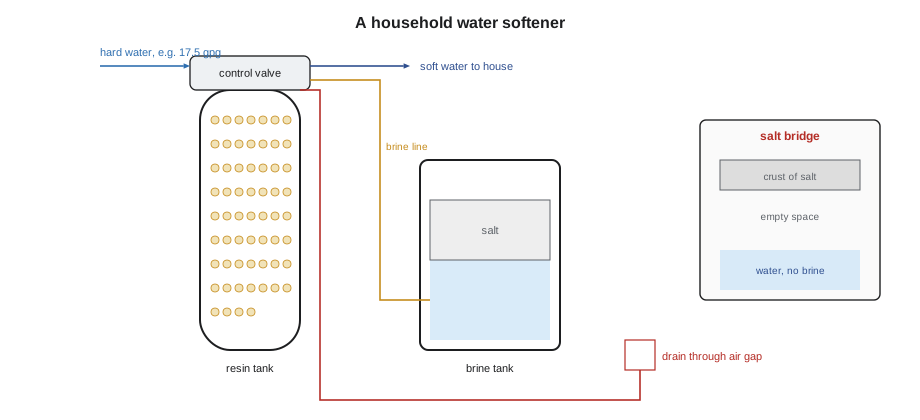
Ansel Ferncastle lives on a well near Plain City, northwest of Columbus, and his new dishwasher had started leaving a chalky film after a few weeks. On Thursday, October 8, Dee tested his tap water with a hardness test strip and then with the drop-count kit from the van: the hot water from the kitchen tap was as hard as the cold. His water softener had stopped softening. When she lifted the brine tank lid, she found a hard crust of salt spanning the tank like a bridge, with an empty space below it: the softener had been drawing plain water instead of brine for weeks. She broke the bridge with a broom handle, checked that the softener's clock had not been reset by a recent power outage, set the hardness to the measured value, and started a manual regeneration. The next morning Mr. Ferncastle tested the water himself with the strips Dee left: soft. "Half the scale complaints on dishwashers, kettles and steam ovens start with water," she said at the November 13 water night. "You need to be able to measure it and talk about it."
This lesson explains water hardness and how it is measured, how household water softeners work and fail, the common types of water filters, reverse osmosis systems, and instant hot water dispensers. Refrigerator water filters were covered in APP-210. Installing softeners, filter systems and dispensers involves new plumbing connections and is a plumber's work; appliance technicians often service and adjust these systems and must understand them.
Water hardness
Hardness is the amount of dissolved calcium and magnesium in the water. It is usually expressed as the equivalent amount of calcium carbonate, in grains per gallon (gpg) or milligrams per liter (mg/L), where one mg/L is the same as one part per million. Both units appear on test kits and appliance settings. One grain per gallon equals about 17.1 mg/L.
| Description (typical) | mg/L as calcium carbonate | Grains per gallon |
|---|---|---|
| Soft | under about 60 | under about 3.5 |
| Moderately hard | about 60 to 120 | about 3.5 to 7 |
| Hard | about 120 to 180 | about 7 to 10.5 |
| Very hard | over about 180 | over about 10.5 |
Hard water forms scale when heated: in water heaters, on dishwasher heaters and spray arms, in steam ovens and coffee systems, and on glassware. Many appliances ask the installer or the customer to set the water hardness so they can dose detergent, regenerate a built-in softener or warn when descaling is due. Hardness can be measured with test strips, which change color, or a titration kit, which counts drops of a reagent until the sample changes color. Municipal water utilities publish their water's hardness; well water varies and must be tested.
Worked problem
Converting hardness units
Dee's titration kit reads 300 mg/L on Mr. Ferncastle's untreated well water. A softener's setting and some appliances use grains per gallon. What setting is that?
Show solution
- Conversion:
- \[300 \div 17.1 \approx 17.5 \text{ gpg}\]
Answer: About 17.5 grains per gallon: very hard water. A dishwasher with its own softener or a steam oven would be set to its hardest or nearly hardest step, and the household softener to about 17 or 18 grains.
How a softener works
A household water softener is an ion exchange unit. Hard water flows through a tank of small plastic resin beads that hold sodium (or potassium) ions loosely. As the water passes, calcium and magnesium ions attach to the resin in place of the sodium, which is released into the water. The water leaving the tank is soft. Eventually the resin is full of calcium and magnesium and can soften no more; it must be regenerated.
Regeneration is run by the control valve on top of the resin tank, on a timer or, in demand-initiated softeners, by a meter that counts the water used. In a typical regeneration the valve first backwashes the resin to loosen it and flush out sediment, then draws brine, strong salt water, from the separate brine tank, through the resin, where the high concentration of sodium drives the hardness ions off the resin. It then rinses the brine out and refills the brine tank with water to dissolve more salt for next time. The waste water and hardness go to a drain, which the plumbing code requires to discharge through an air gap.
Worked problem
How often a softener must regenerate
A softener has a capacity of 32,000 grains. The household uses about 250 gal of water a day at 17.5 grains per gallon hardness. How many days can it run between regenerations?
Show solution
- Hardness removed per day:
- \[250 \times 17.5 \approx 4380 \text{ grains}\]
- Days of capacity:
- \[32\,000 \div 4380 \approx 7.3 \text{ days}\]
Answer: About seven days. A timed softener would be set to regenerate every six or seven days, leaving some reserve; a demand-initiated softener works it out from the metered water. If the hardness setting is too low, the softener runs out of capacity before it regenerates and hard water reaches the appliances.
Softener problems
| Symptom | Common causes | Checks |
|---|---|---|
| Hard water at taps | No salt, salt bridge, clock reset, hardness set too low, bypass open | Salt level, brine tank, settings, bypass valve |
| Salty taste | Brine not rinsed, injector or valve fault | Regeneration cycle, valve service |
| Water in brine tank too high | Blocked injector or drain line, float fault | Injector, drain line, brine valve |
| Low pressure | Clogged resin or sediment, iron fouling | Backwash, resin condition |
| Orange staining continues | Iron in well water exceeds softener capacity | Water test; iron filter by a water treatment firm |
A salt bridge, as at Mr. Ferncastle's house, forms when humidity or the wrong salt makes the salt fuse into a crust. Salt mushing is the opposite: fine salt turns into a sludge at the bottom that blocks the brine draw. Using the salt type the maker recommends, not overfilling the brine tank and breaking any crust gently are the cures. Softeners also lose their settings after long power outages on older timer models, and their resin can be fouled by iron or degraded by chlorine over the years.
Softened water contains more sodium, which matters to people on low-sodium diets; potassium chloride can be used instead of salt in many softeners, and many homes leave the kitchen cold tap unsoftened for drinking. Softened water is also more corrosive to anode rods (lesson 8), so water heater anodes in softened water need checking more often.
Filters
Household water filters remove particles, tastes, odors and some contaminants. The common types are:
- Sediment filters: pleated or spun cartridges that catch sand, rust and grit, rated by the size of particle they stop.
- Activated carbon filters: blocks or granules that adsorb chlorine taste and odor and some organic chemicals. Refrigerator filters (APP-210) and many under-sink filters are carbon filters.
- Reverse osmosis (RO) systems, described below.
- Specialty filters for iron, manganese, arsenic or other contaminants, chosen after a water test, usually by a water treatment specialist.
Filter performance claims are certified to NSF/ANSI standards: for example, NSF/ANSI 42 for aesthetic effects such as chlorine taste, NSF/ANSI 53 for health-related contaminants such as lead, and NSF/ANSI 58 for reverse osmosis systems. A filter certified for one claim does not necessarily meet another; the certification on the cartridge says what it does. Filters must be changed on schedule: a clogged sediment filter reduces flow, and a spent carbon filter stops removing what it was meant to.
Reverse osmosis systems
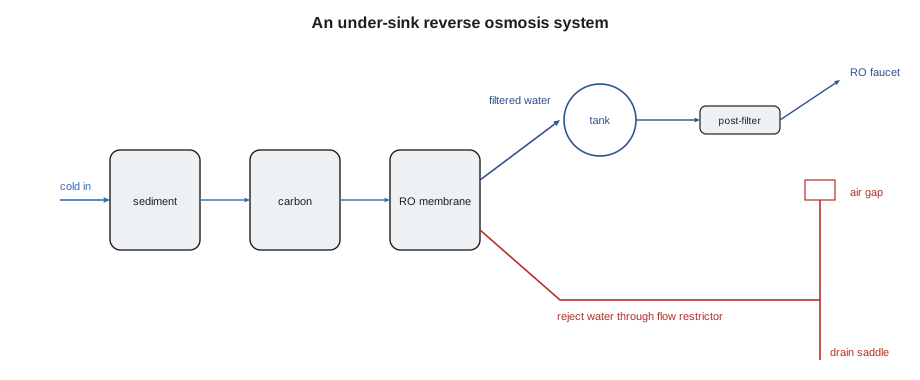
An RO system, usually under the kitchen sink, pushes water through a semi-permeable membrane that lets water molecules through but holds back most dissolved minerals and many contaminants. A typical system has a sediment prefilter, a carbon prefilter that protects the membrane from chlorine, the membrane, a small pressurized storage tank and a carbon post-filter, feeding a separate faucet on the sink. The water the membrane rejects carries the concentrated minerals to the drain through a drain saddle on the sink drain, with an air gap often built into the RO faucet.
Worked problem
Water sent to the drain by an RO system
An RO system makes about 5 gal of filtered water a day and sends about 4 gal to the drain for every 1 gal it makes (a typical ratio for older systems). How much water goes to the drain each day?
Show solution
- Drain water:
- \[5 \times 4 = 20 \text{ gal per day}\]
Answer: About 20 gal a day. Newer systems with pumps or better membranes reject much less. Customers who notice the drain running under the sink are hearing the reject water, which is normal while the tank fills.
An RO system that delivers slowly may have clogged prefilters, a fouled membrane, low supply pressure or a storage tank that has lost its air charge. Because RO water is very low in minerals, some refrigerator and coffee-system makers advise against connecting their appliances to it, or require a remineralizing filter; the appliance's instructions say.
Instant hot water dispensers
An instant hot water dispenser has a small insulated tank under the sink, typically holding about 2/3 gal (typical), with an electric element and thermostat that keep the water near boiling, often around 190 to 200 °F (typical), and a special faucet on the sink. The tank is vented through the faucet: as the water heats and expands, the excess drips from the spout. The faucet and its tubing must be fitted exactly as the instructions show; a blocked or wrongly connected vent tube can let pressure build in a tank that is not designed for it. Some units have a high-limit thermostat and a reset button.
Worked problem
An instant hot element
An instant hot dispenser's element is rated 750 W at 120 V. What should it read cold, and what current does it draw?
Show solution
- Resistance:
- \[R = \frac{120^2}{750} = 19.2 \ \Omega\]
- Current:
- \[I = \frac{750}{120} = 6.25 \text{ A}\]
Answer: About 19.2 Ω and 6.25 A. These dispensers are often on the same under-sink receptacle as a disposer, and the instructions say whether they may share.
Dispensers deliver water hot enough to scald in a second. Customers with children may want a model with a child-resistant handle. Dripping from the spout is normal while the tank heats; steaming, spitting or constant dripping when idle usually means the thermostat setting is too high or the thermostat has failed. Scale builds up quickly in hard water and can be reduced by feeding the dispenser through a filter.
Testing hardness on a call
Penfold's vans carry hardness test strips and a titration kit. Test strips are quick: dip a strip in a cup of water, wait the time on the package, and compare its color with the chart. A titration kit is more precise: fill the tube to the line with water, add the indicator, then add the titrating solution one drop at a time, swirling, until the color changes; each drop equals a set hardness, printed on the kit. Dee tests both the cold water at the kitchen tap and the hot, because a softener may serve the hot side only, and she notes both on the ticket. When a softener is installed, testing the water before and after it shows whether it is working: soft water should show almost no hardness.
Appliance hardness settings use their own steps, listed in the use and care guide against mg/L or grains per gallon. Setting a dishwasher with a built-in softener, a steam oven or a coffee system to the measured hardness at installation, and recording it, prevents many later calls about scale and ignored descaling warnings.
After a power outage
Older timer-controlled softeners regenerate at a set time of night, usually around 2 a.m. (typical), when no one is using water. After a power outage their clocks may stop or reset, so they regenerate in the middle of the day, when the household is using water, or not at all. A customer who reports hard water a few days after a storm may need only the clock set. Newer softeners keep their settings in memory but may still need the time of day reset. Some homes have the softener plugged into a receptacle switched by a light switch, which someone turns off without knowing.
Filter records
Most filter problems are filters left in place too long. A clogged sediment filter reduces flow to the whole house or to the appliance it serves; a spent carbon filter no longer removes chlorine taste; an old refrigerator filter slows the ice maker, as APP-210 showed. The technician notes the filter type and installation date on a label on the housing and on the ticket, so the customer and the next technician know when it was last changed. Replacement cartridges must carry the same certification claims as the originals if the customer is relying on them for a health-related contaminant, not only for taste.
Common mistakes
MistakeAssuming municipal water is never hard.
InsteadLook up the utility's figure or test it; many supplies are hard.
MistakeSetting a softener's hardness from a guess.
InsteadMeasure the raw water hardness and set it to the measured value.
MistakeMissing a salt bridge because the brine tank looks full.
InsteadPush gently through the salt to check for a crust over an empty space.
MistakeConnecting a refrigerator to RO water without checking the instructions.
InsteadSome makers require a different supply or a remineralizing filter.
MistakePlugging an instant hot dispenser's vent tube.
InsteadFit the vent exactly as instructed; the tank must vent through the faucet.
Summary and key terms
- Hardness is calcium and magnesium, measured in mg/L or grains per gallon (1 gpg ≈ 17.1 mg/L).
- Softeners exchange hardness ions for sodium or potassium on resin beads.
- Regeneration backwashes, brines and rinses the resin; its drain needs an air gap.
- Capacity in grains divided by daily hardness load gives days between regenerations.
- Salt bridges, low hardness settings and lost clock settings cause hard water.
- Filters are certified to NSF/ANSI standards for specific claims.
- RO systems send reject water to the drain and need prefilter and membrane care.
- Instant hot dispensers are vented through their faucet and deliver scalding water.
- Hardness
- Dissolved calcium and magnesium, expressed as calcium carbonate.
- Grain per gallon
- A hardness unit equal to about 17.1 mg/L.
- Ion exchange
- Swapping hardness ions for sodium or potassium ions on a resin.
- Regeneration
- Restoring a softener's resin with brine.
- Salt bridge
- A crust of salt across a brine tank with an empty space below.
- Activated carbon
- A filter medium that adsorbs chlorine and some chemicals.
- Reverse osmosis
- Filtering water through a membrane that holds back dissolved minerals.
- Instant hot dispenser
- An under-sink heater that supplies near-boiling water to a special faucet.
Practice problems
Work each problem on paper first, then reveal the answer to check.
Convert 300 mg/L to grains per gallon.
Show answer
About 17.5 gpg.
What is a salt bridge?
Show answer
A crust of salt across the brine tank with an empty space below, so the softener draws plain water.
Why must a softener's drain discharge through an air gap?
Show answer
To stop drain water from being drawn back into the water supply.
What does NSF/ANSI 58 cover?
Show answer
Reverse osmosis systems.
What should a 750 W, 120 V instant hot element read cold?
Show answer
About 19.2 Ω.
Lesson quiz · 5 questions
Score 60% or more to complete this lesson.
Create a free account to save your progress, take quizzes and earn a certificate.