
APP-310 · Lesson 2 of 12 · 24 min
Dishwasher pumps, motors and spray arms
▶ Video coming soon A video version of this lesson is on the way.
Dee's file from Monday, September 14, began with a customer description that Kiran would hear many times: "It sounds like it's running, but the top rack doesn't get clean, and now there's a grinding noise." Thaddeus Vreeland's 2017 dishwasher in Driving Park had a cracked middle spray arm that let most of its water escape sideways instead of reaching the upper rack, and a shard of drinking glass caught in the circulation pump's impeller made the grinding. Dee removed the lower rack and the filters, lifted out the glass with long-nose pliers, turned the impeller by hand to make sure it spun freely, and fitted a new spray arm from the van. "Two problems, both in the water path," she said. "Most of what goes wrong with a dishwasher's mechanical side is in the water path, and most of it you can see if you take the filters out."
This lesson follows the water through the machine: from the sump, through the filters and the circulation pump, out through the spray arms and back. It covers the motors that drive the pumps, how a single pump can feed different spray arms in turn, how to test the pumps and motors safely, and what spray arm faults look like. Drain pumps get their own section, because they fail often and are simple to test.
The sump and filters
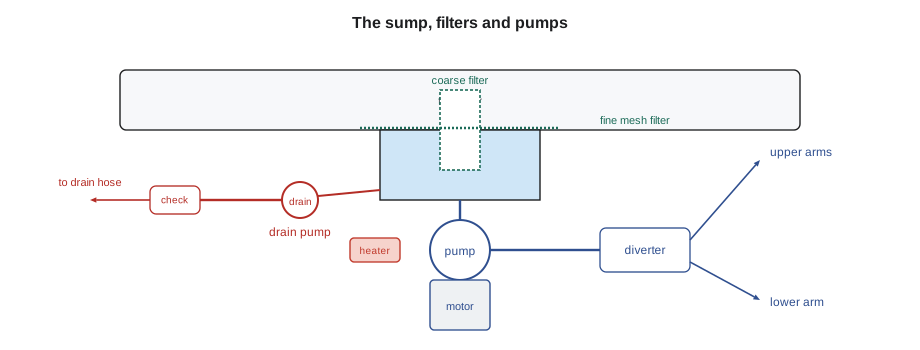
The sump is the well at the bottom of the tub where water collects. In most current dishwashers the sump holds the filter assembly: usually a coarse cylindrical filter that the customer can twist out, a fine mesh flat filter around it, and sometimes a micro-filter. Water returning from the spray arms passes through the filters on its way back to the circulation pump, so food particles stay out of the pump and the spray. Many current machines use manual-clean filters that the customer must remove and rinse, typically about once a month or as the use and care guide says (typical). Older and some current models have self-cleaning filters with a hard-food chopper, a small blade on the pump shaft that chops food so it can be drained away; those machines are louder.
A clogged filter is one of the most common causes of poor cleaning, bad smells and grit on dishes. When the filter blocks, the pump draws less water, the spray weakens, and dirty water may bypass the filter and recirculate onto the dishes. The technician should check the filter before anything else on a cleaning complaint and show the customer how to clean it.
The circulation pump and its motor
The circulation pump, also called the wash pump, takes water from the sump and pushes it up to the spray arms. Its impeller is driven by a motor. Older dishwashers used a reversing induction motor with one impeller set for wash in one direction and drain in the other. Most current machines have a separate wash pump and drain pump. Many current wash pumps are driven by brushless DC (BLDC) motors controlled by the main board or a motor board, which let the machine vary the spray pressure for different cycles; APP-320 covers those motors and their electronics. Others use a permanent split capacitor (PSC) induction motor like those in APP-120, with a run capacitor.
In many current models the heater is built into the circulation pump housing, as a flow-through heater, rather than lying exposed in the bottom of the tub. The pump and heater then form one assembly, and a fault in one may mean replacing both. Lesson 4 covers heaters.
Water level matters to the pump. If the fill is short, the pump draws air with the water, the spray becomes weak and noisy, and the motor may speed up. The control may detect the change and add water or show an error. If the machine is badly out of level, the sump may not have enough water over the pump inlet even with a correct fill.
| Motor type | Where found | How it is tested (follow the tech sheet) |
|---|---|---|
| Reversing induction motor | Older dishwashers with one pump | Winding resistances, start switch or capacitor |
| PSC motor | Some wash pumps | Winding resistances, run capacitor, insulation to ground |
| BLDC motor with board | Many current wash pumps | Supply to motor board, motor phase resistances, control diagnostic test |
| Synchronous drain pump motor | Most drain pumps | Coil resistance; impeller turns freely, no foreign objects |
Diverters and spray arms
Many dishwashers do not run all their spray arms at once. A diverter, a valve or rotating disc in the pump outlet, sends the water to the lower arm for a while and then to the upper arms, giving each more pressure. The diverter is moved by a small motor or by the water itself, and its position may be sensed by a switch so the control knows where it is. A failed diverter can leave one rack unwashed. The tech sheet shows how to test it, often by running the diagnostic mode and watching which arm turns.
The spray arms spin because water leaving their angled holes pushes them around, like a lawn sprinkler. The lower arm sits on a hub in the sump; the middle arm hangs under the upper rack and is fed through a tube at the back of the tub that docks with the rack; some machines have a top spray at the ceiling and a third-rack spray. Faults include holes blocked by seeds, glass or scale; a crack that lets water escape; a broken bearing that lets the arm wobble; and a middle-arm feed that does not dock because the upper rack is set at the wrong height or has been pushed in crooked. Spray arm holes can be cleared with a toothpick or the tool the maker provides; arms heavy with scale can be soaked in vinegar or replaced.
A simple test is to turn each arm by hand after loading: it should turn freely without hitting anything. Running the machine with the door switch defeated to watch the spray is unsafe and is not done; instead, the technician uses the maker's diagnostic test, listens, and inspects the arms and their holes with the machine off.
The drain pump
Most current dishwashers drain with a small separate drain pump beside the sump, driven by a synchronous motor: a small permanent-magnet motor that runs at a fixed speed set by the supply frequency. Its impeller can usually turn a little either way by hand before it catches; that free play is normal and lets it start. Drain pumps run for short periods, perhaps 30 seconds to two minutes each time (typical).
Drain pumps fail electrically, with an open coil, or mechanically, with a broken impeller or an object such as a fruit pit, a piece of glass or a twist tie jammed in the pump. A machine that will not drain, hums during drain or drains slowly may have a blocked pump, a blocked drain hose, an unremoved knockout plug in a new disposer, a blocked air gap or a kinked hose. Lesson 3 covers the drain path. The technician tests the pump coil resistance against the tech sheet with the power off, removes the pump or its cover where the design allows to look for objects, and checks that the impeller turns.
Worked problem
How long a drain should take
A dishwasher's sump holds about 0.85 gal at the end of a fill. Its drain pump is rated about 4 gal per minute into a normal drain (typical). How long should the drain take, and what does a drain that takes 90 seconds suggest?
Show solution
- Time to drain:
- \[t = 0.85 \div 4 \times 60 \approx 13 \text{ s}\]
- A 90 s drain is about seven times slower.
Answer: The pump should clear the sump in roughly 15 to 30 seconds once primed. A drain taking 90 seconds points to a restriction: a partly blocked pump, hose, air gap or disposer inlet. Most controls set an error if the water level does not fall within the time they allow.
Testing pumps and motors safely
Dishwashers in North America run on 120 V and combine water and electricity in a small space, so the technician starts every test the same way: turn off the circuit breaker or unplug the cord, prove the supply dead at the junction box or the machine's terminal block with a meter, and close the water supply valve if any water connection will be opened. Lesson 11 covers the junction box and supply connections.
Pump and motor tests then follow the tech sheet. A coil or winding resistance close to the value on the tech sheet suggests the winding is intact; an open reading means it is broken; a reading to the frame or ground means it is leaking to ground, which can trip a GFCI. Many current machines include a diagnostic test mode, entered by a button sequence printed on the tech sheet, which runs each pump, valve and heater in turn. Running that test with the panels on, and listening and watching for water, tells the technician which part does not respond without opening any live circuit.
Worked problem
Checking a pump motor current
A wash pump motor rated for 120 V draws 0.7 A when running in the diagnostic test, according to a clamp meter on the supply. What is the apparent power, and what would a much higher current suggest?
Show solution
- Apparent power:
- \[S = V \times I = 120 \times 0.7 = 84 \text{ VA}\]
- A typical small wash pump draws under about 1 A (typical; the tech sheet governs).
Answer: About 84 VA. A current several times higher with the pump humming suggests a jammed impeller or a locked rotor; the technician switches off at once and looks for an object in the pump.
Noise complaints
Dishwashers make normal noises: the water filling, the pump starting and changing speed, the spray hitting the door, the drain pump's buzz and the click of the diverter and detergent dispenser. Quieter, insulated models make customers notice sounds they never heard before. Abnormal noises include grinding from an object in the pump, rattling from a spray arm hitting a dish, squealing from a dry motor bearing, a loud hum with no water movement, and banging from the water supply when the inlet valve closes, which is water hammer and may need an arrestor on the supply, fitted by a plumber where new plumbing is needed.
When a customer complains of noise, the technician asks when it happens in the cycle and listens through a full cycle or the diagnostic test where possible. A noise that happens only during drain points to the drain pump; a noise during wash, to the circulation pump or a spray arm; a bang when the fill stops, to water hammer in the supply.
Spray arm bearings, wash towers and seals
Spray arms ride on simple plastic bearings: the lower arm on a hub in the sump, the middle arm on a hub under the upper rack. Over the years the bearing wears, the arm wobbles, and some of the water that should leave through the arm's holes escapes around the hub instead. A worn bearing often shows as a lower arm that sits crooked or a middle arm that can be lifted noticeably on one side. Some machines feed the upper arms through a telescoping wash tower that rises from the sump when the pump runs and drops back when it stops; a tower that sticks down, often because of a utensil left in the way, leaves the upper rack unwashed. Others use a fixed tube at the back wall with a docking port on the upper rack, which must line up for the middle arm to get water.
Where water passes from the pump into the spray system there are seals and gaskets: the sump gasket, the pump outlet seal and the seals at the feed tube's connections. A worn seal leaks water back into the sump, lowering the spray pressure, or outward into the base pan, where it triggers the flood switch. The tech sheet shows the order in which the sump and pump come apart, and which seals are replaced whenever the assembly is opened.
Replacing a wash pump assembly
On many current machines the circulation pump, its motor and the flow-through heater are one assembly held to the sump by a twist-lock or clips, reached from underneath once the machine is out of its opening or tilted back. Before ordering one, the technician confirms the fault with the diagnostic test and a measurement, because the assembly is one of the most expensive parts in the machine. On replacement, every connector, hose clamp and seal is fitted exactly as the tech sheet shows, the base pan is checked for water, and the machine is run through a cycle with the toe-kick off and a dry towel under the pump to check for leaks before it is pushed back into place.
Common mistakes
MistakeReplacing a wash pump without removing the filters to look for objects.
InsteadRemove the filters and check the impeller and sump first.
MistakeRunning the machine with the door switch defeated to watch the spray.
InsteadUse the maker's diagnostic test with the panels and door closed.
MistakeCondemning a drain pump because its impeller has some free play.
InsteadSynchronous pump impellers normally turn a little before they catch.
MistakeTesting motor windings with the circuit still live.
InsteadTurn off, prove dead, then measure resistance.
MistakeMissing a middle spray arm that does not dock.
InsteadCheck the upper rack height and the feed tube connection.
Summary and key terms
- Water returns through the filters in the sump to the circulation pump.
- Clogged filters cause poor cleaning, smells and grit.
- Wash pumps may use PSC or BLDC motors; heaters are often built into the pump housing.
- Diverters send water to the lower or upper arms in turn.
- Spray arms fail by blocked holes, cracks, worn bearings or poor docking.
- Drain pumps use small synchronous motors and often jam on objects.
- A drain should take seconds; a slow drain points to a restriction.
- Turn off, prove dead and use the diagnostic test before replacing pumps.
- Circulation pump
- The pump that sends wash water from the sump to the spray arms.
- Drain pump
- The pump that empties the sump into the drain hose.
- Diverter
- A valve or disc that directs water to different spray arms in turn.
- Synchronous motor
- A small motor that runs at a speed fixed by the supply frequency.
- Flow-through heater
- A heater built into the pump housing that heats water as it circulates.
- Hard-food chopper
- A blade on the pump shaft that chops food so it can be drained.
- Diagnostic test mode
- A maker's test that runs each component in turn.
- Water hammer
- A bang in the pipes when a valve closes quickly.
Practice problems
Work each problem on paper first, then reveal the answer to check.
Where should the technician look first for an object causing a grinding noise?
Show answer
In the sump and the circulation pump impeller, after removing the filters.
A sump holds 0.85 gal and the drain pump moves 4 gal per minute. How long should the drain take?
Show answer
About 13 seconds once primed.
What does a diverter do?
Show answer
It sends water to the lower arm and the upper arms in turn.
Why does a synchronous drain pump impeller turn a little by hand before catching?
Show answer
The free play is normal and helps the motor start.
A bang is heard when the fill stops. What is it?
Show answer
Water hammer in the supply.
Lesson quiz · 5 questions
Score 60% or more to complete this lesson.
Create a free account to save your progress, take quizzes and earn a certificate.