
APP-310 · Lesson 7 of 12 · 22 min
Trash compactors and other built-ins
▶ Video coming soon A video version of this lesson is on the way.
Gideon Tremlett's trash compactor in Westgate had stopped working with its ram halfway down, on Thursday, September 17. Dee switched off its circuit and unplugged it before she pulled the drawer, which came out only with effort. The bag was packed far above the fill line, and a broken wine bottle had jammed against the ram. She lifted the ram by hand with the power off, as the tech sheet describes, removed the bag wearing cut-resistant gloves, and found the drawer safety switch's actuator bent where the overfilled drawer had been forced shut. She straightened the bracket, checked the switch with her meter, cleaned the power screws and ran the compactor through a cycle. "A compactor is a motor with a lot of force behind it," she said at the third water night, on Friday, November 13. "All its switches are there to keep that force away from a hand. Check every one."
This lesson covers trash compactors in detail and then the other built-in appliances a technician meets in a modern kitchen that use water or sit in the cabinets: dishwasher drawers, warming drawers, plumbed coffee systems and plumbed steam ovens. Built-in refrigeration is covered in APP-210 and APP-330, and built-in microwaves in APP-330.
How a trash compactor works
A trash compactor is a cabinet-sized appliance with a drawer that holds a heavy bag inside a steel bin. When the customer closes the drawer and starts a cycle, a ram (the compacting plate) is driven down onto the trash, crushes it, and returns to the top. Compacting reduces the volume of household trash several times over, often to about a quarter (typical), so bags last longer.
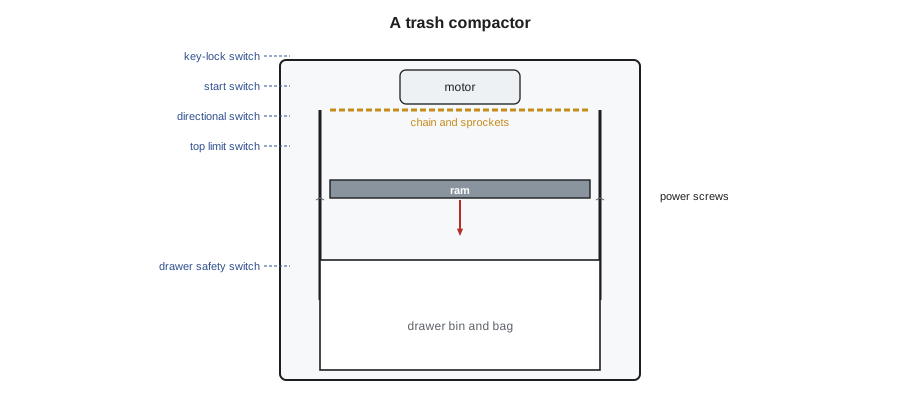
Most compactors drive the ram with two vertical power screws, one at each side, turned by a motor through a chain and sprockets or a gear train. The motor, commonly about 1/3 horsepower (typical), turns the screws, and nuts fixed to the ram ride down the threads. When the ram meets enough resistance from the compacted trash, the motor's load rises; a directional switch or a current-sensing control reverses the motor and the ram returns to the top, where a top limit switch stops it.
Worked problem
Pressure under the ram
A compactor ram exerts a force of about 2,250 lb (a typical value) on trash in a bin 15 in by 15 in. What pressure does the ram apply to the trash?
Show solution
- Area:
- \[A = 15 \times 15 = 225 \text{ in}^2\]
- Pressure:
- \[P = \frac{F}{A} = \frac{2250}{225} = 10 \text{ psi}\]
Answer: About 10 psi over the whole bin: enough to crush cans and break glass, and far more than enough to injure a hand. That is why the drawer, key and limit switches matter.
Compactor switches and safety
A compactor has several switches in series or in a control circuit, and all must be in the right state for the motor to run:
- A key-lock or on-off switch, so children cannot start it; the key is kept away from the compactor.
- A drawer safety switch that is closed only when the drawer is fully shut, so the ram cannot move with the drawer open.
- A start switch that the customer holds or presses to begin a cycle.
- A tilt or bin switch on some models that stops the cycle if the drawer is pulled while the ram is down.
- The directional and top limit switches that reverse and stop the ram.
Because these switches protect hands, the technician tests each one with the power off and the meter, as the tech sheet's schematic shows, and never runs a compactor with any of them bypassed. A drawer switch that is bent, worn or stuck closed must be repaired or replaced before the compactor goes back into service.
Compactor faults
| Symptom | Likely cause | Checks |
|---|---|---|
| Will not start | Key switch off, drawer switch open, start switch, motor | Each switch with the meter; motor windings |
| Ram stops partway | Overfilled bin, broken chain, stripped power screw nut | Bag level; chain; screw nuts |
| Ram does not return | Directional switch, control, motor reversing circuit | Directional switch and wiring |
| Drawer will not open | Ram not at top, debris under drawer | Return ram; inspect drawer runners |
| Noisy cycle | Dry or dirty power screws, slack chain | Clean and lubricate as the tech sheet says; adjust chain |
| Odor | Leaking bag, residue in bin | Clean bin; odor filter if fitted |
Most compactor wear is mechanical: chains stretch, sprockets wear, nuts on the power screws strip, and drawer runners bend under heavy bags. The tech sheet gives the chain adjustment and the lubrication the maker wants; some screws must run dry. Customers should use the maker's bags, keep glass bottles out or lay them flat, and never step on the drawer or force it shut over an overfilled bag.
Dishwasher drawers
A dishwasher drawer is a dishwasher built as one or two pull-out drawers, each with its own tub, pump, spray arm, heater and controls. Each drawer seals against a lid when it closes, and each needs its own water supply connection and drain, usually joined under the unit. The cleaning, pumping, heating and drying principles of lessons 1 to 5 apply unchanged. The differences are mechanical: each drawer's tub moves on runners, so its supply, drain and electrical connections pass through flexible service loops that must be routed exactly as the instructions show, or they wear through or kink. The lid seal is a common source of leaks, and the drawer must close fully to seal.
Warming drawers
A warming drawer holds cooked food at serving temperature. It has a heating element below the drawer, a thermostat or electronic control that sets a low temperature range, often about 85 to 195 °F (typical), and sometimes a vent that the user opens to let moisture out for crisp foods or closes to keep food moist. Faults are usually an open element, a failed thermostat or control, or a door switch on models that switch off when opened.
Worked problem
A warming drawer element
A warming drawer's element is rated 450 W at 120 V. What should it read cold, and what current does it draw?
Show solution
- Resistance:
- \[R = \frac{120^2}{450} = \frac{14400}{450} = 32 \ \Omega\]
- Current:
- \[I = \frac{450}{120} = 3.75 \text{ A}\]
Answer: About 32 Ω and 3.75 A. As with every element, the technician also checks each terminal to the frame for leakage.
Plumbed coffee systems and steam ovens
Some high-end kitchens have built-in coffee systems and steam ovens that are plumbed: connected permanently to the water supply, and in the case of steam ovens often to the drain as well, instead of using a refillable water tank. These appliances use a small inlet solenoid valve, a water filter, a pump, and in steam ovens a steam generator, a small boiler or heated chamber that turns water into steam. The water connection usually needs a shutoff valve within reach, a supply pressure within the range in the instructions and, where the instructions require it, a backflow preventer. The drain connection needs an air gap or air break like a dishwasher's, as the instructions and local code say.
The common faults of these appliances come from water quality. Scale builds up in steam generators, heating elements and valves, and the appliance's control counts the water used and asks for descaling at intervals that depend on the hardness setting. Lesson 10 explains water hardness and how it is measured. Ignored descaling warnings lead to blocked valves, failed elements and error codes. Filters must be changed when the appliance says. A technician servicing a plumbed appliance first closes its shutoff valve and relieves the pressure as the tech sheet describes, because the inlet line is under full house pressure.
Who connects built-ins
Built-in appliances involve three trades: the cabinet installer who builds the opening, the plumber who provides the water supply, valve and drain, and the electrician who provides the circuit. An appliance technician installs the appliance in the prepared opening and connects it to the existing valve, drain and circuit as the instructions describe. Penfold's rule follows that division: new supply lines, valves, drains, backflow preventers, circuits, receptacles and switches are for the licensed plumber or electrician. In Columbus, plumbing work is done by licensed plumbers, usually under a permit, and electrical work by licensed electrical contractors. Lesson 11 covers installation steps.
Compactor maintenance and bags
Compactor service visits are more often maintenance than repair. Over time, the power screws collect grime and dried liquids from leaking bags, the chain stretches, and the drawer runners pick up debris. The tech sheet's maintenance section gives the cleaning and lubrication the maker wants: some screws are lubricated with a specific grease, others must run dry so they do not collect dirt. The chain tension is set so the chain does not jump the sprockets, and a stretched chain is replaced. The drawer is checked to see that it closes fully and squarely, because a drawer that sits slightly open will not close the drawer safety switch and the compactor will not start.
The bags matter more than customers think. Compactor bags are thick and sized for the bin; ordinary garbage bags tear under the ram and leak, and the liquids cause odor and corrosion in the bin. Many compactors have a charcoal odor filter or an air freshener holder in the drawer, which needs replacing at the intervals the guide gives. Glass bottles should be laid flat in the center of the bin, or kept out altogether, and aerosol cans, flammable materials and anything that could burst should never go in a compactor.
Diagnosing a dishwasher drawer
Dishwasher drawers use the same diagnostic approach as any dishwasher, with two additions. First, each drawer's control may also check the lid, which seals the tub when the drawer closes; a lid actuator that does not lower, or a lid seal that is torn or dirty, gives leaks or codes. Second, because the tub moves, its hoses and wiring pass through the service loops behind the drawer. Faults that come and go as the drawer is opened and closed point to a damaged loop, a chafed hose or a broken wire in the moving harness. The tech sheet shows how to remove the drawer from its runners to reach the loops, and the reconnection order, which must be followed exactly.
Inside a plumbed coffee system
A built-in coffee system takes water from its supply through a shutoff valve, a filter and an inlet solenoid valve into a small reservoir or directly to a pump, which pushes it through a thermoblock or small boiler to the brewing unit at high pressure. The control measures the water used with a flow meter and counts it against the hardness setting to decide when to ask for descaling. The descaling program runs a descaling solution through the water path; it must be done with the maker's product and procedure, because some descalers damage seals or leave residues. A technician called to a coffee system that will not draw water checks the supply valve, the filter (which may need replacing), the inlet valve and the hardness setting before looking for a failed pump.
Steam oven descaling and drains
A plumbed steam oven has a steam generator, a water inlet valve, a level sensor and often a drain pump that empties the generator after use, discharging through an air break or air gap to the sink drain. Steam generators scale quickly in hard water. The oven's control asks for descaling at intervals based on water used and hardness; if the hardness was set to soft at installation in a hard-water area, the warnings come far too late. Kiran checked the training binder's example: the same oven needed descaling about every month at the hardest setting and only a few times a year at the softest. That one setting, made by whoever installed the oven, decides much of its service life.
Common mistakes
MistakeRunning a compactor with the drawer switch bypassed to test it.
InsteadTest each switch with the meter, power off; never bypass a safety switch.
MistakeReaching into a compactor bin while it is plugged in.
InsteadUnplug or switch off at the panel, and wear cut-resistant gloves.
MistakeRouting dishwasher drawer hoses any way they fit.
InsteadFollow the instructions' service loop routing so the hoses do not wear or kink.
MistakeReplacing a steam oven element without asking about descaling.
InsteadCheck the hardness setting and descaling history; scale often caused the failure.
MistakeAdding a new valve or drain for a plumbed appliance.
InsteadLeave new plumbing to the plumber; connect to what is provided.
Summary and key terms
- Trash compactors drive a ram on power screws with a motor, chain and sprockets.
- The ram exerts enough force to injure; every safety switch must work.
- Key-lock, drawer, start, directional and top limit switches control the compactor.
- Overfilled bins and broken glass cause most compactor jams.
- Dishwasher drawers work like dishwashers but route hoses through service loops.
- Warming drawers have low-temperature elements and controls.
- Plumbed coffee systems and steam ovens need shutoff valves, filters and descaling.
- New plumbing and electrical work belong to licensed trades.
- Trash compactor
- A built-in appliance that crushes household trash in a drawer bin.
- Ram
- The plate that is driven down to compact the trash.
- Power screw
- A threaded rod that moves the ram as it turns.
- Drawer safety switch
- A switch closed only when the compactor drawer is fully shut.
- Directional switch
- The switch that reverses the compactor motor at the end of the stroke.
- Dishwasher drawer
- A dishwasher built as one or two pull-out drawers.
- Service loop
- A planned loop of hose or cable that lets a moving part travel without strain.
- Descaling
- Removing mineral scale from an appliance's water path.
Practice problems
Work each problem on paper first, then reveal the answer to check.
Why does a compactor have a drawer safety switch?
Show answer
So the ram cannot move with the drawer open.
A ram exerts 2,250 lb on a 15 in by 15 in bin. What pressure is that?
Show answer
10 psi.
What should a 450 W, 120 V warming drawer element read cold?
Show answer
About 32 Ω.
What causes most steam oven and coffee system faults?
Show answer
Scale from hard water, often after ignored descaling warnings.
Who provides a new water supply valve for a plumbed coffee system?
Show answer
A licensed plumber.
Lesson quiz · 5 questions
Score 60% or more to complete this lesson.
Create a free account to save your progress, take quizzes and earn a certificate.